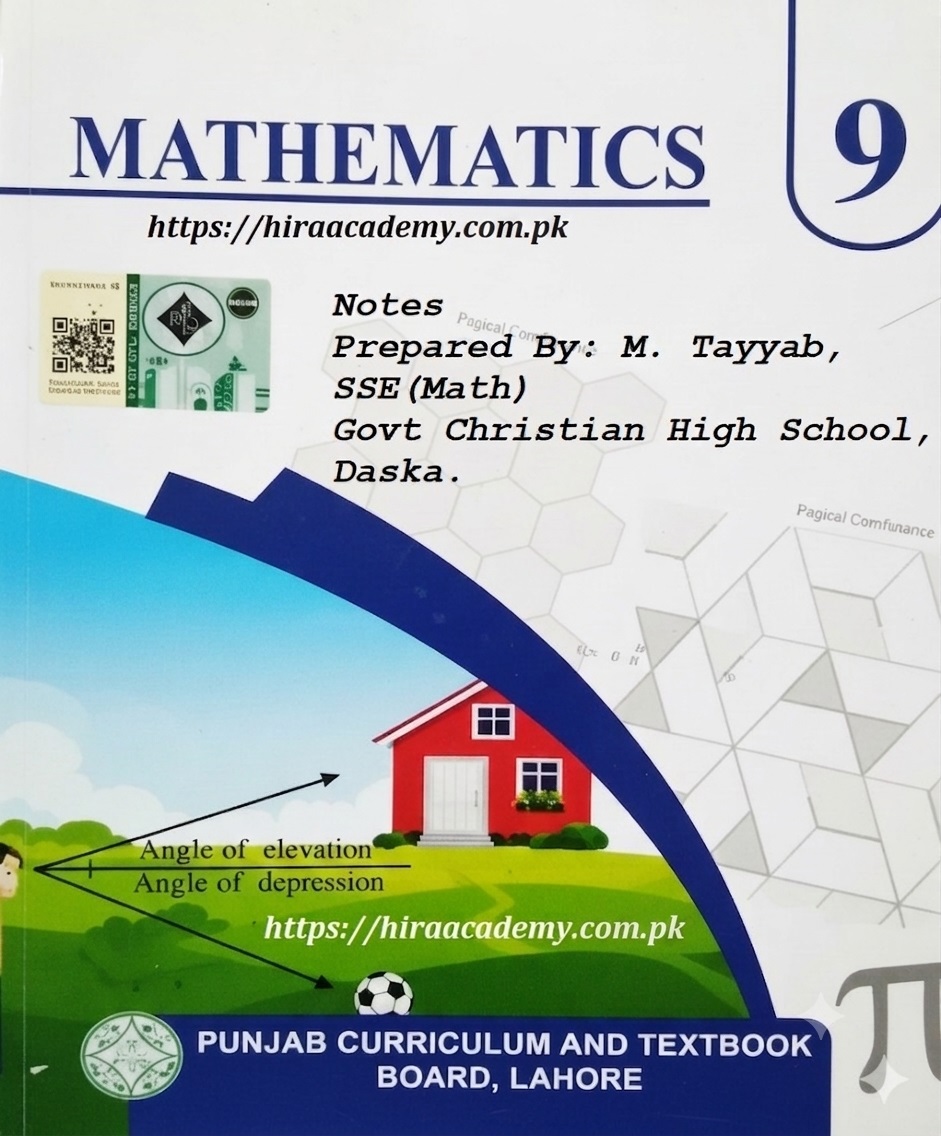
Important Questions – All 13 Chapters
Click on any chapter to find its priority short and long questions for board exam preparation.
📘
Chapter 1 – Real Numbers
Rational and irrational numbers, decimal representation, operations
New 2026
↓
Real numbers form the foundation of mathematics. This chapter covers rational and irrational numbers, decimal representation, and operations on real numbers.
📗
Chapter 2 – Logarithms
Laws of logarithms, common logarithms, exponential equations
New 2026↓
Logarithms help simplify complex calculations. This chapter covers laws, common logarithms, and applications in solving exponential equations.
📙
Chapter 3 – Sets and Functions
Set operations, Venn diagrams, function types, notation
New 2026↓
Sets and functions are fundamental concepts in mathematics with applications in computer science and data analysis.
📕
Chapter 4 – Factorization and Algebraic Manipulation
Factorization techniques, algebraic fractions, simplification
New 2026↓
Factorization simplifies algebraic expressions and equations. This chapter covers various factorization techniques and simplification.
📓
Chapter 5 – Linear Equations and Inequalities
Solving linear equations, graphing inequalities, word problems
New 2026↓
Linear equations and inequalities are essential for solving real-world problems in economics, physics, and engineering.
📔
Chapter 6 – Trigonometry
Trigonometric ratios, identities, triangle solving, applications
New 2026↓
Trigonometry deals with relationships between angles and sides of triangles with applications in architecture and navigation.
📒
Chapter 7 – Coordinate Geometry
Cartesian plane, distance formula, midpoint, line equations
New 2026↓
Coordinate geometry connects algebra and geometry with applications in computer graphics and engineering.
📚
Chapter 8 – Logic
Statements, truth tables, logical equivalence, proof techniques
New 2026↓
Logic forms the basis of mathematical reasoning and computer programming.
📖
Chapter 9 – Similar Figures
Similarity criteria, ratio of areas and volumes, geometry applications
New 2026↓
Similar figures have the same shape but different sizes with applications in map reading and scale models.
📘
Chapter 10 – Graphs of Functions
Linear, quadratic functions, graphing techniques, interpretations
New 2026↓
Graphs provide visual representations of functions with applications in economics and science.
📗
Chapter 11 – Loci and Construction
Geometric constructions, loci problems, engineering applications
New 2026↓
Loci are sets of points satisfying specific conditions with applications in engineering design.
📙
Chapter 12 – Information Handling
Data collection, graphical representations, statistical analysis
New 2026↓
Information handling is crucial in data analysis and decision making.
📙
Chapter 13 – Probability
Basic concepts, sample spaces, probability calculation, applications
New 2026↓
Probability quantifies uncertainty in scientific research and finance.
How to Use Important Questions to Prepare Smarter, Not Just Harder
Board exams reward focused preparation as much as effort. With 13 chapters of Class 9 Mathematics to cover, students who revise everything with equal intensity often run out of time before the exam, while those who identify and master the high-frequency short and long questions tend to walk in more confident and better prepared. That's exactly the purpose of this page.
An important question is one that appears repeatedly across past papers, tests a concept examiners consistently return to, or covers a theorem or definition that shows up in multiple contexts. These aren't guesses — they reflect real patterns in how Punjab Board exams under the PECTAA 2026 syllabus are structured, chapter by chapter.
Short questions typically test definitions, single-step calculations, or quick conceptual checks — the kind of question worth 2 marks that you should be able to answer in under two minutes. Long questions, on the other hand, require full multi-step working, often combining two or three concepts from the same chapter, and are where most of the marks in a paper are concentrated. Practicing both types separately helps you build speed on the quick questions while reserving enough time for the longer, higher-value ones.
This page is best used as a final-stage revision tool, not a substitute for learning the material in the first place. If a chapter's important questions feel unfamiliar, that's a signal to go back to the full solved exercises and definitions before returning here. Used at the right time — typically the last two to three weeks before an exam — this focused list can meaningfully improve how efficiently you revise.
Chapters like Trigonometry, Coordinate Geometry, and Logarithms tend to carry a disproportionate share of long-question marks in board papers, so extra attention to their important questions often pays off. Meanwhile, chapters like Sets and Functions or Logic are more likely to appear as short questions testing precise definitions.
This resource is equally useful for teachers setting revision homework close to exams, and for parents who want to help their child focus their remaining study time effectively. Because it's built around the PECTAA 2026 syllabus shared by all 10 BISE boards in Punjab — Bahawalpur, DG Khan, Faisalabad, Federal, Gujranwala, Lahore, Multan, Rawalpindi, Sahiwal, and Sargodha — it applies regardless of which board a student sits under.
Open any chapter below to see its important short and long questions. If you'd rather test yourself with multiple-choice questions, or need the full solved exercises for a topic, both are linked in the toolkit section further down this page.
💡 Tackling Short Questions Efficiently
- • Master definitions first: Most short questions test a precise definition or theorem statement.
- • Practice for speed: Aim to answer each short question in under two minutes.
- • Group by chapter: Revise all short questions from one chapter together to reinforce the topic.
- • Repeat what you miss: Come back to any short question you couldn't answer immediately.
- • Write, don't just recall: Actually writing the answer out cements it better than reading it silently.
🎯 Mastering Long Questions for Board Marks
- • Time each attempt: Practice long questions under a realistic time limit to build exam speed.
- • Show all working: Long questions carry step-marks, so never skip intermediate steps.
- • Prioritize high-weight chapters: Trigonometry and Coordinate Geometry often carry more long-question marks.
- • Cross-check with solved exercises: If a long question feels unfamiliar, revisit that chapter's full solutions.
- • Simulate exam conditions: Attempt a mix of short and long questions together in one timed session.
✅ Why Use Important Questions?
- • Focused on high-frequency topics – based on patterns in past board papers.
- • Split into short and long questions – matching how marks are actually distributed.
- • Aligned with PECTAA 2026 – built from the current Class 9 syllabus.
- • Free and instantly accessible – no sign-up required.
- • Ideal for last-minute revision – a focused list for time-limited students.
👥 Who Should Use This Page?
- • Class 9 students revising in the final weeks before their exam.
- • Teachers setting focused revision homework close to test dates.
- • Parents helping their child prioritize limited remaining study time.
- • Students catching up quickly after missing part of the syllabus.
- • Students from all 10 Punjab BISE boards, since all follow PECTAA 2026.
9th Class Math Important Questions – What's Inside (PECTAA 2026)
This page collects the high-priority short and long questions from each chapter of the syllabus prescribed by the Punjab Education Curriculum Training and Assessment Authority, built for focused, time-efficient board exam revision.
Prepared by Muhammad Tayyab (SSE), Govt Christian High School Daska, each chapter's important questions link through to their full worked solutions, so you can check your answer the moment you finish attempting it.
✅ What's Included Per Chapter
- ✓Short questions for quick, high-value revision
- ✓Long questions matching board exam format
- ✓Based on the PECTAA 2026 syllabus
- ✓Linked to full worked solutions
- ✓Free access, no downloads required
- ✓Searchable by chapter or topic
🌐 Chapters Covered
Real Numbers, Logarithms, Sets and Functions, Factorization, Linear Equations, Trigonometry, Coordinate Geometry, Logic, Similar Figures, Graphs of Functions, Loci and Construction, Information Handling, and Probability.
Each chapter's important questions link directly from the accordion below.
Explore the Complete 9th Class Math Toolkit
These important questions are part of a larger set of Math 9 resources. Explore the notes hub, key book, MCQs, and more below.
🏠
Math 9 Notes Hub
The main hub linking every Class 9 Math resource in one place.
📔
Math Key Book
Full solution guide with chapter-wise answers to every textbook question.
📄
Notes PDF
Downloadable and printable chapter-wise PDF notes for offline study.
✏️
Solved Exercises
Step-by-step worked solutions for every exercise in all 13 chapters.
✅
Math MCQs
Chapter-wise multiple-choice questions with an online practice test.
📖
Definitions
Every key term and theorem explained clearly, chapter by chapter.
🧮
Formula Sheet
A quick-revision sheet with all formulas organized by chapter.
🎯
Guess Paper
The latest important chapters and exercises predicted for this year's exam.
🗂️
Past Papers
Solved previous board papers with pattern analysis for smarter prep.
Frequently Asked Questions About Important Questions
What counts as an important question?
Important questions are short and long questions that appear frequently in past board papers or test concepts examiners commonly focus on.
Are both short and long questions included?
Yes, each chapter includes short questions for quick revision and long questions for full board-style practice.
Are these questions based on PECTAA 2026?
Yes, all important questions are selected from chapters following the updated PECTAA 2026 syllabus.
Can this replace full chapter revision?
It's best used alongside full revision. Important questions help you prioritize when time is limited, but don't skip understanding the whole chapter.
When should I use this page?
It's most useful in the final weeks before your exam, once you've covered the full syllabus and want to focus your remaining time.
Are answers provided for each question?
Yes, each important question links through to its full worked solution so you can check your answer.
Which BISE boards does this apply to?
All 10 BISE boards in Punjab follow PECTAA 2026, so these important questions apply to every board equally.
Is this resource free?
Yes, all important questions are free to access online with no sign-up required.
Do you cover harder chapters like Trigonometry?
Yes, important questions are provided for all 13 chapters, including the ones students typically find most challenging.
Where can I find MCQs or full solved exercises?
This page is part of a larger Math 9 toolkit—see the resource cards below for MCQs, solved exercises, and more.
⚠️ Common Board Prep Mistakes
- • Only memorizing answers: Memorized answers fall apart if the question is worded slightly differently.
- • Ignoring short questions: They're quick marks that many students lose through carelessness.
- • Rushing long questions: Skipping steps to save time often costs more marks than it saves.
- • Leaving revision too late: Important questions work best with at least two weeks of practice before the exam.
🧠 Building a Focused Revision Plan
- • List your weak chapters first: Start revision with topics you're least confident about.
- • Alternate short and long questions: Mixing both keeps your revision balanced across mark types.
- • Review understanding, not memory: Ask yourself why the method works, not just what the answer is.
- • Test yourself blind: Try answering a question before checking if it's on this important list.