📘 Exercise 3.2 – Solved
Study the solved questions for Class 9 Mathematics Exercise 3.2 on Sets and Functions. This page provides step-by-step working for set operations, De Morgan's Laws, Venn diagrams, commutative properties, and inclusion-exclusion principle. The embedded PDF notes remain available below.
📖 What's Inside: This section covers all solved questions from Exercise 3.2 including set operations (union, intersection, difference, complement), verification of commutative and De Morgan's Laws, drawing and reading Venn diagrams, and applying the inclusion-exclusion principle to solve real-world survey problems involving two and three sets. Each problem is presented with clear, step-by-step mathematical working following the official Punjab Curriculum and Textbook Board (PECTAA) method. Perfect for Punjab Boards (Lahore, Gujranwala, Multan, etc.) and all BISE boards across Pakistan.
If the PDF does not load, click here to view it directly on Google Drive.
🔗 Quick Links – Chapter 3: Sets and Functions
📐 Exercise 3.2 – Questions & Solutions
Q1
Consider the universal set \(U = \{x \mid x \text{ is a multiple of 2} \wedge 0 < x \leq 30\}\), \(A = \{x \mid x \text{ is a multiple of 6}\}\) and \(B = \{x \mid x \text{ is a multiple of 8}\}\). (i) List all elements of sets \(A\) and \(B\) in tabular form. (ii) Find \(A \cap B\). (iii) Draw a Venn Diagram.
Solution
\(U = \{2, 4, 6, 8, 10, 12, 14, 16, 18, 20, 22, 24, 26, 28, 30\}\)
\(A = \{6, 12, 18, 24, 30\}\)
\(B = \{8, 16, 24\}\)
(ii) \(A \cap B = \{24\}\)
(iii) Venn Diagram
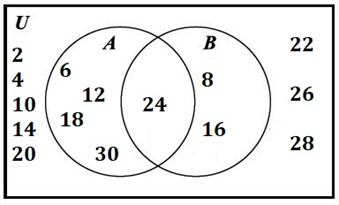
Figure Q1(iii): The overlapping region contains \(24\) (the only common multiple of \(6\) and \(8\) up to \(30\)). The A-only region contains \(\{6, 12, 18, 30\}\), the B-only region contains \(\{8, 16\}\), and the elements outside both circles are \(\{2, 4, 10, 14, 20, 22, 26, 28\}\).
Q2
Let \(U = \{x \mid x \text{ is an integer} \wedge 0 < x \leq 150\}\), \(G = \{x \mid x = 2^{m} \text{ for integer } m \wedge 0 \leq m \leq 12\}\) and \(H = \{x \mid x \text{ is a square}\}\). (i) List all elements of sets \(G\) and \(H\) in tabular form. (ii) Find \(G \cup H\). (iii) Find \(G \cap H\).
Solution
For \(G\): compute \(2^{m} \leq 150\) with \(0 \leq m \leq 12\). For \(H\): compute \(k^{2} \leq 150\).
\(G = \{1, 2, 4, 8, 16, 32, 64, 128\}\)
\(H = \{1, 4, 9, 16, 25, 36, 49, 64, 81, 100, 121, 144\}\)
(ii) \(G \cup H = \{1, 2, 4, 8, 9, 16, 25, 32, 36, 49, 64, 81, 100, 121, 128, 144\}\)
(iii) \(G \cap H = \{1, 4, 16, 64\}\)
Q3
Consider the set \(P = \{x \mid x \text{ is a prime number} \wedge 0 < x \leq 20\}\) and \(Q = \{x \mid x \text{ is a divisor of } 210 \wedge 0 < x \leq 20\}\). (i) Find \(P \cap Q\). (ii) Find \(P \cup Q\).
Solution
\(P = \{2, 3, 5, 7, 11, 13, 17, 19\}\)
\(Q = \{1, 2, 3, 5, 6, 7, 10, 14, 15\}\)
(i) \(P \cap Q = \{2, 3, 5, 7\}\)
(ii) \(P \cup Q = \{1, 2, 3, 5, 6, 7, 10, 11, 13, 14, 15, 17, 19\}\)
Q4
Verify the commutative properties of union and intersection for the following pairs of sets. (i) \(A = \{1, 2, 3, 4, 5\}\), \(B = \{4, 6, 8, 10\}\) (ii) \(A = \mathbb{N}\), \(B = \mathbb{Z}\) (iii) \(A = \{x \mid x \in \mathbb{R} \wedge x \geq 0\}\), \(B = \mathbb{R}\)
Solution
(i) \(A = \{1, 2, 3, 4, 5\}\), \(B = \{4, 6, 8, 10\}\)
Commutative property of union: \(A \cup B = B \cup A\)
\(\text{L.H.S} = A \cup B = \{1, 2, 3, 4, 5, 6, 8, 10\}\)
\(\text{R.H.S} = B \cup A = \{1, 2, 3, 4, 5, 6, 8, 10\}\)
\(\therefore \text{L.H.S} = \text{R.H.S}\) ✓
Commutative property of intersection: \(A \cap B = B \cap A\)
\(\text{L.H.S} = A \cap B = \{4\}\)
\(\text{R.H.S} = B \cap A = \{4\}\)
\(\therefore \text{L.H.S} = \text{R.H.S}\) ✓
(ii) \(A = \mathbb{N}\), \(B = \mathbb{Z}\)
Commutative property of union: \(A \cup B = B \cup A\)
\(\text{L.H.S} = \mathbb{N} \cup \mathbb{Z} = \{0, \pm 1, \pm 2, \pm 3, \ldots\} = \mathbb{Z}\)
\(\text{R.H.S} = \mathbb{Z} \cup \mathbb{N} = \{0, \pm 1, \pm 2, \pm 3, \ldots\} = \mathbb{Z}\)
\(\therefore \text{L.H.S} = \text{R.H.S}\) ✓
Commutative property of intersection: \(A \cap B = B \cap A\)
\(\text{L.H.S} = \mathbb{N} \cap \mathbb{Z} = \{1, 2, 3, \ldots\} = \mathbb{N}\)
\(\text{R.H.S} = \mathbb{Z} \cap \mathbb{N} = \{1, 2, 3, \ldots\} = \mathbb{N}\)
\(\therefore \text{L.H.S} = \text{R.H.S}\) ✓
(iii) \(A = \{x \mid x \in \mathbb{R} \wedge x \geq 0\}\), \(B = \mathbb{R}\)
Union: \(A \cup B = \mathbb{R} = B \cup A\). ✓
Intersection: \(A \cap B = A = B \cap A\). ✓
Q5
Let \(U = \{a, b, c, d, e, f, g, h, i, j\}\), \(A = \{a, b, c, d, g, h\}\), \(B = \{c, d, e, f, j\}\). Verify De Morgan's Laws for these sets. Draw Venn Diagram.
Solution
De Morgan's Laws: (i) \((A \cup B)' = A' \cap B'\) (ii) \((A \cap B)' = A' \cup B'\)
(i) Verify \((A \cup B)' = A' \cap B'\)
\(A \cup B = \{a, b, c, d, e, f, g, h, j\}\)
\(\text{L.H.S} = (A \cup B)' = U - (A \cup B) = \{i\}\)
\(A' = U - A = \{e, f, i, j\}\)
\(B' = U - B = \{a, b, g, h, i\}\)
\(\text{R.H.S} = A' \cap B' = \{e, f, i, j\} \cap \{a, b, g, h, i\} = \{i\}\)
\(\therefore \text{L.H.S} = \text{R.H.S}\) ✓
(ii) Verify \((A \cap B)' = A' \cup B'\)
\(A \cap B = \{c, d\}\)
\(\text{L.H.S} = (A \cap B)' = U - (A \cap B) = \{a, b, e, f, g, h, i, j\}\)
\(A' = \{e, f, i, j\},\quad B' = \{a, b, g, h, i\}\)
\(\text{R.H.S} = A' \cup B' = \{a, b, e, f, g, h, i, j\}\)
\(\therefore \text{L.H.S} = \text{R.H.S}\) ✓
Venn Diagrams for Q5
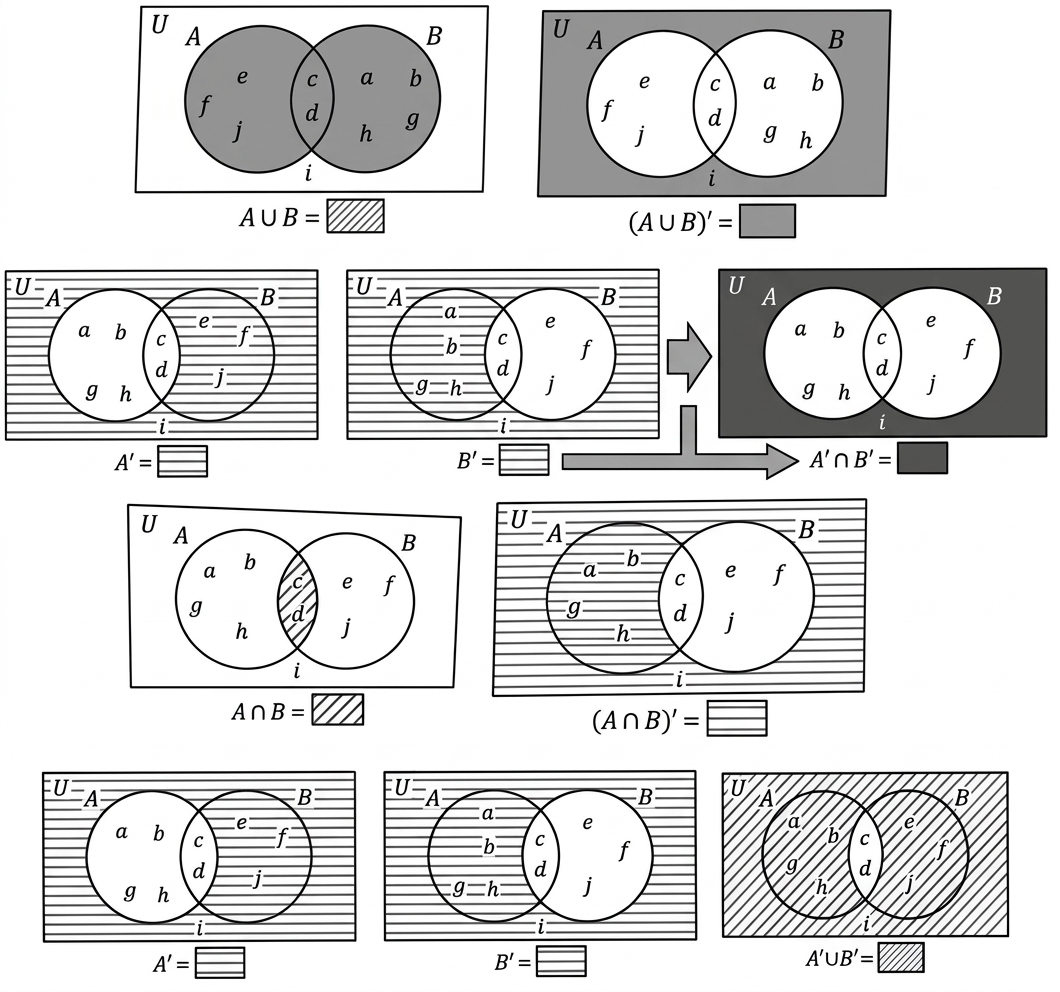
Figure Q5: Left panel shows \((A \cup B)' = A' \cap B' = \{i\}\). Right panel shows \((A \cap B)' = A' \cup B' = \{a, b, e, f, g, h, i, j\}\).
Q6
If \(U = \{1, 2, 3, \ldots, 20\}\) and \(A = \{1, 3, 5, \ldots, 19\}\), verify: (i) \(A \cup A' = U\) (ii) \(A \cap U = A\) (iii) \(A \cap A' = \emptyset\)
Solution
\(U = \{1, 2, 3, \ldots, 20\}\)
\(A = \{1, 3, 5, 7, 9, 11, 13, 15, 17, 19\}\)
\(A' = \{2, 4, 6, 8, 10, 12, 14, 16, 18, 20\}\)
(i) \(A \cup A' = U\) ✓
(ii) \(A \cap U = A\) ✓
(iii) \(A \cap A' = \emptyset\) ✓
Q7
In a class of \(55\) students, \(34\) like to play cricket and \(30\) like to play hockey. Also, each student likes to play at least one of the two games. How many students like to play both games?
Solution
\(n(C \cup H) = 55,\quad n(C) = 34,\quad n(H) = 30\)
\(n(C \cup H) = n(C) + n(H) - n(C \cap H)\)
\(55 = 34 + 30 - n(C \cap H)\)
\(55 = 64 - n(C \cap H)\)
\(n(C \cap H) = 64 - 55 = 9\)
✅ 9 students like to play both games.
Q8
In a group of \(500\) employees, \(250\) can speak Urdu, \(150\) can speak English, \(50\) can speak Punjabi, \(40\) can speak Urdu and English, \(30\) can speak both English and Punjabi, and \(10\) can speak Urdu and Punjabi. How many can speak all three languages?
Solution
\(n(U_r) = 250,\quad n(E) = 150,\quad n(P) = 50\)
\(n(U_r \cap E) = 40,\quad n(E \cap P) = 30,\quad n(U_r \cap P) = 10\)
\(n(U_r \cup E \cup P) = n(U_r) + n(E) + n(P)\)
\(\quad - n(U_r \cap E) - n(E \cap P) - n(U_r \cap P) + n(U_r \cap E \cap P)\)
\(= 250 + 150 + 50 - 40 - 30 - 10 + x\)
\(= 370 + x\)
Since there are \(500\) employees in total, \(n(U_r \cup E \cup P) = 500\) gives \(370 + x = 500\), so \(x = 130\).
✅ 130 employees can speak all three languages.
Q9
In a sports event, \(19\) people wear blue shirts, \(15\) wear green shirts, \(3\) wear blue and green shirts, \(4\) wear a cap and blue shirts, \(2\) wear a cap and green shirts. The total number of people with either a blue or green shirt or a cap is \(34\). How many people are wearing caps?
Solution
\(n(B) = 19,\quad n(G) = 15,\quad n(B \cap G) = 3\)
\(n(C \cap B) = 4,\quad n(C \cap G) = 2,\quad n(B \cup G \cup C) = 34\)
Assume \(n(B \cap G \cap C) = 0\)
\(34 = 19 + 15 + n(C) - 3 - 4 - 2 + 0\)
\(34 = 25 + n(C)\)
\(n(C) = 34 - 25 = 9\)
✅ 9 people are wearing caps.
Q10
In a training session, \(17\) participants have laptops, \(11\) have tablets, \(9\) have laptops and tablets, \(6\) have laptops and books and \(4\) have both tablets and books. Eight participants have all three items. The total number of participants with laptops, tablets or books is \(35\). How many participants have books?
Solution
\(n(L) = 17,\quad n(T) = 11,\quad n(L \cap T) = 9\)
\(n(L \cap B) = 6,\quad n(T \cap B) = 4,\quad n(L \cap T \cap B) = 8\)
\(n(L \cup T \cup B) = 35\)
\(35 = 17 + 11 + n(B) - 9 - 6 - 4 + 8\)
\(35 = 17 + n(B)\)
\(n(B) = 35 - 17 = 18\)
✅ 18 participants have books.
Q11
A shopping mall has \(150\) employees labelled \(1\) to \(150\), representing the universal set \(U\). The employees fall into these categories: Set \(A\): \(40\) employees with salary \(30\text{k} - 40\text{k}\), labelled \(50\) to \(89\). Set \(B\): \(50\) employees with salary \(50\text{k} - 80\text{k}\), labelled \(101\) to \(150\). Set \(C\): \(60\) employees with salary \(100\text{k} - 150\text{k}\), labelled \(1\) to \(49\) and \(90\) to \(100\). (a) Find \((A' \cup B') \cap C\). (b) Find \(n(A \cap (B' \cap C'))\).
Solution
\(U = \{1, 2, 3, \ldots, 150\}\)
\(A = \{50, 51, \ldots, 89\}\)
\(B = \{101, 102, \ldots, 150\}\)
\(C = \{1, 2, 3, \ldots, 49, 90, 91, \ldots, 100\}\)
(a) \((A' \cup B') \cap C\)
\(A' = \{1, \ldots, 49, 90, \ldots, 150\},\quad B' = \{1, \ldots, 100\}\)
\(A' \cup B' = \{1, 2, \ldots, 150\} = U\)
\((A' \cup B') \cap C = C\)
(b) \(n(A \cap (B' \cap C'))\)
\(B' = \{1, \ldots, 100\},\quad C' = \{50, \ldots, 89, 101, \ldots, 150\}\)
\(B' \cap C' = \{50, \ldots, 89\} = A\)
\(n(A \cap (B' \cap C')) = n(A) = 40\)
✅ (a) \(C\); (b) 40
Q12
In a secondary school with \(125\) students participating in at least one of cricket, football, and hockey: \(60\) play cricket, \(70\) play football, \(40\) play hockey, \(25\) play both cricket and football, \(15\) play both football and hockey, \(10\) play both cricket and hockey. (a) How many students play all three sports? (b) Draw a Venn diagram showing the distribution.
Solution
\(n(C \cup F \cup H) = 125,\quad n(C) = 60,\quad n(F) = 70,\quad n(H) = 40\)
\(n(C \cap F) = 25,\quad n(F \cap H) = 15,\quad n(C \cap H) = 10\)
\(125 = 60 + 70 + 40 - 25 - 15 - 10 + n(C \cap F \cap H)\)
\(125 = 120 + n(C \cap F \cap H)\)
\(n(C \cap F \cap H) = 5\)
✅ (a) 5 students play all three sports.
(b) Venn Diagram
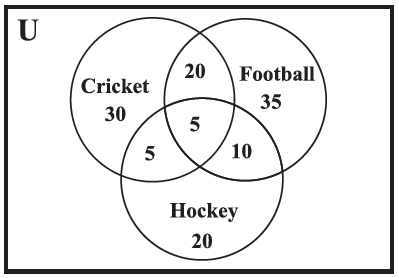
Figure Q12(b): Cricket only 30, Football only 35, Hockey only 20, Cricket & Football only 20, Football & Hockey only 10, Cricket & Hockey only 5, all three 5.
All three (center): \(5\)
Cricket & Football only: \(25 - 5 = 20\)
Football & Hockey only: \(15 - 5 = 10\)
Cricket & Hockey only: \(10 - 5 = 5\)
Cricket only: \(60 - (20 + 5 + 5) = 30\)
Football only: \(70 - (20 + 10 + 5) = 35\)
Hockey only: \(40 - (10 + 5 + 5) = 20\)
Q13
A survey of \(130\) people about favorite foods showed: \(40\) like nihari, \(65\) like biryani, \(50\) like korma, \(20\) like nihari and biryani, \(35\) like biryani and korma, \(27\) like nihari and korma, and \(12\) like all three. (a) At least how many people like nihari, biryani or korma? (b) How many people did not like any of the three? (c) How many like only one of the three foods? (d) Draw a Venn diagram.
Solution
Let \(N\) = people who like nihari, \(B\) = people who like biryani, \(K\) = people who like korma.
\(n(U) = 130,\quad n(N) = 40,\quad n(B) = 65,\quad n(K) = 50\)
\(n(N \cap B) = 20,\quad n(B \cap K) = 35,\quad n(N \cap K) = 27,\quad n(N \cap B \cap K) = 12\)
(a) At least how many like nihari, biryani or korma?
\(n(N \cup B \cup K) = 40 + 65 + 50 - 20 - 35 - 27 + 12 = 85\)
(b) How many did not like any?
\(n(N \cup B \cup K)' = n(U) - n(N \cup B \cup K) = 130 - 85 = 45\)
(c) How many like only one of the three foods?
Only Nihari: \(40 - 20 - 27 + 12 = 5\)
Only Biryani: \(65 - 20 - 35 + 12 = 22\)
Only Korma: \(50 - 35 - 27 + 12 = 0\)
Total = \(5 + 22 + 0 = 27\)
(d) Venn Diagram
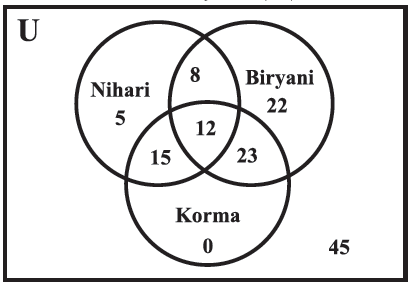
Figure Q13(d): Nihari only 5, Biryani only 22, Korma only 0, Nihari & Biryani only 8, Biryani & Korma only 23, Nihari & Korma only 15, all three 12, and 45 people outside all circles.
All three (center): \(12\)
Nihari & Biryani only: \(20 - 12 = 8\)
Biryani & Korma only: \(35 - 12 = 23\)
Nihari & Korma only: \(27 - 12 = 15\)
Only Nihari: \(40 - (8 + 12 + 15) = 5\)
Only Biryani: \(65 - (8 + 12 + 23) = 22\)
Only Korma: \(50 - (23 + 12 + 15) = 0\)
Outside all circles: \(45\)
✅ (a) 85; (b) 45; (c) 27; (d) See Venn diagram above.
💡 Exam Tip:
For verification questions, always show L.H.S. and R.H.S. separately, then write “Hence L.H.S = R.H.S”. For Venn diagram problems with three sets, start from the innermost region (all three) and work outward — subtract the overlap you have already placed. Remember the inclusion-exclusion formula: \(n(A \cup B \cup C) = n(A) + n(B) + n(C) - n(A \cap B) - n(B \cap C) - n(A \cap C) + n(A \cap B \cap C)\).
❓ Frequently Asked Questions – Exercise 3.2
First list each set in tabular form. With \(U = \{2, 4, 6, 8, \ldots, 30\}\):
\(A = \{6, 12, 18, 24, 30\}\)
\(B = \{8, 16, 24\}\)
\(A \cap B = \{24\}\)
In the Venn diagram, \(24\) lies in the overlapping region; \(\{6, 12, 18, 30\}\) in \(A\)-only; \(\{8, 16\}\) in \(B\)-only; and \(\{2, 4, 10, 14, 20, 22, 26, 28\}\) outside both circles.
De Morgan's Laws:
\((A \cup B)' = A' \cap B'\)
\((A \cap B)' = A' \cup B'\)
To verify, take complements of \(A\) and \(B\) inside \(U\), compute both sides separately, and show they are identical. For example with \(U=\{a,b,c,d,e,f,g,h,i,j\}\), \(A=\{a,b,c,d,g,h\}\), \(B=\{c,d,e,f,j\}\), we get \((A \cup B)' = \{i\}\) and \(A' \cap B' = \{i\}\).
Figure: Left panel — \((A \cup B)' = A' \cap B'\). Right panel — \((A \cap B)' = A' \cup B'\).
Compute each side separately:
Union: \(A \cup B = \{1, 2, 3, 4, 5, 6, 8, 10\}\), and \(B \cup A = \{1, 2, 3, 4, 5, 6, 8, 10\}\)
Intersection: \(A \cap B = \{4\}\), and \(B \cap A = \{4\}\)
Conclude with “Hence L.H.S = R.H.S” once both sides match — this is the standard verification format expected.
The three-set Inclusion-Exclusion formula is:
\(n(A \cup B \cup C) = n(A) + n(B) + n(C) - n(A \cap B) - n(B \cap C) - n(A \cap C) + n(A \cap B \cap C)\)
Substitute all known values and solve for the unknown. In the survey of \(130\) people with \(n(N) = 40\), \(n(B) = 65\), \(n(K) = 50\), \(n(N \cap B) = 20\), \(n(B \cap K) = 35\), \(n(N \cap K) = 27\), \(n(N \cap B \cap K) = 12\), we get \(n(N \cup B \cup K) = 40 + 65 + 50 - 20 - 35 - 27 + 12 = 85\).
Start from the innermost region:
1. Place \(n(A \cap B \cap C)\) at the center.
2. Pair-only: \(n(A \cap B) - n(A \cap B \cap C)\), and similarly for other pairs.
3. Set-only: \(n(A) - (\text{pair regions} + \text{center})\), and similarly for \(B\) and \(C\).
4. Outside: \(n(U) - n(A \cup B \cup C)\).
Example: Cricket only 30, Football only 35, Hockey only 20, pairs 5/5/10, center 5.
The complete PDF for Class 9 Math Exercise 3.2 (Sets and Functions) is embedded on this page and can be downloaded free of cost using the “⬇️ Download PDF – Exercise 3.2 Solutions (Free)” button located directly above the FAQ section. The PDF contains the full set of solved questions including all Venn diagram proofs, De Morgan's Laws, and survey problems, prepared according to the PECTAA 2025 syllabus.
Chapter 1Real Numbers
Chapter 2Logarithms
Chapter 3✨ Sets and Functions
Chapter 4Factorization
Chapter 5Linear Equations and Inequalities
Chapter 6Trigonometry
Chapter 7Coordinate Geometry
Chapter 8Logic
Chapter 9Similar Figures
Chapter 10Graphs of Functions
Chapter 11Loci and Construction
Chapter 12Information Handling
Chapter 13Probability
📖 Complete syllabus coverage for Class 9 Mathematics – Chapters 1 to 13
Created by Hira Science Academy | Aligned with PECTAA Syllabus