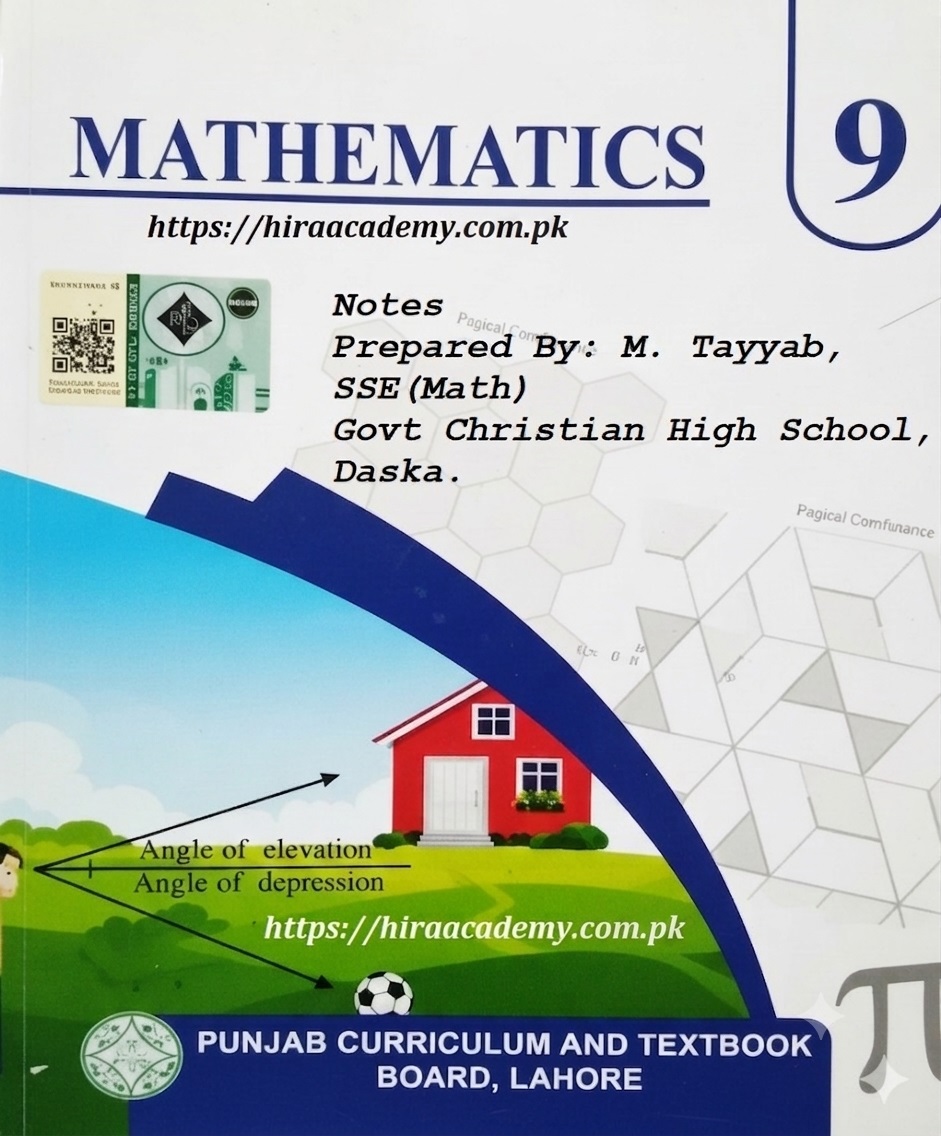
Definitions – All 13 Chapters
Click on any chapter to open its key terms, definitions, and theorems.
📘
Chapter 1 – Real Numbers
Rational and irrational numbers, decimal representation, operations
New 2026
↓
Real numbers form the foundation of mathematics. This chapter covers rational and irrational numbers, decimal representation, and operations on real numbers.
📗
Chapter 2 – Logarithms
Laws of logarithms, common logarithms, exponential equations
New 2026↓
Logarithms help simplify complex calculations. This chapter covers laws, common logarithms, and applications in solving exponential equations.
📙
Chapter 3 – Sets and Functions
Set operations, Venn diagrams, function types, notation
New 2026↓
Sets and functions are fundamental concepts in mathematics with applications in computer science and data analysis.
📕
Chapter 4 – Factorization and Algebraic Manipulation
Factorization techniques, algebraic fractions, simplification
New 2026↓
Factorization simplifies algebraic expressions and equations. This chapter covers various factorization techniques and simplification.
📓
Chapter 5 – Linear Equations and Inequalities
Solving linear equations, graphing inequalities, word problems
New 2026↓
Linear equations and inequalities are essential for solving real-world problems in economics, physics, and engineering.
📔
Chapter 6 – Trigonometry
Trigonometric ratios, identities, triangle solving, applications
New 2026↓
Trigonometry deals with relationships between angles and sides of triangles with applications in architecture and navigation.
📒
Chapter 7 – Coordinate Geometry
Cartesian plane, distance formula, midpoint, line equations
New 2026↓
Coordinate geometry connects algebra and geometry with applications in computer graphics and engineering.
📚
Chapter 8 – Logic
Statements, truth tables, logical equivalence, proof techniques
New 2026↓
Logic forms the basis of mathematical reasoning and computer programming.
📖
Chapter 9 – Similar Figures
Similarity criteria, ratio of areas and volumes, geometry applications
New 2026↓
Similar figures have the same shape but different sizes with applications in map reading and scale models.
📘
Chapter 10 – Graphs of Functions
Linear, quadratic functions, graphing techniques, interpretations
New 2026↓
Graphs provide visual representations of functions with applications in economics and science.
📗
Chapter 11 – Loci and Construction
Geometric constructions, loci problems, engineering applications
New 2026↓
Loci are sets of points satisfying specific conditions with applications in engineering design.
📙
Chapter 12 – Information Handling
Data collection, graphical representations, statistical analysis
New 2026↓
Information handling is crucial in data analysis and decision making.
📙
Chapter 13 – Probability
Basic concepts, sample spaces, probability calculation, applications
New 2026↓
Probability quantifies uncertainty in scientific research and finance.
Why Precise Definitions Matter More Than Students Realize
It's easy to underestimate definitions while studying — they can feel like the "boring part" compared to solving equations or working through a diagram. But in Class 9 Mathematics, a fuzzy grasp of a definition is one of the most common hidden reasons students struggle with an otherwise solvable question. This page gathers every key term and theorem from all 13 chapters of the PECTAA 2026 syllabus in one clear reference.
Consider a simple example: a student who can recite "a rational number can be written as a fraction" but doesn't fully grasp what that means will struggle the moment a question is phrased slightly differently. Precise understanding — not just memorized wording — is what lets you recognize a concept even when a question doesn't use the exact textbook phrasing.
Definitions also directly determine your exam performance in more ways than students expect. Board exams frequently include short questions that ask you to "define" or "state" a term, worth guaranteed marks if you know the definition precisely. Beyond that, many MCQs are built entirely around distinguishing between similar-sounding terms, and long questions often require you to correctly apply a theorem whose conditions you need to recall accurately.
Each chapter of Class 9 Mathematics introduces its own vocabulary: Real Numbers brings terms like rational, irrational, and terminating decimals; Sets and Functions introduces domain, range, and one-to-one correspondence; Trigonometry relies on precise definitions of sine, cosine, and tangent in terms of a right triangle's sides. Mixing these up, even slightly, tends to cascade into errors later in a solution.
The best way to use this page is as a companion to your regular study, not a replacement for it. Before starting a chapter's exercises, skim its definitions here so the vocabulary is fresh. Closer to exams, use it as a rapid-fire revision tool — read a term, try to recall the definition yourself, then check it against what's written.
This resource is equally useful for teachers preparing quick oral tests on terminology, and for parents who want to quiz their child without needing deep subject expertise — a clear definition is easy to check against. Since these definitions follow the PECTAA 2026 syllabus shared by all 10 BISE boards in Punjab — Bahawalpur, DG Khan, Faisalabad, Federal, Gujranwala, Lahore, Multan, Rawalpindi, Sahiwal, and Sargodha — this page applies no matter which board a student is registered under.
Open any chapter below to review its definitions and theorems. Once you're confident with the vocabulary, the formula sheet and solved exercises linked further down this page are the natural next step.
💡 Techniques for Memorizing Definitions
- • Explain it in your own words: If you can rephrase a definition without losing its meaning, you understand it.
- • Use flashcards: Write the term on one side and the definition on the other for quick self-testing.
- • Group related terms: Learn similar-sounding definitions together to avoid confusing them.
- • Connect to an example: Pair each definition with a worked example that uses it.
- • Revise daily in short bursts: A few minutes of definitions review each day beats one long cram session.
🎯 Turning Definitions Into Exam Marks
- • Write full sentences: Short-question answers should be complete, not just a keyword.
- • Practice stating theorems: Some questions ask you to state a theorem exactly—practice this wording.
- • Use definitions to check exercises: If a solution step seems off, verify it against the relevant definition.
- • Test with MCQs: Use our MCQs test above to see how well you can distinguish between similar terms.
- • Do a final sweep before exams: Reread every chapter's definitions once in the last two days before your test.
✅ Why Use This Definitions Page?
- • Clear, simple wording – definitions explained beyond textbook phrasing.
- • All 13 chapters covered – one reference for every term you'll need.
- • Theorems included – not just definitions, but the key results built on them.
- • Matches PECTAA 2026 – terminology aligned with the current syllabus.
- • Free and searchable – find any term quickly, no sign-up needed.
👥 Who Should Use This Page?
- • Class 9 students reviewing terms before exercises or exams.
- • Teachers running quick oral tests on terminology.
- • Parents quizzing their child without needing subject expertise.
- • Students revising quickly before short-question sections of exams.
- • Students from all 10 Punjab BISE boards, since all follow PECTAA 2026.
9th Class Math Definitions – What's Included (PECTAA 2026)
This page collects every essential definition and theorem from the syllabus prescribed by the Punjab Education Curriculum Training and Assessment Authority, explained in plain, exam-ready language.
Prepared by Muhammad Tayyab (SSE), Govt Christian High School Daska, each chapter's terms are grouped together so you can quickly find and review exactly the concept you need.
✅ What's Included Per Chapter
- ✓Clear definitions for every key term
- ✓Important theorems where applicable
- ✓Based on the PECTAA 2026 syllabus
- ✓Plain, student-friendly wording
- ✓Free access, no downloads required
- ✓Searchable by chapter or term
🌐 Chapters Covered
Real Numbers, Logarithms, Sets and Functions, Factorization, Linear Equations, Trigonometry, Coordinate Geometry, Logic, Similar Figures, Graphs of Functions, Loci and Construction, Information Handling, and Probability.
Each chapter's definitions link directly from the accordion below.
Explore the Complete 9th Class Math Toolkit
These definitions are part of a larger set of Math 9 resources. Explore the notes hub, key book, formula sheet, and more below.
🏠
Math 9 Notes Hub
The main hub linking every Class 9 Math resource in one place.
📔
Math Key Book
Full solution guide with chapter-wise answers to every textbook question.
📄
Notes PDF
Downloadable and printable chapter-wise PDF notes for offline study.
✏️
Solved Exercises
Step-by-step worked solutions for every exercise in all 13 chapters.
⭐
Important Questions
Short and long board-focused questions to prioritize your revision.
✅
Math MCQs
Chapter-wise multiple-choice questions with an online practice test.
🧮
Formula Sheet
A quick-revision sheet with all formulas organized by chapter.
🎯
Guess Paper
The latest important chapters and exercises predicted for this year's exam.
🗂️
Past Papers
Solved previous board papers with pattern analysis for smarter prep.
Frequently Asked Questions About Math Definitions
Are definitions provided for every chapter?
Yes, key definitions and theorems are provided for all 13 chapters under the PECTAA 2026 syllabus.
Why are definitions so important in Math exams?
Many short questions and MCQs test definitions directly, and understanding a term precisely helps you apply the related formula correctly.
Are these definitions written simply?
Yes, each definition is explained in clear, student-friendly language rather than dense textbook wording.
Can I use this for last-minute revision?
Yes, this page is designed as a quick reference for revising definitions and theorems close to exam day.
Are theorems included too?
Yes, important theorems are included alongside their related definitions wherever the syllabus requires them.
Are these definitions aligned with PECTAA 2026?
Yes, all definitions match the terminology and scope used in the updated PECTAA 2026 syllabus.
Which BISE boards can use this page?
All 10 BISE boards in Punjab follow PECTAA 2026, so these definitions apply equally to every board.
Is this resource free?
Yes, all chapter-wise definitions are completely free to access online with no sign-up required.
Should I review definitions before solving exercises?
Yes, reviewing a chapter's definitions first makes its exercise solutions much easier to follow.
Do definitions help with MCQs too?
Yes, many MCQs directly test definitions, so reviewing them is one of the fastest ways to improve MCQ accuracy.
⚠️ Common Definition Mistakes
- • Confusing similar terms: Mixing up related definitions, like rational and irrational numbers.
- • Memorizing without understanding: Reciting a definition without grasping what it actually means.
- • Incomplete answers: Leaving out a key condition that makes a definition precise.
- • Skipping theorems: Focusing only on definitions and neglecting the theorems built on them.
🧠 Building Stronger Conceptual Understanding
- • Ask "why" after every definition: Understanding the reasoning behind a term deepens recall.
- • Draw diagrams where possible: Visualizing a definition, especially in geometry, aids memory.
- • Test yourself out of order: Random-order recall is a stronger test than reviewing in sequence.
- • Teach it to someone else: Explaining a definition aloud reveals gaps in your own understanding.