📘 Exercise 1.1 – Solved
Study the solved questions for Class 9 Mathematics Exercise 1.1 on Real Numbers. This page provides step-by-step working for rational and irrational number classification, number line representation, and recurring decimal conversion. The embedded PDF notes remain available below.
📖 What's Inside: This section covers all solved questions from Exercise 1.1 including identifying rational and irrational numbers, representing numbers on the number line, converting recurring decimals to fractions, and naming properties of real numbers and inequalities. Each problem is presented with clear, step-by-step mathematical working following the official Punjab Curriculum and Textbook Board (PECTAA) method. Perfect for Punjab Boards (Lahore, Gujranwala, Multan, etc.) and all BISE boards across Pakistan.
If the PDF does not load, click here to view it directly on Google Drive.
🔗 Quick Links – Chapter 1: Real Numbers
📐 Exercise 1.1 – Questions & Solutions
Q1
Identify each of the following as a rational or irrational number: (i) \(2.353535\) (ii) \(0.6\) (iii) \(2.236067...\) (iv) \(\sqrt{7}\) (v) \(e\) (vi) \(\pi\) (vii) \(5 + \sqrt{11}\) (viii) \(\sqrt{3} + \sqrt{13}\) (ix) \(\frac{15}{4}\) (x) \((2 - \sqrt{2})(2 + \sqrt{2})\)
Solution
| Sr# | Number | Type | Reason |
|---|---|---|---|
| i | \(2.353535\) | Rational | Decimal repeats (35 repeats), so it's recurring. |
| ii | \(0.6\) | Rational | Decimal repeats (6 repeats), so it's recurring. |
| iii | \(2.236067...\) | Irrational | Decimal doesn't repeat or end. |
| iv | \(\sqrt{7}\) | Irrational | Can't be written as \(p/q\); decimal doesn't repeat or end. |
| v | \(e\) | Irrational | Decimal doesn't end or repeat. Known irrational number. |
| vi | \(\pi\) | Irrational | Decimal doesn't end or repeat. Known irrational number. |
| vii | \(5 + \sqrt{11}\) | Irrational | Rational + irrational = irrational. |
| viii | \(\sqrt{3} + \sqrt{13}\) | Irrational | Irrational + irrational = irrational (in most cases). |
| ix | \(\frac{15}{4}\) | Rational | In \(p/q\) form where \(p\) & \(q\) are integers. |
| x | \((2 - \sqrt{2})(2 + \sqrt{2})\) | Rational | This equals \(4 - 2 = 2\), which is rational (special product formula). |
Q2
Represent the following numbers on the number line: (i) \(\sqrt{2}\) (ii) \(\sqrt{3}\) (iii) \(4\frac{1}{3}\) (iv) \(-2\frac{1}{7}\) (v) \(\frac{5}{8}\) (vi) \(2\frac{3}{4}\)
Solution
(i) Locating \(\sqrt{2} \approx 1.414\)
a.Draw a number line with \(A = 0\) and \(B = 1\).
b.At \(B\), draw a perpendicular \(BC = 1\) unit.
c.Join \(A\) to \(C\) to form a right-angled \(\Delta ABC\).
By Pythagoras theorem:
\((Hypotenuse)^2 = (Base)^2 + (Perpendicular)^2\)
\((AC)^2 = (AB)^2 + (BC)^2\)
\((AC)^2 = (1)^2 + (1)^2\)
\((AC)^2 = 1 + 1\)
\((AC)^2 = 2\)
\(\sqrt{(AC)^2} = \sqrt{2}\)
\(AC = \sqrt{2}\)
With \(A\) as center and radius \(AC = \sqrt{2}\), draw an arc cutting the number line at \(P\).

Figure: Representation of \(\sqrt{2}\) on the number line.
(ii) Locating \(\sqrt{3} \approx 1.732\)
Step 1: Construct \(\sqrt{2}\)
a.Draw a number line with \(A = 0\) and \(B = 1\).
b.At \(B\), draw a perpendicular \(BC = 1\) unit.
c.Join \(A\) to \(C\) to form a right-angled \(\Delta ABC\).
By Pythagoras theorem:
\((Hypotenuse)^2 = (Base)^2 + (Perpendicular)^2\)
\((AC)^2 = (AB)^2 + (BC)^2\)
\((AC)^2 = (1)^2 + (1)^2\)
\((AC)^2 = 1 + 1\)
\((AC)^2 = 2\)
\(\sqrt{(AC)^2} = \sqrt{2}\)
\(AC = \sqrt{2}\)
With \(A\) as center and radius \(AC = \sqrt{2}\), draw an arc cutting the number line at \(D\).
Step 2: Construct \(\sqrt{3}\)
a.At \(C\), draw a perpendicular \(CE = 1\) unit (upwards).
b.Join \(A\) to \(E\) to form a right-angled \(\Delta ACE\).
By Pythagoras theorem:
\((Hypotenuse)^2 = (Base)^2 + (Perpendicular)^2\)
\((AE)^2 = (AC)^2 + (CE)^2\)
\((AE)^2 = (\sqrt{2})^2 + (1)^2\)
\((AE)^2 = 2 + 1\)
\((AE)^2 = 3\)
\(\sqrt{(AE)^2} = \sqrt{3}\)
\(AE = \sqrt{3}\)
With \(A\) as center and radius \(AE = \sqrt{3}\), draw an arc cutting the number line at \(F\).
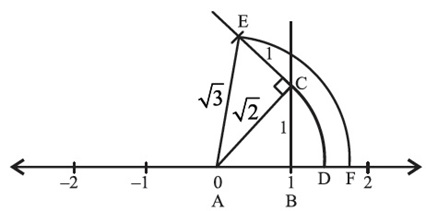
Figure: Representation of \(\sqrt{3}\) on the number line.
(iii) \(4\frac{1}{3} = 4.33\)
a.Locate 4 and 5 on the number line.
b.Divide the space between them into 3 equal parts.
c.Mark the point \(\frac{1}{3}\) of the way from 4 to 5.
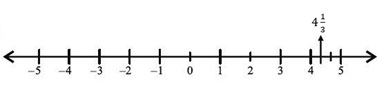
Figure: Representation of \(4\frac{1}{3}\) on the number line.
(iv) \(-2\frac{1}{7} = -2.143\)
a.Locate \(-2\) and \(-3\) on the number line.
b.Divide the space between them into 7 equal parts.
c.Mark the point \(\frac{1}{7}\) of the way from \(-2\) to \(-3\).
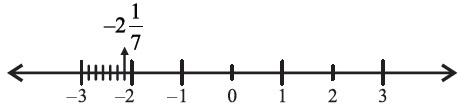
Figure: Representation of \(-2\frac{1}{7}\) on the number line.
(v) \(\frac{5}{8} = 0.625\)
a.Locate 0 and 1 on the number line.
b.Divide the space into 8 equal parts.
c.Mark the \(5^{th}\) division point.
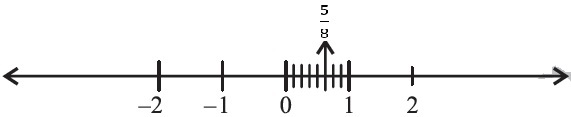
Figure: Representation of \(\frac{5}{8}\) on the number line.
(vi) \(2\frac{3}{4} = 2.75\)
a.Locate 2 and 3 on the number line.
b.Divide the space into 4 equal parts.
c.Mark the point \(\frac{3}{4}\) of the way from 2 to 3.
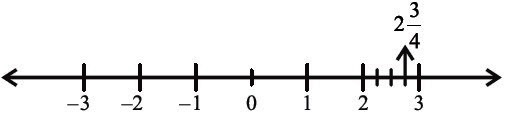
Figure: Representation of \(2\frac{3}{4}\) on the number line.
Q3
Express the following as a rational number \(\frac{p}{q}\) where \(p\) and \(q\) are integers and \(q \neq 0\). (i) \(0.4\) (ii) \(0.37\) (iii) \(0.21\)
Solution
(i) Let \(x = 0.4\)
\(x = 0.444\ldots\)... (i)
\(10x = 10(0.444\ldots)\)
\(10x = 4.444\ldots\)... (ii)
\(10x - x = (4.444\ldots) - (0.444\ldots)\)
\(9x = 4\)
\(x = \frac{4}{9}\)
(ii) Let \(x = 0.37\)
\(x = 0.373737\ldots\)... (i)
\(100x = 100(0.373737\ldots)\)
\(100x = 37.373737\ldots\)... (ii)
Subtracting (i) from (ii)
\(100x - x = (37.373737\ldots) - (0.373737\ldots)\)
\(99x = 37\)
\(x = \frac{37}{99}\)
(iii) Let \(x = 0.21\)
\(x = 0.212121\ldots\)... (i)
\(100x = 100(0.212121\ldots)\)
\(100x = 21.212121\ldots\)... (ii)
Subtracting (i) from (ii)
\(100x - x = 21.212121\ldots - 0.212121\ldots\)
\(99x = 21\)
\(x = \frac{21}{99}\)
Q4
Name the property used in the following: (i) \((a + 4) + b = a + (4 + b)\) (ii) \(\sqrt{2} + \sqrt{3} = \sqrt{3} + \sqrt{2}\) (iii) \(x - x = 0\) (iv) \(a(b + c) = ab + ac\) (v) \(16 + 0 = 16\) (vi) \(100 \times 1 = 100\) (vii) \(4 \times (5 \times 8) = (4 \times 5) \times 8\) (viii) \(ab = ba\)
Solution
| Sr# | Expression | Property Name |
|---|---|---|
| i | \((a + 4) + b = a + (4 + b)\) | Associative property over addition |
| ii | \(\sqrt{2} + \sqrt{3} = \sqrt{3} + \sqrt{2}\) | Commutative property over addition |
| iii | \(x - x = 0\) | Additive Inverse |
| iv | \(a(b + c) = ab + ac\) | Left distributive property of multiplication over addition |
| v | \(16 + 0 = 16\) | Additive Identity |
| vi | \(100 \times 1 = 100\) | Multiplicative Identity |
| vii | \(4 \times (5 \times 8) = (4 \times 5) \times 8\) | Associative Property under Multiplication |
| viii | \(ab = ba\) | Commutative Property under Multiplication |
Q5
Name the property used in the following: (i) \(-3 < -1 \Rightarrow 0 < 2\) (ii) If \(a < b\) then \(\frac{1}{a} > \frac{1}{b}\) (iii) If \(a < b\) then \(a + c < b + c\) (iv) If \(ac < bc\) and \(c > 0\) then \(a < b\) (v) If \(ac < bc\) and \(c < 0\) then \(a > b\) (vi) Either \(a > b\) or \(a = b\) or \(a < b\)
Solution
| Sr# | Expression | Property Name |
|---|---|---|
| i | \(-3 < -1 \Rightarrow 0 < 2\) | Additive Property of Inequality |
| ii | If \(a < b\) then \(\frac{1}{a} > \frac{1}{b}\) | Reciprocal Property |
| iii | If \(a < b\) then \(a + c < b + c\) | Additive Property (of order) |
| iv | If \(ac < bc\) and \(c > 0\) then \(a < b\) | Multiplicative Property (when \(c > 0\)) |
| v | If \(ac < bc\) and \(c < 0\) then \(a > b\) | Multiplicative Property (when \(c < 0\)) |
| vi | Either \(a > b\) or \(a = b\) or \(a < b\) | Trichotomy Property |
Q6
Find two rational numbers between: (i) \(\frac{1}{3}\) and \(\frac{1}{4}\) (ii) \(3\) and \(4\) (iii) \(\frac{3}{5}\) and \(\frac{4}{5}\)
Solution
(i) Between \(\frac{1}{3}\) and \(\frac{1}{4}\)
\(1^{st}\) rational number = \(\left(\frac{1}{3} + \frac{1}{4}\right) \div 2\)
= \(\left(\frac{4 + 3}{12}\right) \times \frac{1}{2}\)
= \(\frac{7}{12} \times \frac{1}{2} = \frac{7}{24}\)
\(2^{nd}\) rational number = \(\left(\frac{1}{3} + \frac{7}{24}\right) \div 2\)
= \(\left(\frac{8 + 7}{24}\right) \times \frac{1}{2}\)
= \(\frac{15}{24} \times \frac{1}{2} = \frac{15}{48}\)
(ii) Between \(3\) and \(4\)
1st rational number = \((3 + 4) \div 2 = (7) \times \frac{1}{2} = \frac{7}{2}\)
2nd rational number = \(\left(3 + \frac{7}{2}\right) \div 2\)
= \(\left(\frac{6 + 7}{2}\right) \times \frac{1}{2} = \frac{13}{2} \times \frac{1}{2} = \frac{13}{4}\)
(iii) Between \(\frac{3}{5}\) and \(\frac{4}{5}\)
1st rational number = \(\left(\frac{3}{5} + \frac{4}{5}\right) \div 2\)
= \(\left(\frac{3 + 4}{5}\right) \times \frac{1}{2} = \frac{7}{5} \times \frac{1}{2} = \frac{7}{10}\)
2nd rational number = \(\left(\frac{3}{5} + \frac{7}{10}\right) \div 2\)
= \(\left(\frac{6 + 7}{10}\right) \times \frac{1}{2} = \frac{13}{10} \times \frac{1}{2} = \frac{13}{20}\)
💡 Exam Tip:
For the number-line construction questions, always show the right-angled triangle and state the Pythagoras theorem clearly. When converting recurring decimals, remember to multiply by 10, 100, or 1000 depending on how many digits repeat. These solutions follow the exact PECTAA / Punjab Board textbook method.
❓ Frequently Asked Questions – Exercise 1.1
Exercise 1.1 of Unit 1 (Real Numbers) covers: identifying numbers as rational or irrational, representing numbers such as \(\sqrt{2}\), \(\sqrt{3}\), \(4\frac{1}{3}\), \(-2\frac{1}{7}\), \(\frac{5}{8}\) and \(2\frac{3}{4}\) on the number line, converting recurring decimals \(\left(0.\overline{4},\; 0.\overline{37},\; 0.\overline{21}\right)\) into \(\frac{p}{q}\) form, naming properties of real numbers and inequalities, and finding rational numbers between two given rational numbers. Full step-by-step working is shown on this page and in the embedded PDF.
Let \(x\) equal the recurring decimal. Multiply both sides by \(10\), \(100\) or \(1000\) depending on how many digits repeat (\(10\) for one repeating digit, \(100\) for two, and so on). Subtract the original equation from the multiplied one so the repeating part cancels, then solve for \(x\).
Example 1:
\[ \begin{aligned} x &= 0.\overline{4} = 0.444\ldots \\ 10x &= 4.444\ldots \\ 10x - x &= 4.444\ldots - 0.444\ldots \\ 9x &= 4 \quad\Rightarrow\quad x = \frac{4}{9} \end{aligned} \]Example 2:
\[ \begin{aligned} x &= 0.\overline{37} = 0.373737\ldots \\ 100x &= 37.373737\ldots \\ 100x - x &= 37.373737\ldots - 0.373737\ldots \\ 99x &= 37 \quad\Rightarrow\quad x = \frac{37}{99} \end{aligned} \]The same method gives \(0.\overline{21} = \dfrac{21}{99}\).
Use a right-angled triangle and the Pythagoras theorem.
For \(\sqrt{2}\): Mark \(A=0\) and \(B=1\) on the number line. At \(B\), draw a perpendicular \(BC = 1\) unit. Join \(A\) to \(C\) to form a right-angled triangle \(\triangle ABC\). By Pythagoras:
\[ \begin{aligned} (AC)^{2} &= (AB)^{2} + (BC)^{2} \\ (AC)^{2} &= 1^{2} + 1^{2} = 2 \\ AC &= \sqrt{2} \end{aligned} \]With \(A\) as centre and radius \(AC = \sqrt{2}\), draw an arc cutting the number line at \(P\).
For \(\sqrt{3}\): At \(C\), draw another perpendicular \(CE = 1\) unit and join \(A\) to \(E\). Then:
\[ \begin{aligned} (AE)^{2} &= (AC)^{2} + (CE)^{2} \\ (AE)^{2} &= (\sqrt{2})^{2} + 1^{2} = 2 + 1 = 3 \\ AE &= \sqrt{3} \end{aligned} \]With \(A\) as centre and radius \(AE = \sqrt{3}\), draw an arc cutting the number line at \(F\). Diagrams are shown in the Q2 solution above.
A rational number can be written as \(\dfrac{p}{q}\) where \(p\) and \(q\) are integers and \(q \neq 0\) — its decimal either terminates or repeats. For example, \(\frac{15}{4} = 3.75\) (terminating) and \(0.\overline{37} = \frac{37}{99}\) (repeating).
An irrational number cannot be written in the form \(\dfrac{p}{q}\), and its decimal neither terminates nor repeats. For example, \(\sqrt{7},\; \pi,\; e,\; 5 + \sqrt{11}\). This classification is exactly what Q1 of Exercise 1.1 tests.
Take the average of the two numbers: \(\dfrac{a + b}{2}\). That average is one rational number between them. Repeat the process using the average and one of the original numbers to get a second.
Example: between \(\dfrac{1}{3}\) and \(\dfrac{1}{4}\):
\[ \begin{aligned} \text{1st rational number} &= \left(\frac{1}{3} + \frac{1}{4}\right) \div 2 \\ &= \left(\frac{4+3}{12}\right) \times \frac{1}{2} \\ &= \frac{7}{12} \times \frac{1}{2} = \frac{7}{24} \end{aligned} \] \[ \begin{aligned} \text{2nd rational number} &= \left(\frac{1}{3} + \frac{7}{24}\right) \div 2 \\ &= \left(\frac{8+7}{24}\right) \times \frac{1}{2} \\ &= \frac{15}{24} \times \frac{1}{2} = \frac{15}{48} \end{aligned} \]Q6 of Exercise 1.1 works through three such pairs.
The complete PDF for Class 9 Mathematics Exercise 1.1 (Real Numbers) is embedded on this page and can be downloaded free of cost using the “⬇️ Download PDF – Exercise 1.1 Solutions (Free)” button located directly above this FAQ section. The PDF contains the full set of solved questions for this exercise.
Chapter 1✨ Real Numbers
Chapter 2Logarithms
Chapter 3Sets and Functions
Chapter 4Factorization
Chapter 5Linear Equations and Inequalities
Chapter 6Trigonometry
Chapter 7Coordinate Geometry
Chapter 8Logic
Chapter 9Similar Figures
Chapter 10Graphs of Functions
Chapter 11Loci and Construction
Chapter 12Information Handling
Chapter 13Probability
📖 Complete syllabus coverage for Class 9 Mathematics – Chapters 1 to 13
Created by Hira Science Academy | Aligned with PECTAA Syllabus