Study tip: This page contains the review exercise for Chapter 8: Logic. Read the Chapter 8 definitions first if you need the formulas, then practise with the Chapter 8 MCQs.
✅ Worked solutions ready
All review questions are worked below in the same order as the textbook. Use the Show Solution button on each card to reveal the step-by-step working, then cross-check with the PDF embedded further down. The multiple-choice questions (MCQs) are available on a separate page.
📘 Review Exercise – Solved
Learn and practise Class 9 Maths Chapter 8 Review Exercise Solutions on Logic with complete worked solutions. This page covers inductive and deductive reasoning, logical statements, truth tables, conditionals, axioms, conjectures, theorems, and algebraic proofs with step-by-step logic. Aligned with the Punjab Curriculum and Textbook Board Class 9 Mathematics unit on Logic.
📖 What's Inside: The review exercise covers complex problems on logical reasoning, truth tables, conditionals, proofs, and the distinction between axioms, conjectures, and theorems. Each question is worked step by step in the same order as the textbook.
If the PDF does not load, open the Review Exercise directly on Google Drive.
Advertisement
🔗 Quick Links – Chapter 8: Logic
Important Revision Points
- Logic: Systematic method of reasoning to interpret truth and deduce new information.
- Inductive Reasoning: General conclusion from repeated observations.
- Deductive Reasoning: Conclusion from known facts/premises.
- Statement: Sentence that is true or false (not both).
- Negation (~p): Opposite truth value of p.
- Conjunction (p∧q): True only if both true.
- Disjunction (p∨q): True if at least one true.
- Conditional (p→q): False only when p true & q false.
- Axiom/Postulate: Statement accepted without proof.
- Theorem: Statement proven using axioms/logic.
- Conjecture: Believed true but unproven (e.g., Goldbach's).
📐 Review Exercise – Questions & Solutions
Q2
Write the converse, inverse, and contrapositive of the following conditionals:
(i) \(\sim p \rightarrow q\)
(ii) \(q \rightarrow p\)
(iii) \(\sim p \rightarrow \sim q\)
(iv) \(\sim q \rightarrow \sim p\)
Solution
(i) \(\sim p \rightarrow q\)
Converse: \(q \rightarrow \sim p\)
Inverse: \(p \rightarrow \sim q\)
Contrapositive: \(\sim q \rightarrow p\)
(ii) \(q \rightarrow p\)
Converse: \(p \rightarrow q\)
Inverse: \(\sim q \rightarrow \sim p\)
Contrapositive: \(\sim p \rightarrow \sim q\)
(iii) \(\sim p \rightarrow \sim q\)
Converse: \(\sim q \rightarrow \sim p\)
Inverse: \(p \rightarrow q\)
Contrapositive: \(q \rightarrow p\)
(iv) \(\sim q \rightarrow \sim p\)
Converse: \(\sim p \rightarrow \sim q\)
Inverse: \(q \rightarrow p\)
Contrapositive: \(p \rightarrow q\)
Q3
Write the truth table of the following expressions:
(i) \(\sim (p \lor q) \lor (\sim q)\)
(ii) \(\sim (\sim q \lor \sim p)\)
(iii) \((p \lor q) \leftrightarrow (p \land q)\)
Solution
(i) \(\sim (p \lor q) \lor (\sim q)\)
| p | q | \(p \lor q\) | \(\sim (p \lor q)\) | \(\sim q\) | Result |
|---|---|---|---|---|---|
| T | T | T | F | F | F |
| T | F | T | F | T | T |
| F | T | T | F | F | F |
| F | F | F | T | T | T |
(ii) \(\sim (\sim q \lor \sim p)\)
| p | q | \(\sim p\) | \(\sim q\) | \(\sim q \lor \sim p\) | Result |
|---|---|---|---|---|---|
| T | T | F | F | F | T |
| T | F | F | T | T | F |
| F | T | T | F | T | F |
| F | F | T | T | T | F |
(iii) \((p \lor q) \leftrightarrow (p \land q)\)
| p | q | \(p \lor q\) | \(p \land q\) | Result |
|---|---|---|---|---|
| T | T | T | T | T |
| T | F | T | F | F |
| F | T | T | F | F |
| F | F | F | F | T |
Q4
Differentiate between a mathematical statement and its proof. Give two examples.
Solution
| Mathematical Statement | Mathematical Proof |
|---|---|
| A mathematical statement is a sentence or mathematical expression that is either true or false but not both. | A proof is a logical explanation that verifies a statement using definitions, axioms, known theorems, or logical reasoning. |
| (i) If x is an odd integer, then x² is also an odd integer. (ii) The sum of two odd numbers is an even number. |
(i) If x = 2k + 1 ⇒ x² = 2m + 1 → Odd (proved using algebra). (ii) If x = 2k + 1, y = 2n + 1 ⇒ x + y = 2m → Even (proved using identities). |
Q5
Difference between an Axiom and a Theorem.
Solution
| Axiom | Theorem |
|---|---|
| An axiom is a mathematical statement accepted without proof. It is based on basic facts or everyday experience and forms the foundation of further reasoning. | A theorem is a mathematical statement that has been proven true using axioms, previously known theorems, and logical steps. |
| (i) Through a given point, infinitely many lines can pass. (ii) Euclid's Axiom: A straight line can be drawn between any two points. |
(i) The sum of interior angles of a quadrilateral is 360°. (ii) Fundamental Theorem of Arithmetic: Every integer greater than 1 can be expressed uniquely as a product of primes. |
Q6
What is the importance of logical reasoning in mathematical proofs? Give an example to illustrate your point.
Solution
Logical reasoning is essential in mathematics because it allows us to prove or disprove statements using facts, definitions, and structured thinking. Without logical reasoning, we cannot be certain whether a mathematical statement is valid.
Consider this deductive reasoning:
Premise 1: All human beings need to breathe to live.
Premise 2: Ahmad is a human.
Conclusion: Therefore, Ahmad needs to breathe to live.
This same type of reasoning is used in mathematical deductive proofs. For example, in algebra, we use identities and rules to show that both sides of an equation are equal through step-by-step logic. This ensures the result is always true if the premises are true.
Q7
Identify: Axiom, Conjecture, or Theorem.
Solution
| Statement | Type | Reasoning |
|---|---|---|
| (i) There is exactly one straight line through any two points. | Axiom | This is a basic assumption in Euclidean geometry, accepted without proof. |
| (ii) Every even number greater than 2 can be written as the sum of two primes. | Conjecture | This is the Goldbach Conjecture, believed to be true but not yet proven. |
| (iii) The sum of the angles in a triangle is 180°. | Theorem | This is a proven result in Euclidean geometry, based on axioms and logical reasoning. |
Q8
Formulate simple deductive proofs for each of the following algebraic expressions, prove that L.H.S = R.H.S:
(i) \((x - 4)^2 + 9 = x^2 - 8x + 25\)
(ii) \((x + 1)^2 - (x - 1)^2 = 4x\)
(iii) \((x + 5)^2 - (x - 5)^2 = 20x\)
Solution
(i) Prove that \((x - 4)^2 + 9 = x^2 - 8x + 25\)
\(L.H.S = (x - 4)^2 + 9\)
\(= (x - 4)(x - 4) + 9\)
\(= x(x - 4) - 4(x - 4) + 9\)
\(= x^2 - 4x - 4x + 16 + 9\)
\(= x^2 - 8x + 25\)
\(= R.H.S\)
(ii) Prove that \((x + 1)^2 - (x - 1)^2 = 4x\)
\(L.H.S = (x + 1)^2 - (x - 1)^2\)
\(= [(x + 1)(x + 1)] - [(x - 1)(x - 1)]\)
\(= [x(x + 1) + 1(x + 1)] - [x(x - 1) - 1(x - 1)]\)
\(= (x^2 + x + x + 1) - (x^2 - x - x + 1)\)
\(= (x^2 + 2x + 1) - (x^2 - 2x + 1)\)
\(= x^2 + 2x + 1 - x^2 + 2x - 1\)
\(= 4x\)
\(= R.H.S\)
(iii) Prove that \((x + 5)^2 - (x - 5)^2 = 20x\)
\(L.H.S = (x + 5)^2 - (x - 5)^2\)
\(= [(x + 5)(x + 5)] - [(x - 5)(x - 5)]\)
\(= [x(x + 5) + 5(x + 5)] - [x(x - 5) - 5(x - 5)]\)
\(= (x^2 + 5x + 5x + 25) - (x^2 - 5x - 5x + 25)\)
\(= (x^2 + 10x + 25) - (x^2 - 10x + 25)\)
\(= x^2 + 10x + 25 - x^2 + 10x - 25\)
\(= 20x\)
\(= R.H.S\)
Q9
Prove the following by justifying each step:
(i) \(\frac{4 + 16x}{4} = 1 + 4x\)
(ii) \(\frac{6x^2 + 18x}{3x^2 - 27} = \frac{2x}{x - 3}\)
Solution
(i) Prove that \(\frac{4 + 16x}{4} = 1 + 4x\)
\(L.H.S = \frac{4 + 16x}{4}\)
\(= \frac{1}{4} \times (4 + 16x)\)
\(= \frac{1}{4} \times (4 \times 1 + 4 \times 4x)\)
\(= \frac{1}{4} \times 4(1 + 4x)\)
\(= \left(\frac{1}{4} \times 4\right) \cdot (1 + 4x)\)
\(= (1) \cdot (1 + 4x)\)
\(= 1 + 4x\)
\(= R.H.S\)
(ii) Prove that \(\frac{6x^2 + 18x}{3x^2 - 27} = \frac{2x}{x - 3}\)
\(L.H.S = \frac{6x^2 + 18x}{3x^2 - 27}\)
\(= \frac{6x(x + 3)}{3(x^2 - 9)}\)
\(= \frac{2x(x + 3)}{(x + 3)(x - 3)}\)
\(= \frac{2x}{x - 3}\)
\(= R.H.S\)
Q10
Suppose \(x\) is an integer. If \(x\) is odd, then \(9x + 4\) is odd.
Solution
Let \(x\) be an odd integer. By definition, an odd number can be written as:
\(x = 2k + 1,\quad \text{where } k \in \mathbb{Z}\)
Now, substitute this expression of \(x\) into the given algebraic expression \(9x + 4\):
\(9x + 4 = 9(2k + 1) + 4\)
\(= 18k + 9 + 4\)
\(= 18k + 13\)
\(= 18k + 12 + 1\)
\(= 2(9k + 6) + 1\)
Let \(m = 9k + 6\), which is an integer (since \(k \in \mathbb{Z}\)), so:
\(9x + 4 = 2m + 1\)
✅ Therefore, \(9x + 4\) is an odd integer, by definition.
Q11
Suppose \(x\) is an integer. If \(x\) is odd, then \(7x + 5\) is even.
Solution
Let \(x\) be an odd integer. By definition, an odd number can be written as:
\(x = 2k + 1,\quad \text{where } k \in \mathbb{Z}\)
Now, substitute this expression of \(x\) into the given algebraic expression \(7x + 5\):
\(7x + 5 = 7(2k + 1) + 5\)
\(= 14k + 7 + 5\)
\(= 14k + 12\)
\(= 2(7k + 6)\)
Let \(m = 7k + 6\), which is an integer (since \(k \in \mathbb{Z}\)), so:
\(7x + 5 = 2m\)
✅ Therefore, \(7x + 5\) is an even integer, by definition.
Q12
Prove the following statements:
(i) If \(x\) is an odd integer, then show that \(x^2 - 4x + 6\) is odd.
(ii) If \(x\) is an even integer then show that \(x^2 + 2x + 4\) is even.
Solution
(i) If \(x\) is an odd integer, then show that \(x^2 - 4x + 6\) is odd.
Let \(x\) be an odd integer: \(x = 2k + 1\) where \(k \in \mathbb{Z}\).
\(x^2 - 4x + 6 = (2k + 1)^2 - 4(2k + 1) + 6\)
\(= (4k^2 + 4k + 1) - 8k - 4 + 6\)
\(= 4k^2 - 4k + 3\)
\(= 4k^2 - 4k + 2 + 1\)
\(= 2(2k^2 - 2k + 1) + 1\)
Let \(m = 2k^2 - 2k + 1\), which is an integer, so \(x^2 - 4x + 6 = 2m + 1\).
✅ Therefore, \(x^2 - 4x + 6\) is an odd integer.
(ii) If \(x\) is an even integer then show that \(x^2 + 2x + 4\) is even.
Let \(x\) be an even integer: \(x = 2k\) where \(k \in \mathbb{Z}\).
\(x^2 + 2x + 4 = (2k)^2 + 2(2k) + 4\)
\(= 4k^2 + 4k + 4\)
\(= 2(2k^2 + 2k + 2)\)
Let \(m = 2k^2 + 2k + 2\), which is an integer, so \(x^2 + 2x + 4 = 2m\).
✅ Therefore, \(x^2 + 2x + 4\) is an even integer.
Q13
Prove that for any two non-empty sets \(A\) and \(B\), \((A \cap B)' = A' \cup B'\).
Solution
Since \(x \in (A \cap B)'\) was arbitrary, we conclude:
\((A \cap B)' \subseteq A' \cup B' \quad \dots (i)\)
Now suppose \(y \in A' \cup B'\):
\(\Rightarrow y \in A' \text{ or } y \in B'\)
\(\Rightarrow y \notin A \text{ or } y \notin B\)
\(\Rightarrow y \notin (A \cap B)\)
\(\Rightarrow y \in (A \cap B)'\)
Thus:
\(A' \cup B' \subseteq (A \cap B)' \quad \dots (ii)\)
From \((i)\) and \((ii)\), we conclude:
✅ \((A \cap B)' = A' \cup B'\)
Q14
If \(x\) and \(y\) are positive real numbers and \(x^2 < y^2\) then \(x < y\).
Solution
\(x^2 < y^2\)
Taking square root on both sides:
\(\sqrt{x^2} < \sqrt{y^2}\)
\(\Rightarrow x < y\)
✅ Therefore, if \(x^2 < y^2\) then \(x < y\).
Q15
Prove that the sum of the interior angles of a triangle is \(180^\circ\).
Solution
Given: Let \(\Delta ABC\) be a triangle with interior angles labeled as \(\angle 1\), \(\angle 2\), and \(\angle 3\).
To Prove: \(m\angle 1 + m\angle 2 + m\angle 3 = 180^\circ\).
Construction: Draw a straight line \(XY\) passing through vertex \(A\) such that it is parallel to the opposite side \(BC\), i.e., \(XY \parallel BC\).
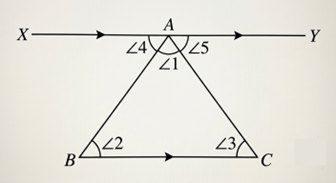
Proof:
| Statements | Reasons |
|---|---|
| \(m\angle 4 + m\angle 1 + m\angle 5 = 180^\circ\) | Angles on a straight line |
| \(m\angle 4 = m\angle 2\) | Alternate interior angles (since \(XY \parallel BC\)) |
| \(m\angle 5 = m\angle 3\) | Alternate interior angles (since \(XY \parallel BC\)) |
| \(m\angle 2 + m\angle 1 + m\angle 3 = 180^\circ\) | Substituting (ii) and (iii) into (i) |
✅ Therefore, \(m\angle 1 + m\angle 2 + m\angle 3 = 180^\circ\).
Q16
If \(a\), \(b\) and \(c\) are non-zero real numbers, prove that:
(i) \(\frac{a}{b} = \frac{c}{d} \Leftrightarrow ad = bc\)
(ii) \(\frac{a}{b} \cdot \frac{c}{d} = \frac{ac}{bd}\)
(iii) \(\frac{a}{b} + \frac{c}{b} = \frac{a+c}{b}\)
Solution
(i) Prove that \(\frac{a}{b} = \frac{c}{d} \Leftrightarrow ad = bc\)
\(\frac{a}{b} = \frac{c}{d}\)
\(\left(\frac{a}{b}\right) \cdot (bd) = \left(\frac{c}{d}\right) \cdot (bd)\)
\(\left(\frac{b}{b}\right) \cdot (ad) = \left(\frac{d}{d}\right) \cdot (bc)\)
\(1 \cdot (ad) = 1 \cdot (bc)\)
\(ad = bc\)
(ii) Prove that \(\frac{a}{b} \cdot \frac{c}{d} = \frac{ac}{bd}\)
\(L.H.S = \frac{a}{b} \cdot \frac{c}{d}\)
\(= \left(a \cdot \frac{1}{b}\right) \cdot \left(c \cdot \frac{1}{d}\right)\)
\(= (a \cdot c) \cdot \left(\frac{1}{b} \cdot \frac{1}{d}\right)\)
\(= (ac) \cdot \left(\frac{1}{bd}\right)\)
\(= \frac{ac}{bd}\)
\(= R.H.S\)
(iii) Prove that \(\frac{a}{b} + \frac{c}{b} = \frac{a+c}{b}\)
\(L.H.S = \frac{a}{b} + \frac{c}{b}\)
\(= \left(a \cdot \frac{1}{b}\right) + \left(c \cdot \frac{1}{b}\right)\)
\(= (a + c) \cdot \frac{1}{b}\)
\(= \frac{a + c}{b}\)
\(= R.H.S\)
Key Concepts – Logic
- Logic: Systematic method of reasoning to interpret truth and deduce new information.
- Inductive Reasoning: General conclusion from repeated observations.
- Deductive Reasoning: Conclusion from known facts/premises.
- Statement: Sentence that is true or false (not both).
- Negation (~p): Opposite truth value of p.
- Conjunction (p∧q): True only if both true.
- Disjunction (p∨q): True if at least one true.
- Conditional (p→q): False only when p true & q false.
- Axiom/Postulate: Statement accepted without proof.
- Theorem: Statement proven using axioms/logic.
- Conjecture: Believed true but unproven (e.g., Goldbach's).
💡 Exam Tip:
In logic questions, always pay attention to the exact wording. The contrapositive of a true conditional is always true, but the converse and inverse are not necessarily true. When constructing truth tables, be systematic: list all combinations of truth values for p and q, then evaluate the compound expression step by step. For proofs involving odd and even integers, start by expressing the integer in the form 2k+1 (odd) or 2k (even), then substitute and simplify to reach the required form.
❓ Frequently Asked Questions – Review Exercise
The review exercise covers all key concepts of logic, including inductive and deductive reasoning, statements and their negations, conjunction and disjunction, truth tables, conditionals and their contrapositives, axioms, conjectures, theorems, and algebraic proofs.
The complete PDF is embedded near the top of this page and can also be downloaded with the "⬇️ Download PDF – Review Exercise Solutions (Free)" button directly below the PDF viewer.
The multiple-choice questions (MCQs) are available on a separate page. You can access them via the Chapter 8 MCQs page or through the quick links section on this page.
An axiom is a statement accepted as true without proof, serving as a starting point for reasoning. A theorem is a statement that has been proven true using axioms, definitions, and logical steps.
The contrapositive of \(p \rightarrow q\) is \(\sim q \rightarrow \sim p\). A conditional and its contrapositive are logically equivalent, meaning if one is true, the other is also true.
Use the Chapter 8 quick links on this page for Definitions and MCQs, or return to the Chapter 8 hub page for the full list.
Chapter 1Real Numbers
Chapter 2Logarithms
Chapter 3Sets and Functions
Chapter 4Factorization and Algebraic Manipulation
Chapter 5Linear Equations and Inequalities
Chapter 6Trigonometry
Chapter 7Coordinate Geometry
Chapter 8✨ Logic
Chapter 9Similar Figures
Chapter 10Graphs of Functions
Chapter 11Loci and Construction
Chapter 12Information Handling
Chapter 13Probability
📖 Complete syllabus coverage for Class 9 Mathematics – Chapters 1 to 13
Created by Hira Science Academy | Aligned with Punjab Board Class 9 Mathematics