Study tip: This page is one exercise of Chapter 7: Coordinate Geometry. Read the Chapter 7 definitions first if you need the formulas, then practise with the Chapter 7 MCQs.
✅ Worked solutions ready
All exercise questions are worked below in the same order as the textbook. Use the Show Solution button on each card to reveal the step-by-step working, then cross-check with the PDF embedded further down. Fully solved Exercise 7.2 is also available on this site.
📘 Exercise 7.1 – Solved
Learn and practise Class 9 Maths Exercise 7.1 Solutions on Coordinate Geometry with complete worked solutions. This page covers the distance formula, midpoint formula, collinearity conditions, and geometric proofs using coordinates. Aligned with the Punjab Curriculum and Textbook Board Class 9 Mathematics unit on Coordinate Geometry.
📖 What's Inside: This exercise covers the distance between two points, the midpoint of a line segment, collinearity of three points, finding the center and radius of a circle given the diameter, and proving geometric properties (right triangle, isosceles triangle, parallelogram) using coordinates. Each question is worked step by step in the same order as the textbook exercise.
If the PDF does not load, open Exercise 7.1 directly on Google Drive.
Advertisement
🔗 Quick Links – Chapter 7: Coordinate Geometry
Important Revision Points
- Distance Formula: \(d = \sqrt{(x_2 - x_1)^2 + (y_2 - y_1)^2}\).
- Midpoint Formula: \(M = \left( \dfrac{x_1 + x_2}{2}, \dfrac{y_1 + y_2}{2} \right)\).
- Collinear Points: Points lie on the same straight line; the sum of distances of two segments equals the third, or the slopes are equal.
- Right Triangle: Check if the Pythagorean theorem holds (\(a^2 + b^2 = c^2\)).
- Isosceles Triangle: Check if two sides have equal length.
- Parallelogram: Check if the diagonals bisect each other (i.e., have the same midpoint).
- Circle: Center is the midpoint of the diameter; radius is half the diameter's length.
📐 Exercise 7.1 – Questions & Solutions
Q1
Describe the location in the plane of the point \(P(x,y)\), for which:
(i) \(x > 0\)
(ii) \(x > 0\) and \(y > 0\)
(iii) \(x = 0\)
(iv) \(y = 0\)
(v) \(x > 0\) and \(y \leq 0\)
(vi) \(y = 0, x = 0\)
(vii) \(x = y\)
(viii) \(x \geq 3\)
(ix) \(y > 0\)
(x) \(x\) and \(y\) have opposite signs
Solution
(i) The open right half of the Cartesian plane.
(ii) First quadrant, excluding the axes.
(iii) All points on the \(y\)-axis.
(iv) All points on the \(x\)-axis.
(v) The Fourth Quadrant and the positive \(x\)-axis.
(vi) The Origin \((0,0)\).
(vii) The straight line through the origin with slope 1 (bisects the first and third quadrants).
(viii) All points on or to the right of the vertical line \(x = 3\).
(ix) The set of all points lying above the \(x\)-axis.
(x) The set of points in the \(2^{\text{nd}}\) and \(4^{\text{th}}\) quadrants.
Q2
Find the distance between the points:
(i) \(A(6,7)\), \(B(0,-2)\)
(ii) \(C(-5,-2)\), \(D(3,2)\)
(iii) \(L(0,3)\), \(M(-2,-4)\)
(iv) \(P(-8,-7)\), \(Q(0,0)\)
Solution
(i) \(A(6,7)\), \(B(0,-2)\)
\(|AB| = \sqrt{(x_2 - x_1)^2 + (y_2 - y_1)^2}\)
\(= \sqrt{(0 - 6)^2 + (-2 - 7)^2}\)
\(= \sqrt{(-6)^2 + (-9)^2}\)
\(= \sqrt{36 + 81}\)
\(= \sqrt{117} = 3\sqrt{13}\)
(ii) \(C(-5,-2)\), \(D(3,2)\)
\(|CD| = \sqrt{(x_2 - x_1)^2 + (y_2 - y_1)^2}\)
\(= \sqrt{(3 - (-5))^2 + (2 - (-2))^2}\)
\(= \sqrt{(8)^2 + (4)^2}\)
\(= \sqrt{64 + 16}\)
\(= \sqrt{80} = 4\sqrt{5}\)
(iii) \(L(0,3)\), \(M(-2,-4)\)
\(|LM| = \sqrt{(x_2 - x_1)^2 + (y_2 - y_1)^2}\)
\(= \sqrt{(-2 - 0)^2 + (-4 - 3)^2}\)
\(= \sqrt{(-2)^2 + (-7)^2}\)
\(= \sqrt{4 + 49}\)
\(= \sqrt{53}\)
(iv) \(P(-8,-7)\), \(Q(0,0)\)
\(|PQ| = \sqrt{(x_2 - x_1)^2 + (y_2 - y_1)^2}\)
\(= \sqrt{(0 - (-8))^2 + (0 - (-7))^2}\)
\(= \sqrt{(8)^2 + (7)^2}\)
\(= \sqrt{64 + 49}\)
\(= \sqrt{113}\)
✅ (i) \(3\sqrt{13}\) (ii) \(4\sqrt{5}\) (iii) \(\sqrt{53}\) (iv) \(\sqrt{113}\)
Q3
Find in each of the following:
(i) The distance between the two given points
(ii) Midpoint of the line segment joining the two points:
(a) \(A(3,1)\), \(B(-2,-4)\)
(b) \(A(-8,3)\), \(B(2,-1)\)
(c) \(A(-\sqrt{5},-\frac{1}{3})\), \(B(-3\sqrt{5},5)\)
Solution
(a) \(A(3,1)\), \(B(-2,-4)\)
(i) Distance:
\(|AB| = \sqrt{(-2 - 3)^2 + (-4 - 1)^2}\)
\(= \sqrt{(-5)^2 + (-5)^2}\)
\(= \sqrt{25 + 25} = \sqrt{50} = 5\sqrt{2}\)
(ii) Midpoint:
\(M = \left(\dfrac{3 + (-2)}{2}, \dfrac{1 + (-4)}{2}\right)\)
\(= \left(\dfrac{1}{2}, -\dfrac{3}{2}\right)\)
(b) \(A(-8,3)\), \(B(2,-1)\)
(i) Distance:
\(|AB| = \sqrt{(2 - (-8))^2 + (-1 - 3)^2}\)
\(= \sqrt{(10)^2 + (-4)^2}\)
\(= \sqrt{100 + 16} = \sqrt{116} = 2\sqrt{29}\)
(ii) Midpoint:
\(M = \left(\dfrac{-8 + 2}{2}, \dfrac{3 + (-1)}{2}\right)\)
\(= \left(\dfrac{-6}{2}, \dfrac{2}{2}\right) = (-3, 1)\)
(c) \(A(-\sqrt{5},-\frac{1}{3})\), \(B(-3\sqrt{5},5)\)
(i) Distance:
\(|AB| = \sqrt{(-3\sqrt{5} - (-\sqrt{5}))^2 + (5 - (-\frac{1}{3}))^2}\)
\(= \sqrt{(-2\sqrt{5})^2 + (\frac{16}{3})^2}\)
\(= \sqrt{20 + \frac{256}{9}} = \sqrt{\frac{436}{9}} = \frac{2\sqrt{109}}{3}\)
(ii) Midpoint:
\(M = \left(\dfrac{-\sqrt{5} + (-3\sqrt{5})}{2}, \dfrac{-\frac{1}{3} + 5}{2}\right)\)
\(= \left(\dfrac{-4\sqrt{5}}{2}, \dfrac{\frac{14}{3}}{2}\right) = \left(-2\sqrt{5}, \dfrac{7}{3}\right)\)
✅ (a) \(5\sqrt{2}\), \((\frac{1}{2}, -\frac{3}{2})\) | (b) \(2\sqrt{29}\), \((-3, 1)\) | (c) \(\frac{2\sqrt{109}}{3}\), \((-2\sqrt{5}, \frac{7}{3})\)
Q4
Which of the following points are at a distance of 15 units from the origin?
(i) \((\sqrt{176},7)\)
(ii) \((10,-10)\)
(iii) \((1,15)\)
Solution
(i) \((\sqrt{176},7)\)
\(d = \sqrt{(0 - \sqrt{176})^2 + (0 - 7)^2}\)
\(= \sqrt{176 + 49} = \sqrt{225} = 15\)
So, \((\sqrt{176},7)\) is at 15 units from the origin.
(ii) \((10,-10)\)
\(d = \sqrt{(0 - 10)^2 + (0 - (-10))^2}\)
\(= \sqrt{100 + 100} = \sqrt{200} = 10\sqrt{2}\)
So, \((10,-10)\) is not at 15 units from the origin.
(iii) \((1,15)\)
\(d = \sqrt{(0 - 1)^2 + (0 - 15)^2}\)
\(= \sqrt{1 + 225} = \sqrt{226}\)
So, \((1,15)\) is not at 15 units from the origin.
✅ Only \((\sqrt{176},7)\) is at 15 units from the origin.
Q5
Show that:
(i) the points \(A(0,2)\), \(B(\sqrt{3},1)\) and \(C(0,-2)\) are vertices of a right triangle.
(ii) the points \(A(3,1)\), \(B(-2,-3)\) and \(C(2,2)\) are vertices of an isosceles triangle.
(iii) the points \(A(5,2)\), \(B(-2,3)\), \(C(-3,-4)\) and \(D(4,-5)\) are vertices of a parallelogram.
Solution
(i) \(A(0,2)\), \(B(\sqrt{3},1)\), \(C(0,-2)\) — Right Triangle
\(|\overline{AB}|^2 = (\sqrt{3} - 0)^2 + (1 - 2)^2 = 3 + 1 = 4\)
\(|\overline{BC}|^2 = (0 - \sqrt{3})^2 + (-2 - 1)^2 = 3 + 9 = 12\)
\(|\overline{AC}|^2 = (0 - 0)^2 + (-2 - 2)^2 = 0 + 16 = 16\)
As \(|\overline{AB}|^2 + |\overline{BC}|^2 = 4 + 12 = 16 = |\overline{AC}|^2\), the Pythagorean theorem is verified.
Hence, \(A, B, C\) are vertices of a right triangle.
(ii) \(A(3,1)\), \(B(-2,-3)\), \(C(2,2)\) — Isosceles Triangle
\(|\overline{AB}| = \sqrt{(-2 - 3)^2 + (-3 - 1)^2} = \sqrt{25 + 16} = \sqrt{41}\)
\(|\overline{BC}| = \sqrt{(2 - (-2))^2 + (2 - (-3))^2} = \sqrt{16 + 25} = \sqrt{41}\)
\(|\overline{AC}| = \sqrt{(2 - 3)^2 + (2 - 1)^2} = \sqrt{1 + 1} = \sqrt{2}\)
Since \(|\overline{AB}| = |\overline{BC}|\), \(A, B, C\) are vertices of an isosceles triangle.
(iii) \(A(5,2)\), \(B(-2,3)\), \(C(-3,-4)\), \(D(4,-5)\) — Parallelogram
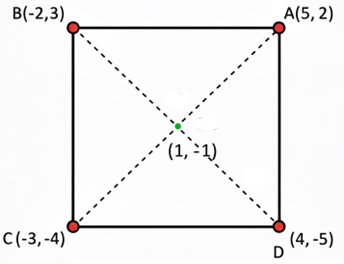
Let \(M_1\) be the midpoint of diagonal \(AC\):
\(M_1 = \left(\dfrac{5 + (-3)}{2}, \dfrac{2 + (-4)}{2}\right) = (1, -1)\)
Let \(M_2\) be the midpoint of diagonal \(BD\):
\(M_2 = \left(\dfrac{-2 + 4}{2}, \dfrac{3 + (-5)}{2}\right) = (1, -1)\)
Since \(M_1 = M_2\), the diagonals bisect each other.
Hence, \(ABCD\) is a parallelogram.
✅ All three statements are verified.
Q6
Find \(h\) such that \(A(-1,h)\), \(B(3,2)\) and \(C(7,3)\) are collinear.
Solution
Slope of \(AB\):
\(m_1 = \dfrac{y_2 - y_1}{x_2 - x_1} = \dfrac{2 - h}{3 - (-1)} = \dfrac{2 - h}{4}\)
Slope of \(BC\):
\(m_2 = \dfrac{y_2 - y_1}{x_2 - x_1} = \dfrac{3 - 2}{7 - 3} = \dfrac{1}{4}\)
Since \(A, B, C\) are collinear, \(m_1 = m_2\):
\(\dfrac{2 - h}{4} = \dfrac{1}{4}\)
\(2 - h = 1\)
\(h = 1\)
✅ \(h = 1\)
Q7
The points \(A(-5,-2)\) and \(B(5,-4)\) are ends of a diameter of a circle. Find the centre and radius of the circle.
Solution
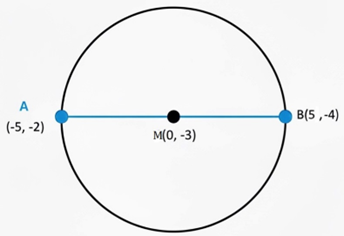
Let the center be \(M(x,y)\) and the radius be \(|\overline{MB}|\).
Using the midpoint formula:
\(M = \left(\dfrac{-5 + 5}{2}, \dfrac{-4 + (-2)}{2}\right)\)
\(= \left(\dfrac{0}{2}, \dfrac{-6}{2}\right) = (0, -3)\)
Using the distance formula for the radius:
\(|\overline{MB}| = \sqrt{(5 - 0)^2 + (-4 - (-3))^2}\)
\(= \sqrt{(5)^2 + (-1)^2}\)
\(= \sqrt{25 + 1} = \sqrt{26}\)
✅ Center = \((0, -3)\), Radius = \(\sqrt{26}\)
Key Concepts – Coordinate Geometry
- Distance Formula: \(d = \sqrt{(x_2 - x_1)^2 + (y_2 - y_1)^2}\).
- Midpoint Formula: \(M = \left( \dfrac{x_1 + x_2}{2}, \dfrac{y_1 + y_2}{2} \right)\).
- Collinear Points: Points lie on the same straight line; the sum of distances of two segments equals the third, or the slopes are equal.
- Right Triangle: Check if the Pythagorean theorem holds (\(a^2 + b^2 = c^2\)).
- Isosceles Triangle: Check if two sides have equal length.
- Parallelogram: Check if the diagonals bisect each other (i.e., have the same midpoint).
- Circle: Center is the midpoint of the diameter; radius is half the diameter's length.
💡 Exam Tip:
For distance and midpoint problems, always write the formula first, then substitute the coordinates carefully. When proving a geometric property (right triangle, isosceles, parallelogram), calculate all necessary side lengths or midpoints systematically. For collinearity, you can either use the slope method or the distance method (sum of two smaller distances = largest distance). Be careful with signs, especially when subtracting negative coordinates.
❓ Frequently Asked Questions – Exercise 7.1
Exercise 7.1 covers the distance formula, the midpoint formula, collinearity of three points, finding the center and radius of a circle given the endpoints of a diameter, and proving geometric properties (right triangle, isosceles triangle, parallelogram) using coordinates.
The complete PDF is embedded near the top of this page and can also be downloaded with the "⬇️ Download PDF – Exercise 7.1 Solutions (Free)" button directly below the PDF viewer.
The distance formula is \(d = \sqrt{(x_2 - x_1)^2 + (y_2 - y_1)^2}\), which calculates the straight-line distance between two points \((x_1, y_1)\) and \((x_2, y_2)\) on the Cartesian plane.
The midpoint is found using the formula \(M = \left( \dfrac{x_1 + x_2}{2}, \dfrac{y_1 + y_2}{2} \right)\), which gives the point exactly halfway between the two endpoints.
Three points are collinear if the slopes of the segments connecting them are equal, or if the sum of the distances between two pairs of points equals the distance between the remaining pair.
Use the Chapter 7 quick links on this page for Exercise 7.2, 7.3, the Review Exercise, Definitions and MCQs, or return to the Chapter 7 hub page for the full list.
Chapter 1Real Numbers
Chapter 2Logarithms
Chapter 3Sets and Functions
Chapter 4Factorization and Algebraic Manipulation
Chapter 5Linear Equations and Inequalities
Chapter 6Trigonometry
Chapter 7✨ Coordinate Geometry
Chapter 8Logic
Chapter 9Similar Figures
Chapter 10Graphs of Functions
Chapter 11Loci and Construction
Chapter 12Information Handling
Chapter 13Probability
📖 Complete syllabus coverage for Class 9 Mathematics – Chapters 1 to 13
Created by Hira Science Academy | Aligned with Punjab Board Class 9 Mathematics