Study tip: This page is one exercise of Chapter 9: Similar Figures. Read the Chapter 9 definitions first if you need the formulas, then practise with the Chapter 9 MCQs.
✅ Worked solutions ready
All six exercise questions are worked below in the same order as the textbook. Use the Show Solution button on each card to reveal the step-by-step working, then cross-check with the PDF embedded further down. Fully solved Exercise 9.2 is also available on this site.
📘 Exercise 9.3 – Solved
Learn and practise Class 9 Maths Exercise 9.3 Solutions on Similar Figures with complete worked solutions. This page covers the ratio of volumes of similar solids, finding missing volumes given side or height ratios, working backwards from volume ratios to find a side, height, base area or radius, and surface-area ratios of similar cans and tanks. Aligned with the Punjab Curriculum and Textbook Board Class 9 Mathematics unit on Similar Figures.
📖 What's Inside: Six exercises covering volume ratios of similar spheres and tetrahedrons, cube roots of volume ratios to find side lengths, finding a missing volume from a length ratio, finding a missing radius from a volume ratio, and surface area and volume of similar cans and water tanks. Each question is worked step by step in the same order as the textbook exercise.
If the PDF does not load, open Exercise 9.3 directly on Google Drive.
Advertisement
🔗 Quick Links – Chapter 9: Similar Figures
Important Revision Points
- Volume ratio of similar solids: \(\dfrac{V_1}{V_2} = \left(\dfrac{l_1}{l_2}\right)^3 = k^3\).
- Scale factor from volume ratio: \(k = \sqrt[3]{\dfrac{V_1}{V_2}}\).
- Surface area ratio: \(\dfrac{A_1}{A_2} = k^2\).
- Scale factor from area ratio: \(k = \sqrt{\dfrac{A_1}{A_2}}\).
- Combining: if the area ratio is known, find \(k\) first, then use \(k^3\) for the volume ratio.
- Units: volumes are in cubic units (cm³, m³); areas in square units (cm², m²).
📐 Exercise 9.3 – Questions & Solutions
Q1
The radii of two spheres are in the ratio \(3 : 4\). What is the ratio of their volumes?
Solution
Given:
\(r_1 : r_2 = 3 : 4,\quad V_1 : V_2 = ?\)
Since spheres are similar:
\(\dfrac{V_1}{V_2} = \left(\dfrac{r_1}{r_2}\right)^3 = \left(\dfrac{3}{4}\right)^3 = \dfrac{27}{64}\)
\(V_1 : V_2 = 27 : 64\)
✅ \(V_1 : V_2 = 27 : 64\)
Q2
Two regular tetrahedrons have volumes in the ratio \(8 : 27\). What is the ratio of their sides?
Solution
Given:
\(V_1 : V_2 = 8 : 27,\quad l_1 : l_2 = ?\)
Since tetrahedrons are similar:
\(\dfrac{V_1}{V_2} = \left(\dfrac{l_1}{l_2}\right)^3\)
\(\left(\dfrac{l_1}{l_2}\right)^3 = \dfrac{8}{27}\)
\(\dfrac{l_1}{l_2} = \sqrt[3]{\dfrac{8}{27}} = \dfrac{2}{3}\)
\(l_1 : l_2 = 2 : 3\)
✅ \(l_1 : l_2 = 2 : 3\)
Q3
Two right cones have volumes in the ratio \(64 : 125\). Find the ratio of (i) their heights, and (ii) their base areas.
Solution
Given:
\(V_1 : V_2 = 64 : 125\)
(i) Ratio of heights
Since cones are similar:
\(\dfrac{V_1}{V_2} = \left(\dfrac{h_1}{h_2}\right)^3\)
\(\left(\dfrac{h_1}{h_2}\right)^3 = \dfrac{64}{125}\)
\(\dfrac{h_1}{h_2} = \sqrt[3]{\dfrac{64}{125}} = \dfrac{4}{5}\)
\(h_1 : h_2 = 4 : 5\)
(ii) Ratio of base areas
By using the area formula for similar figures:
\(\dfrac{A_1}{A_2} = \left(\dfrac{h_1}{h_2}\right)^2\)
\(\dfrac{A_1}{A_2} = \left(\dfrac{4}{5}\right)^2 = \dfrac{16}{25}\)
\(A_1 : A_2 = 16 : 25\)
✅ (i) \(h_1 : h_2 = 4 : 5\) (ii) \(A_1 : A_2 = 16 : 25\)
Q4
Find the missing value in the following similar solids.
Solution
(i) Similar pyramids
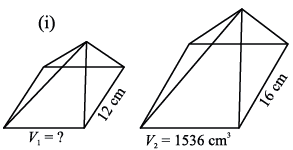
From the figure:
\(l_1 = 12\text{ cm},\quad l_2 = 16\text{ cm},\quad V_2 = 1536\text{ cm}^3,\quad V_1 = ?\)
Since given figures are similar:
\(\dfrac{V_1}{V_2} = \left(\dfrac{l_1}{l_2}\right)^3\)
\(\dfrac{V_1}{1536} = \left(\dfrac{12}{16}\right)^3 = \dfrac{1728}{4096}\)
\(V_1 = \dfrac{1728}{4096} \times 1536 = 648\text{ cm}^3\)
(ii) Similar cylinders
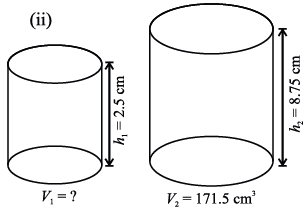
From the figure:
\(h_1 = 2.5\text{ cm},\quad h_2 = 8.75\text{ cm},\quad V_2 = 171.5\text{ cm}^3,\quad V_1 = ?\)
Since given figures are similar:
\(\dfrac{V_1}{V_2} = \left(\dfrac{h_1}{h_2}\right)^3\)
\(\dfrac{V_1}{171.5} = \left(\dfrac{2.5}{8.75}\right)^3 = \dfrac{15.625}{669.82}\)
\(V_1 = \dfrac{15.625}{669.82} \times 171.5 \approx 4.00\text{ cm}^3\)
(iii) Similar cuboids
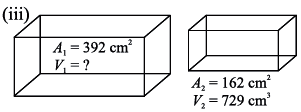
From the figure:
\(A_1 = 392\text{ cm}^2,\quad A_2 = 162\text{ cm}^2,\quad V_2 = 729\text{ cm}^3,\quad V_1 = ?\)
Since given figures are similar:
\(\dfrac{A_1}{A_2} = k^2\)
\(k^2 = \dfrac{392}{162} = \dfrac{196}{81}\)
\(k = \sqrt{\dfrac{196}{81}} = \dfrac{14}{9}\)
Now using the volume ratio:
\(\dfrac{V_1}{V_2} = k^3\)
\(\dfrac{V_1}{729} = \left(\dfrac{14}{9}\right)^3 = \dfrac{2744}{729}\)
\(V_1 = \dfrac{2744}{729} \times 729 = 2744\text{ cm}^3\)
(iv) Similar spheres
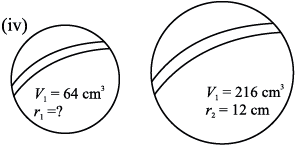
From the figure:
\(V_1 = 64\text{ cm}^3,\quad V_2 = 216\text{ cm}^3,\quad r_2 = 12\text{ cm},\quad r_1 = ?\)
Since given figures are similar:
\(\dfrac{V_1}{V_2} = \left(\dfrac{r_1}{r_2}\right)^3\)
\(\dfrac{64}{216} = \left(\dfrac{r_1}{12}\right)^3\)
\(\dfrac{2}{3} = \dfrac{r_1}{12}\)
\(r_1 = \dfrac{2}{3} \times 12 = 8\text{ cm}\)
✅ (i) \(V_1 = 648\text{ cm}^3\) (ii) \(V_1 \approx 4.00\text{ cm}^3\) (iii) \(V_1 = 2744\text{ cm}^3\) (iv) \(r_1 = 8\text{ cm}\)
Q5
The ratio of the corresponding lengths of two similar canonical cans is \(3 : 2\).
(i) The larger can has a surface area of \(96\text{ m}^2\). Find the surface area of the smaller can.
(ii) The smaller can has volume \(240\text{ m}^3\). Find the volume of the larger can.
Solution
Given:
\(l_1 : l_2 = 3 : 2\)
(i) Surface area of smaller can
\(A_1 = 96\text{ m}^2,\quad A_2 = ?\)
\(\dfrac{A_1}{A_2} = \left(\dfrac{l_1}{l_2}\right)^2\)
\(\dfrac{96}{A_2} = \left(\dfrac{3}{2}\right)^2 = \dfrac{9}{4}\)
\((96)(4) = (9)(A_2)\)
\(A_2 = \dfrac{384}{9} \approx 42.67\text{ m}^2\)
(ii) Volume of larger can
\(V_2 = 240\text{ m}^3,\quad V_1 = ?\)
\(\dfrac{V_1}{V_2} = \left(\dfrac{l_1}{l_2}\right)^3\)
\(\dfrac{V_1}{240} = \left(\dfrac{3}{2}\right)^3 = \dfrac{27}{8}\)
\(V_1 = \dfrac{27}{8} \times 240 = 810\text{ m}^3\)
✅ (i) \(A_2 \approx 42.67\text{ m}^2\) (ii) \(V_1 = 810\text{ m}^3\)
Q6
The ratio of the heights of two similar cylindrical water tanks is \(5 : 3\).
(i) If the surface area of the larger tank is \(250\text{ m}^2\), find the surface area of the smaller tank.
(ii) If the volume of the smaller tank is \(270\text{ m}^3\), find the volume of the larger tank.
Solution
Given:
\(h_1 : h_2 = 5 : 3\)
(i) Surface area of smaller tank
\(A_1 = 250\text{ m}^2,\quad A_2 = ?\)
\(\dfrac{A_1}{A_2} = \left(\dfrac{h_1}{h_2}\right)^2\)
\(\dfrac{250}{A_2} = \left(\dfrac{5}{3}\right)^2 = \dfrac{25}{9}\)
\((250)(9) = (25)(A_2)\)
\(A_2 = \dfrac{2250}{25} = 90\text{ m}^2\)
(ii) Volume of larger tank
\(V_2 = 270\text{ m}^3,\quad V_1 = ?\)
\(\dfrac{V_1}{V_2} = \left(\dfrac{h_1}{h_2}\right)^3\)
\(\dfrac{V_1}{270} = \left(\dfrac{5}{3}\right)^3 = \dfrac{125}{27}\)
\(V_1 = \dfrac{125}{27} \times 270 = 1250\text{ m}^3\)
✅ (i) \(A_2 = 90\text{ m}^2\) (ii) \(V_1 = 1250\text{ m}^3\)
💡 Exam Tip:
The volume ratio of similar solids is the cube of the length ratio; the area ratio is the square. If a question gives you the areas and asks for a volume, first find the length ratio \(k\) (by taking the square root of the area ratio), then cube it. If a question gives you the volumes and asks for a side, take the cube root of the volume ratio. For the "find the missing value" problems, write the formula first, then plug in — this makes partial credit easy to earn even if arithmetic slips.
❓ Frequently Asked Questions – Exercise 9.3
Exercise 9.3 covers the ratio of volumes of similar solids, finding missing volumes given side or height ratios, working backwards from volume ratios to find a side, height, base area or radius, and surface-area ratios of similar cans and tanks.
The complete PDF is embedded near the top of this page and can also be downloaded with the "⬇️ Download PDF – Exercise 9.3 Solutions (Free)" button directly below the PDF viewer.
If two solids are similar with a scale factor \(k\) (the ratio of corresponding lengths), then the ratio of their volumes is \(k^3\). The formula is \(\dfrac{V_1}{V_2} = \left(\dfrac{l_1}{l_2}\right)^3\).
Take the cube root of the volume ratio. If \(V_1 : V_2 = 8 : 27\), then \(l_1 : l_2 = \sqrt[3]{8} : \sqrt[3]{27} = 2 : 3\).
Use the Chapter 9 quick links on this page for Exercise 9.1, 9.2, 9.4, the Review Exercise, Definitions and MCQs, or return to the Chapter 9 hub page for the full list.
Chapter 1Real Numbers
Chapter 2Logarithms
Chapter 3Sets and Functions
Chapter 4Factorization and Algebraic Manipulation
Chapter 5Linear Equations and Inequalities
Chapter 6Trigonometry
Chapter 7Coordinate Geometry
Chapter 8Logic
Chapter 9✨ Similar Figures
Chapter 10Graphs of Functions
Chapter 11Loci and Construction
Chapter 12Information Handling
Chapter 13Probability
📖 Complete syllabus coverage for Class 9 Mathematics – Chapters 1 to 13
Created by Hira Science Academy | Aligned with Punjab Board Class 9 Mathematics