📘 Exercise 3.3 – Solved
Study the solved questions for Class 9 Mathematics Exercise 3.3 on Sets and Functions. This page provides step-by-step working for relations, domain and range, function identification from diagrams, function evaluation, and solving for unknown constants. The embedded PDF notes remain available below.
📖 What's Inside: This section covers all solved questions from Exercise 3.3 including relations on A × A with their domain and range, identifying functions and their types from arrow diagrams (into, onto, bijective), function evaluation at integer and fractional inputs, and solving systems of equations to find unknown constants in linear functions. Each problem is presented with clear, step-by-step mathematical working following the official Punjab Curriculum and Textbook Board (PECTAA) method. Perfect for Punjab Boards (Lahore, Gujranwala, Multan, etc.) and all BISE boards across Pakistan.
If the PDF does not load, click here to view it directly on Google Drive.
🔗 Quick Links – Chapter 3: Sets and Functions
📐 Exercise 3.3 – Questions & Solutions
Q1
For \(A = \{1, 2, 3, 4\}\), find the following relations in \(A\). State the domain and range of each relation.
(i) \(\{(x, y) \mid y = x\}\) (ii) \(\{(x, y) \mid y + x = 5\}\) (iii) \(\{(x, y) \mid x + y < 5\}\) (iv) \(\{(x, y) \mid x + y > 5\}\)
Solution
\(A \times A = \{(1,1),(1,2),(1,3),(1,4),(2,1),(2,2),(2,3),(2,4),(3,1),(3,2),(3,3),(3,4),(4,1),(4,2),(4,3),(4,4)\}\)
(i) \(\{(x, y) \mid y = x\}\)
\(R_{1} = \{(1,1),(2,2),(3,3),(4,4)\}\)
\(\text{Dom}(R_{1}) = \{1, 2, 3, 4\}\)
\(\text{Range}(R_{1}) = \{1, 2, 3, 4\}\)
(ii) \(\{(x, y) \mid y + x = 5\}\)
\(R_{2} = \{(1,4),(2,3),(3,2),(4,1)\}\)
\(\text{Dom}(R_{2}) = \{1, 2, 3, 4\}\)
\(\text{Range}(R_{2}) = \{1, 2, 3, 4\}\)
(iii) \(\{(x, y) \mid x + y < 5\}\)
\(R_{3} = \{(1,1),(1,2),(1,3),(2,1),(2,2),(3,1)\}\)
\(\text{Dom}(R_{3}) = \{1, 2, 3\}\)
\(\text{Range}(R_{3}) = \{1, 2, 3\}\)
(iv) \(\{(x, y) \mid x + y > 5\}\)
\(R_{4} = \{(2,4),(3,3),(3,4),(4,2),(4,3),(4,4)\}\)
\(\text{Dom}(R_{4}) = \{2, 3, 4\}\)
\(\text{Range}(R_{4}) = \{2, 3, 4\}\)
Q2
Which of the following diagrams represent functions, and of which type?
Solution
Given diagrams:
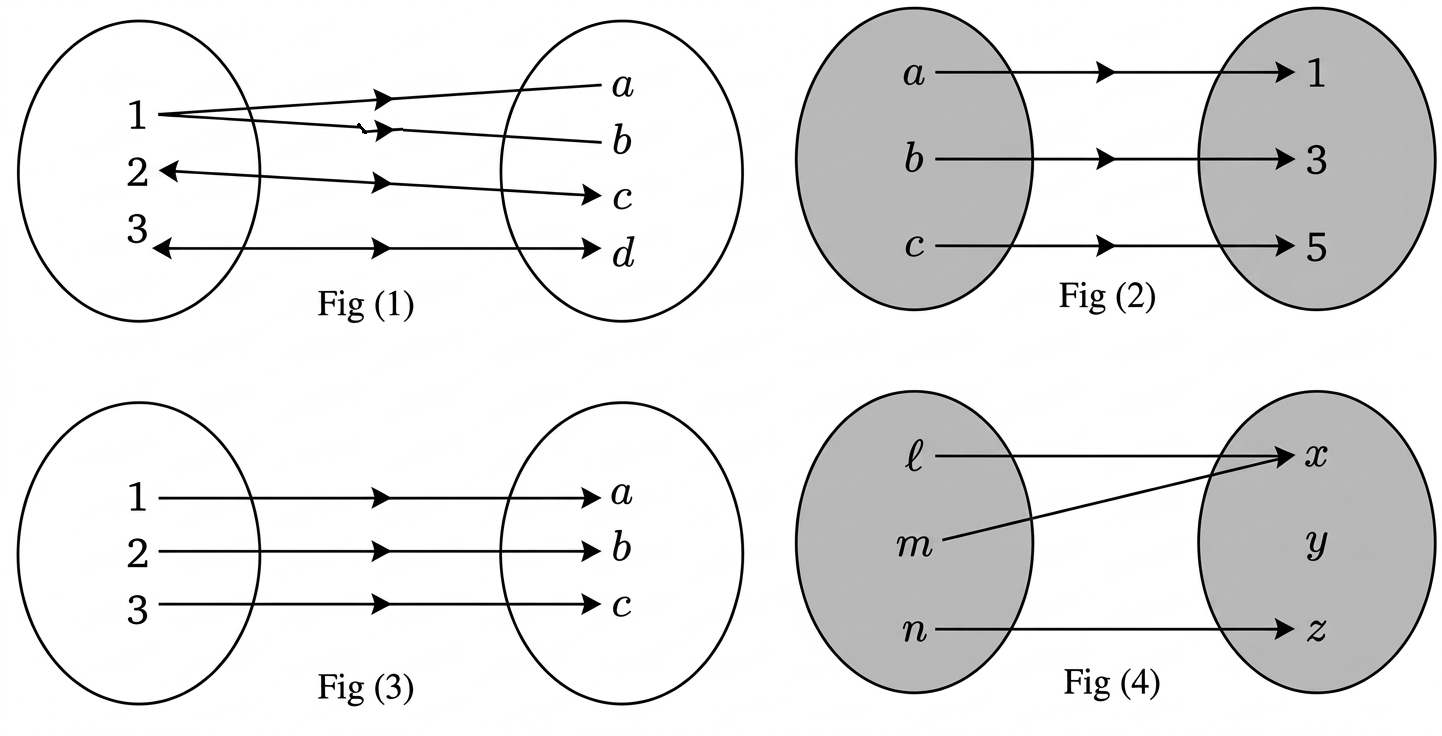
The four mapping diagrams for Q2.
Fig (1): The element \(1\) in the domain maps to both \(a\) and \(b\), so the domain repeats with different images.
✅ Fig (1) is not a function — the domain element \(1\) has two images.
Fig (2): Each of \(a, b, c\) maps to a distinct co-domain element \(1, 3, 5\), and every co-domain element is used.
✅ Fig (2) is a bijective function (one-to-one and onto).
Fig (3): \(1 \to a\), \(2 \to b\), \(3 \to c\) — each domain element has a unique image, and all co-domain elements are used.
✅ Fig (3) is a bijective function (one-to-one and onto).
Fig (4): \(\ell \to x\), \(m \to x\), \(n \to z\) — each domain element has a unique image, but \(y\) in the co-domain is unused.
✅ Fig (4) is an into function (not onto).
Additional note on the Q2 option (i) in the PDF: the ordered-pair set \(\{(1,a),(1,b),(2,c),(2,d),(3,d),(4,3)\}\) is not a function because the first coordinates \(1\) and \(2\) repeat with different images.
Q3
If \(g(x) = 3x + 2\) and \(h(x) = x^{2} + 1\), then find:
(i) \(g(0)\) (ii) \(g(-3)\) (iii) \(g\!\left(\tfrac{2}{3}\right)\) (iv) \(h(1)\) (v) \(h(-4)\) (vi) \(h\!\left(-\tfrac{1}{2}\right)\)
Solution
(i) \(g(0)\)
\(g(x) = 3x + 2\)
\(g(0) = 3(0) + 2 = 0 + 2 = 2\)
(ii) \(g(-3)\)
\(g(-3) = 3(-3) + 2 = -9 + 2 = -7\)
(iii) \(g\!\left(\tfrac{2}{3}\right)\)
\(g\!\left(\tfrac{2}{3}\right) = 3\!\left(\tfrac{2}{3}\right) + 2 = 2 + 2 = 4\)
(iv) \(h(1)\)
\(h(x) = x^{2} + 1\)
\(h(1) = (1)^{2} + 1 = 1 + 1 = 2\)
(v) \(h(-4)\)
\(h(-4) = (-4)^{2} + 1 = 16 + 1 = 17\)
(vi) \(h\!\left(-\tfrac{1}{2}\right)\)
\(h\!\left(-\tfrac{1}{2}\right) = \left(-\tfrac{1}{2}\right)^{2} + 1\)
\(= \tfrac{1}{4} + 1 = \tfrac{1 + 4}{4} = \tfrac{5}{4}\)
Q4
Given that \(f(x) = ax + b + 1\), where \(a\) and \(b\) are constant numbers. If \(f(3) = 8\) and \(f(6) = 14\), then find the values of \(a\) and \(b\).
Solution
\(f(x) = ax + b + 1\)
\(f(3) = a(3) + b + 1\)
\(8 = 3a + b + 1\)
\(7 = 3a + b \quad \dots (i)\)
Now using \(f(6) = 14\):
\(f(6) = a(6) + b + 1\)
\(14 = 6a + b + 1\)
\(13 = 6a + b \quad \dots (ii)\)
Subtract equation (i) from equation (ii):
\((6a + b) - (3a + b) = 13 - 7\)
\(3a = 6\)
\(a = 2\)
Put \(a = 2\) in equation (i):
\(7 = 3(2) + b\)
\(7 = 6 + b\)
\(b = 1\)
✅ \(a = 2\) and \(b = 1\)
Q5
Given that \(g(x) = ax + b + 5\), where \(a\) and \(b\) are constant numbers. If \(g(-1) = 0\) and \(g(2) = 10\), find the values of \(a\) and \(b\).
Solution
\(g(x) = ax + b + 5\)
\(g(-1) = a(-1) + b + 5\)
\(0 = -a + b + 5\)
\(a - b = 5 \quad \dots (i)\)
Now using \(g(2) = 10\):
\(g(2) = a(2) + b + 5\)
\(10 = 2a + b + 5\)
\(2a + b = 5 \quad \dots (ii)\)
Add equations (i) and (ii):
\((a - b) + (2a + b) = 5 + 5\)
\(3a = 10\)
\(a = \tfrac{10}{3}\)
Put \(a = \tfrac{10}{3}\) in equation (i):
\(\tfrac{10}{3} - b = 5\)
\(b = \tfrac{10}{3} - 5 = \tfrac{10 - 15}{3} = -\tfrac{5}{3}\)
✅ \(a = \tfrac{10}{3}\) and \(b = -\tfrac{5}{3}\)
💡 Exam Tip:
When identifying a function from a diagram, check two things: (1) every element in the domain must have exactly one arrow leaving it, and (2) note whether every co-domain element receives an arrow to classify as onto/surjective. For ordered-pair form, scan the first coordinates — if any first coordinate repeats with a different second coordinate, the relation is not a function. For evaluating functions, substitute the input directly and simplify step by step. For systems like \(f(x) = ax + b + 1\), always write two clean equations, eliminate one variable, then back-substitute.
❓ Frequently Asked Questions – Exercise 3.3
List the relation as ordered pairs, then take the set of all first elements as the domain and the set of all second elements as the range. For \(A = \{1, 2, 3, 4\}\):
\(R_{1} = \{(1,1),(2,2),(3,3),(4,4)\} \;\Rightarrow\; \text{Dom} = \{1,2,3,4\},\ \text{Range} = \{1,2,3,4\}\)
\(R_{2} = \{(1,4),(2,3),(3,2),(4,1)\} \;\Rightarrow\; \text{Dom} = \{1,2,3,4\},\ \text{Range} = \{1,2,3,4\}\)
A relation is a function if every domain element has exactly one image. In the Q2 diagrams:
Fig (1): not a function (\(1 \to a\) and \(1 \to b\))
Fig (2): bijective function (one-to-one and onto)
Fig (3): bijective function (one-to-one and onto)
Fig (4): into function (unique images, but \(y\) unused)
An into function maps the domain into a proper subset of the co-domain (some co-domain elements are never used). An onto (surjective) function uses every co-domain element. A bijective function is both one-to-one and onto (every domain element maps to a distinct co-domain element and every co-domain element is used).
In Q2, Fig (4) is into because \(y\) is unused; Fig (2) and Fig (3) are bijective.
Substitute the value for \(x\) directly into the formula and simplify:
\(g(0) = 3(0) + 2 = 2\)
\(g(-3) = 3(-3) + 2 = -7\)
\(g\!\left(\tfrac{2}{3}\right) = 3\!\left(\tfrac{2}{3}\right) + 2 = 4\)
\(h(1) = (1)^{2} + 1 = 2\)
\(h(-4) = (-4)^{2} + 1 = 17\)
\(h\!\left(-\tfrac{1}{2}\right) = \tfrac{1}{4} + 1 = \tfrac{5}{4}\)
Substitute each input to build two linear equations:
From \(f(3) = 8\): \(3a + b = 7\)
From \(f(6) = 14\): \(6a + b = 13\)
Subtract the first from the second to eliminate \(b\): \(3a = 6\), so \(a = 2\). Substitute \(a=2\) into \(3a+b=7\) to get \(6 + b = 7\), so \(b = 1\).
✅ \(a = 2\) and \(b = 1\)
The complete PDF for Class 9 Math Exercise 3.3 (Sets and Functions) is embedded on this page and can be downloaded free of cost using the “⬇️ Download PDF – Exercise 3.3 Solutions (Free)” button located directly above the FAQ section. The PDF contains the full set of solved questions including all relations, function evaluation, function diagrams, and systems of equations, prepared according to the PECTAA 2025 syllabus.
Chapter 1Real Numbers
Chapter 2Logarithms
Chapter 3✨ Sets and Functions
Chapter 4Factorization
Chapter 5Linear Equations and Inequalities
Chapter 6Trigonometry
Chapter 7Coordinate Geometry
Chapter 8Logic
Chapter 9Similar Figures
Chapter 10Graphs of Functions
Chapter 11Loci and Construction
Chapter 12Information Handling
Chapter 13Probability
📖 Complete syllabus coverage for Class 9 Mathematics – Chapters 1 to 13
Created by Hira Science Academy | Aligned with PECTAA Syllabus