📘 Review Exercise 3 – Solved
Master Class 9 Mathematics Review Exercise 3 on Sets and Functions with comprehensive revision problems. This page includes free downloadable notes and complete solutions aligned with the PECTAA 2025 syllabus.
📖 What's Inside: This comprehensive review exercise consolidates all key concepts of Chapter 3 including writing sets in tabular form, listing complements and set operations, verifying identities with Venn diagrams (De Morgan's Laws, \(A - B = A \cap B'\), etc.), using associativity and distributivity of union/intersection, evaluating functions at specific values, solving for unknown constants in linear/quadratic functions, and applying the inclusion-exclusion principle to real-world survey problems. Each problem is presented with clear, step-by-step mathematical working following the official Punjab Curriculum and Textbook Board (PECTAA) method.
If the PDF does not load, click here to view it directly on Google Drive.
🔗 Quick Links – Chapter 3: Sets and Functions
Important Revision Points
- Set operations: \(A \cup B\), \(A \cap B\), \(A - B\), \(A'\)
- De Morgan's Laws: \((A \cap B)' = A' \cup B'\) and \((A \cup B)' = A' \cap B'\)
- Distributivity: \(A \cap (B \cup C) = (A \cap B) \cup (A \cap C)\) and the dual
- Inclusion-Exclusion (3 sets): \(n(A \cup B \cup C) = n(A) + n(B) + n(C) - n(A \cap B) - n(B \cap C) - n(A \cap C) + n(A \cap B \cap C)\)
📐 Review Exercise 3 – Questions & Solutions
Q2
Write each of the following sets in tabular form:
(i) \(\{x \mid x = 2n, n \in \mathbb{N}\}\) (ii) \(\{x \mid x = 2m + 1, m \in \mathbb{N}\}\) (iii) \(\{x \mid x = 11n, n \in \mathbb{W} \wedge n < 11\}\) (iv) \(\{x \mid x \in E \wedge 4 < x < 6\}\) (v) \(\{x \mid x \in \mathbb{Q} \wedge 5 < x < 7\}\) (vi) \(\{x \mid x \in \mathbb{Q} \wedge x^{2} = 2\}\) (vii) \(\{x \mid x \in \mathbb{Q} \wedge x = -x\}\) (viii) \(\{x \mid x \in \mathbb{R} \wedge x \notin \mathbb{Q}\}\)
Solution
| Part | Set-Builder Form | Tabular Form |
|---|---|---|
| (i) | \(\{x \mid x = 2n, n \in \mathbb{N}\}\) | \(\{2, 4, 6, 8, \ldots\}\) |
| (ii) | \(\{x \mid x = 2m + 1, m \in \mathbb{N}\}\) | \(\{3, 5, 7, 9, 11, \ldots\}\) |
| (iii) | \(\{x \mid x = 11n, n \in \mathbb{W} \wedge n < 11\}\) | \(\{0, 11, 22, 33, 44, 55, 66, 77, 88, 99, 110\}\) |
| (iv) | \(\{x \mid x \in E \wedge 4 < x < 6\}\) | \(\emptyset\) (no even integer strictly between 4 and 6) |
| (v) | \(\{x \mid x \in \mathbb{Q} \wedge 5 < x < 7\}\) | \(\emptyset\) (book answer) |
| (vi) | \(\{x \mid x \in \mathbb{Q} \wedge x^{2} = 2\}\) | \(\emptyset\) (no rational number squares to 2) |
| (vii) | \(\{x \mid x \in \mathbb{Q} \wedge x = -x\}\) | \(\{0\}\) |
| (viii) | \(\{x \mid x \in \mathbb{R} \wedge x \notin \mathbb{Q}\}\) | Set of all irrational numbers (book answer: \(\mathbb{Q}\)) |
Q3
Let \(U = \{1, 2, 3, 4, 5, 6, 7, 8, 9, 10\}\), \(A = \{2, 4, 6, 8, 10\}\), \(B = \{1, 2, 3, 4, 5\}\), \(C = \{1, 3, 5, 7, 9\}\). List the members of each of the following sets:
(i) \(A'\) (ii) \(B'\) (iii) \(A \cup B\) (iv) \(A - B\) (v) \(A \cap C\) (vi) \(A' \cup C'\) (vii) \(A' \cup C\) (viii) \(U'\)
Solution
(i) \(A' = U - A = \{1, 3, 5, 7, 9\}\)
(ii) \(B' = U - B = \{6, 7, 8, 9, 10\}\)
(iii) \(A \cup B = \{2, 4, 6, 8, 10\} \cup \{1, 2, 3, 4, 5\} = \{1, 2, 3, 4, 5, 6, 8, 10\}\)
(iv) \(A - B = \{2, 4, 6, 8, 10\} - \{1, 2, 3, 4, 5\} = \{6, 8, 10\}\)
(v) \(A \cap C = \{2, 4, 6, 8, 10\} \cap \{1, 3, 5, 7, 9\} = \emptyset\)
(vi) \(A' = \{1, 3, 5, 7, 9\}\), \(C' = \{2, 4, 6, 8, 10\}\), so \(A' \cup C' = \{1, 2, 3, 4, 5, 6, 7, 8, 9, 10\} = U\)
(vii) \(A' \cup C = \{1, 3, 5, 7, 9\} \cup \{1, 3, 5, 7, 9\} = \{1, 3, 5, 7, 9\} = A'\)
(viii) \(U' = U - U = \emptyset\)
Q4
Using Venn diagrams, if necessary, find the single sets equal to the following:
(i) \(A'\) (ii) \(A \cap U\) (iii) \(A \cup U\) (iv) \(A \cup \emptyset\)
Solution
(i) \(A'\) — the complement of A (everything outside A).
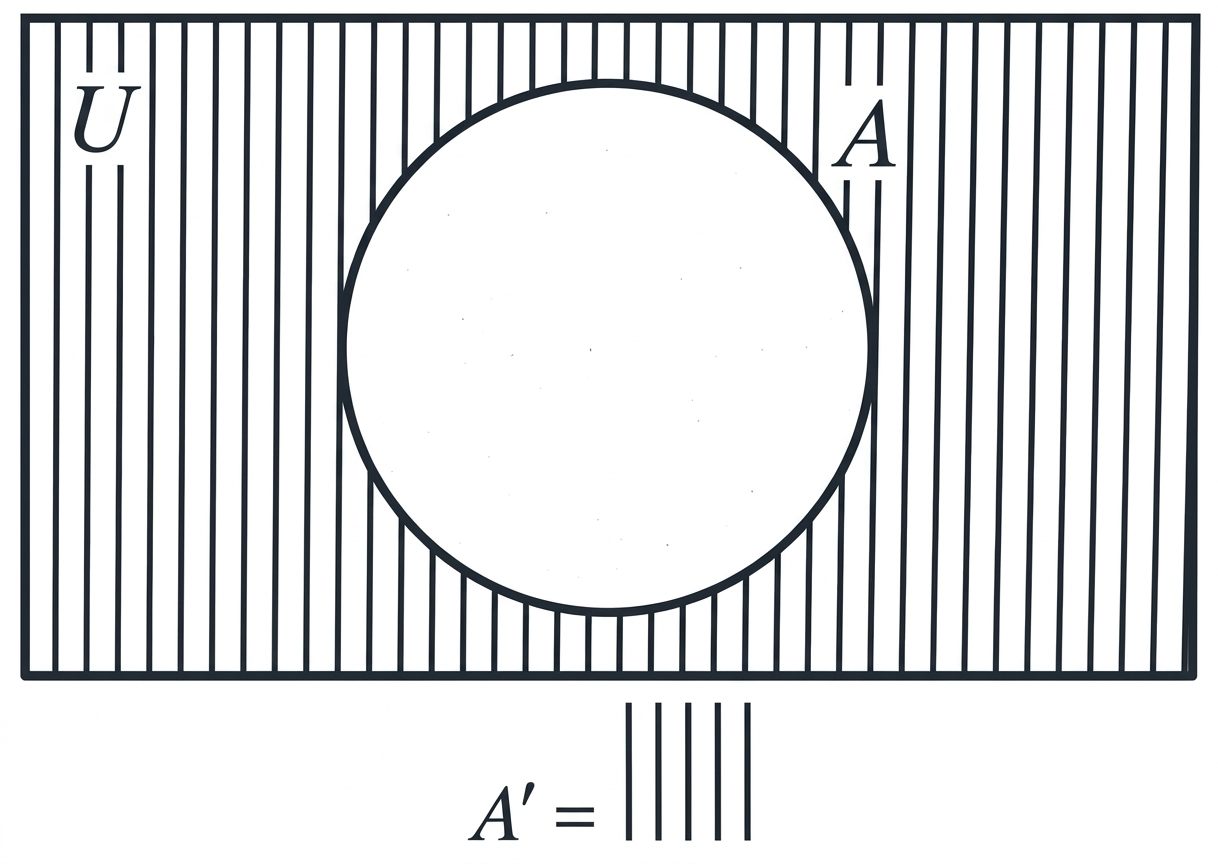
Figure Q4(i): \(A'\)
(ii) \(A \cap U = A\) — the intersection of any set with the universal set is the set itself.
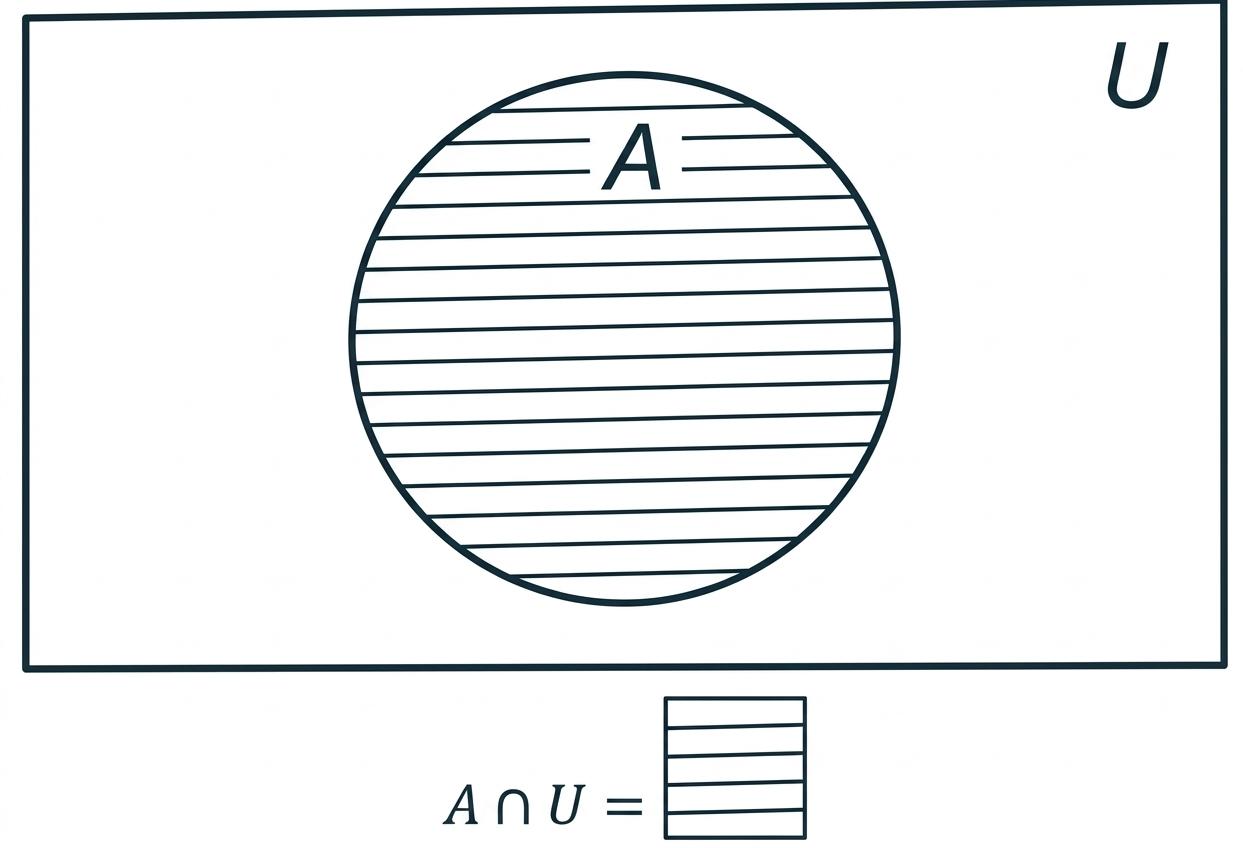
Figure Q4(ii): \(A \cap U = A\)
(iii) \(A \cup U = U\) — the union of any set with the universal set is the universal set.
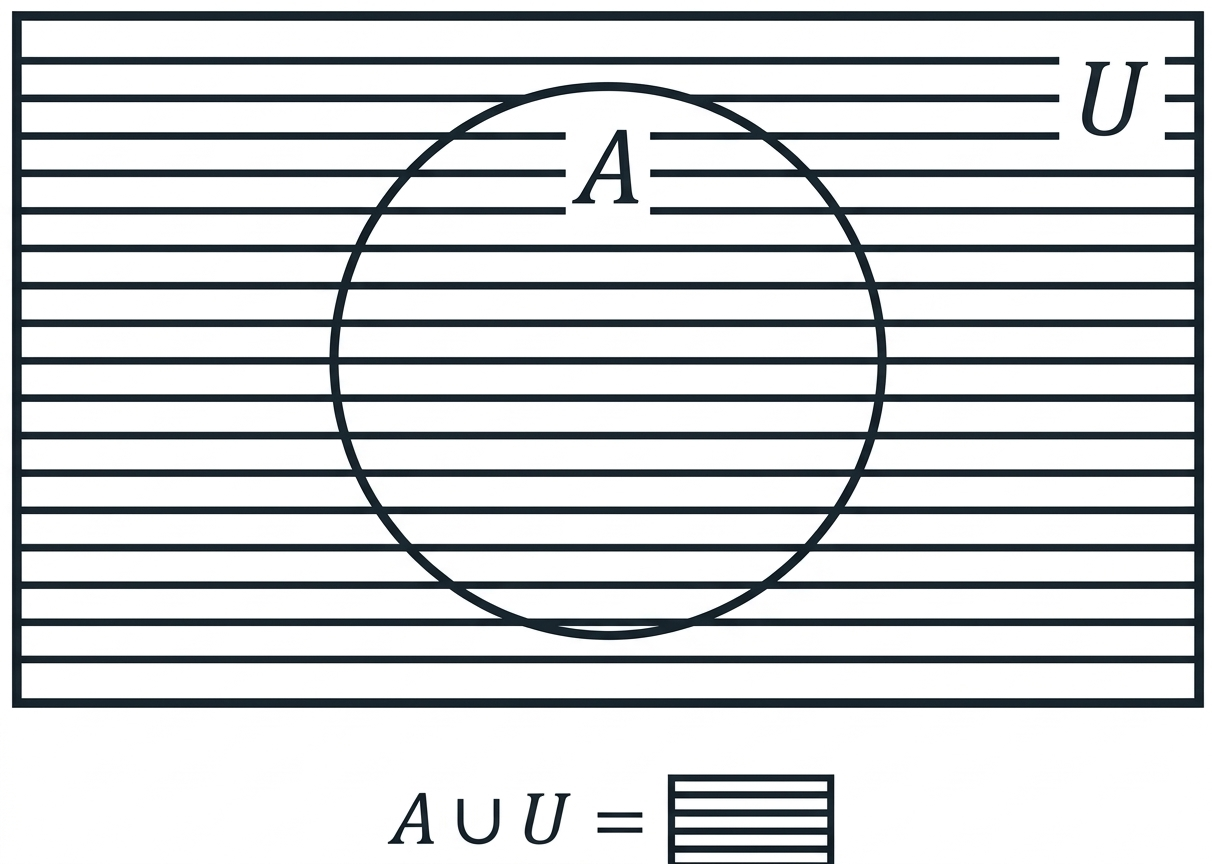
Figure Q4(iii): \(A \cup U = U\)
(iv) \(A \cup \emptyset = A\) — the union of any set with the empty set is the set itself.
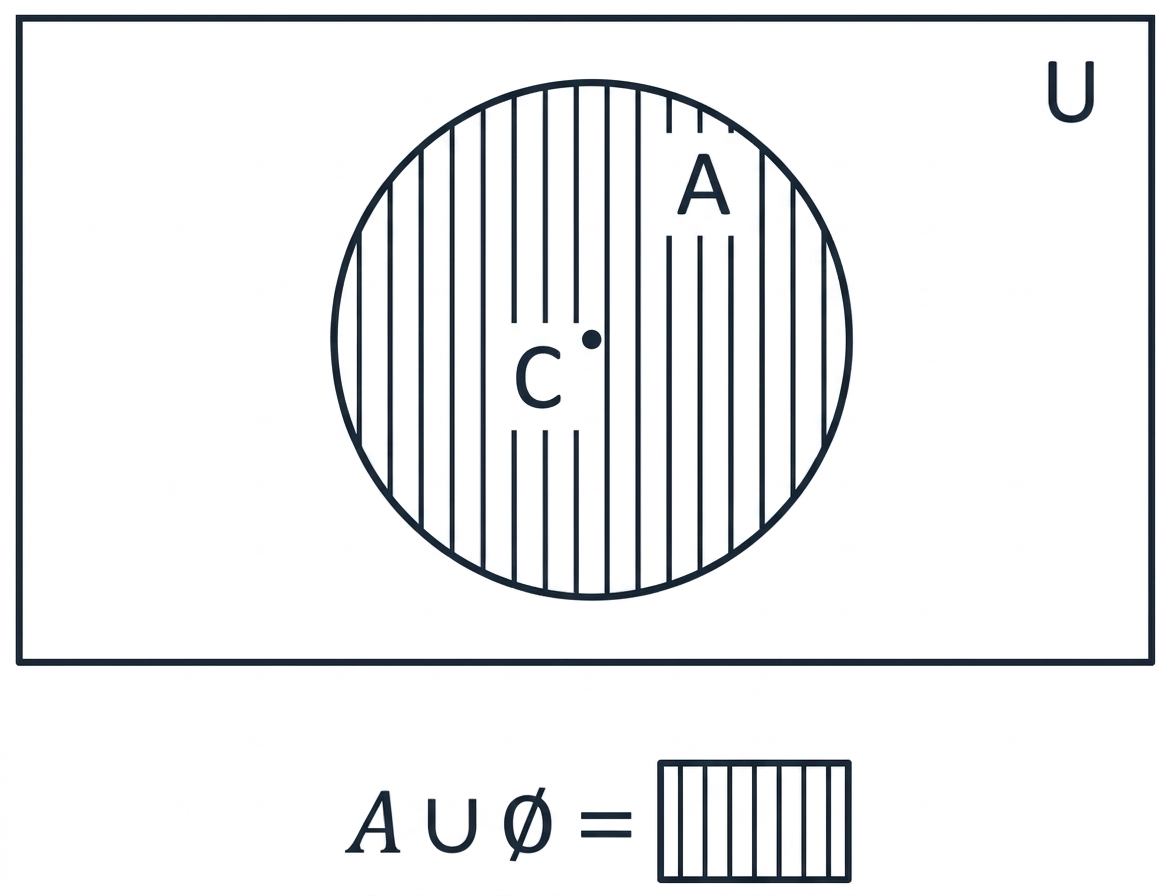
Figure Q4(iv): \(A \cup \emptyset = A\)
Q5
Use Venn diagrams to verify the following:
(i) \(A - B = A \cap B'\) (ii) \((A - B)' \cap B = B\)
Solution
(i) Verify \(A - B = A \cap B'\)
L.H.S = \(A - B\) — shade the part of A that is not in B:
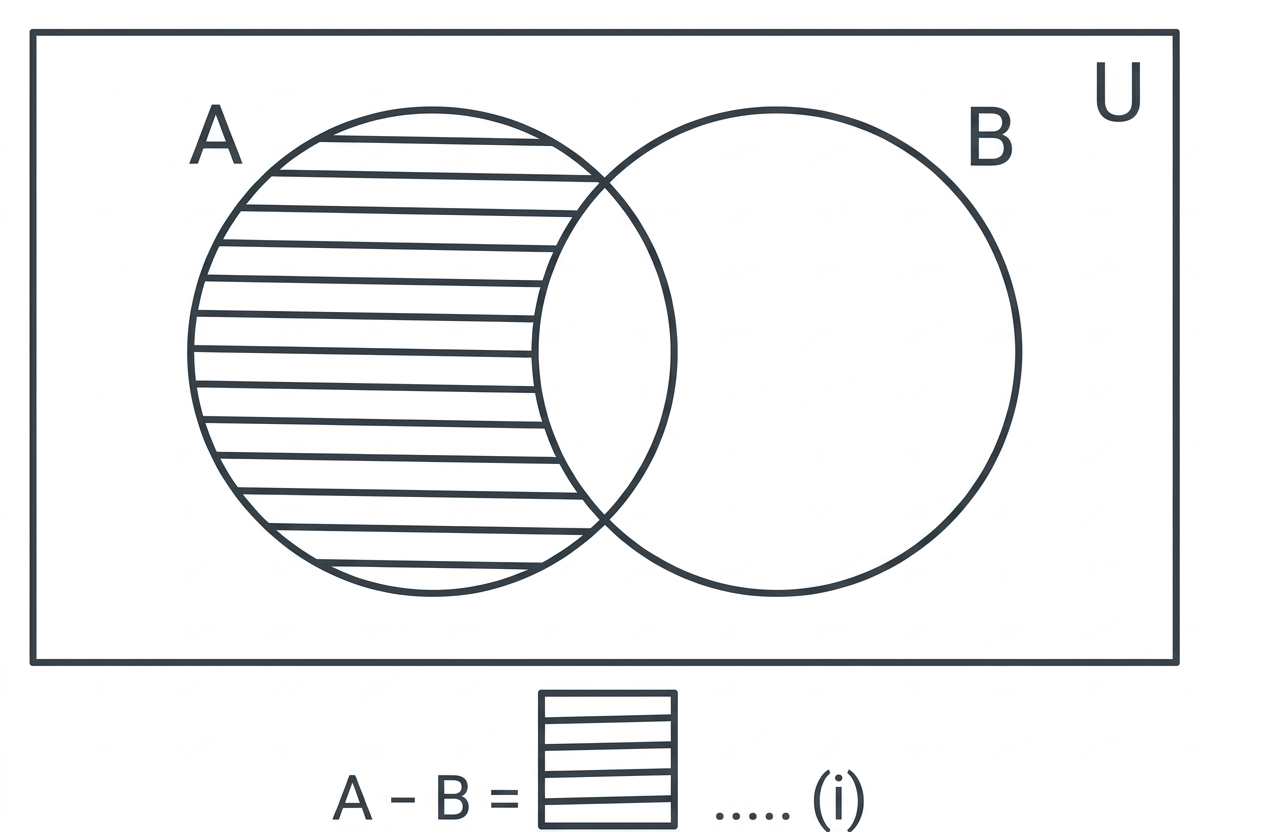
Figure Q5(i) LHS: \(A - B\)
R.H.S = \(A \cap B'\) — shade A, shade B′, keep the overlap:
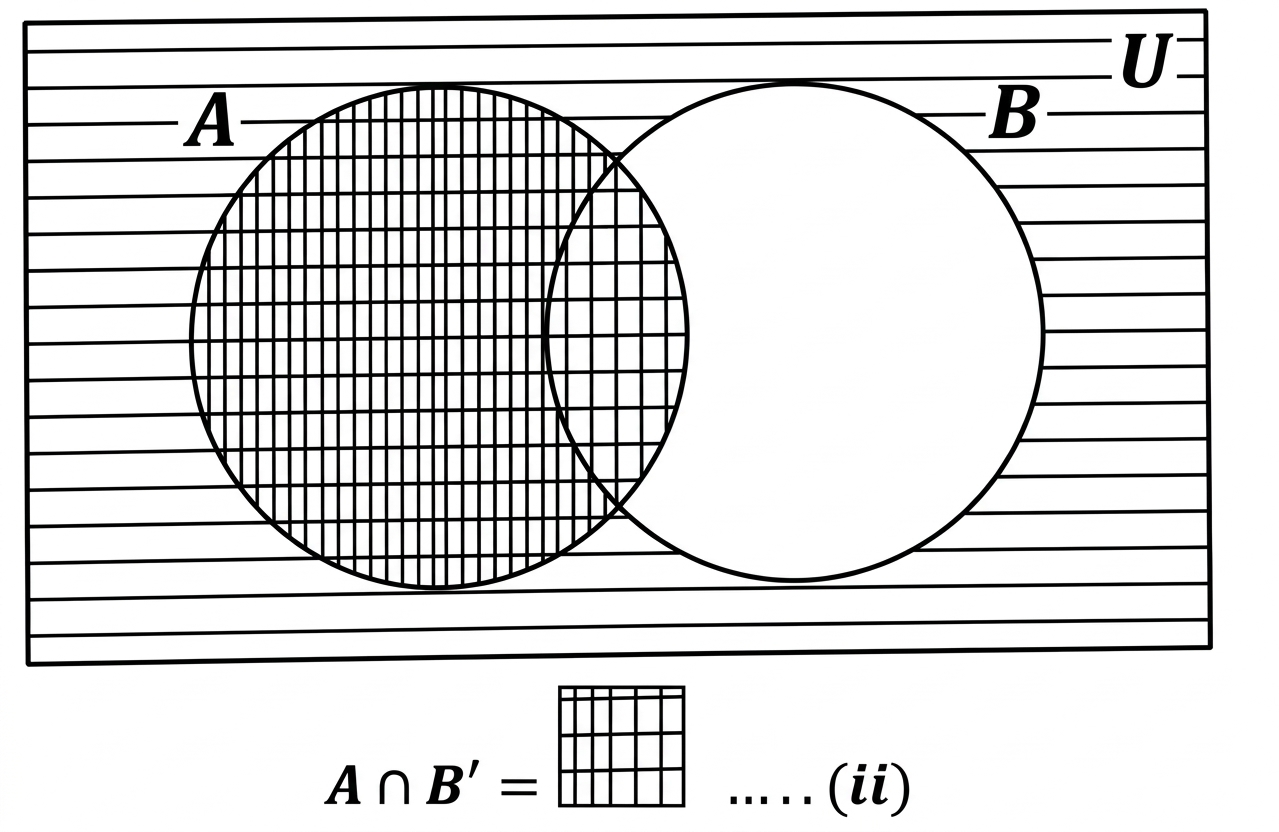
Figure Q5(i) RHS: \(A \cap B'\)
✅ Both Venn diagrams shade the same region, so \(A - B = A \cap B'\).
(ii) Verify \((A - B)' \cap B = B\)
First, the Venn diagram of \(A - B\):
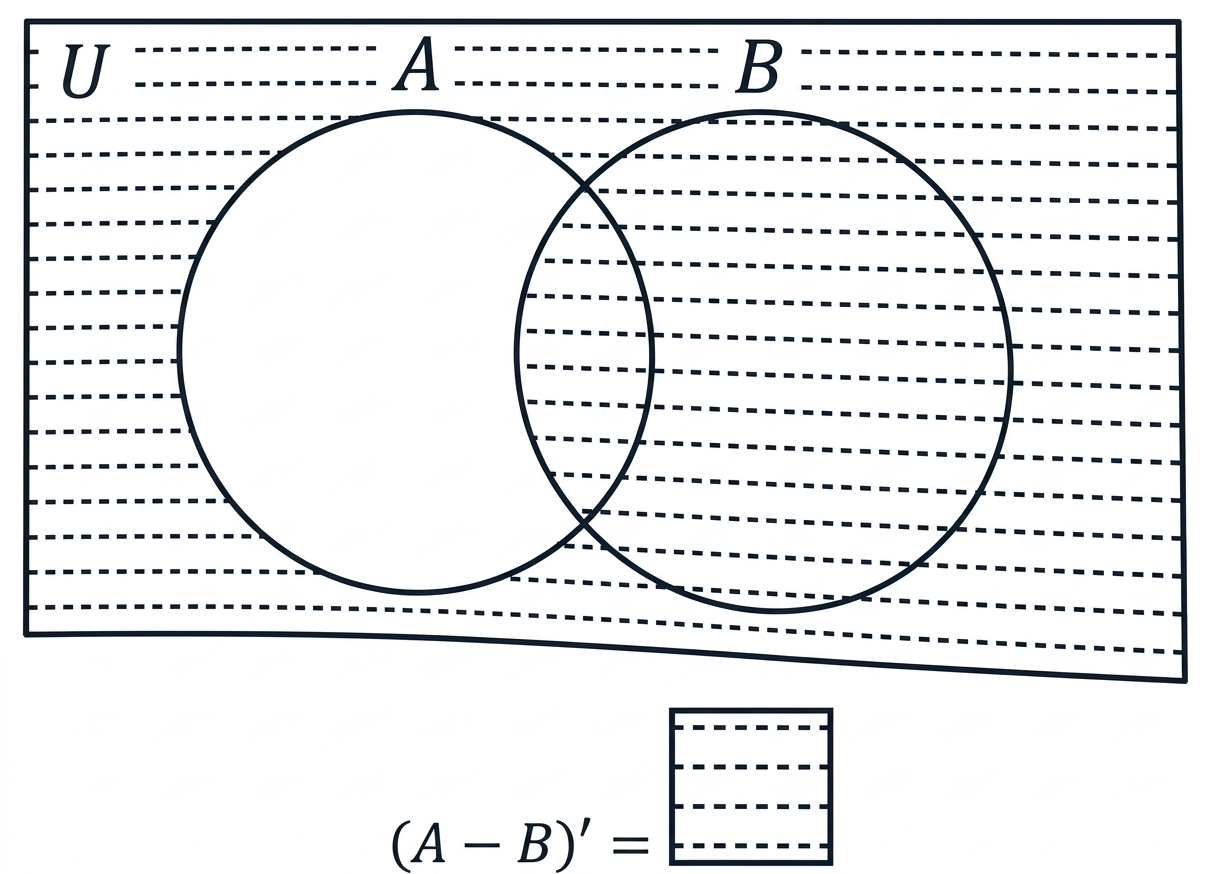
Figure Q5(ii) Step 1: \(A - B\)
Now compute \((A - B)'\) — shade everything outside the A-only region:
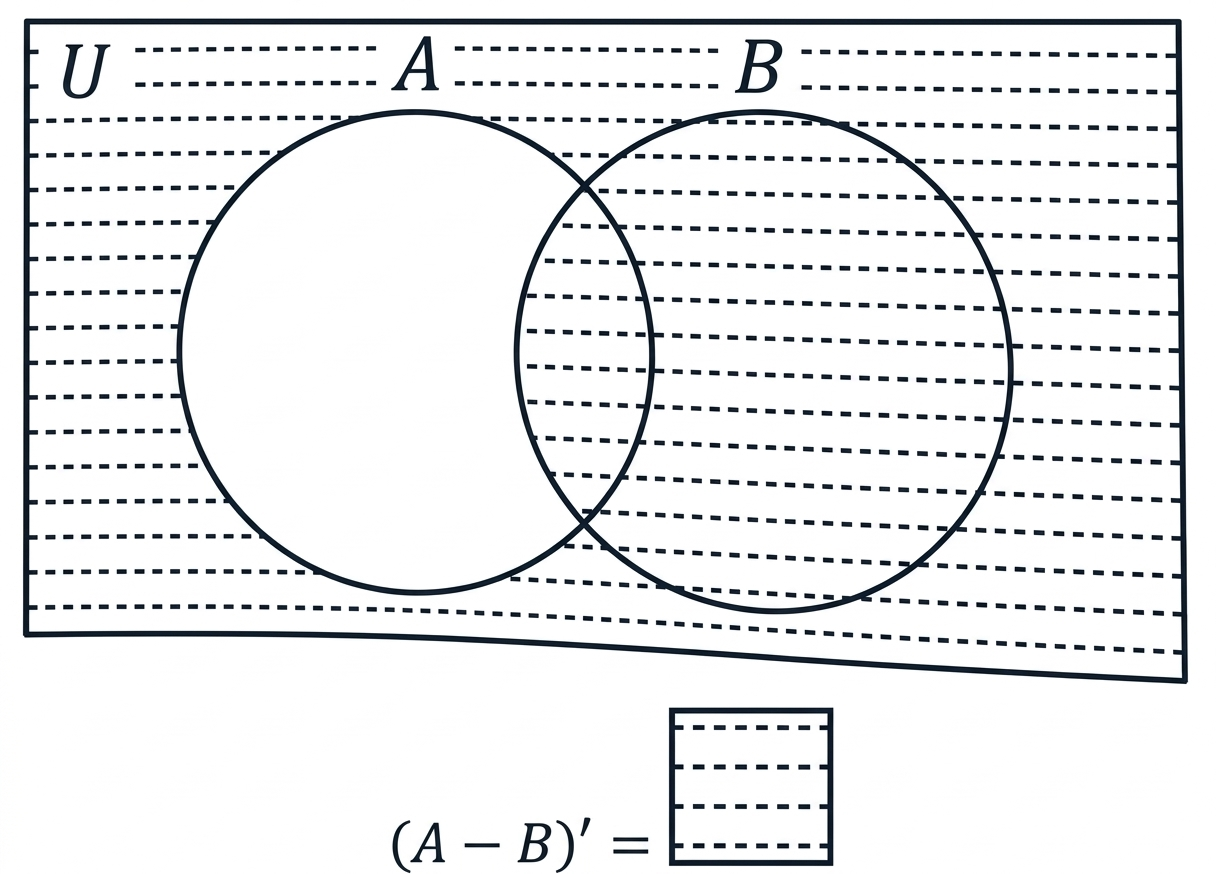
Figure Q5(ii) Step 2: \((A - B)'\)
Finally, intersect with B to show the result is B:
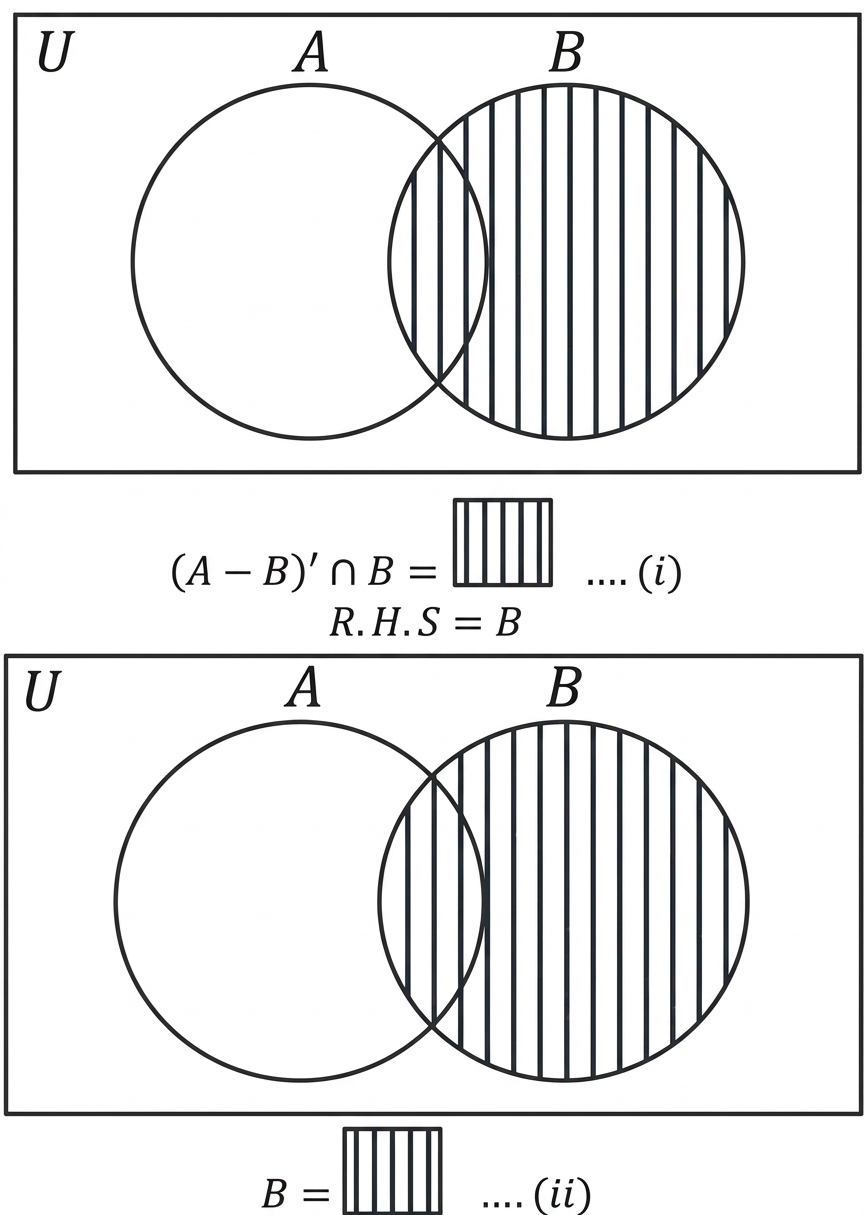
Figure Q5(ii) Step 3: \((A - B)' \cap B = B\)
✅ Verified: \((A - B)' \cap B = B\).
Q7
Verify De Morgan's Law \((A \cap B)' = A' \cup B'\) using Venn diagrams.
Solution
L.H.S = \((A \cap B)'\) — shade everything outside the overlap of A and B:

Figure Q7: Both sides shade the same region, so \((A \cap B)' = A' \cup B'\).
R.H.S = \(A' \cup B'\) — shade A′ (outside A), shade B′ (outside B), and take their union (shade everywhere at least one of A′ or B′ covers). The result covers exactly the same region as the LHS.
✅ L.H.S = R.H.S — De Morgan's Law verified.
Q8
Consider the set \(P = \{x \mid x = 5m, m \in \mathbb{N}\}\) and \(Q = \{x \mid x = 2m, m \in \mathbb{N}\}\). Find \(P \cap Q\).
Solution
\(P = \{5, 10, 15, 20, 25, 30, \ldots\}\) (multiples of 5)
\(Q = \{2, 4, 6, 8, 10, 12, 14, 16, 18, 20, \ldots\}\) (even numbers)
\(P \cap Q = \{10, 20, 30, 40, \ldots\}\)
\(= \{10k \mid k \in \mathbb{N}\}\) (multiples of 10)
✅ \(P \cap Q = \{10, 20, 30, 40, \ldots\}\) — the set of multiples of 10.
Q9
From suitable properties of union and intersection, deduce the following results:
(i) \(A \cap (A \cup B) = A \cup (A \cap B)\) (ii) \(A \cup (A \cap B) = A \cap (A \cup B)\)
Solution
(i) \(A \cap (A \cup B) = A \cup (A \cap B)\)
\(\text{L.H.S} = A \cap (A \cup B)\)
\(= (A \cap A) \cup (A \cap B)\) (distributivity)
\(= A \cup (A \cap B)\) (idempotent law \(A \cap A = A\))
\(= \text{R.H.S} \quad \checkmark\)
(ii) \(A \cup (A \cap B) = A \cap (A \cup B)\)
By the absorption laws of set algebra: \(A \cup (A \cap B) = A\) and \(A \cap (A \cup B) = A\). Therefore:
\(A \cup (A \cap B) = A = A \cap (A \cup B)\)
\(\therefore \text{L.H.S} = \text{R.H.S} \quad \checkmark\)
✅ Both identities hold.
Q10
If \(g(x) = 7x - 2\) and \(s(x) = 8x^{2} - 3\), then find:
(i) \(g(0)\) (ii) \(g(-1)\) (iii) \(g\!\left(-\tfrac{5}{3}\right)\) (iv) \(s(1)\) (v) \(s(-4)\) (vi) \(s\!\left(\tfrac{7}{2}\right)\)
Solution
(i) \(g(0)\)
\(g(0) = 7(0) - 2 = -2\)
(ii) \(g(-1)\)
\(g(-1) = 7(-1) - 2 = -7 - 2 = -9\)
(iii) \(g\!\left(-\tfrac{5}{3}\right)\)
\(g\!\left(-\tfrac{5}{3}\right) = 7\!\left(-\tfrac{5}{3}\right) - 2 = -\tfrac{35}{3} - 2 = \tfrac{-35 - 6}{3} = -\tfrac{41}{3}\)
(iv) \(s(1)\)
\(s(1) = 8(1)^{2} - 3 = 8 - 3 = 5\)
(v) \(s(-4)\)
\(s(-4) = 8(-4)^{2} - 3 = 8(16) - 3 = 128 - 3 = 125\)
(vi) \(s\!\left(\tfrac{7}{2}\right)\)
\(s\!\left(\tfrac{7}{2}\right) = 8\!\left(\tfrac{7}{2}\right)^{2} - 3 = 8 \cdot \tfrac{49}{4} - 3 = 98 - 3 = 95\)
Q11
Given \(f(x) = ax + b\), where \(a\) and \(b\) are constants. If \(f(-2) = 3\) and \(f(4) = 10\), find the values of \(a\) and \(b\).
Solution
\(f(-2) = a(-2) + b = 3 \;\Rightarrow\; -2a + b = 3 \quad \dots (i)\)
\(f(4) = a(4) + b = 10 \;\Rightarrow\; 4a + b = 10 \quad \dots (ii)\)
Subtract (i) from (ii):
\((4a + b) - (-2a + b) = 10 - 3\)
\(6a = 7 \;\Rightarrow\; a = \tfrac{7}{6}\)
Put \(a = \tfrac{7}{6}\) in equation (i):
\(-2\!\left(\tfrac{7}{6}\right) + b = 3 \;\Rightarrow\; -\tfrac{7}{3} + b = 3\)
\(b = 3 + \tfrac{7}{3} = \tfrac{9 + 7}{3} = \tfrac{16}{3}\)
✅ \(a = \tfrac{7}{6}\) and \(b = \tfrac{16}{3}\)
Q12
Consider the function defined by \(k(x) = 7x - 5\). If \(k(x) = 100\), find the value of \(x\).
Solution
\(k(x) = 100\)
\(7x - 5 = 100\)
\(7x = 105\)
\(x = 15\)
✅ \(x = 15\)
Q13
Consider the function \(g(x) = mx^{2} + n\), where \(m\) and \(n\) are constants. If \(g(4) = 20\) and \(g(0) = 5\), find the values of \(m\) and \(n\).
Solution
\(g(0) = m(0)^{2} + n = 5 \;\Rightarrow\; n = 5\)
\(g(4) = m(4)^{2} + n = 20\)
\(16m + 5 = 20\)
\(16m = 15 \;\Rightarrow\; m = \tfrac{15}{16}\)
✅ \(m = \tfrac{15}{16}\) and \(n = 5\)
Q14
A shopping mall has \(100\) products labelled \(1\) to \(100\), representing the universal set \(U\). Set \(A\): Electronics, \(30\) products labelled \(1\) to \(30\). Set \(B\): Clothing, \(25\) products labelled \(31\) to \(55\). Set \(C\): Beauty Products, \(25\) products labelled \(76\) to \(100\). Write each set in tabular form, and find \(A \cup B \cup C\).
Solution
\(U = \{1, 2, 3, \ldots, 100\}\)
\(A = \{1, 2, 3, \ldots, 30\}\)
\(B = \{31, 32, 33, \ldots, 55\}\)
\(C = \{76, 77, 78, \ldots, 100\}\)
\(A \cup B \cup C = \{1, 2, \ldots, 30\} \cup \{31, \ldots, 55\} \cup \{76, \ldots, 100\}\)
\(= \{1, 2, 3, \ldots, 55, 76, 77, 78, \ldots, 100\}\)
✅ \(A \cup B \cup C = \{1, 2, \ldots, 55, 76, 77, 78, \ldots, 100\}\)
Q15
Out of \(180\) students who appeared in the annual examination, \(120\) passed the math test, \(90\) passed the science test, and \(60\) passed both the math and science tests.
(a) How many passed either the math or science test? (b) How many did not pass either? (c) How many passed the science test but not the math test?
Solution
\(n(U) = 180,\quad n(M) = 120,\quad n(S) = 90,\quad n(M \cap S) = 60\)
(a) Passed math or science:
\(n(M \cup S) = n(M) + n(S) - n(M \cap S)\)
\(= 120 + 90 - 60 = 150\)
(b) Passed neither:
\(n(M \cup S)' = n(U) - n(M \cup S) = 180 - 150 = 30\)
(c) Passed science but not math:
\(n(S \cap M') = n(S) - n(M \cap S) = 90 - 60 = 30\)
✅ (a) 150 students; (b) 30 students; (c) 30 students.
Q16
In a software house of \(300\) developers, a survey revealed: \(150\) like Python, \(130\) like Java, \(120\) like PHP, \(70\) like Python and Java, \(60\) like Python and PHP, \(50\) like Java and PHP, \(40\) like all three.
(a) How many use at least one language? (b) How many use only one? (c) How many use none? (d) How many use only PHP?
Solution
\(n(U) = 300,\quad n(P) = 150,\quad n(J) = 130,\quad n(H) = 120\)
\(n(P \cap J) = 70,\quad n(P \cap H) = 60,\quad n(J \cap H) = 50,\quad n(P \cap J \cap H) = 40\)
(a) At least one language:
\(n(P \cup J \cup H) = 150 + 130 + 120 - 70 - 60 - 50 + 40 = 260\)
(b) Only one language:
Only Python: \(150 - 70 - 60 + 40 = 60\)
Only Java: \(130 - 70 - 50 + 40 = 50\)
Only PHP: \(120 - 60 - 50 + 40 = 50\)
Total = \(60 + 50 + 50 = 160\)
(c) None of the three languages:
\(n(P \cup J \cup H)' = n(U) - n(P \cup J \cup H) = 300 - 260 = 40\)
(d) Only PHP:
\(= 120 - 60 - 50 + 40 = 50\)
✅ (a) 260; (b) 160; (c) 40; (d) 50
💡 Exam Tip:
For Venn diagram verification questions, always draw the LHS and RHS separately and shade the resulting regions — then show that both shaded regions coincide, so L.H.S = R.H.S. For survey problems with three sets, start from the innermost (all three) value and subtract overlaps outward. For function evaluation and inverse questions, substitute directly and simplify. For finding unknown constants in \(f(x) = ax + b\) or \(g(x) = mx^2 + n\), always build two clean equations, then eliminate and back-substitute.
❓ Frequently Asked Questions – Review Exercise 3
Substitute the allowed values of the index variable into the formula. For \(x = 2n\) with \(n \in \mathbb{N}\) starting from \(1\):
\(n=1 \to x=2,\; n=2 \to x=4,\; n=3 \to x=6,\; \ldots\)
\(\Rightarrow \{2, 4, 6, 8, \ldots\}\)
If the index starts at \(0\) (whole numbers), then \(x = 2m + 1\) gives \(1, 3, 5, 7, \ldots\) instead.
De Morgan's two laws are:
\((A \cap B)' = A' \cup B'\)
\((A \cup B)' = A' \cap B'\)
To verify, draw a Venn diagram for the left side (shade everything outside \(A \cap B\), i.e. everything except the overlap), then draw a separate Venn diagram for the right side (\(A'\) and \(B'\) together), and confirm both shaded areas coincide.
Figure: Both sides of De Morgan's Law shade the same region.
Draw \(A - B\) first: shade the part of \(A\) that is not inside \(B\). Then draw \(A \cap B'\): shade \(A\), shade \(B'\) (outside \(B\)), and keep the region shaded in both. The two shaded regions coincide:
\(A - B = A \cap B'\)
Figure: \(A - B\) (LHS) and \(A \cap B'\) (RHS) shade the same region.
Substitute the input for \(x\) and simplify:
\(g(0) = 7(0) - 2 = -2\)
\(g(-1) = 7(-1) - 2 = -9\)
\(g\!\left(-\tfrac{5}{3}\right) = -\tfrac{35}{3} - 2 = -\tfrac{41}{3}\)
\(s(1) = 8(1)^{2} - 3 = 5\)
\(s(-4) = 8(16) - 3 = 125\)
\(s\!\left(\tfrac{7}{2}\right) = 8 \cdot \tfrac{49}{4} - 3 = 98 - 3 = 95\)
Use the three-set Inclusion-Exclusion formula:
\(n(A \cup B \cup C) = n(A) + n(B) + n(C) - n(A \cap B) - n(B \cap C) - n(A \cap C) + n(A \cap B \cap C)\)
For the software house with \(300\) developers: \(n(P) = 150\), \(n(J) = 130\), \(n(H) = 120\), pairwise overlaps \(70, 60, 50\), all three \(= 40\):
\(n(P \cup J \cup H) = 150 + 130 + 120 - 70 - 60 - 50 + 40 = 260\)
Only one language = \(60 + 50 + 50 = 160\)
Only PHP = \(120 - 60 - 50 + 40 = 50\)
The complete PDF for Class 9 Math Review Exercise 3 (Sets and Functions) is embedded on this page and can be downloaded free of cost using the “⬇️ Download PDF – Review Exercise 3 Solutions (Free)” button located directly above the FAQ section. The PDF contains the full set of solved questions for this review exercise, prepared according to the PECTAA 2025 syllabus.
Chapter 1Real Numbers
Chapter 2Logarithms
Chapter 3✨ Sets and Functions
Chapter 4Factorization
Chapter 5Linear Equations and Inequalities
Chapter 6Trigonometry
Chapter 7Coordinate Geometry
Chapter 8Logic
Chapter 9Similar Figures
Chapter 10Graphs of Functions
Chapter 11Loci and Construction
Chapter 12Information Handling
Chapter 13Probability
📖 Complete syllabus coverage for Class 9 Mathematics – Chapters 1 to 13
Created by Hira Science Academy | Aligned with PECTAA Syllabus