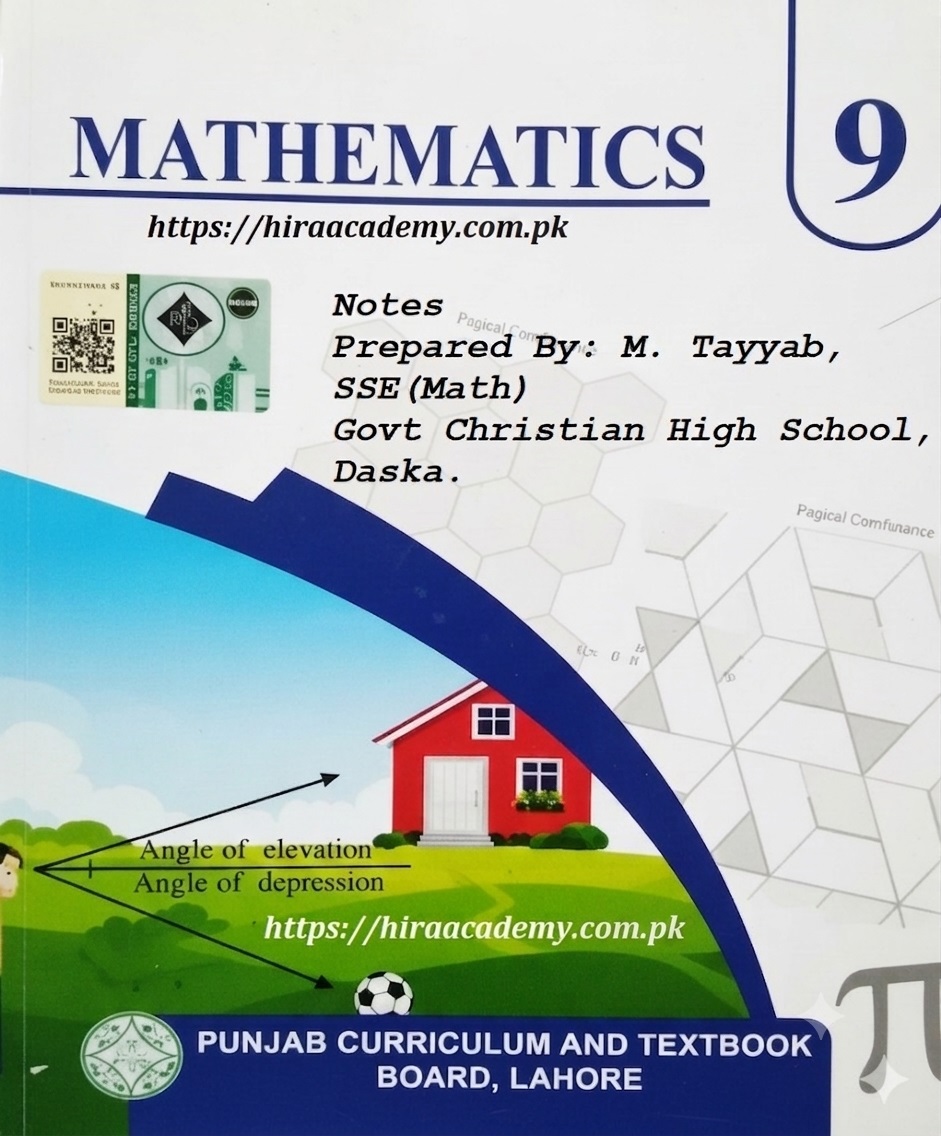
Guess Paper Priorities – All 13 Chapters
Click on any chapter to see its exercises, definitions, and MCQs for focused final revision.
📘
Chapter 1 – Real Numbers
Rational and irrational numbers, decimal representation, operations
New 2026
↓
Real numbers form the foundation of mathematics. This chapter covers rational and irrational numbers, decimal representation, and operations on real numbers.
📗
Chapter 2 – Logarithms
Laws of logarithms, common logarithms, exponential equations
New 2026↓
Logarithms help simplify complex calculations. This chapter covers laws, common logarithms, and applications in solving exponential equations.
📙
Chapter 3 – Sets and Functions
Set operations, Venn diagrams, function types, notation
New 2026↓
Sets and functions are fundamental concepts in mathematics with applications in computer science and data analysis.
📕
Chapter 4 – Factorization and Algebraic Manipulation
Factorization techniques, algebraic fractions, simplification
New 2026↓
Factorization simplifies algebraic expressions and equations. This chapter covers various factorization techniques and simplification.
📓
Chapter 5 – Linear Equations and Inequalities
Solving linear equations, graphing inequalities, word problems
New 2026↓
Linear equations and inequalities are essential for solving real-world problems in economics, physics, and engineering.
📔
Chapter 6 – Trigonometry
Trigonometric ratios, identities, triangle solving, applications
New 2026↓
Trigonometry deals with relationships between angles and sides of triangles with applications in architecture and navigation.
📒
Chapter 7 – Coordinate Geometry
Cartesian plane, distance formula, midpoint, line equations
New 2026↓
Coordinate geometry connects algebra and geometry with applications in computer graphics and engineering.
📚
Chapter 8 – Logic
Statements, truth tables, logical equivalence, proof techniques
New 2026↓
Logic forms the basis of mathematical reasoning and computer programming.
📖
Chapter 9 – Similar Figures
Similarity criteria, ratio of areas and volumes, geometry applications
New 2026↓
Similar figures have the same shape but different sizes with applications in map reading and scale models.
📘
Chapter 10 – Graphs of Functions
Linear, quadratic functions, graphing techniques, interpretations
New 2026↓
Graphs provide visual representations of functions with applications in economics and science.
📗
Chapter 11 – Loci and Construction
Geometric constructions, loci problems, engineering applications
New 2026↓
Loci are sets of points satisfying specific conditions with applications in engineering design.
📙
Chapter 12 – Information Handling
Data collection, graphical representations, statistical analysis
New 2026↓
Information handling is crucial in data analysis and decision making.
📙
Chapter 13 – Probability
Basic concepts, sample spaces, probability calculation, applications
New 2026↓
Probability quantifies uncertainty in scientific research and finance.
How to Use a Guess Paper Without Gambling Your Grade
A guess paper has a bit of a mixed reputation — some students treat it as a shortcut to skip real revision, while others dismiss it entirely as unreliable. The honest truth sits in between: a guess paper built on real patterns from past Punjab Board papers can meaningfully sharpen your last few weeks of preparation, as long as you use it to prioritize, not to gamble.
This page highlights the chapters of Class 9 Mathematics under the PECTAA 2026 syllabus that have historically carried the most marks, along with the specific exercises within those chapters worth extra attention. Trigonometry, Coordinate Geometry, and Linear Equations tend to appear consistently in long questions, while chapters like Sets and Functions and Logic are more frequently tested through short questions and MCQs.
It's worth being clear about what a guess paper can and can't do. It cannot predict your exact exam paper — no resource honestly can. What it can do is help you allocate your remaining revision time more efficiently, especially if you're running short on time before the exam and need to make hard choices about where to focus.
The safest way to use this guess paper is as a final-stage prioritization tool, applied only after you've already covered the full syllabus at least once. If you haven't studied a chapter yet, skipping it because it's "low priority" here is a risky strategy — board exams do sometimes include questions from every chapter, and a guess paper shifts probabilities, it doesn't eliminate them.
Beyond chapter priorities, solid board exam tips matter just as much as knowing what to study. Reading the entire question paper before starting, managing your time across MCQs, short questions, and long questions, and leaving a few minutes at the end to review your answers are habits that consistently help students perform closer to their actual ability under exam conditions.
This resource is useful for teachers guiding last-minute revision sessions, and for parents who want to understand where their child should be focusing in the final stretch. Since it's built around the PECTAA 2026 syllabus shared by all 10 BISE boards in Punjab — Bahawalpur, DG Khan, Faisalabad, Federal, Gujranwala, Lahore, Multan, Rawalpindi, Sahiwal, and Sargodha — the same priorities apply no matter which board a student is registered under.
Use the chapter accordion below to review high-priority topics in depth. For focused practice on the individual exercises and questions flagged here, our important-questions and solved-exercises pages are linked further down.
📌 Priority Chapters for This Year's Exam
| Chapter | Priority | Focus Areas |
|---|---|---|
| Trigonometry | High | Ratios, identities, right-triangle problems |
| Coordinate Geometry | High | Distance, midpoint, slope formulas |
| Linear Equations | High | Solving systems, word problems |
| Logarithms | Medium | Laws of logarithms, simplification |
| Factorization | Medium | Common techniques, special products |
| Sets and Functions | Medium | Definitions, domain and range |
| Logic | Standard | Definitions, truth tables |
Priority levels reflect historical patterns and are a revision guide, not a guarantee of exam content.
💡 Board Exam Day Tips
- • Read the full paper first: Skim every question before starting to plan your time.
- • Start with what you know best: Build confidence early before tackling harder questions.
- • Manage your time by section: Divide your time across MCQs, short, and long questions in advance.
- • Show all working: Method marks matter even if your final answer is wrong.
- • Leave time to review: Save the last 5–10 minutes to check your answers.
🎯 Making the Most of Your Final Weeks
- • Prioritize, don't skip: Use this guess paper to order your revision, not to drop chapters entirely.
- • Practice high-priority exercises first: Focus extra time on the chapters flagged above.
- • Balance with full syllabus review: Do a quick pass over every chapter, even lower-priority ones.
- • Test yourself regularly: Use our MCQs test above to check retention as exams approach.
- • Stay calm and consistent: A steady daily revision plan beats last-minute cramming.
✅ Why Use This Guess Paper?
- • Based on real patterns – priorities reflect past board paper trends.
- • Chapter and exercise level detail – not just vague topic names.
- • Built for the PECTAA 2026 syllabus – current and relevant.
- • Free and instantly accessible – no sign-up needed.
- • Best for final-stage revision – sharpens focus in your last few weeks.
👥 Who Should Use This Page?
- • Class 9 students in the final weeks before their board exam.
- • Teachers guiding last-minute revision sessions.
- • Parents wanting to understand where their child should focus.
- • Students short on time who need to prioritize what's left to revise.
- • Students from all 10 Punjab BISE boards, since all follow PECTAA 2026.
9th Class Math Guess Paper – What's Included (PECTAA 2026)
This page identifies the highest-priority chapters and exercises from the syllabus prescribed by the Punjab Education Curriculum Training and Assessment Authority, built to sharpen your final revision.
Prepared by Muhammad Tayyab (SSE), Govt Christian High School Daska, priorities are based on patterns from past board papers and are meant to guide, not replace, full syllabus preparation.
✅ What's Included
- ✓Priority chapter breakdown table
- ✓High-value exercises flagged per chapter
- ✓Based on the PECTAA 2026 syllabus
- ✓General board exam day tips
- ✓Free access, no downloads required
- ✓Searchable by chapter or topic
🌐 Chapters Covered
Real Numbers, Logarithms, Sets and Functions, Factorization, Linear Equations, Trigonometry, Coordinate Geometry, Logic, Similar Figures, Graphs of Functions, Loci and Construction, Information Handling, and Probability.
Each chapter's exercises, definitions, and MCQs link directly from the accordion below.
Explore the Complete 9th Class Math Toolkit
This guess paper is part of a larger set of Math 9 resources. Explore the notes hub, important questions, past papers, and more below.
🏠
Math 9 Notes Hub
The main hub linking every Class 9 Math resource in one place.
📔
Math Key Book
Full solution guide with chapter-wise answers to every textbook question.
📄
Notes PDF
Downloadable and printable chapter-wise PDF notes for offline study.
✏️
Solved Exercises
Step-by-step worked solutions for every exercise in all 13 chapters.
⭐
Important Questions
Short and long board-focused questions to prioritize your revision.
✅
Math MCQs
Chapter-wise multiple-choice questions with an online practice test.
📖
Definitions
Every key term and theorem explained clearly, chapter by chapter.
🧮
Formula Sheet
A quick-revision sheet with all formulas organized by chapter.
🗂️
Past Papers
Solved previous board papers with pattern analysis for smarter prep.
Frequently Asked Questions About the Guess Paper
What is a math guess paper?
A guess paper highlights the chapters and exercises most likely to carry significant marks, based on past board paper patterns.
Is this based on PECTAA 2026?
Yes, the chapters and exercises highlighted here are selected from the current PECTAA 2026 syllabus.
Should I rely only on this for exam prep?
No, use it to guide your priorities, not to replace full syllabus coverage—unexpected questions can still appear elsewhere.
When should I use the guess paper?
It's most useful in the final two to three weeks before your exam, once you've already covered the syllabus.
Are important exercises highlighted too?
Yes, alongside high-priority chapters, specific exercises within them are flagged for focused practice.
Which BISE boards does this apply to?
All 10 BISE boards in Punjab follow PECTAA 2026, so this guess paper applies to every board equally.
Is this resource free?
Yes, the complete guess paper with chapter priorities and board tips is free to access online.
How accurate are guess papers?
They're based on patterns, not guarantees—they improve your odds of efficient revision but can't predict the paper exactly.
Can I combine this with other resources?
Yes, this guess paper works best alongside our important questions and solved exercises pages.
Does this include board exam tips?
Yes, general board exam strategies are included alongside the chapter and exercise priorities.
⚠️ Guess Paper Mistakes to Avoid
- • Skipping "low priority" chapters entirely: Board exams can still include questions from any chapter.
- • Using it too early: A guess paper works best after you've already covered the full syllabus once.
- • Memorizing without understanding: Focused revision still needs to build real understanding, not rote answers.
- • Treating it as a guarantee: Priorities reflect patterns, not certainties—stay prepared broadly.
🧠 A Smarter Final Revision Plan
- • Start with high-priority chapters: Spend extra time on Trigonometry, Coordinate Geometry, and Linear Equations.
- • Do a full syllabus sweep too: Quickly review every chapter, even lower-priority ones, before your exam.
- • Combine with important questions: Use the linked important-questions page for focused short and long question practice.
- • Practice past papers too: Pair this guess paper with our past papers page for a complete picture.