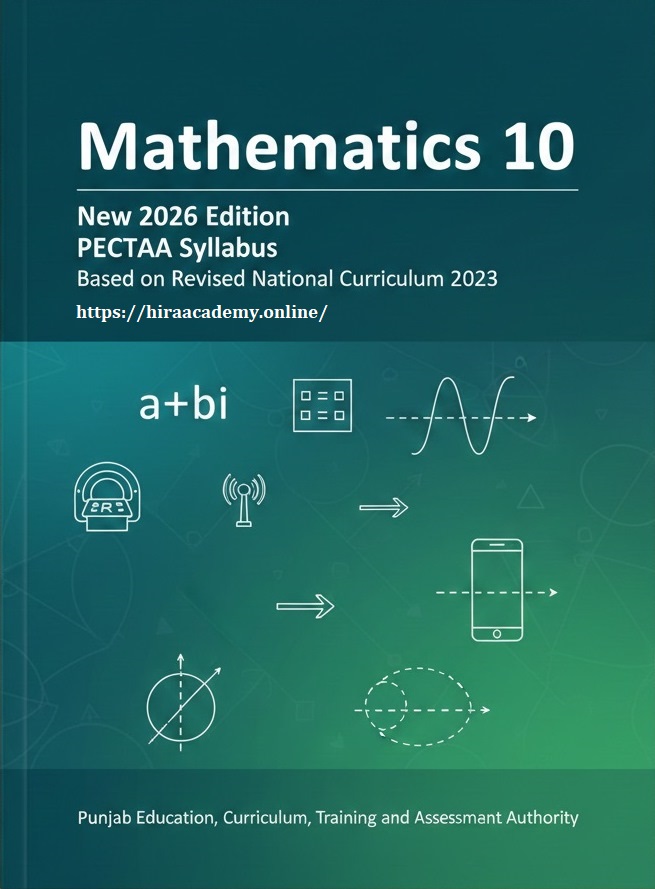
Guess Paper Priorities – All 12 Chapters
Click on any chapter to see its exercises for focused final revision.
Unit 1 – Complex Numbers
Complex number operations, Argand diagrams, engineering applications
New 2026
Complex numbers extend the real number system to solve equations with no real solutions. This unit covers complex number operations, Argand diagrams, and applications in engineering, particularly in electrical engineering and signal processing.
Unit 2 – Quadratic Equations and Inequalities
Solving techniques, discriminant analysis, optimization applications
New 2026
Quadratic equations model various real-world phenomena. This unit covers solving techniques, discriminant analysis, quadratic inequalities, and applications in optimization problems, physics, and economics.
Unit 3 – Matrices and Determinants
Matrix operations, determinants, inverses, computer graphics applications
New 2026
Matrices are essential in computer graphics, economics, and engineering. This unit covers matrix operations, determinants, inverses, and applications in solving systems of equations, transformations, and data analysis.
Unit 4 – Functions and Graphs
Function types, properties, graphing techniques, scientific applications
New 2026
Functions model relationships between variables. This unit covers various function types, their properties, graphing techniques, and applications in scientific research, data analysis, and modeling real-world phenomena.
Unit 5 – Algebraic Fractions
Simplification, operations, equations, engineering applications
New 2026
Algebraic fractions appear in engineering calculations and financial formulas. This unit covers simplification, operations, and solving equations involving algebraic fractions with applications in circuit analysis, optimization, and financial modeling.
Unit 6 – Vectors in Plane
Vector operations, dot product, physics and engineering applications
New 2026
Vectors represent quantities with magnitude and direction. This unit covers vector operations, dot product, applications in physics and engineering, and geometric interpretations for force analysis, motion, and computer graphics.
Unit 7 – Trigonometry
Trigonometric identities, equations, inverse functions, real-world applications
New 2026
Trigonometry has applications in architecture, navigation, and wave phenomena. This unit covers trigonometric identities, equations, inverse functions, and real-world problem solving for height and distance calculations, wave analysis, and engineering design.
Unit 8 – Chords and Arcs of a Circle
Relationships between chords, arcs, angles, design and engineering applications
New 2026
Circle geometry has practical applications in design and engineering. This unit covers relationships between chords, arcs, angles, and their properties with proofs, with applications in mechanical design, architecture, and manufacturing.
Unit 9 – Tangent and Angles of a Circle
Tangent properties, angle relationships, geometry and design applications
New 2026
Tangents and circle angles are fundamental in geometry and design. This unit covers tangent properties, angle relationships in circles, and their applications in engineering design, robotics path planning, and optical systems.
Unit 10 – Practical Geometry of Circles
Geometric constructions, tangents, inscribed figures, step-by-step methods
New 2026
Practical geometry involves constructing circle-related figures. This unit covers geometric constructions involving circles, tangents, and inscribed figures with step-by-step methods for technical drawing, CAD applications, and engineering design.
Unit 11 – Information Handling
Data collection, graphical representations, statistical analysis, decision making
New 2026
Information handling is crucial in data analysis and decision making. This unit covers data collection, graphical representations, measures of central tendency, and interpretation for business analytics, research studies, and scientific data analysis.
Unit 12 – Probability
Basic concepts, compound events, conditional probability, real-world applications
New 2026
Probability quantifies uncertainty in scientific research and finance. This unit covers basic probability concepts, compound events, conditional probability, and real-world applications in risk assessment, quality control, financial modeling, and data science.
Class 10 Math Guess Paper – What's Included (PECTAA 2026)
This page identifies the highest-priority chapters and exercises from the syllabus, built to sharpen your final revision.
Prepared by Muhammad Tayyab, Govt Christian High School Daska, priorities are based on patterns from past board papers and are meant to guide, not replace, full syllabus preparation.
✅ What's Included
- ✓Priority chapter breakdown table
- ✓High-value exercises flagged per chapter
- ✓Based on the PECTAA 2026 syllabus
- ✓Free access, no downloads required
🌐 Chapters Covered
All 12 chapters of the new syllabus, from Complex Numbers through Probability, based on the Revised National Curriculum 2023.
Works for students of all 10 Punjab BISE boards, since PECTAA 2026 is shared across boards.
Browse Notes by Individual Chapter
Each chapter has its own hub page with exercise cards, review exercise, and full chapter notes.
📘
Chapter 1: Complex Numbers
Complex number operations, Argand diagrams, and engineering applications with step-by-step solved exercises.
📗
Chapter 2: Quadratic Equations and Inequalities
Solving techniques, discriminant analysis, optimization applications, and real-world problem solving strategies.
📙
Chapter 3: Matrices and Determinants
Matrix operations, determinants, inverses, and computer graphics applications with complete solved exercises.
📕
Chapter 4: Functions and Graphs
Function types, properties, graphing techniques, and scientific applications for comprehensive understanding.
📓
Chapter 5: Algebraic Fractions
Simplification, operations, solving equations, and engineering applications with detailed step-by-step solutions.
📔
Chapter 6: Vectors in Plane
Vector operations, dot product, and physics and engineering applications with practical solved problems.
📒
Chapter 7: Trigonometry
Trigonometric identities, equations, inverse functions, and real-world applications in architecture and navigation.
📚
Chapter 8: Chords and Arcs of a Circle
Relationships between chords, arcs, angles, and design and engineering applications for circular geometry.
📖
Chapter 9: Tangent and Angles of a Circle
Tangent properties, angle relationships, and geometry and design applications with construction techniques.
📘
Chapter 10: Practical Geometry of Circles
Geometric constructions, tangents, inscribed figures, and step-by-step methods for technical drawing.
📗
Chapter 11: Information Handling
Data collection, graphical representations, statistical analysis, and decision making for real-world problems.
📙
Chapter 12: Probability
Basic concepts, compound events, conditional probability, and real-world applications in risk assessment.
Explore the Complete Class 10 Math Toolkit
This guess paper is part of a larger set of Class 10 Math resources. Explore the notes hub, formula sheet, past papers, and more below.
🏠
Class 10 Math Notes Hub
The main hub linking every Class 10 Math resource in one place.
📔
Math Key Book
Full solution guide with chapter-wise answers to every textbook question.
📄
Notes PDF
Downloadable and printable chapter-wise PDF notes for offline study.
✏️
Solved Exercises
Step-by-step worked solutions for every exercise in all 12 chapters.
⭐
Important Questions
Short and long board-focused questions to prioritize your revision.
✅
Math MCQs
Chapter-wise multiple-choice questions with an online practice test.
📖
Definitions
Every key term and theorem explained clearly, chapter by chapter.
🧮
Formula Sheet
A quick-revision sheet with all formulas organized by chapter.
🗂️
Past Papers
Solved previous board papers with pattern analysis for smarter prep.