💡 Chapter 19: Electronics – Exercise Short Questions
Prepared by Muhammad Tayyab, Subject Specialist Physics, Govt Christian High School Daska. Based on PECTAA 2026 syllabus (National Curriculum 2023).
📖 What's Inside: This section covers exercise short questions from Chapter 19 Electronics including semiconductor diode function, forward bias, LED function and light emission, analog-to-digital converter (ADC), difference between analog and digital signals, Boolean logic, NOT gate, and AND gate. Each question is presented with a precise answer as per the official PECTAA 2026 Physics curriculum. Perfect for Punjab Boards (Lahore, Gujranwala, Multan, etc.) and all BISE boards across Pakistan.
📚 Related Resources – Chapter 19: Electronics
Electronics covers semiconductor devices, diodes, LEDs, logic gates, Boolean algebra, and digital circuits.
📝 Exercise Short Questions & Answers (PECTAA 2026)
19.1 What is the function of a semiconductor diode?
Answer: A semiconductor diode allows current to flow in only one direction.
✅ Allows current in one direction only.
19.2 What happens when a diode is forward biased?
Answer: In forward bias, the applied voltage reduces the potential barrier at the junction and narrows the depletion region. This enables charge carriers (electrons and holes) to easily cross the junction, causing the flow of current through the diode.
✅ Reduces barrier, narrows depletion region, current flows.
19.3 What is the function of an LED?
Answer: A Light-Emitting Diode (LED) is a semiconductor device that allows electric current to flow in one direction, like a typical diode, and emits light when electrons recombine with holes.
✅ Allows current in one direction and emits light.
19.4 Why does an LED emit light when current passes through it?
Answer: As electrons from the N-type material move across and recombine with holes in the P-type material, energy is released in the form of photons, creating visible light.
✅ Photons released during recombination of electrons and holes.
19.5 What does an analog-to-digital converter (ADC) do?
Answer: An analog-to-digital converter (ADC) converts analog signals into digital binary form for processing by computers.
✅ Converts analog signals to digital binary form.
19.6 What is the difference between analog and digital signals?
Answer: Analog Signal: Voltages and currents vary smoothly and continuously over time within a certain range. Digital Signal: Voltages switch between only two discrete values: "high" (1) or "low" (0).
✅ Analog: continuous; Digital: discrete (high/low).
19.7 What is Boolean logic in digital electronics?
Answer: Boolean logic is the foundation of digital electronics and computing, which uses binary values (bits), where each bit is either 0 or 1. Boolean algebra uses three basic logic operations: AND, OR, and NOT.
✅ Foundation of digital electronics using AND, OR, NOT.
19.8 What does a NOT gate do in a digital circuit?
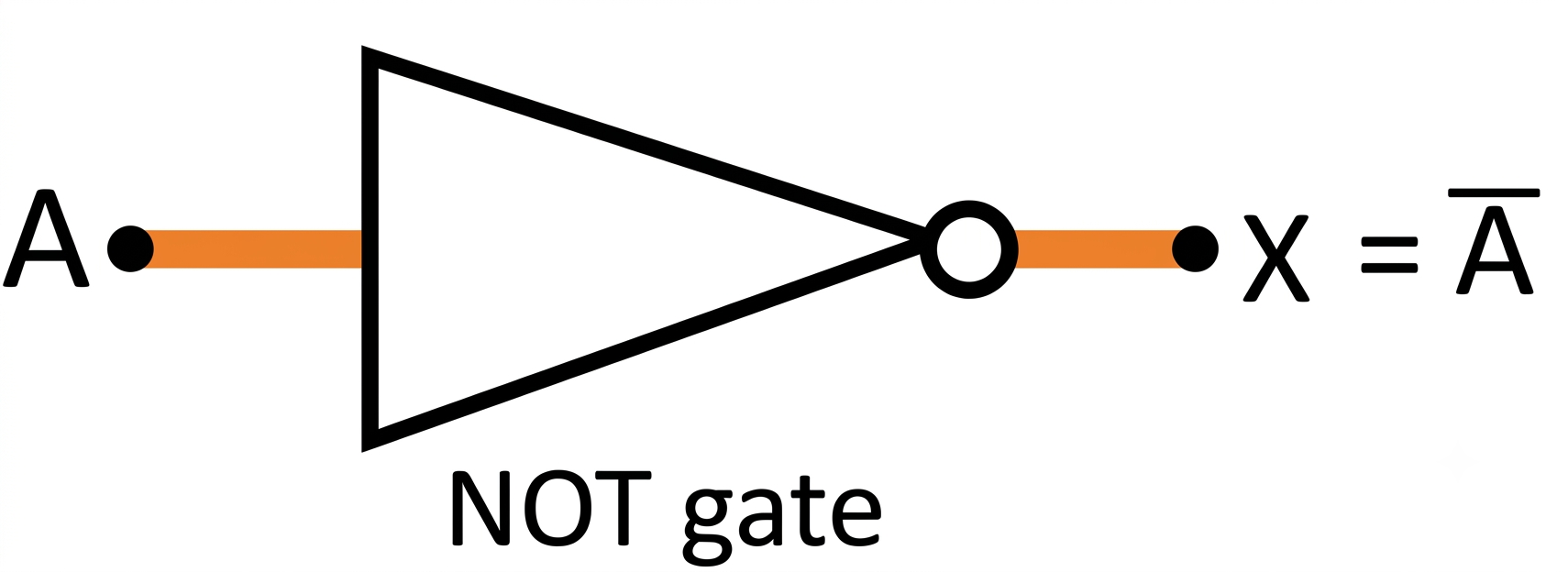
Answer: NOT gate has single input. It is also called an inverter as it inverts the input signal, i.e., if its input is 1, then the output will 0 and vice versa. Its logic equation is \(X = \bar{A}\).
✅ Inverts the input signal (1→0, 0→1).
NOT Gate Symbol:
19.9 What is the role of an AND gate in digital circuits?
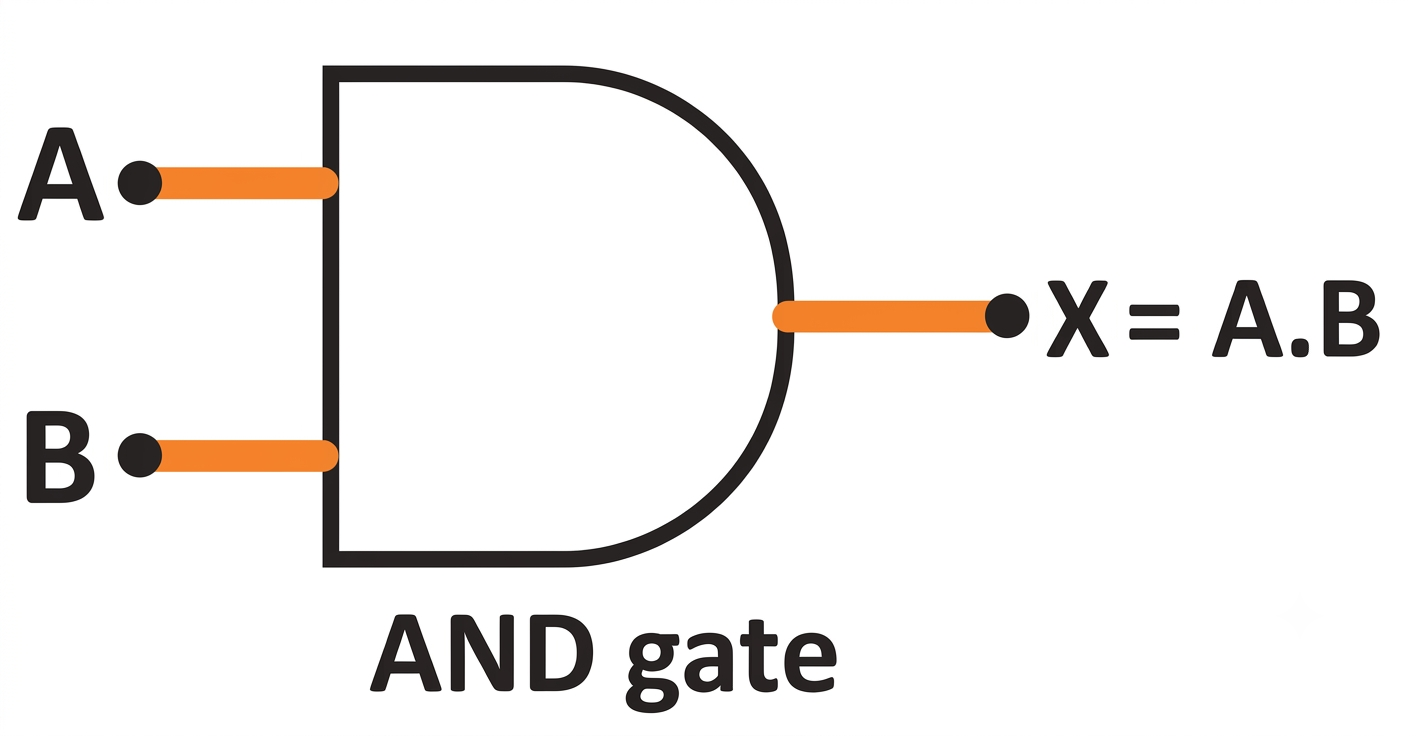
Answer: The AND gate has two inputs. The output of the AND gate will only be 1 (high) if both inputs are 1 (high). In other words, if A and B are two inputs of the AND gate, then output X will be 1 if \(A = 1\) and \(B = 1\). Its logic equation is \(X = A \cdot B\).
✅ Output 1 only if both inputs are 1.
AND Gate Symbol:
Truth table:
| A | B | X = A · B |
|---|---|---|
| 0 | 0 | 0 |
| 0 | 1 | 0 |
| 1 | 0 | 0 |
| 1 | 1 | 1 |
📐 Key Logic Equations – Electronics
NOT Gate: \( X = \bar{A} \)
AND Gate: \( X = A \cdot B \)
Unit 10Thermal Physics
Unit 11Transfer of Thermal Energy
Unit 12Waves
Unit 13Sound
Unit 14Light
Unit 15Electrostatics
Unit 16Electricity
Unit 17Electromagnetism
Unit 18Electromagnetic Induction & EM Waves
Unit 19✨ Electronics
Unit 20Atomic and Nuclear Physics
Unit 21Space and Environment
📖 Complete syllabus coverage for Class 10 Physics (PECTAA 2026) – Units 10 to 21
💡 Exam Tip:
For exercise short questions, write precise and to-the-point answers. Use key terms like "semiconductor diode", "forward bias", "depletion region", "LED", "ADC", "Boolean logic", "NOT gate", "AND gate" as they are commonly tested in exams. These questions follow the PECTAA 2026 pattern and are prepared by Subject Specialist Muhammad Tayyab.
Created by Hira Science Academy | Aligned with PECTAA 2026 Syllabus