💡 Chapter 19: Electronics – Constructed Response Questions
Prepared by Muhammad Tayyab, Subject Specialist Physics, Govt Christian High School Daska. Based on PECTAA 2026 syllabus (National Curriculum 2023).
📖 What's Inside: This section covers constructed response questions from Chapter 19 Electronics including diode reverse bias damage and physical limits, LED brightness control and display applications, digital vs analog signal reliability, NOT gate as inverter and its role in digital decision-making, and security system logic using NAND gates. Each question is presented with a detailed answer as per the official PECTAA 2026 Physics curriculum. Perfect for Punjab Boards (Lahore, Gujranwala, Multan, etc.) and all BISE boards across Pakistan.
📚 Related Resources – Chapter 19: Electronics
Electronics covers semiconductor devices, diodes, LEDs, logic gates, Boolean algebra, and digital circuits.
📝 Constructed Response Questions & Answers (PECTAA 2026)
19.1 Why would a diode be damaged if it is connected in reverse bias with a very high voltage? What does this tell us about the diode's physical limits?
Answer: A very high reverse voltage can cause the diode to break down and become damaged. This shows that a diode has physical limits on the reverse voltage it can withstand.
✅ High reverse voltage causes breakdown, showing diode's reverse voltage limit.
19.2 What makes an LED glow brighter or dimmer depending on the voltage applied? How is this property used in adjustable display brightness?
Answer: As the voltage increases beyond the threshold voltage, the current through the LED increases sharply, resulting in greater light emission. This property can be used to adjust the brightness of displays by controlling the voltage or current.
✅ LED brightness increases with current. Used to control display brightness.
19.3 Why are digital systems more reliable than analog systems when transmitting signals over long distances?
Answer: Digital signals have only two levels, high and low (1 and 0), so they can be distinguished more easily from noise. Therefore, digital signals can be transmitted over long distances with less loss of information.
✅ Digital signals are less affected by noise due to discrete levels.
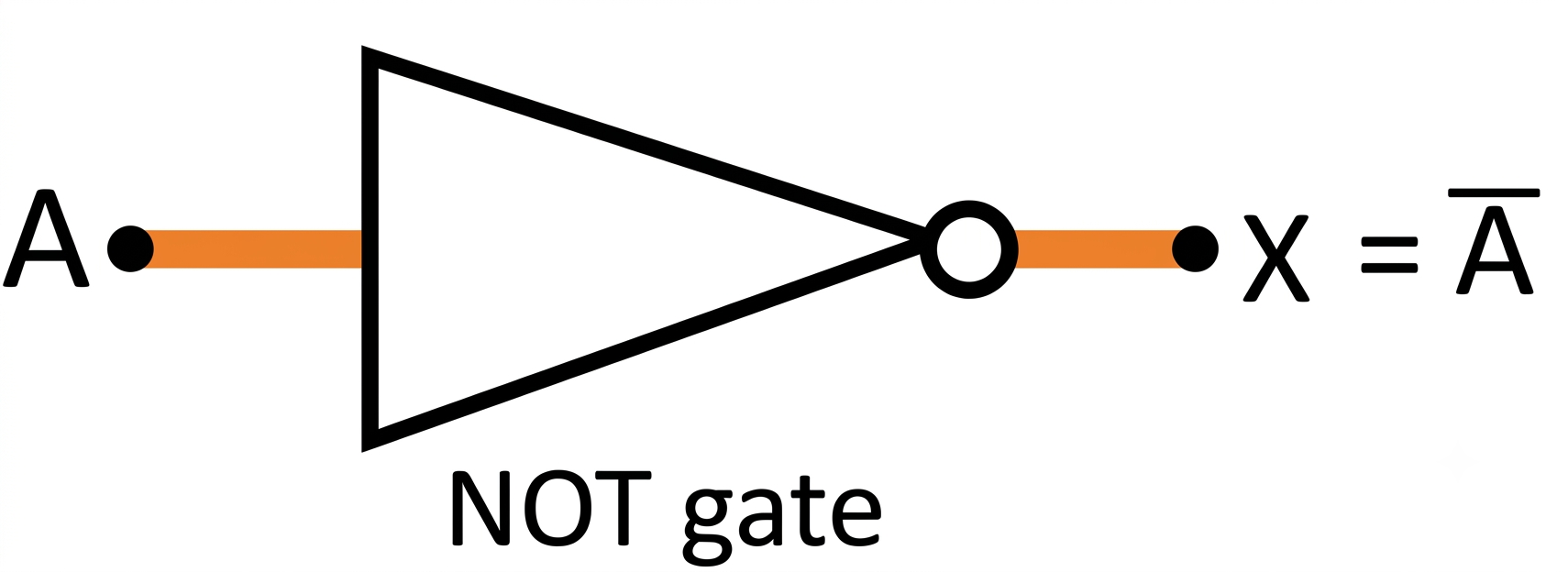
19.4 Why is the NOT gate also called an inverter, and how can such a simple function have a major role in digital decision-making?
Answer: A NOT gate is called an inverter because it reverses the input: 1 becomes 0 and 0 becomes 1. This simple operation is important for controlling and combining logical conditions in digital circuits.
✅ NOT gate inverts input. Essential for controlling and combining logical conditions.
NOT Gate Symbol:
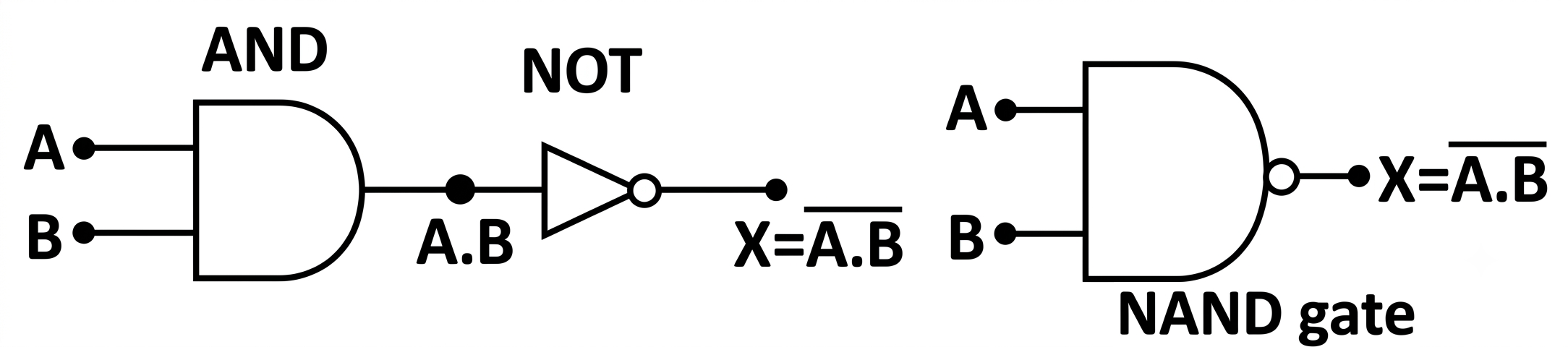
19.5 Why would a security system use NAND gates instead of OR or AND gates for certain logical conditions?
Answer: A NAND gate gives an output of 0 only when both inputs are 1 and gives 1 otherwise. This makes it useful for security systems where the alarm needs to be activated when one or more conditions are not satisfied.
✅ NAND gate outputs 1 unless both inputs are 1. Useful for alarm activation when conditions are not met.
NAND Gate Symbol:
Truth table:
| A | B | X = A · B |
|---|---|---|
| 0 | 0 | 1 |
| 0 | 1 | 1 |
| 1 | 0 | 1 |
| 1 | 1 | 0 |
📐 Key Logic Equations – Electronics
NOT Gate: \( X = \bar{A} \)
NAND Gate: \( X = \overline{A \cdot B} \)
Unit 10Thermal Physics
Unit 11Transfer of Thermal Energy
Unit 12Waves
Unit 13Sound
Unit 14Light
Unit 15Electrostatics
Unit 16Electricity
Unit 17Electromagnetism
Unit 18Electromagnetic Induction & EM Waves
Unit 19✨ Electronics
Unit 20Atomic and Nuclear Physics
Unit 21Space and Environment
📖 Complete syllabus coverage for Class 10 Physics (PECTAA 2026) – Units 10 to 21
💡 Exam Tip:
For constructed response questions, write clear and concise answers with reasoning. Use key terms like "reverse bias breakdown", "LED threshold voltage", "digital vs analog signals", "NOT gate inverter", and "NAND gate security applications". These questions follow the PECTAA 2026 pattern and are prepared by Subject Specialist Muhammad Tayyab.
Created by Hira Science Academy | Aligned with PECTAA 2026 Syllabus