📘 Chapter 4: Turning Effect of Forces – Short Answer Questions
Prepared by Muhammad Tayyab, Subject Specialist Physics, Govt Christian High School Daska. Based on PECTAA 2026 syllabus (National Curriculum 2023).
📖 What's Inside: This section covers short answer questions from Chapter 4 Turning Effect of Forces including parallel forces, rigid body, axis of rotation, moment arm, turning effect, torque, couple, resolution of forces, rectangular components, principle of moments, centre of mass and gravity, equilibrium (static & dynamic), conditions of equilibrium, states of equilibrium, stability, rotational motion, centripetal force and its sources. Each question is presented with a detailed answer as per the official PECTAA 2026 Physics curriculum. Perfect for Punjab Boards (Lahore, Gujranwala, Multan, etc.) and all BISE boards across Pakistan.
📚 Related Resources – Chapter 4: Turning Effect of Forces
📋 Exercise Short Qs
📝 Short Qs
📖 Comprehensive Qs
🔢 Numerical Problems
✅ MCQs
✏️ Constructed Response
Turning Effect of Forces covers torque, equilibrium, center of mass, and couple.
📑 Quick Jump to Questions
📖 Short Answer Questions & Answers (PECTAA 2026)
1 What are parallel forces?
Answer:
All those forces which act parallel to one another are known as parallel forces. The points of application of such forces may be different.
✅ Forces that act parallel to each other.
2 Define like and unlike parallel forces. Illustrate with an example.
Answer:
If the parallel forces are acting in the same direction, then they are called like parallel forces, and if their directions are opposite to one another, they are called unlike parallel forces.
Example: Three forces \(F_1, F_2\) and \(F_3\) acting on a rigid body at different points. Here, \(F_1\) and \(F_2\) are like parallel forces but \(F_2\) and \(F_3\) are unlike parallel forces.
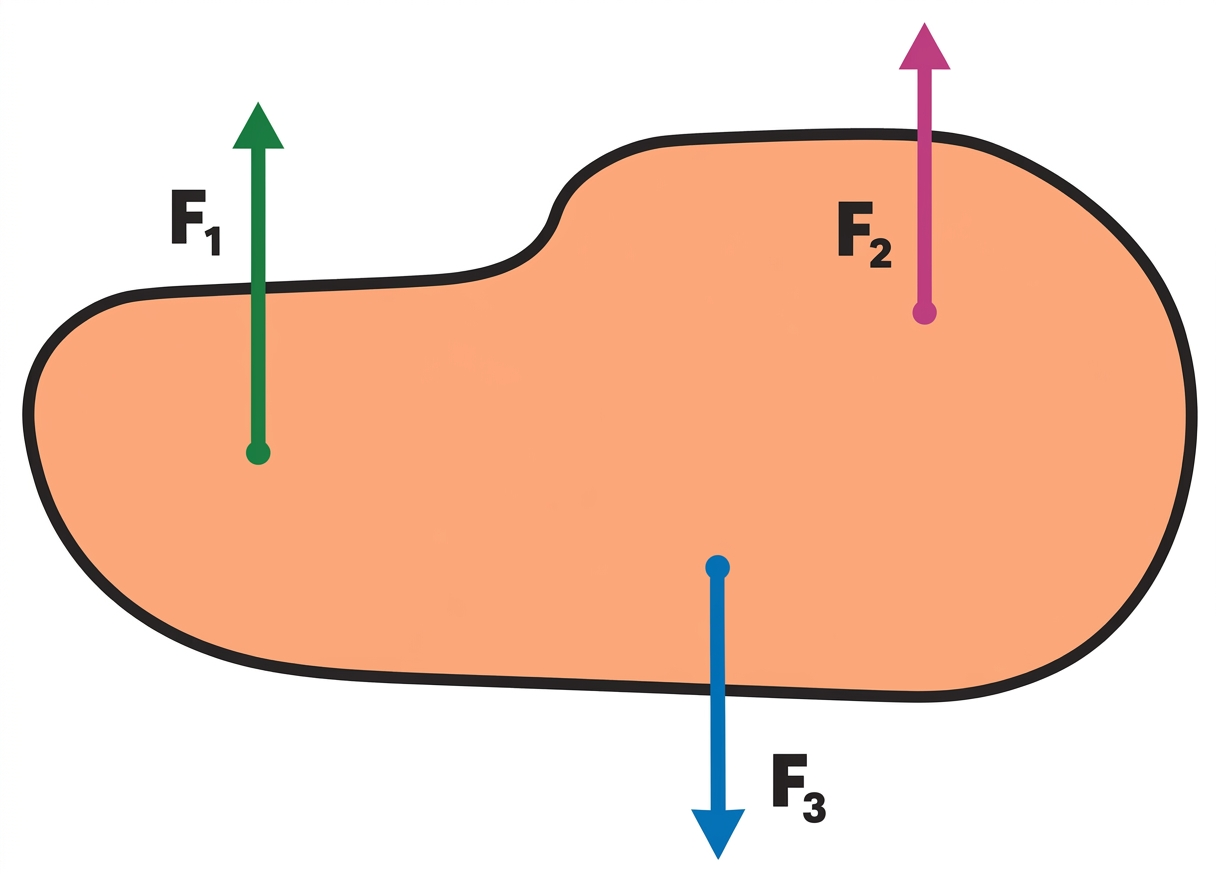
Figure: Like and Unlike Parallel Forces
✅ Like: same direction; Unlike: opposite directions.
3 What is a rigid body?
Answer:
If the distance between two points of the body remains the same under the action of a force, it is called a rigid body.
✅ Distance between any two points remains constant.
4 What is the axis of rotation?
Answer:
During rotation, all the particles of the rigid body rotate along fixed circles. The straight line joining the centres of these circles is called the axis of rotation.
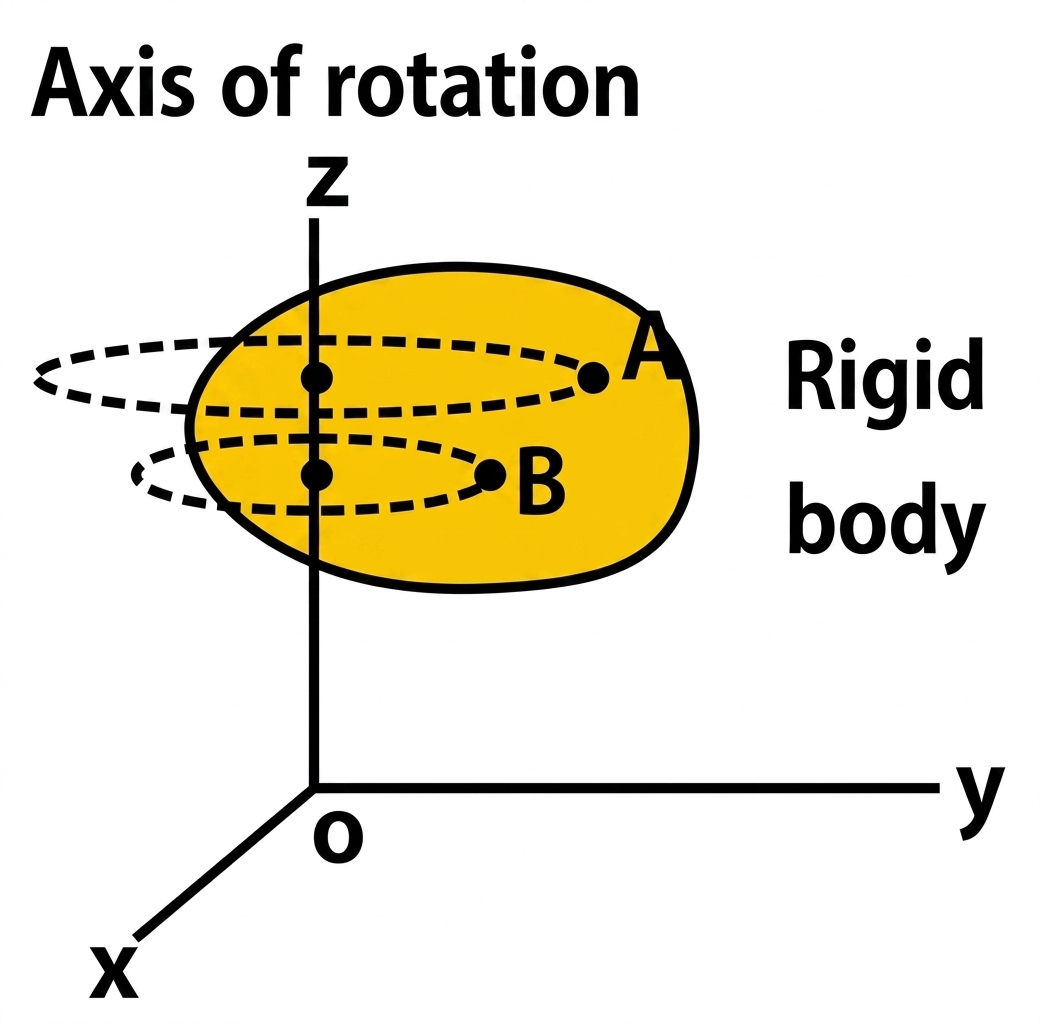
Figure: Axis of Rotation
✅ Line joining centres of circular paths of particles.
5 What is the line of action of a force?
Answer:
The line along which the force acts is called the line of action of the force.
✅ Line along which force acts.
6 What is a moment arm?
Answer:
The perpendicular distance of the line of action of a force from the axis of rotation is known as moment arm of the force.
✅ Perpendicular distance from axis of rotation to line of action.
7 What is the turning effect of a force? Give examples.
Answer:
The turning effect of a force is the force that causes a rigid body to rotate about an axis.
Example: We use turning effect of force when we open or close a water tap.
✅ Force that causes rotation. Example: opening a tap.
8 On what factors does the turning effect of a force depend?
Answer:
The turning effect of a force depends on two main factors:
(i) Magnitude of the Force: The greater the applied force, the greater is its turning effect.
(ii) Perpendicular Distance (Moment Arm): The larger the perpendicular distance between the line of action of the force and the axis of rotation, the greater is the turning effect.
✅ Depends on force magnitude and moment arm.
9 What is the moment of force or torque?
Answer:
Moment of a force or torque is defined as the product of the force and the moment arm.
\(\tau = F \times l\)
Where \(\tau\) (tau) is the torque, \(F\) is the applied force, and \(l\) is the moment arm.
The SI unit of torque is newton metre (Nm).
✅ \(\tau = F \times l\), unit: Nm.
10 When is the torque of a force zero?
Answer:
The torque of a force is zero when the line of action of a force passes through the axis of rotation, because its moment arm becomes zero.
✅ When line of action passes through axis of rotation.
11 What is a couple?
Answer:
When two equal and opposite parallel forces act at two different points of the same body, they form a couple.
A couple is a special type of torque.
✅ Two equal, opposite, parallel forces at different points.
12 What is meant by resolution of a force and component of a vector?
Answer:
Resolution of a Force: To divide a force into its components is known as resolution of a force.
Component of a Vector: A component of a vector is its effective value in a given direction.
✅ Resolution: dividing force into components. Component: effective value in a direction.
13 What are rectangular (perpendicular) components of a vector and their values?
Answer:
Usually, a force is resolved into two components which are perpendicular to each other. These are called its perpendicular or rectangular components of the force.
Their values are:
\(F_x = F \cos \theta\)
\(F_y = F \sin \theta\)
✅ \(F_x = F \cos \theta\), \(F_y = F \sin \theta\).
14 What is the principle of moments?
Answer:
When a body is in balanced position, the sum of clockwise moments about any point equals the sum of anticlockwise moments about that point.
✅ Sum of clockwise moments = Sum of anticlockwise moments.
15 Define centre of mass and centre of gravity of a body.
Answer:
Centre of Mass: The centre of mass of a body is that point where the whole mass of the body is assumed to be concentrated.
Centre of Gravity: The centre of gravity is a point inside or outside the body at which the whole weight of the body is acting.
✅ Centre of Mass: whole mass concentrated. Centre of Gravity: whole weight acts.
16 What is the relation between centre of mass and centre of gravity on the surface of Earth?
Answer:
On the surface of the Earth, where \(g\) is almost uniform, the centre of mass of an object coincides with its centre of gravity.
✅ They coincide when \(g\) is uniform.
17 Where is the centre of gravity located for geometric shapes like a square, rectangle, and triangle?
Answer:
Square, Rectangle: Point of intersection of the diagonals.
Triangle: Point of intersection of the medians.
✅ Square/Rectangle: intersection of diagonals. Triangle: intersection of medians.
18 What are the locations of the centre of gravity for a round plate, sphere, cylinder, and metre rule?
Answer:
Round plate: Centre of the plate.
Sphere: Centre of the sphere.
Cylinder: Centre of the axis.
Metre rule: Centre of the rod.
✅ Round plate: centre; Sphere: centre; Cylinder: centre of axis; Metre rule: centre.
19 Define equilibrium. What are the two types of equilibrium?
Answer:
Equilibrium: A body is said to be in equilibrium if it has no acceleration.
Types:
(i) Static Equilibrium: A body at rest is said to be in static equilibrium.
(ii) Dynamic Equilibrium: A body moving with uniform velocity is said to be in dynamic equilibrium.
✅ Static (at rest) and Dynamic (uniform velocity).
20 State the conditions of equilibrium.
Answer:
First Condition of Equilibrium: A body is said to be in translational equilibrium only if the vector sum of all the external forces acting on it is equal to zero.
\(\sum F = 0\)
Second Condition of Equilibrium: The vector sum of all the torques acting on a body about any point must be zero.
\(\sum \tau = 0\)
✅ \(\sum F = 0\) and \(\sum \tau = 0\).
21 What are the three states of equilibrium? Also write one example of each.
Answer:
1. Stable Equilibrium: A body is said to be in a state of stable equilibrium, if after a slight tilt, it comes back to its original position.
Example: A cone standing on its base comes back to its original position when slightly tilted.
2. Unstable Equilibrium: A body is said to be in a state of unstable equilibrium, if after a slight tilt, it tends to move on further away from its original position.
Example: A cone standing on its vertex moves further away from its original position when slightly tilted.
3. Neutral Equilibrium: A body is in neutral equilibrium, if it comes to rest in its new position after disturbance without any change in its centre of mass.
Example: A ball lying on a horizontal surface comes to rest in its new position when moved.
✅ Stable (returns), Unstable (topples), Neutral (stays in new position).
22 How can the stability of a system be improved?
Answer:
We can improve the stability of a system either by lowering the centre of gravity or by widening the base.
To enhance the stability of racing cars, their centres of mass are kept as low as possible. Their base areas are also increased by keeping the wheel outside of their main bodies.
✅ Lower centre of gravity or widen the base.
23 State the law of rotational motion analogous to Newton's first law.
Answer:
A rotating object will continue to do so with constant angular velocity unless acted upon by a resultant moment (torque). If a resultant torque is applied, the rotating object will accelerate depending on the direction of the torque relative to the axis of rotation.
✅ Rotational analogue of Newton's First Law.
24 Why is a force required to keep an object moving with uniform speed in a circular path?
Answer:
When a body moves along a circular path, its velocity is constantly changing because the direction of the tangent at each point is different. Hence, a force perpendicular to the direction of motion is always required to keep the object moving with uniform speed in a circular path.
✅ Velocity changes direction, so a force is needed.
25 What is centripetal force? Write its formula.
Answer:
The force that causes an object to move in a circle at constant speed is called the centripetal force.
For an object of mass \(m\) moving with uniform speed \(v\) in a circle of radius \(r\), the centripetal force \(F_c\) is given by:
\(F_c = \frac{mv^2}{r}\)
✅ \(F_c = \frac{mv^2}{r}\)
26 What provides the centripetal force to a stone whirled by a string?
Answer:
The tension \(T\) in the string provides the necessary centripetal force to keep the stone along the circular path.
✅ Tension in the string.
27 What provides the centripetal force to the Moon and satellites orbiting the Earth?
Answer:
The gravitational pull of the Earth provides the necessary centripetal force to keep the Moon and satellites in their circular orbits.
✅ Gravitational pull of the Earth.
28 What provides the centripetal force in a washing machine dryer?
Answer:
Friction between the clothes and the drum walls provides the necessary centripetal force.
✅ Friction between clothes and drum.
📐 Key Concepts – Turning Effect of Forces (Short Answers)
Torque: \(\tau = F \times l\)
Rectangular Components: \(F_x = F \cos \theta\), \(F_y = F \sin \theta\)
Equilibrium: \(\sum F = 0\), \(\sum \tau = 0\)
Centripetal Force: \(F_c = \frac{mv^2}{r}\)
Stability: Lower CG or widen base.
💡 Exam Tip:
For short answer questions, provide concise and accurate definitions with key equations. These questions test your understanding of fundamental concepts in the Turning Effect of Forces chapter. Focus on clarity and precision in your answers. These questions follow the PECTAA 2026 pattern and are prepared by Subject Specialist Muhammad Tayyab.
Chapter 1Physical Quantities and Measurements
Chapter 2Kinematics
Chapter 3Dynamics
Chapter 4✨ Turning Effect of Forces
Chapter 5Work and Energy
Chapter 6Mechanical Properties of Matter
Chapter 7Thermal Properties of Matter
Chapter 8Magnetism
Chapter 9Nature of Science
📖 Complete syllabus coverage for Class 9 Physics (PECTAA 2026) – Chapters 1 to 9
Created by Hira Science Academy | Aligned with PECTAA 2026 Syllabus