📘 Chapter 4: Turning Effect of Forces – Comprehensive Questions
Prepared by Muhammad Tayyab, Subject Specialist Physics, Govt Christian High School Daska. Based on PECTAA 2026 syllabus (National Curriculum 2023).
📖 What's Inside: This section covers comprehensive questions from Chapter 4 Turning Effect of Forces including Principle of Moments, Determination of Centre of Gravity of Irregular Lamina, Conditions of Equilibrium, and Improvement of Stability. Each question is presented with a detailed answer as per the official PECTAA 2026 Physics curriculum. Perfect for Punjab Boards (Lahore, Gujranwala, Multan, etc.) and all BISE boards across Pakistan.
📚 Related Resources – Chapter 4: Turning Effect of Forces
📋 Exercise Short Qs
📝 Short Qs
📖 Comprehensive Qs
🔢 Numerical Problems
✅ MCQs
✏️ Constructed Response
Turning Effect of Forces covers torque, equilibrium, center of mass, and couple.
📖 Comprehensive Questions & Answers (PECTAA 2026)
4.1 Explain the principle of moments with an example.
Answer:
Principle of Moments: When a body is in balanced position, the sum of clockwise moments about any point equals the sum of anticlockwise moments about that point.
Example: To understand this principle, consider a metre rule balanced on a wedge at its centre of gravity (CG) so that the rule stays horizontal. Suppose two weights \(w_{1}\) and \(w_{2}\) are suspended on one side of the metre rule at distances \(l_{1}\) and \(l_{2}\) from the centre, and a third weight \(w_{3}\) is suspended on the other side at distance \(l_{3}\), until the rule is again balanced.
The weights \(w_{1}\) and \(w_{2}\) tend to rotate the rod anticlockwise about CG. The weight \(w_{3}\) tends to rotate it clockwise. The values of the moments of the weights are: \(w_{1} \times l_{1}\), \(w_{2} \times l_{2}\), \(w_{3} \times l_{3}\).
When the metre rule is balanced, then:
Total anticlockwise moments = Total clockwise moments
\((w_{1} \times l_{1}) + (w_{2} \times l_{2}) = w_{3} \times l_{3}\)
This equation verifies the principle of moments.
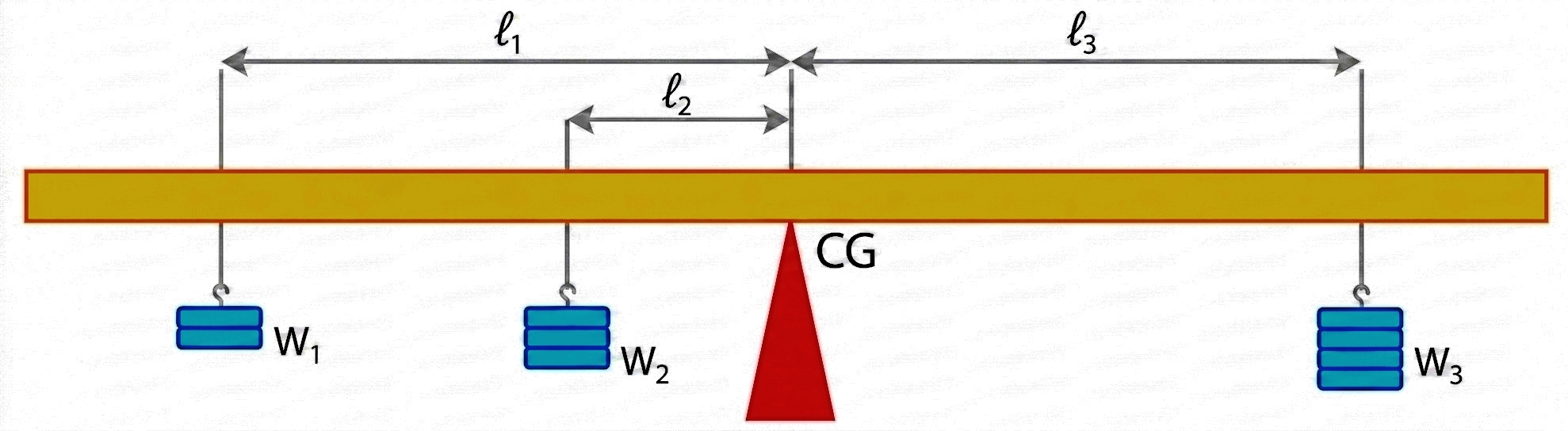
Figure: Metre rule balanced on a wedge – Principle of Moments
✅ For equilibrium: Sum of clockwise moments = Sum of anticlockwise moments.
4.2 Describe how could you determine the centre of gravity of an irregular shaped lamina experimentally.
Answer:
To find the centre of gravity of an irregular shaped plane lamina, it can be suspended freely through different points. Each time the object is suspended, its centre of gravity lies on the vertical line drawn from the point of suspension using a plumbline. The exact position of the centre of gravity is at the point where two such vertical lines cross each other.
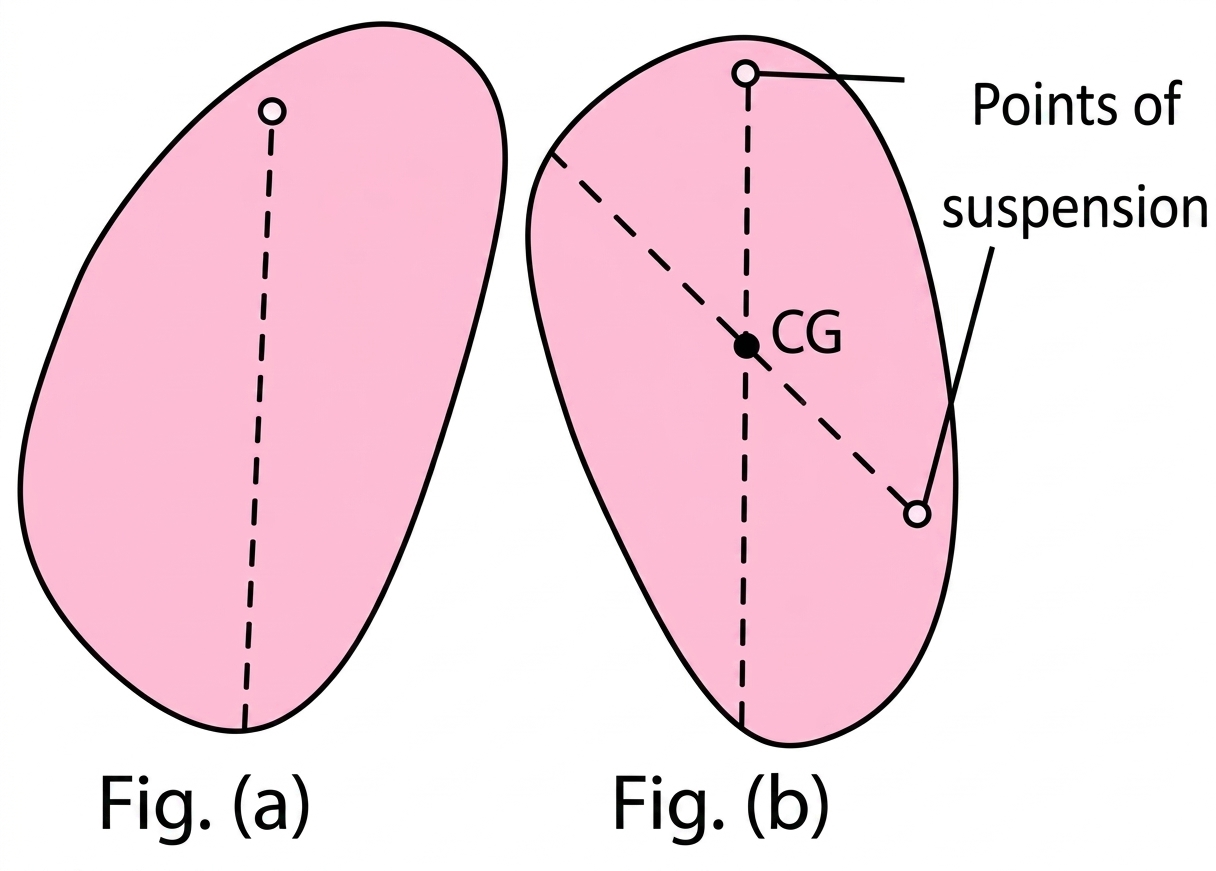
Figure: Determining Centre of Gravity of Irregular Lamina
✅ The centre of gravity is the intersection point of vertical lines drawn from different suspension points.
4.3 State and explain the conditions of equilibrium. Show that if two equal and opposite forces act at two different points of a body, the resultant force is zero but the resultant torque is not zero.
Answer:
First Condition of Equilibrium: The vector sum of all the external forces acting on a body must be zero.
\(\sum F = 0\)
The sum of all the components of forces along the x-axis should be zero, and the sum of all the components of forces along the y-axis should also be zero.
Second Condition of Equilibrium: The vector sum of all the torques acting on a body about any point must be zero.
\(\sum \tau = 0\)
The second condition of equilibrium applies to rotational equilibrium, which means that the body should not rotate under the action of the forces.
Explanation: Consider a rigid body. Two forces \(F_{1}\) and \(F_{2}\) of equal magnitude are acting on it:
In case (a), both forces act along the same line of action. Their resultant force is zero. Thus, the first condition of equilibrium is satisfied.
In case (b), the lines of action of the two forces are different. Although the resultant force is zero, the forces form a couple which can produce torque and rotate the body about a point.
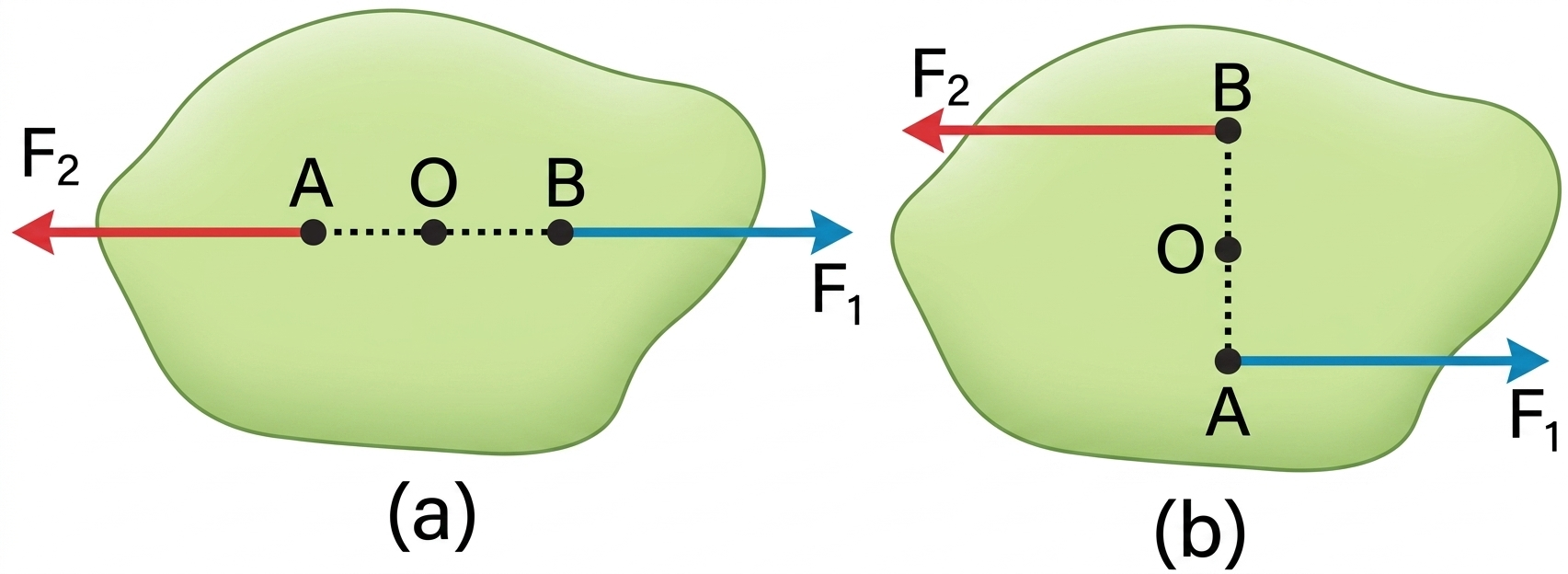
Figure: Equal and opposite forces – resultant force zero but torque not zero
✅ For complete equilibrium: \(\sum F = 0\) and \(\sum \tau = 0\).
4.4 How the stability of an object can be improved? Give a few examples to support your answer.
Answer:
The stability of a system can be improved in two ways:
1. Lowering the centre of gravity: Keeping the centre of gravity as low as possible.
2. Widening the base area: Increasing the area of support at the base.
Daily Life Applications & Examples:
Low Armchair: A low armchair is more stable than a high chair because of its low centre of gravity.
Loading a Bus: If heavy loads are placed on the floor of a bus, its centre of gravity remains low and it stays in stable equilibrium. Placing heavy items (like steel sheets) on top raises its centre of gravity, bringing it near an unstable state where a slight tilt can overturn it.
Racing Cars: To prevent racing cars from toppling over at high speeds and sharp turns, their centre of mass is kept as low as possible and their base area is increased by placing the wheels outside the main body.
Balancing Toys: Balancing toys are designed so that their centre of gravity always remains below the pivot point. When disturbed, the centre of gravity is raised, and the toy automatically returns to its initial stable position by lowering its centre of gravity.
✅ Stability improved by: (1) Lowering centre of gravity, (2) Widening base area.
📐 Key Concepts – Turning Effect of Forces (Comprehensive)
Principle of Moments: Sum of clockwise moments = Sum of anticlockwise moments.
First Condition of Equilibrium: \(\sum F = 0\)
Second Condition of Equilibrium: \(\sum \tau = 0\)
Torque: \(\tau = F \times d = rF\sin\theta\)
Centre of Gravity: Point where whole weight of body is acting.
Stability: Improved by lowering CG or widening base.
💡 Exam Tip:
For comprehensive questions, write detailed answers with clear explanations, definitions, and mathematical derivations where required. Use diagrams to support your explanations (as shown in the figures). These questions test your in-depth understanding of concepts like torque, equilibrium, center of gravity, and stability. These questions follow the PECTAA 2026 pattern and are prepared by Subject Specialist Muhammad Tayyab.
Chapter 1Physical Quantities and Measurements
Chapter 2Kinematics
Chapter 3Dynamics
Chapter 4✨ Turning Effect of Forces
Chapter 5Work and Energy
Chapter 6Mechanical Properties of Matter
Chapter 7Thermal Properties of Matter
Chapter 8Magnetism
Chapter 9Nature of Science
📖 Complete syllabus coverage for Class 9 Physics (PECTAA 2026) – Chapters 1 to 9
Created by Hira Science Academy | Aligned with PECTAA 2026 Syllabus