📘 Chapter 4: Turning Effect of Forces – Exercise Short Answer Questions
Prepared by Muhammad Tayyab, Subject Specialist Physics, Govt Christian High School Daska. Based on PECTAA 2026 syllabus (National Curriculum 2023).
📖 What's Inside: This section covers exercise short answer questions from Chapter 4 Turning Effect of Forces including like and unlike parallel forces, rectangular components, line of action, moment of force (torque), resultant force and torque, states of equilibrium, dynamic equilibrium, centre of mass and gravity, stability principles, and centripetal force. Each question is presented with a detailed answer as per the official PECTAA 2026 Physics curriculum. Perfect for Punjab Boards (Lahore, Gujranwala, Multan, etc.) and all BISE boards across Pakistan.
📚 Related Resources – Chapter 4: Turning Effect of Forces
📋 Exercise Short Qs
📝 Short Qs
📖 Comprehensive Qs
🔢 Numerical Problems
✅ MCQs
✏️ Constructed Response
Turning Effect of Forces covers torque, equilibrium, center of mass, and couple.
📖 Exercise Short Answer Questions & Answers (PECTAA 2026)
4.1 Define like and unlike parallel forces.
Answer:
If the parallel forces are acting in the same direction, then they are called like parallel forces and if their directions are opposite to one another, they are called unlike parallel forces.
✅ Like: same direction; Unlike: opposite directions.
4.2 What are rectangular components of a vector and their values?
Answer:
Usually, a force is resolved into two components which are perpendicular to each other. These are called its perpendicular or rectangular components of the force.
Their values are:
\(F_x = F \cos \theta\)
\(F_y = F \sin \theta\)
✅ Rectangular components: \(F_x = F \cos \theta\), \(F_y = F \sin \theta\).
4.3 What is the line of action of a force?
Answer:
The line along which the force acts is called the line of action of the force.
✅ Line along which force acts.
4.4 Define moment of a force. Prove that \(\tau = rF \sin \theta\), where \(\theta\) is angle between \(r\) and \(F\).
Answer:
Moment of a force or torque is defined as the product of the force and the moment arm.
\(\tau = F \times l\)
When the force \(F\) acts at an angle \(\theta\) to the position vector \(r\), the perpendicular component of the position vector is:
\(l = r \sin \theta\)
Therefore,
\(\tau = F(r \sin \theta)\)
\(\tau = rF \sin \theta\)
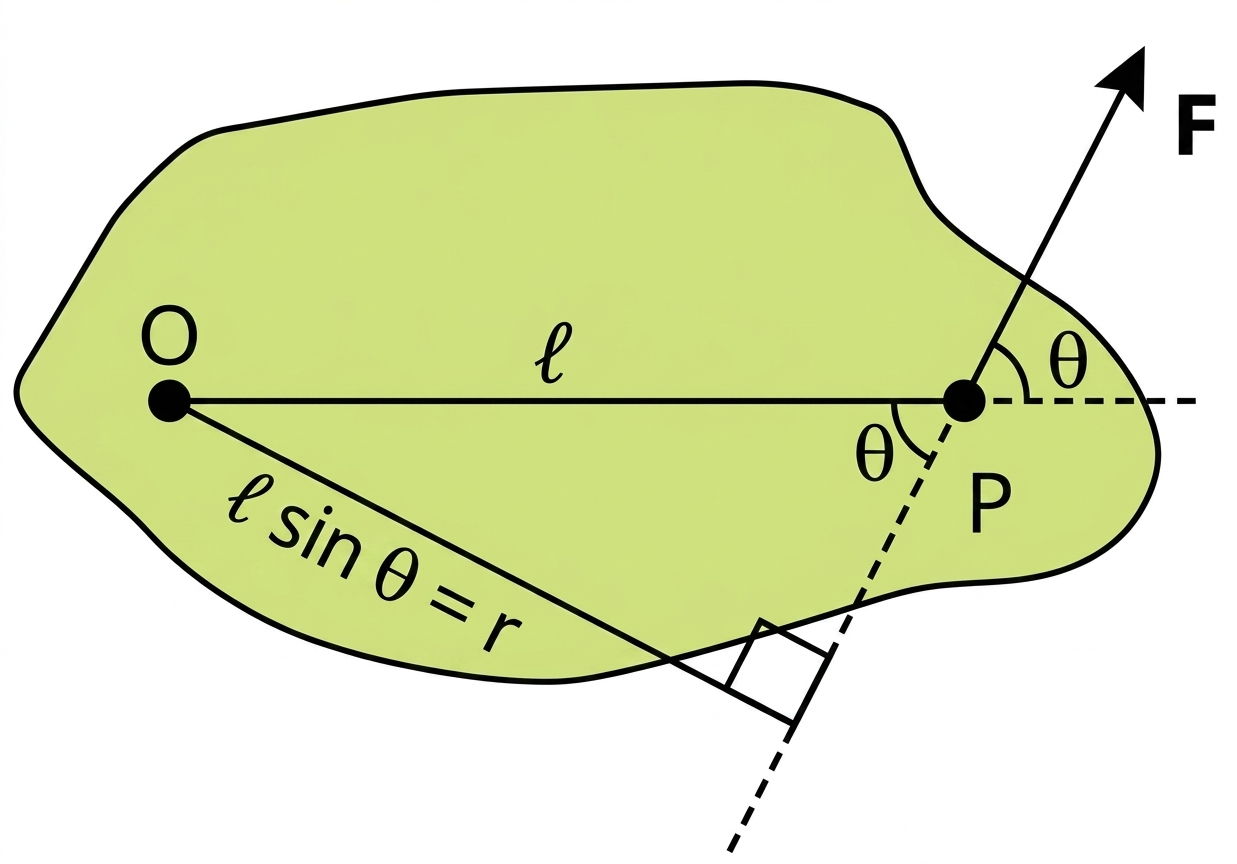
Figure: Moment of Force (Torque)
✅ \(\tau = rF \sin \theta\)
4.5 With the help of a diagram, show that the resultant force is zero but the resultant torque is not zero.
Answer:
When two equal and opposite parallel forces act at two different points of the same body, their resultant force is zero but they form a couple which produces torque.
\(\sum F = 0\)
\(\sum \tau \neq 0\)
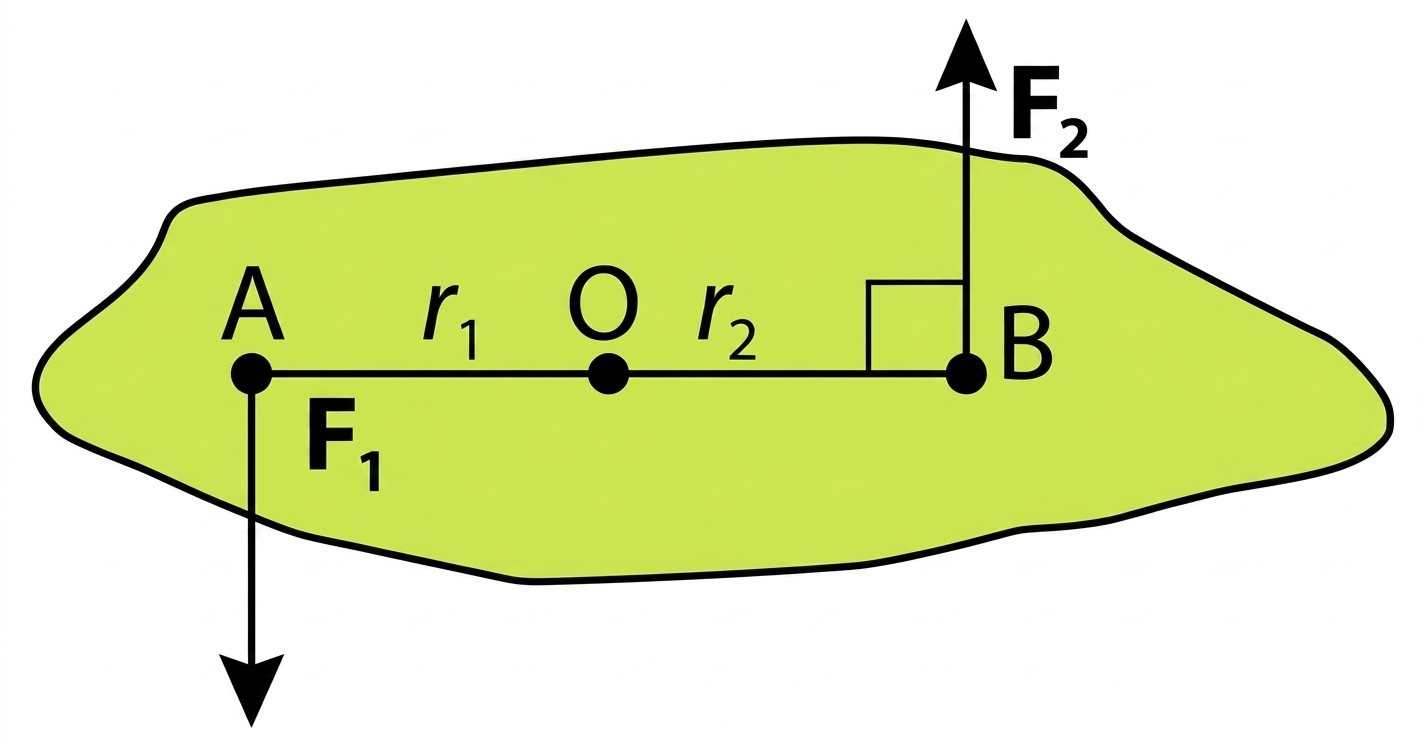
Figure: Equal and opposite forces – resultant force zero but torque not zero
✅ Resultant force is zero, but resultant torque is not zero (couple).
4.6 Identify the state of equilibrium in each case in the figure given below.
Answer:
(a) The cone is in stable equilibrium because it returns to its original position after being tilted.
(b) The hemisphere with a ball on top is in unstable equilibrium because it topples away from its original position after being tilted.
(c) The cylinder is in neutral equilibrium because it stays in its new position after being tilted.
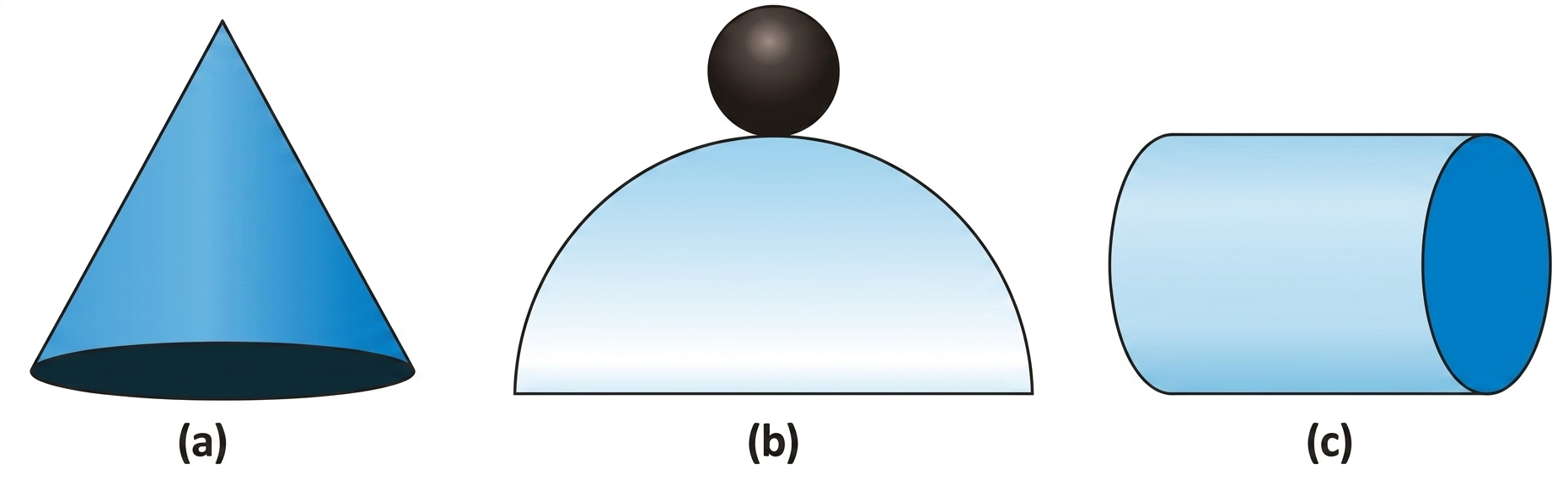
Figure: States of Equilibrium – Stable, Unstable, Neutral
✅ Stable: returns to original; Unstable: topples away; Neutral: stays in new position.
4.7 Give an example of the body which is moving yet in equilibrium.
Answer:
A paratrooper descending with uniform velocity is in dynamic equilibrium. The force of gravity acting downward is balanced by the resistance of air acting upward.
✅ Paratrooper descending with uniform velocity (dynamic equilibrium).
4.8 Define centre of mass and centre of gravity of a body.
Answer:
Centre of Mass: The centre of mass of a body is that point where the whole mass of the body is assumed to be concentrated.
Centre of Gravity: The centre of gravity is a point inside or outside the body at which the whole weight of the body is acting.
✅ Centre of Mass: point where whole mass is concentrated. Centre of Gravity: point where whole weight acts.
4.9 What are two basic principles of stability in physics which are applied in designing balancing toys and racing cars?
Answer:
We can improve the stability of a system either by lowering the centre of gravity or by widening the base.
✅ 1. Lower centre of gravity. 2. Widen the base area.
4.10 How can you prove that the centripetal force always acts perpendicular to velocity?
Answer:
When a body is moving along a circular path, its velocity at any point is directed along the tangent drawn at that point. The centripetal force is directed towards the centre of the circle. The tangent to a circle is perpendicular to its radius. Therefore, the centripetal force always acts perpendicular to the velocity.
✅ Centripetal force is towards centre; velocity is tangent; radius ⟂ tangent, so force ⟂ velocity.
📐 Key Concepts – Turning Effect of Forces (Exercise Short)
Rectangular Components: \(F_x = F \cos \theta\), \(F_y = F \sin \theta\)
Torque: \(\tau = rF \sin \theta\)
Couple: \(\sum F = 0\), \(\sum \tau \neq 0\)
Equilibrium: Stable, Unstable, Neutral
Stability: Lower CG or widen base.
Centripetal Force: Always perpendicular to velocity.
💡 Exam Tip:
For exercise short answer questions, provide concise and accurate definitions with key equations. These questions test your understanding of fundamental concepts in the Turning Effect of Forces chapter. Focus on clarity and precision in your answers. These questions follow the PECTAA 2026 pattern and are prepared by Subject Specialist Muhammad Tayyab.
Chapter 1Physical Quantities and Measurements
Chapter 2Kinematics
Chapter 3Dynamics
Chapter 4✨ Turning Effect of Forces
Chapter 5Work and Energy
Chapter 6Mechanical Properties of Matter
Chapter 7Thermal Properties of Matter
Chapter 8Magnetism
Chapter 9Nature of Science
📖 Complete syllabus coverage for Class 9 Physics (PECTAA 2026) – Chapters 1 to 9
Created by Hira Science Academy | Aligned with PECTAA 2026 Syllabus