📘 Chapter 4: Turning Effect of Forces – Numerical Problems
Prepared by Muhammad Tayyab, Subject Specialist Physics, Govt Christian High School Daska. Based on PECTAA 2026 syllabus (National Curriculum 2023).
📖 What's Inside: This section covers numerical problems from Chapter 4 Turning Effect of Forces including rectangular components of force, torque calculation, equilibrium problems, principle of moments, and tension in strings. Each problem is presented with Given Data, To Find, and step-by-step Solution as per the official PECTAA 2026 Physics curriculum. Perfect for Punjab Boards (Lahore, Gujranwala, Multan, etc.) and all BISE boards across Pakistan.
📚 Related Resources – Chapter 4: Turning Effect of Forces
📋 Exercise Short Qs
📝 Short Qs
📖 Comprehensive Qs
🔢 Numerical Problems
✅ MCQs
✏️ Constructed Response
Turning Effect of Forces covers torque, equilibrium, center of mass, and couple.
📐 Numerical Problems & Solutions (PECTAA 2026)
4.1
A force of \(200N\) is acting on a cart at an angle of \(30^\circ\) with the horizontal direction. Find the x and y-components of the force.
Given Data
Force\(F = 200\ N\)
Angle\(\theta = 30^\circ\)
To Find
x-component of force \(F_x = ?\)
y-component of force \(F_y = ?\)
Solution
Using the formulas for rectangular components:
\[\begin{aligned}
F_x &= F \cos \theta = 200 \cos 30^\circ = 200(0.866) = 173.2\ N \\
F_y &= F \sin \theta = 200 \sin 30^\circ = 200(0.5) = 100\ N
\end{aligned}\]
✅ \(F_x = 173.2\ N\), \(F_y = 100\ N\)
4.2
A force of \(300N\) is applied perpendicularly at the knob of a door to open it. If the knob is \(1.2m\) away from the hinge, what is the torque applied? Is it positive or negative torque?
Given Data
Force applied\(F = 300\ N\)
Moment arm\(l = 1.2\ m\)
To Find
Torque \(\tau = ?\)
Solution
Using the formula for torque:
\[\begin{aligned}
\tau &= F \times l \\
\tau &= 300 \times 1.2 \\
\tau &= 360\ Nm
\end{aligned}\]
Since the force turns the door counterclockwise, the torque is positive.
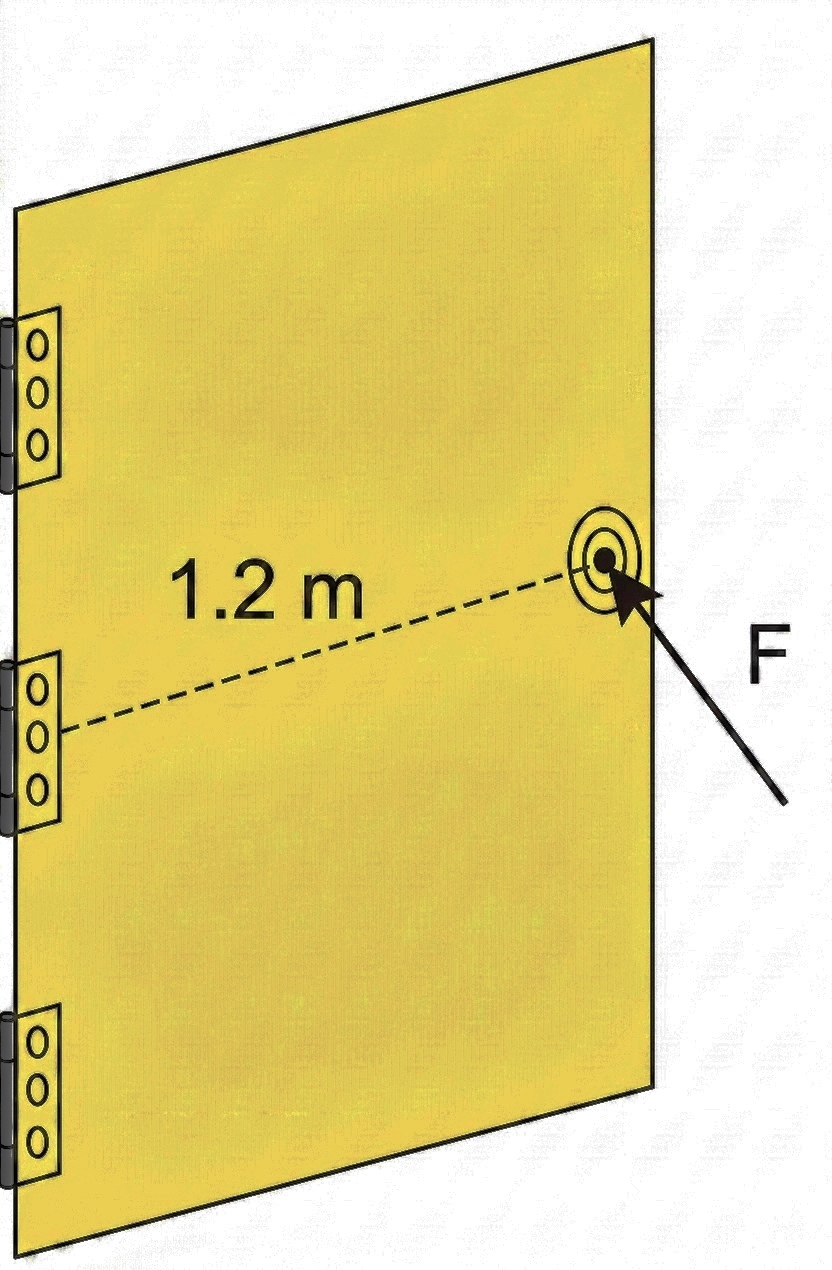
Figure: Force applied to door knob – Torque calculation
✅ \(\tau = 360\ Nm\) (Positive torque)
4.3
Two weights are hanging from a metre rule at the positions as shown in the given figure. If the rule is balanced at its centre of gravity (C.G), find the unknown weight \(w\).
Given Data
Distance of unknown weight from C.G.\(= 40\ cm = 0.4\ m\)
Distance of \(4N\) weight from C.G.\(= 30\ cm = 0.3\ m\)
Weight on right side\(= 4\ N\)
To Find
Unknown weight \(w = ?\)
Solution
By principle of moments:
\[\begin{aligned}
\text{Clockwise moments} &= \text{Anti-clockwise moments} \\
4 \times 0.3 &= w \times 0.4 \\
1.2 &= 0.4w \\
w &= \frac{1.2}{0.4} \\
w &= 3\ N
\end{aligned}\]
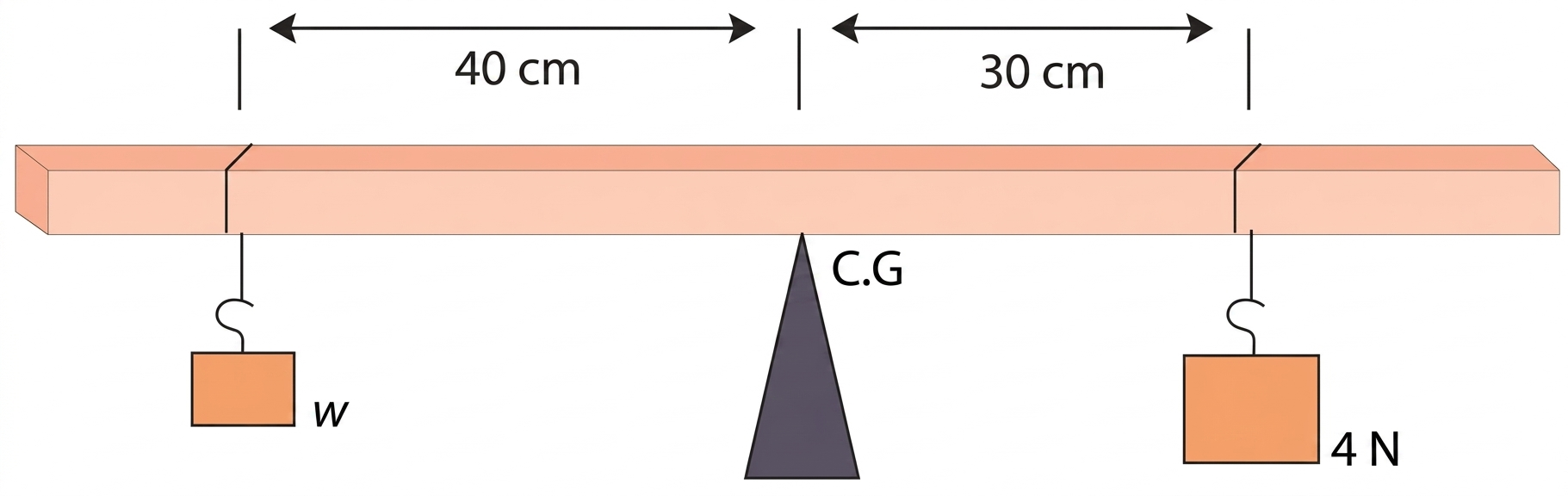
Figure: Metre rule balanced with hanging weights
✅ \(w = 3\ N\)
4.4
A see-saw is balanced with two children sitting near either end. Child A weighs \(30kg\) and sits \(2m\) away from the pivot, while child B weighs \(40kg\) and sits \(1.5m\) from the pivot. Calculate the total moment on each side and determine if the see-saw is in equilibrium.
Given Data
Mass of child A\(m_1 = 30\ kg\)
Distance of A from pivot\(l_1 = 2\ m\)
Mass of child B\(m_2 = 40\ kg\)
Distance of B from pivot\(l_2 = 1.5\ m\)
Acceleration due to gravity\(g = 10\ ms^{-2}\)
To Find
Moment on each side \(= ?\)
Is the see-saw in equilibrium \(= ?\)
Solution
Using the formula for moment (torque):
\[\begin{aligned}
\text{Child A's Moment (Clockwise)}: \tau_1 &= m_1 g l_1 = (30)(10)(2) = 600\ Nm \\
\text{Child B's Moment (Anticlockwise)}: \tau_2 &= m_2 g l_2 = (40)(10)(1.5) = 600\ Nm
\end{aligned}\]
Since both moments are equal and opposite, the see-saw is in equilibrium.
✅ \(\tau_1 = 600\ Nm\), \(\tau_2 = 600\ Nm\), See-saw is in equilibrium.
4.5
A crowbar is used to lift a box. If the downward force of \(250N\) is applied at the end of the bar, how much weight does the other end bear? The crowbar itself has negligible weight.
Given Data
Applied force\(F = 250\ N\)
Distance of force from pivot\(l_1 = 30\ cm = 0.3\ m\)
Distance of weight from pivot\(l_2 = 5\ cm = 0.05\ m\)
To Find
Weight \(w = ?\)
Solution
By principle of moments:
\[\begin{aligned}
\text{Clockwise moments} &= \text{Anti-clockwise moments} \\
F \times l_1 &= w \times l_2 \\
(250)(0.3) &= w(0.05) \\
75 &= 0.05w \\
w &= \frac{75}{0.05} \\
w &= 1500\ N
\end{aligned}\]
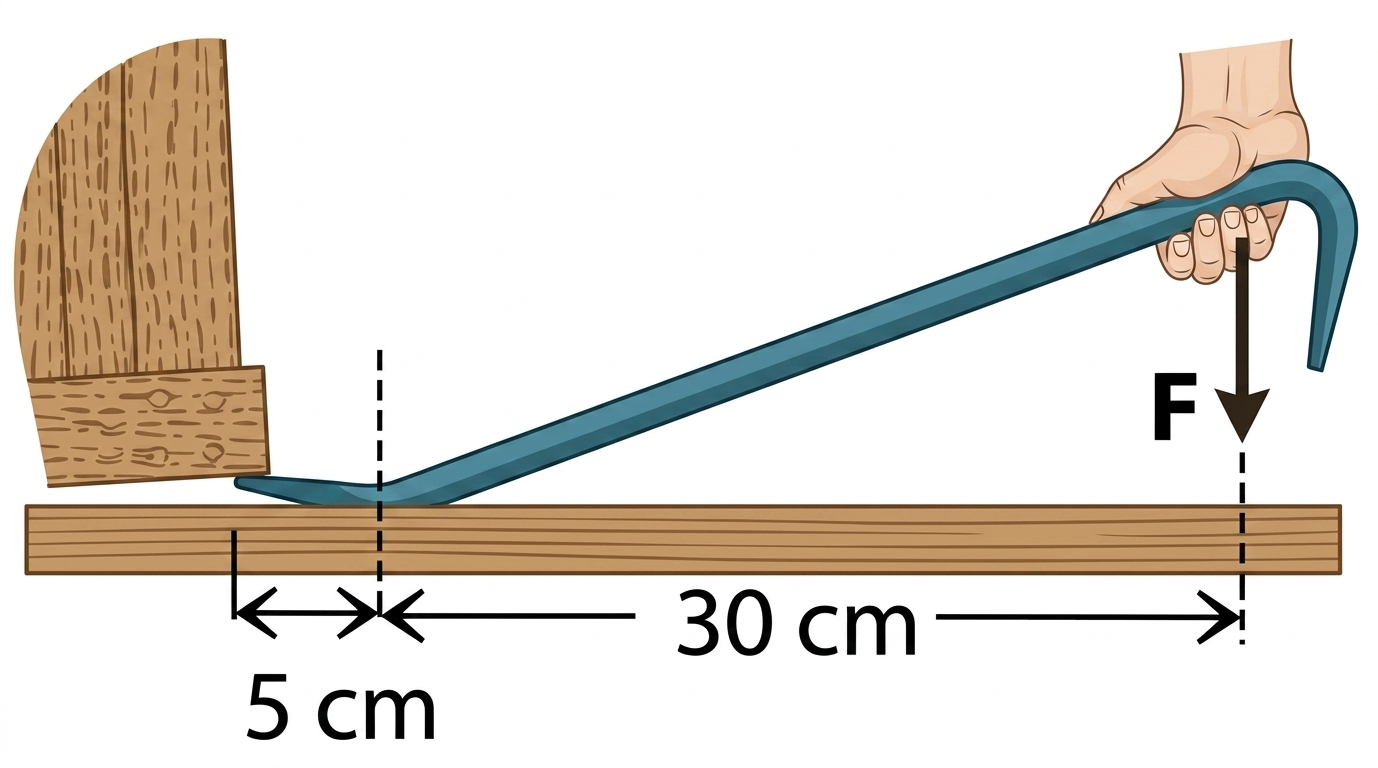
Figure: Crowbar used as a lever
✅ \(w = 1500\ N\)
4.6
A \(30cm\) long spanner is used to open the nut of a car. If the torque required for it is \(150Nm\), how much force \(F\) should be applied on the spanner?
Given Data
Length of spanner\(l = 30\ cm = 0.3\ m\)
Torque required\(\tau = 150\ Nm\)
To Find
Force \(F = ?\)
Solution
Using the formula for torque:
\[\begin{aligned}
\tau &= F \times l \\
150 &= F(0.3) \\
F &= \frac{150}{0.3} \\
F &= 500\ N
\end{aligned}\]
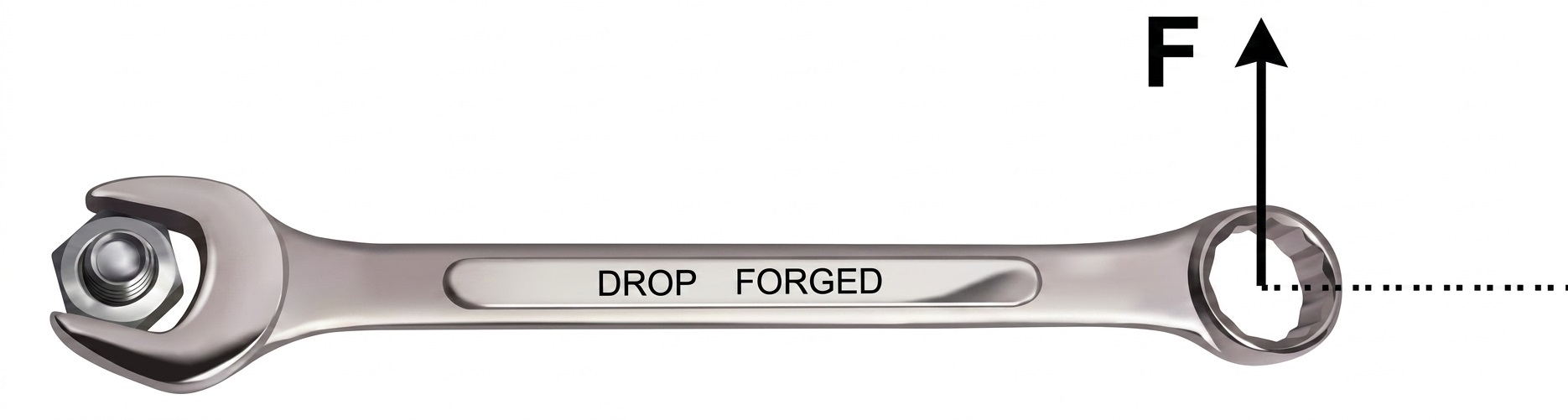
Figure: Force applied on a spanner
✅ \(F = 500\ N\)
4.7
A \(5N\) ball hanging from a rope is pulled to the right by a horizontal force \(F\). The rope makes an angle of \(60^\circ\) with the ceiling. Determine the magnitude of force \(F\) and tension \(T\) in the string.
Given Data
Weight of ball\(w = 5\ N\)
Angle with ceiling\(\theta = 60^\circ\)
To Find
Horizontal force \(F = ?\)
Tension in string \(T = ?\)
Solution
The tension \(T\) has two components: \(T_x = T\cos\theta\) and \(T_y = T\sin\theta\).
For vertical equilibrium, the upward force \(T_y\) equals the weight \(w\):
\[\begin{aligned}
T_y &= w \\
T \sin\theta &= w \\
T \sin 60^\circ &= 5 \\
T &= \frac{5}{0.866} \\
T &= 5.8\ N
\end{aligned}\]
For horizontal equilibrium, the horizontal force \(F\) equals \(T_x\):
\[\begin{aligned}
F &= T_x = T\cos\theta = 5.8 \cos 60^\circ = 5.8(0.5) = 2.9\ N
\end{aligned}\]
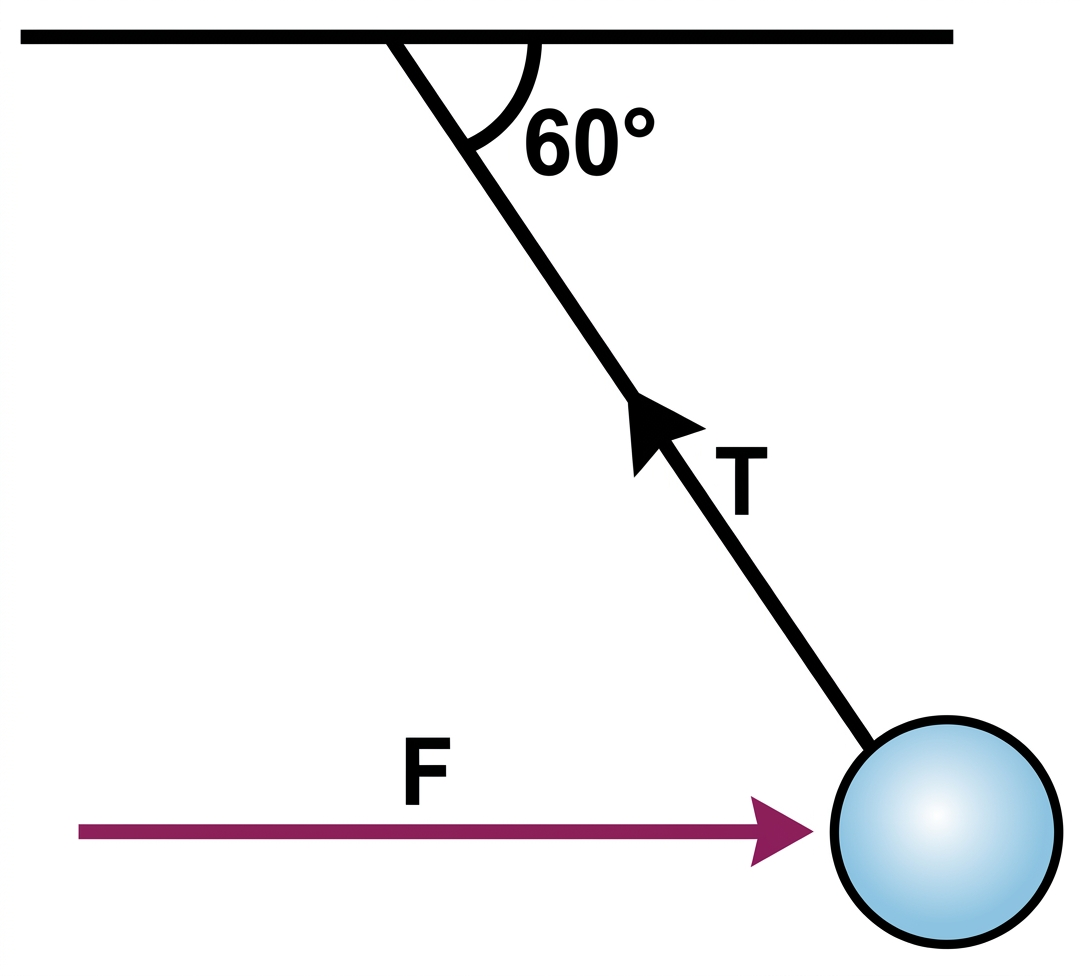
Figure: Ball suspended from a rope
✅ \(T = 5.8\ N\), \(F = 2.9\ N\)
4.8
A signboard is suspended by means of two steel wires as shown. If the weight of the board is \(200N\), what is the tension in the strings?
Given Data
Weight of the board\(w = 200\ N\)
To Find
Tension in first string \(T_1 = ?\)
Tension in second string \(T_2 = ?\)
Solution
Here all forces act vertically. Since wires are symmetrically placed, \(T_1 = T_2\).
As the signboard is in equilibrium:
\[\begin{aligned}
T_1 + T_2 - w &= 0 \\
T_1 + T_1 &= 200 \\
2T_1 &= 200 \\
T_1 &= 100\ N, \quad T_2 = 100\ N
\end{aligned}\]
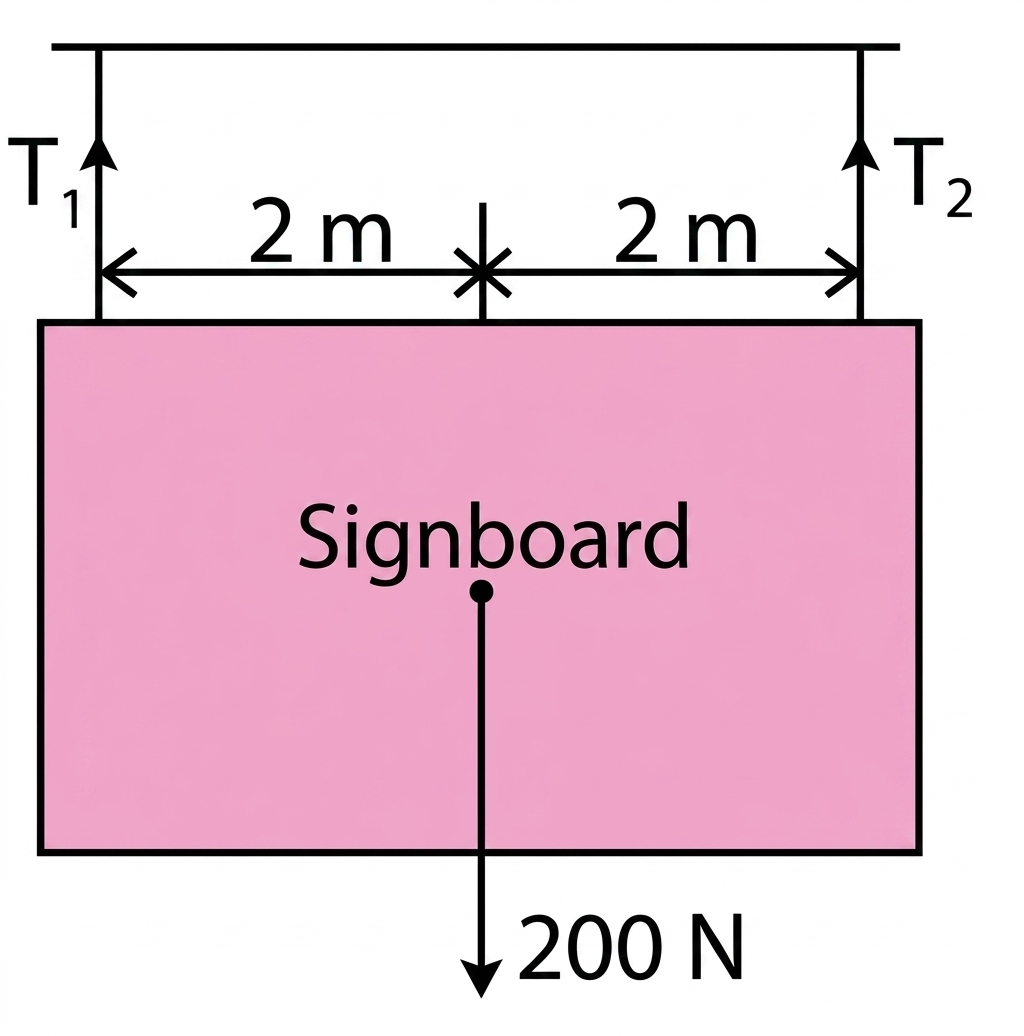
Figure: Signboard suspended by two strings
✅ \(T_1 = 100\ N\), \(T_2 = 100\ N\)
4.9
One girl of \(30kg\) mass sits \(1.6m\) from the axis of a see-saw. Another girl of mass \(40kg\) wants to sit on the other side so that the see-saw may remain in equilibrium. How far away from the axis should the other girl sit?
Given Data
Mass of first girl\(m_1 = 30\ kg\)
Distance of first girl from axis\(l_1 = 1.6\ m\)
Mass of second girl\(m_2 = 40\ kg\)
To Find
Distance of second girl from axis \(l_2 = ?\)
Solution
According to principle of moments:
\[\begin{aligned}
F_1 \times l_1 &= F_2 \times l_2 \\
m_1 g l_1 &= m_2 g l_2 \\
(30)(10)(1.6) &= (40)(10)(l_2) \\
480 &= 400l_2 \\
l_2 &= \frac{480}{400} \\
l_2 &= 1.2\ m
\end{aligned}\]
✅ \(l_2 = 1.2\ m\)
4.10
Find the tension in each string if the block weighs \(150N\).
Given Data
Weight of block\(w = 150\ N\)
To Find
Tension in first string \(T_1 = ?\)
Tension in second string \(T_2 = ?\)
Solution
As the block is in equilibrium, the vertical component of \(T_1\) balances the weight \(w\):
\[\begin{aligned}
T_1 \sin 60^\circ &= 150 \\
T_1 &= \frac{150}{0.866} \\
T_1 &= 173.21\ N
\end{aligned}\]
Now, the horizontal component of \(T_1\) is balanced by \(T_2\):
\[\begin{aligned}
T_1 \cos 60^\circ &= T_2 \\
(173.21)(0.5) &= T_2 \\
T_2 &= 86.6\ N
\end{aligned}\]
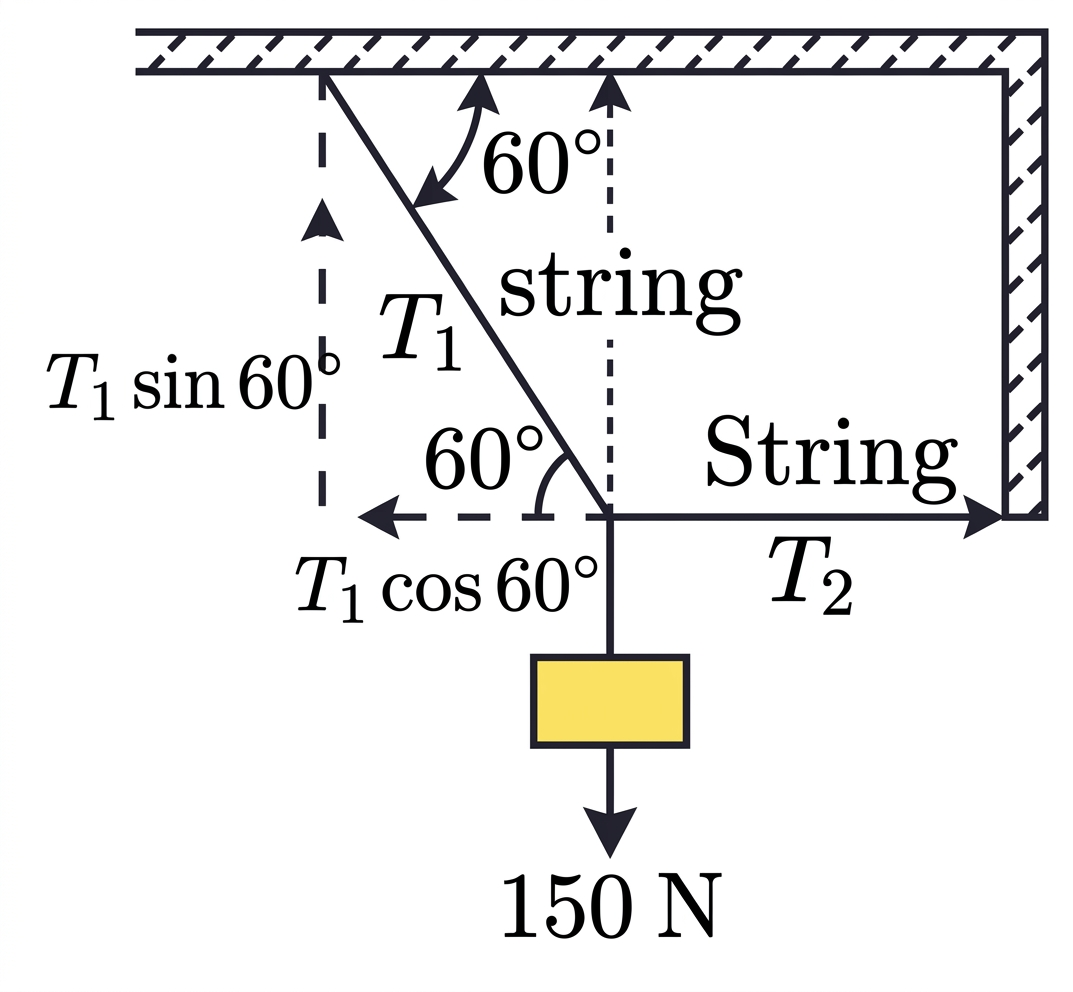
Figure: Block suspended by two strings
✅ \(T_1 = 173.21\ N\), \(T_2 = 86.6\ N\)
📘 Solved Examples (PECTAA 2026)
Example 4.1
Let us add three force vectors \(F_1, F_2\) and \(F_3\) having magnitudes of \(200 N\), \(300 N\) and \(250 N\) acting at angles of \(30^\circ, 45^\circ, 60^\circ\) with \(x\)-axis. By selecting a suitable scale \(100 N = 1 cm\), we can draw the force vectors. Find the magnitude and direction of the resultant force.
Given Data
\(F_1\)\(200 N\) at \(30^\circ\)
\(F_2\)\(300 N\) at \(45^\circ\)
\(F_3\)\(250 N\) at \(60^\circ\)
Scale\(100 N = 1 cm\)
To Find
Resultant force \(F = ?\)
Direction of resultant \(\theta = ?\)
Solution
Using the head-to-tail rule as shown in the figure:
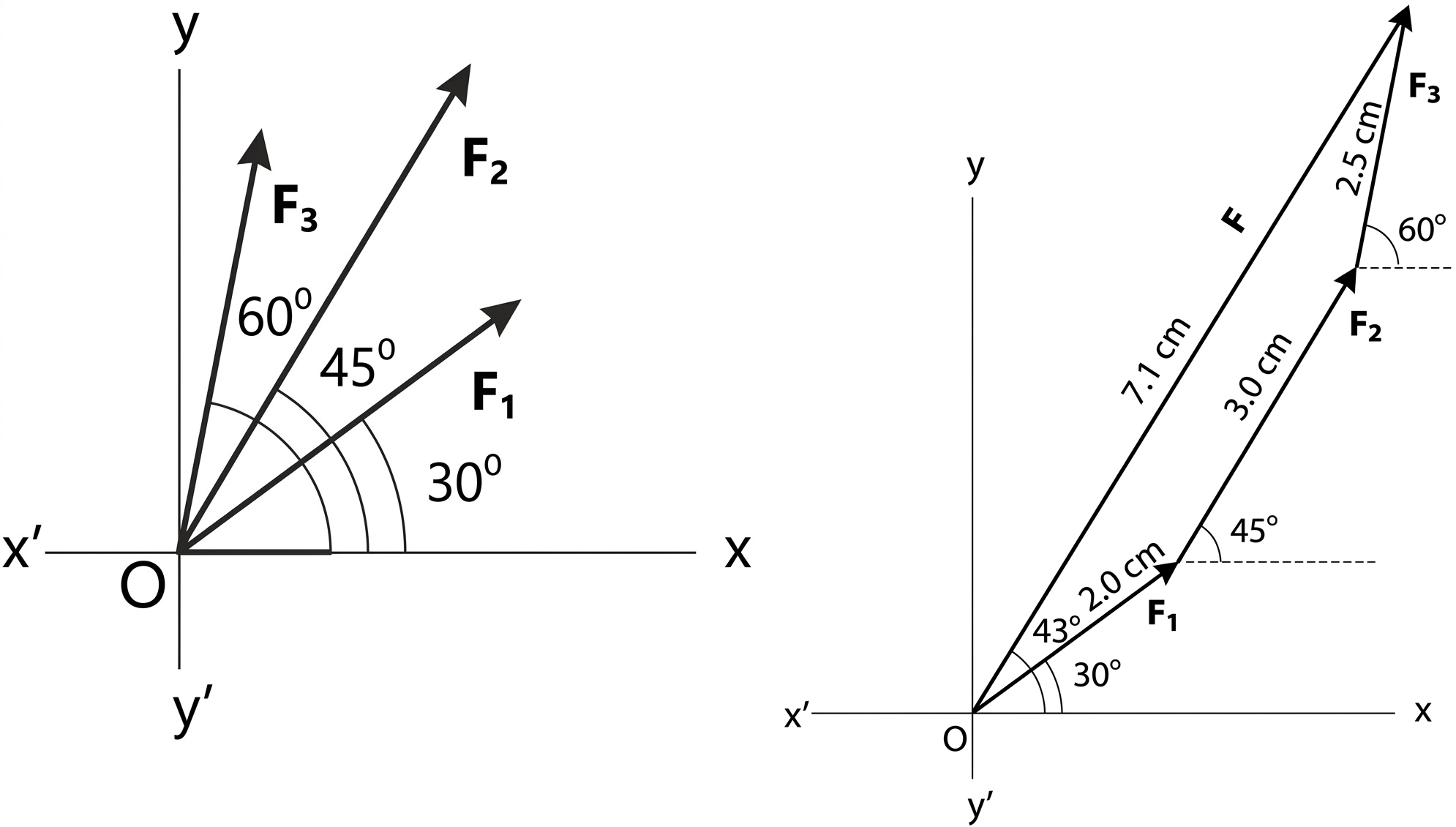
Figure: Addition of force vectors using head-to-tail rule
Result:
\[\begin{aligned}
\text{Measured length} &= 7.1\ cm \\
\text{Resultant magnitude} &= 7.1 \times 100 = 710\ N \\
\text{Angle with x-axis} &= 43^\circ
\end{aligned}\]
✅ \(F = 710\ N\) at \(43^\circ\)
Example 4.2
A spanner \(25 cm\) long is used to open a nut. If a force of \(400 N\) is applied at the end of a spanner, what is the torque acting on the nut?
Given Data
Length of spanner\(l = 25\ cm = 0.25\ m\)
Force applied\(F = 400\ N\)
To Find
Torque \(\tau = ?\)
Solution
Using the formula for torque:
\[\begin{aligned}
\tau &= F \times l \\
\tau &= 400 \times 0.25 \\
\tau &= 100\ Nm
\end{aligned}\]
Figure: Force applied on a spanner
✅ \(\tau = 100\ Nm\)
Example 4.3
A force of \(160 N\) is acting on a wooden box at an angle of \(60^\circ\) with the horizontal direction. Determine the values of its \(x\) and \(y\) components.
Given Data
Force\(F = 160\ N\)
Angle\(\theta = 60^\circ\)
To Find
x-component \(F_x = ?\)
y-component \(F_y = ?\)
Solution
Using the formulas for rectangular components:
\[\begin{aligned}
F_x &= F \cos \theta = 160 \cos 60^\circ = 160(0.5) = 80\ N \\
F_y &= F \sin \theta = 160 \sin 60^\circ = 160(0.866) = 138.56\ N
\end{aligned}\]
✅ \(F_x = 80\ N\), \(F_y = 138.56\ N\)
Example 4.4
A metre stick is pinned at its one end O on a table so that it can rotate freely. One force of magnitude \(18N\) is applied perpendicular to the length of the stick at its free end. Another force of magnitude \(60N\) is acting at an angle of \(30^\circ\) with the stick as shown in the figure. At what distance from the end of stick that is pinned should the second force act such that the stick does not rotate?
Given Data
Force 1\(F_1 = 18\ N\) (perpendicular)
Distance of \(F_1\) from pivot\(l_1 = 1\ m\)
Force 2\(F_2 = 60\ N\) at \(30^\circ\)
To Find
Distance of \(F_2\) from pivot \(d = ?\)
Solution
Resolve \(F_2\) into rectangular components. The component \(F_{2x}\) passes through the axis of rotation, so its torque is zero.
\[\begin{aligned}
F_{2y} &= F_2 \sin 30^\circ = 60(0.5) = 30\ N
\end{aligned}\]
For the stick not to rotate:
\[\begin{aligned}
F_{2y} \times d &= F_1 \times l_1 \\
30 \times d &= 18 \times 1.0 \\
d &= \frac{18}{30} \\
d &= 0.6\ m
\end{aligned}\]
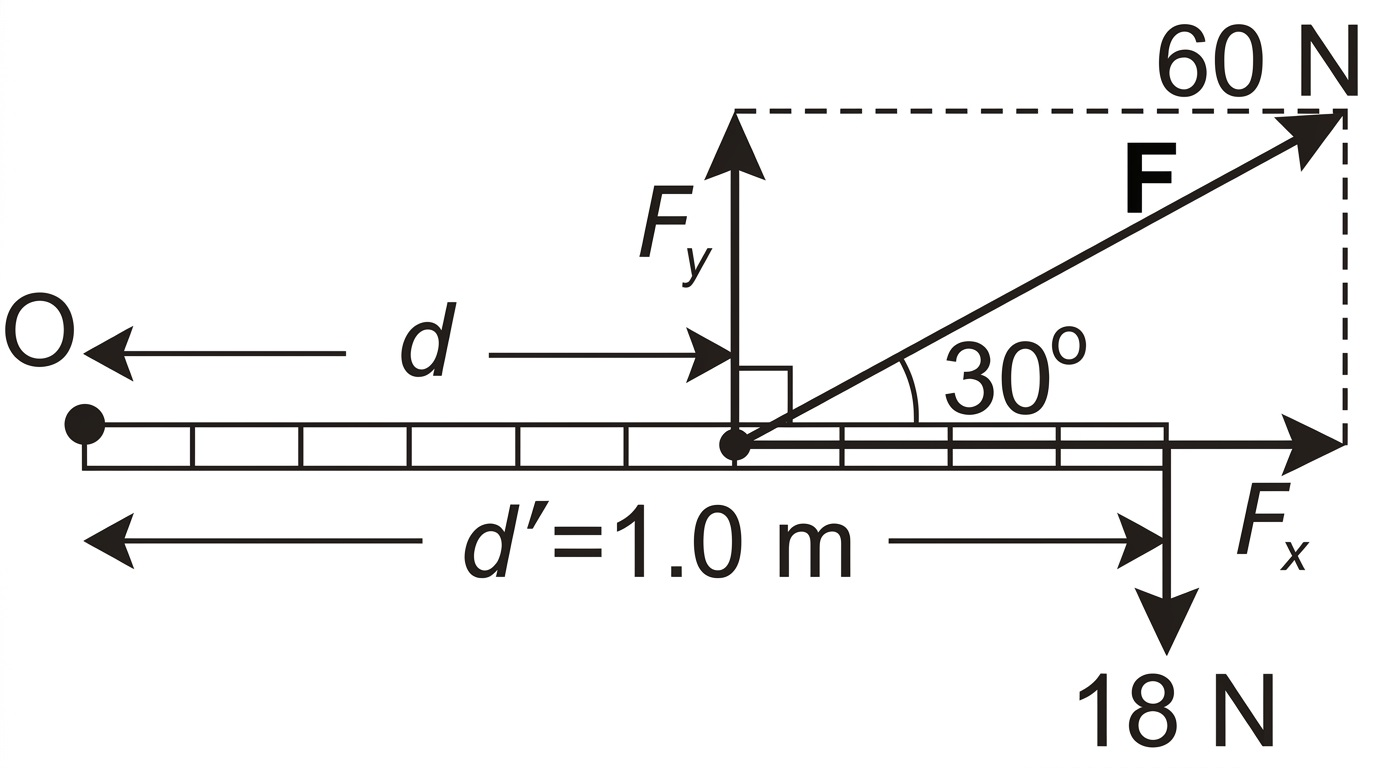
Figure: Forces on a pinned metre stick
✅ \(d = 0.6\ m\)
Example 4.5
A picture is suspended by means of two vertical strings as shown in figure. The weight of the picture is \(5N\) and it is acting at its centre of gravity. Find the tension \(T_1\) & \(T_2\) in the two strings.
Given Data
Weight of the picture\(w = 5\ N\)
To Find
Tension in first string \(T_1 = ?\)
Tension in second string \(T_2 = ?\)
Solution
Here all forces act vertically. Since the picture is suspended symmetrically, the tensions are equal: \(T_1 = T_2\).
As the picture is in equilibrium:
\[\begin{aligned}
T_1 + T_2 - w &= 0 \\
T_1 + T_1 &= 5 \\
2T_1 &= 5 \\
T_1 &= 2.5\ N, \quad T_2 = 2.5\ N
\end{aligned}\]
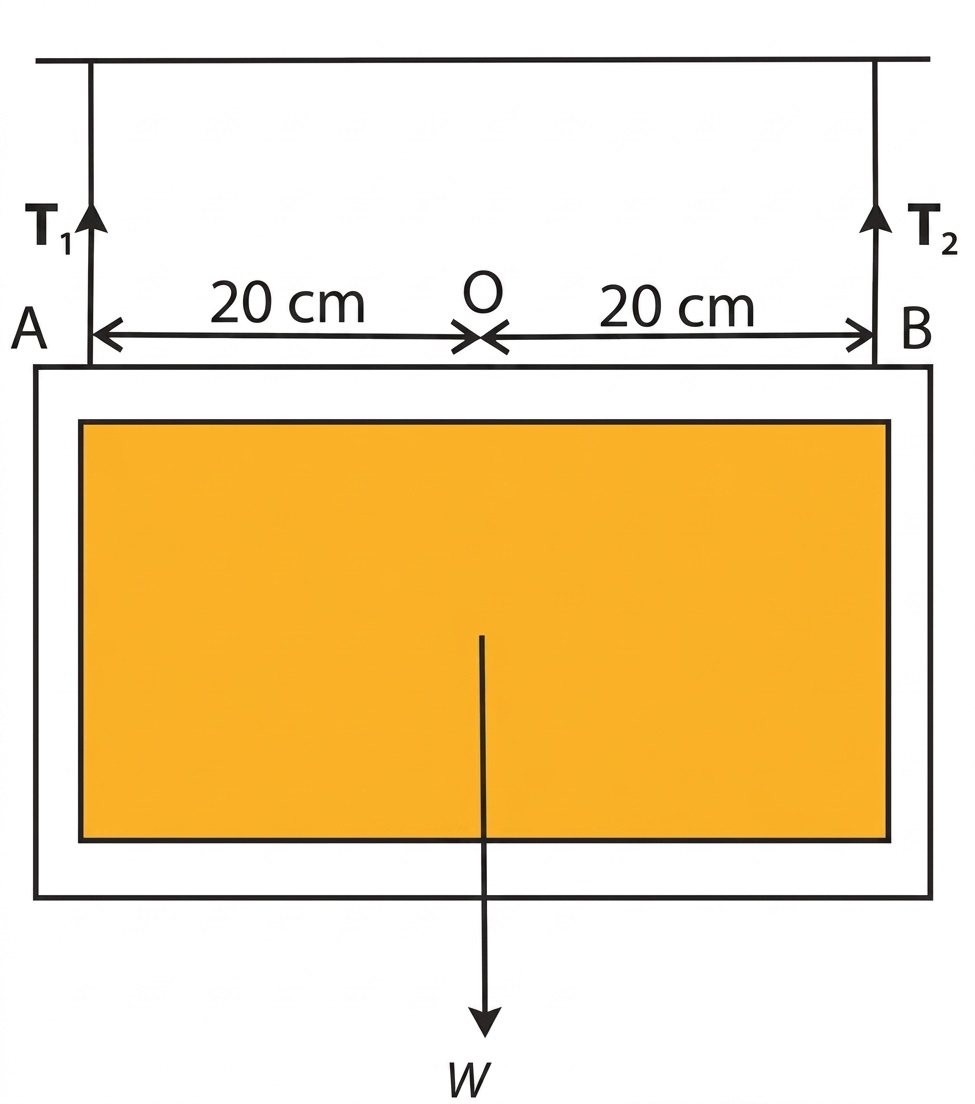
Figure: Picture suspended by two strings
✅ \(T_1 = 2.5\ N\), \(T_2 = 2.5\ N\)
📐 Important Formulas – Turning Effect of Forces
Resultant Force: \(F = \sqrt{(F_x)^2 + (F_y)^2}\)
Angle: \(\theta = \tan^{-1}\left(\frac{F_y}{F_x}\right)\)
x-component of force: \(F_x = F \cos \theta\)
y-component of force: \(F_y = F \sin \theta\)
Torque: \(\tau = F \times l\) or \(\tau = rF \sin \theta\)
1st Condition of Equilibrium: \(\sum F = 0\)
2nd Condition of Equilibrium: \(\sum \tau = 0\)
Principle of moments: Clockwise moments = Anti-clockwise moments
Weight: \(w = mg\)
💡 Exam Tip:
For numerical problems, always write the given data, the formula being used, and show the steps of your solution clearly. Pay attention to unit conversions (cm to m). Practice the principles of moments and torque calculations thoroughly as they are the foundation for most numericals in this chapter. These problems follow the PECTAA 2026 pattern and are prepared by Subject Specialist Muhammad Tayyab.
Chapter 1Physical Quantities and Measurements
Chapter 2Kinematics
Chapter 3Dynamics
Chapter 4✨ Turning Effect of Forces
Chapter 5Work and Energy
Chapter 6Mechanical Properties of Matter
Chapter 7Thermal Properties of Matter
Chapter 8Magnetism
Chapter 9Nature of Science
📖 Complete syllabus coverage for Class 9 Physics (PECTAA 2026) – Chapters 1 to 9
Created by Hira Science Academy | Aligned with PECTAA 2026 Syllabus