📘 Chapter 2: Kinematics – Numerical Problems
Prepared by Muhammad Tayyab, Subject Specialist Physics, Govt Christian High School Daska. Based on PECTAA 2026 syllabus (National Curriculum 2023).
📖 What's Inside: This section covers numerical problems from Chapter 2 Kinematics including vector representation, speed, acceleration, equations of motion, free fall, and average velocity calculations. Each problem is presented with Given Data, To Find, and step-by-step Solution as per the official PECTAA 2026 Physics curriculum. Perfect for Punjab Boards (Lahore, Gujranwala, Multan, etc.) and all BISE boards across Pakistan.
📚 Related Resources – Chapter 2: Kinematics
📋 Exercise Short Qs
📝 Short Qs
📖 Comprehensive Qs
🔢 Numerical Problems
✅ MCQs
✏️ Constructed Response
Kinematics covers motion, scalars, vectors, and graphical analysis of motion.
📑 Quick Jump to Problems
📐 Numerical Problems & Solutions (PECTAA 2026)
2.1
Draw the representative lines of the following vectors: (a) A velocity of \(400 \text{ ms}^{-1}\) making an angle of \(60^\circ\) with x-axis. (b) A force of \(50 \text{ N}\) making an angle of \(120^\circ\) with x-axis.
Solution
(a) A velocity of \(400 \text{ ms}^{-1}\) at \(60^\circ\) with x-axis:
(i) Draw horizontal and vertical lines to represent x-axis and y-axis.
(ii) Select a suitable scale: If \(100 \text{ ms}^{-1} = 1 \text{ cm}\), then \(400 \text{ ms}^{-1} = 4 \text{ cm}\).
(iii) Draw \(4 \text{ cm}\) line \(OQ\) at angle of \(60^\circ\) with positive x-axis. The \(OQ\) is vector \(\vec{V}\).
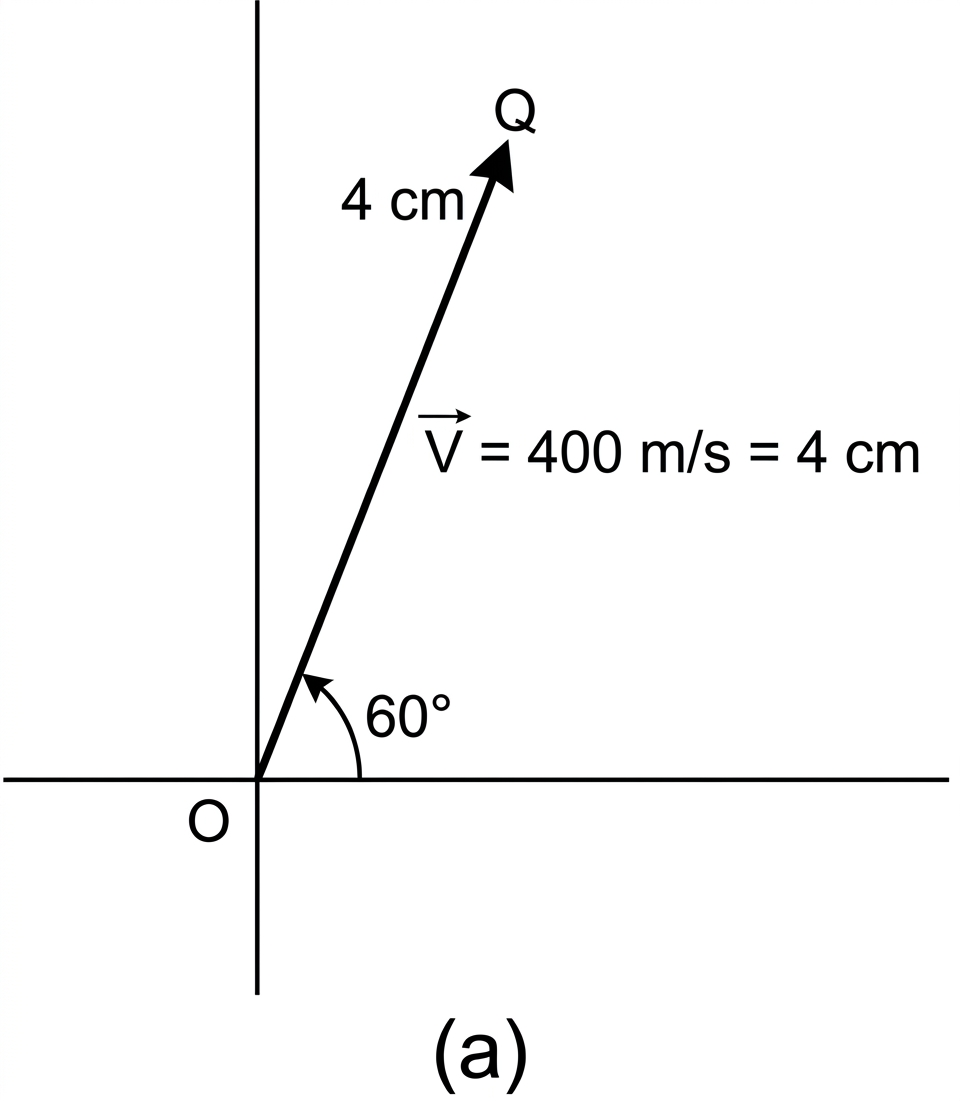
Figure (a): Velocity vector \(400 \text{ ms}^{-1}\) at \(60^\circ\)
(b) A force of \(50 \text{ N}\) at \(120^\circ\) with x-axis:
(i) Draw horizontal and vertical lines to represent x-axis and y-axis.
(ii) Select a suitable scale: If \(10 \text{ N} = 1 \text{ cm}\), then \(50 \text{ N} = 5 \text{ cm}\).
(iii) Draw \(5 \text{ cm}\) line \(OQ\) at angle of \(120^\circ\) with x-axis. The \(OQ\) is vector \(\vec{F}\).
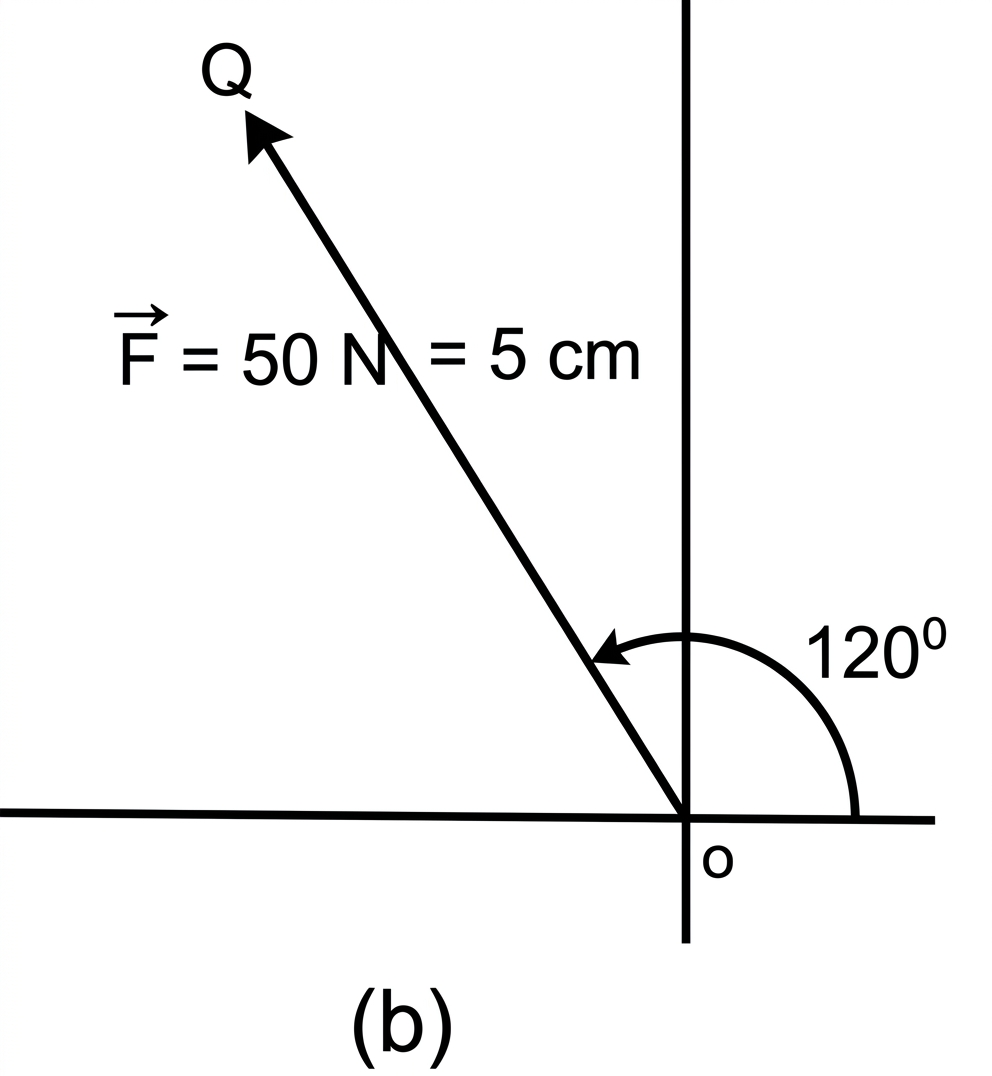
Figure (b): Force vector \(50 \text{ N}\) at \(120^\circ\)
✅ (a) 4 cm line at 60° (scale: 100 ms⁻¹ = 1 cm). (b) 5 cm line at 120° (scale: 10 N = 1 cm).
2.2
A car is moving with an average speed of \(72 \text{ kmh}^{-1}\). How much time will it take to cover a distance of \(360 \text{ km}\)?
Given Data
\(Average\ speed\)\(= v_{av} = 72\ \text{kmh}^{-1}\)
\(Distance\)\(= S = 360\ \text{km}\)
To Find
\(Time = t = ?\)
Solution
By using formula of distance:
\[\begin{aligned}
S &= v_{av} \times t \\
360 &= 72 \times t \\
t &= \frac{360}{72} \\
\boldsymbol{t} &= \boldsymbol{5\ \text{hr}}
\end{aligned}\]
✅ Time = 5 hours
2.3
A truck starts from rest. It reaches a velocity of \(90 \text{ kmh}^{-1}\) in 50 seconds. Find its average acceleration.
Given Data
\(Initial\ velocity\)\(= v_i = 0\ \text{ms}^{-1}\)
\(Final\ velocity\)\(= v_f = 90\ \text{kmh}^{-1} = 90 \times \frac{10}{36} = 25\ \text{ms}^{-1}\)
\(Time\)\(= t = 50\ \text{s}\)
To Find
\(Average\ acceleration = a_{av} = ?\)
Solution
By using formula of average acceleration:
\[\begin{aligned}
a_{av} &= \frac{v_f - v_i}{t} \\
a_{av} &= \frac{25 - 0}{50} \\
\boldsymbol{a_{av}} &= \boldsymbol{0.5\ \text{ms}^{-2}}
\end{aligned}\]
✅ Average acceleration = \(0.5\ \text{ms}^{-2}\)
2.4
A car passes a green traffic signal while moving with a velocity of \(5 \text{ ms}^{-1}\). It then accelerates at \(1.5 \text{ ms}^{-2}\). What is the velocity of the car after 5 seconds?
Given Data
\(Initial\ velocity\)\(= v_i = 5\ \text{ms}^{-1}\)
\(Acceleration\)\(= a = 1.5\ \text{ms}^{-2}\)
\(Time\)\(= t = 5\ \text{s}\)
To Find
\(Final\ velocity = v_f = ?\)
Solution
By using first equation of motion:
\[\begin{aligned}
v_f &= v_i + at \\
v_f &= 5 + (1.5)(5) \\
v_f &= 5 + 7.5 \\
\boldsymbol{v_f} &= \boldsymbol{12.5\ \text{ms}^{-1}}
\end{aligned}\]
✅ Final velocity = \(12.5\ \text{ms}^{-1}\)
2.5
A motorcycle initially travelling at \(18 \text{ kmh}^{-1}\) accelerates at a constant rate of \(2 \text{ ms}^{-2}\). How far will the motorcycle go in 10 seconds?
Given Data
\(Initial\ velocity\)\(= v_i = 18\ \text{kmh}^{-1} = 18 \times \frac{10}{36} = 5\ \text{ms}^{-1}\)
\(Acceleration\)\(= a = 2\ \text{ms}^{-2}\)
\(Time\)\(= t = 10\ \text{s}\)
To Find
\(Distance\ moved = S = ?\)
Solution
By using second equation of motion:
\[\begin{aligned}
S &= v_i t + \frac{1}{2} at^2 \\
S &= (5)(10) + \frac{1}{2}(2)(10)^2 \\
S &= 50 + 100 \\
\boldsymbol{S} &= \boldsymbol{150\ \text{m}}
\end{aligned}\]
✅ Distance = \(150\ \text{m}\)
2.6
A wagon is moving on the road with a velocity of \(54 \text{ kmh}^{-1}\). Brakes are applied suddenly. The wagon covers a distance of \(25 \text{ m}\) before stopping. Determine the acceleration of the wagon.
Given Data
\(Initial\ velocity\)\(= v_i = 54\ \text{kmh}^{-1} = 54 \times \frac{10}{36} = 15\ \text{ms}^{-1}\)
\(Distance\)\(= S = 25\ \text{m}\)
\(Final\ velocity\)\(= v_f = 0\ \text{ms}^{-1}\)
To Find
\(Acceleration = a = ?\)
Solution
By using third equation of motion:
\[\begin{aligned}
2aS &= v_f^2 - v_i^2 \\
2(a)(25) &= (0)^2 - (15)^2 \\
50a &= -225 \\
a &= -\frac{225}{50} \\
\boldsymbol{a} &= \boldsymbol{-4.5\ \text{ms}^{-2}}
\end{aligned}\]
✅ Acceleration = \(-4.5\ \text{ms}^{-2}\) (deceleration)
2.7
A stone is dropped from a height of \(45 \text{ m}\). How long will it take to reach the ground? What will be its velocity just before hitting the ground?
Given Data
\(Height\)\(= h = 45\ \text{m}\)
\(Initial\ velocity\)\(= v_i = 0\ \text{ms}^{-1}\)
\(Acceleration\ due\ to\ gravity\)\(= g = 10\ \text{ms}^{-2}\)
To Find
\(Time\ to\ reach\ ground = t = ?\)
\(Velocity\ just\ before\ hitting\ ground = v_f = ?\)
Solution
By using second equation of motion body moving under gravity:
\[\begin{aligned}
h &= v_i t + \frac{1}{2} gt^2 \\
45 &= (0)(t) + \frac{1}{2}(10)(t)^2 \\
45 &= 5t^2 \\
t^2 &= 9 \\
\boldsymbol{t} &= \boldsymbol{3\ \text{s}}
\end{aligned}\]
Now for final velocity by using first equation of motion under gravity:
\[\begin{aligned}
v_f &= v_i + gt \\
v_f &= 0 + (10)(3) \\
\boldsymbol{v_f} &= \boldsymbol{30\ \text{ms}^{-1}}
\end{aligned}\]
✅ Time = 3 s, Velocity = \(30\ \text{ms}^{-1}\)
2.8
A car travels \(10 \text{ km}\) with an average velocity of \(20 \text{ ms}^{-1}\). Then it travels in the same direction through a diversion at an average velocity of \(4 \text{ ms}^{-1}\) for the next \(0.8 \text{ km}\). Determine the average velocity of the car for the total journey.
Given Data
\(First\ distance\)\(= S_1 = 10\ \text{km} = 10000\ \text{m}\)
\(First\ average\ velocity\)\(= v_1 = 20\ \text{ms}^{-1}\)
\(Second\ distance\)\(= S_2 = 0.8\ \text{km} = 800\ \text{m}\)
\(Second\ average\ velocity\)\(= v_2 = 4\ \text{ms}^{-1}\)
To Find
\(Average\ velocity\ for\ total\ journey = v_{av} = ?\)
Solution
For \(S_1\), time taken by using formula \(S = vt\):
\[
t_1 = \frac{S_1}{v_1} = \frac{10000}{20} = 500\ \text{s}
\]
For \(S_2\), time taken:
\[
t_2 = \frac{S_2}{v_2} = \frac{800}{4} = 200\ \text{s}
\]
Total time = \(t = t_1 + t_2 = 500 + 200 = 700\ \text{s}\)
Total distance = \(S = S_1 + S_2 = 10000 + 800 = 10800\ \text{m}\)
Now by using formula of distance:
\[\begin{aligned}
S &= v_{av} \times t \\
10800 &= v_{av} \times 700 \\
v_{av} &= \frac{10800}{700} \\
\boldsymbol{v_{av}} &= \boldsymbol{15.4\ \text{ms}^{-1}}
\end{aligned}\]
✅ Average velocity = \(15.4\ \text{ms}^{-1}\)
2.9
A ball is dropped from the top of a tower. The ball reaches the ground in 5 seconds. Find the height of the tower and the velocity of the ball with which it strikes the ground.
Given Data
\(Time\)\(= t = 5\ \text{s}\)
\(Initial\ velocity\)\(= v_i = 0\ \text{ms}^{-1}\)
\(Acceleration\ due\ to\ gravity\)\(= g = 10\ \text{ms}^{-2}\)
To Find
\(Height\ of\ tower = h = ?\)
\(Final\ velocity = v_f = ?\)
Solution
By using second equation of motion body moving under gravity:
\[\begin{aligned}
h &= v_i t + \frac{1}{2} gt^2 \\
h &= (0)(5) + \frac{1}{2}(10)(5)^2 \\
h &= 0 + 5 \times 25 \\
\boldsymbol{h} &= \boldsymbol{125\ \text{m}}
\end{aligned}\]
Now for final velocity by using first equation of motion under gravity:
\[\begin{aligned}
v_f &= v_i + gt \\
v_f &= 0 + (10)(5) \\
\boldsymbol{v_f} &= \boldsymbol{50\ \text{ms}^{-1}}
\end{aligned}\]
✅ Height = \(125\ \text{m}\), Velocity = \(50\ \text{ms}^{-1}\)
2.10
A cricket ball is hit so that it travels straight up in the air. An observer notes that it took 3 seconds to reach the highest point. What was the initial velocity of the ball? If the ball was hit 1 m above the ground, how high did it rise from the ground?
Given Data
\(Time\ to\ reach\ highest\ point\)\(= t = 3\ \text{s}\)
\(Final\ velocity\)\(= v_f = 0\ \text{ms}^{-1}\)
\(Acceleration\ due\ to\ gravity\)\(= g = -10\ \text{ms}^{-2}\ (upward\ motion)\)
To Find
\(Initial\ velocity = v_i = ?\)
\(Height\ of\ ball\ 1\ m\ above\ ground = h_t = ?\)
Solution
For initial velocity by using first equation of motion under gravity:
\[\begin{aligned}
v_f &= v_i + gt \\
0 &= v_i + (-10)(3) \\
0 &= v_i - 30 \\
v_i &= 30 \\
\boldsymbol{v_i} &= \boldsymbol{30\ \text{ms}^{-1}}
\end{aligned}\]
Now by using second equation of motion body moving under gravity:
\[\begin{aligned}
h &= v_i t + \frac{1}{2} gt^2 \\
h &= (30)(3) + \frac{1}{2}(-10)(3)^2 \\
h &= 90 - 45 \\
h &= 45\ \text{m}
\end{aligned}\]
Required total height = \(h_t = h_{gain} + h_{initial}\)
\[
h_t = 45\ \text{m} + 1\ \text{m} = 46\ \text{m}
\]
✅ Initial velocity = \(30\ \text{ms}^{-1}\), Total height = \(46\ \text{m}\)
📘 Solved Examples (PECTAA 2026)
Example 2.1
Draw the velocity vector \(\nu\); a velocity of \(300 \text{ ms}^{-1}\) at an angle of \(60^\circ\) to the east of north.
Solution
A velocity of \(300 \text{ ms}^{-1}\) making an angle of \(60^\circ\) with x-axis.
(i) Draw two mutually perpendicular lines to represent N, S, E and W.
(ii) Select a suitable scale: If \(100 \text{ ms}^{-1} = 1 \text{ cm}\), then \(300 \text{ ms}^{-1} = 3 \text{ cm}\).
(iii) Draw \(3 \text{ cm}\) line \(OP\) at angle of \(60^\circ\) starting from N towards E. The \(OP\) is vector \(\vec{v}\).
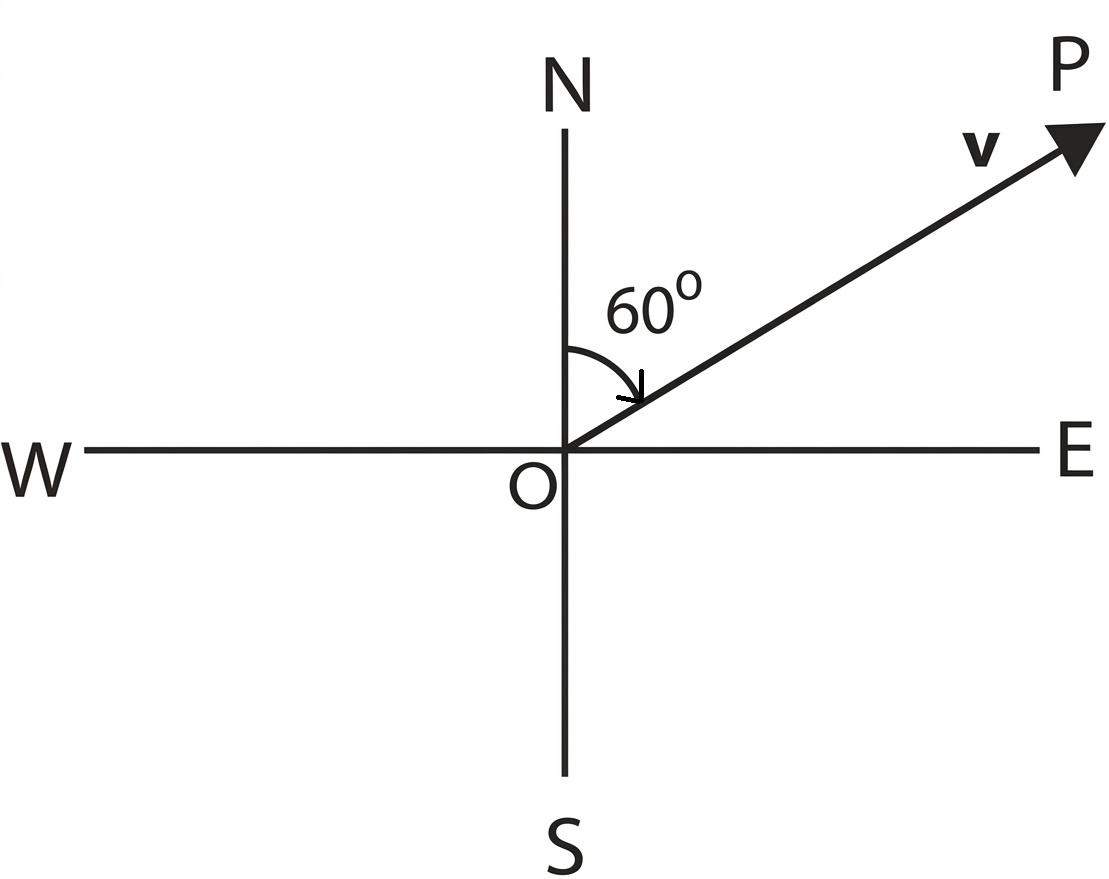
Figure: Velocity vector \(300 \text{ ms}^{-1}\) at \(60^\circ\) east of north
✅ Vector \(\vec{v}\) drawn with 3 cm line at 60° from N towards E
Example 2.2
Draw a force vector \(F\) having magnitude \(350 \text{ N}\) and acting at an angle of \(60^\circ\) with x-axis.
Solution
A force vector \(F\) having magnitude \(350 \text{ N}\) and acting at an angle of \(60^\circ\) with x-axis.
(i) Draw horizontal and vertical lines to represent x-axis and y-axis.
(ii) Select a suitable scale, e.g. \(100 \text{ N} = 1 \text{ cm}\), then \(350 \text{ N} = 3.5 \text{ cm}\).
(iii) Draw a \(3.5 \text{ cm}\) line \(OP\) at an angle of \(60^\circ\) with x-axis.
(iv) Make an arrow head at the end of the line \(OP\). The \(OP\) is the vector \(F\).
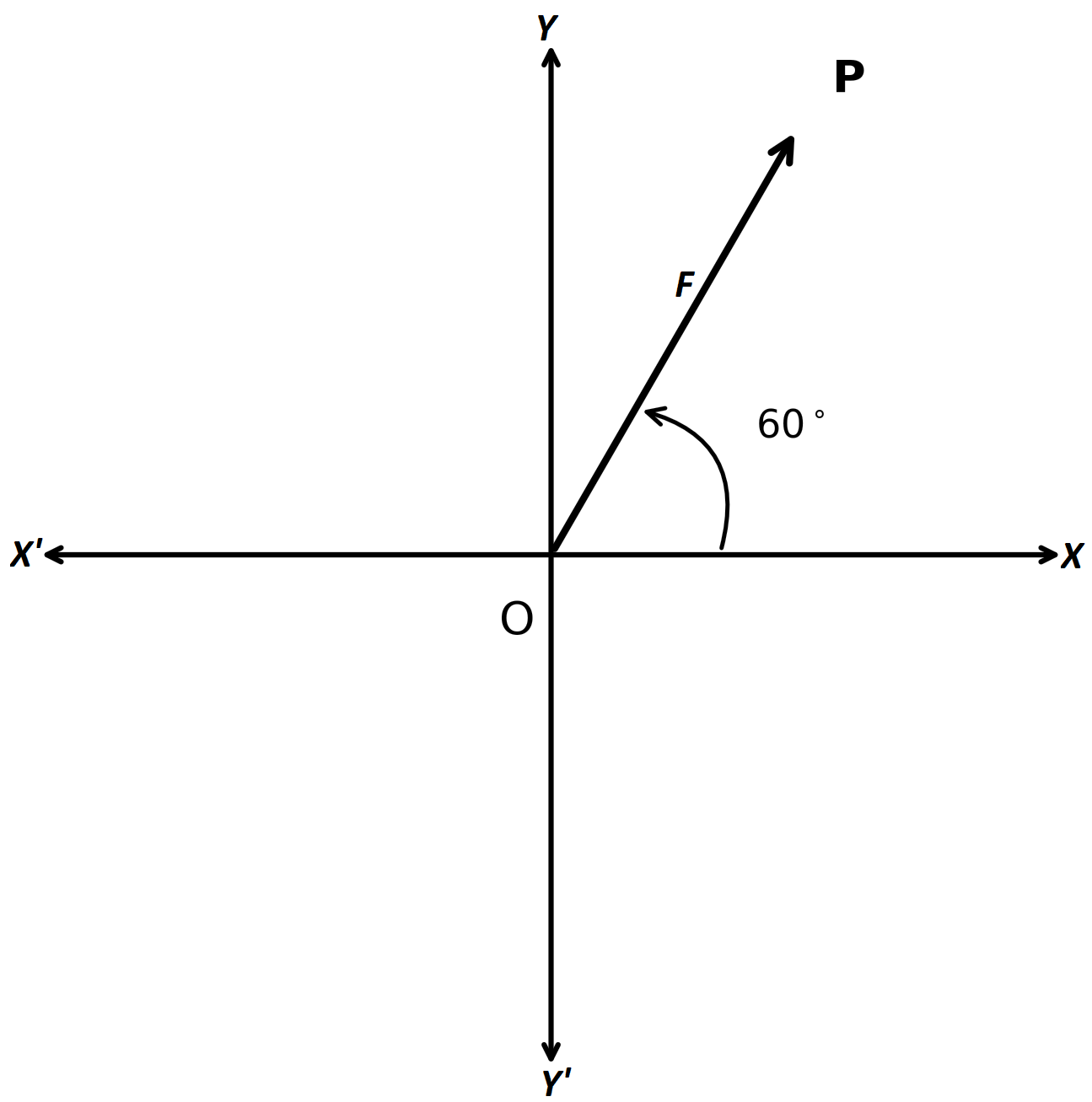
Figure: Force vector \(350 \text{ N}\) at \(60^\circ\) with x-axis
✅ Vector \(F\) drawn with 3.5 cm line at 60° from x-axis
Example 2.3
An eagle dives to the ground along a \(300 \text{ m}\) path with an average speed of \(60 \text{ ms}^{-1}\). How long does it take to cover this distance?
Given Data
\(Total\ distance\)\(= S = 300\ \text{m}\)
\(Average\ speed\)\(= v_{av} = 60\ \text{ms}^{-1}\)
To Find
\(Total\ time\ taken = t = ?\)
Solution
By using formula of average speed:
\[\begin{aligned}
v_{av} &= \frac{S}{t} \\
60 &= \frac{300}{t} \\
t &= \frac{300}{60} \\
\boldsymbol{t} &= \boldsymbol{5\ \text{s}}
\end{aligned}\]
✅ Time = 5 seconds
Example 2.4
A plane starts running from rest on a runway. It accelerates down the runway and after 20 seconds attains a velocity of \(252 \text{ kmh}^{-1}\). Determine the average acceleration of the plane.
Given Data
\(Initial\ velocity\)\(= v_i = 0\ \text{ms}^{-1}\)
\(Final\ velocity\)\(= v_f = 252\ \text{kmh}^{-1} = 252 \times \frac{10}{36} = 70\ \text{ms}^{-1}\)
\(Time\)\(= t = 20\ \text{s}\)
To Find
\(Average\ acceleration = a_{av} = ?\)
Solution
By using formula of average acceleration:
\[\begin{aligned}
a_{av} &= \frac{v_f - v_i}{t} \\
a_{av} &= \frac{70 - 0}{20} \\
a_{av} &= \frac{70}{20} \\
\boldsymbol{a_{av}} &= \boldsymbol{3.5\ \text{ms}^{-2}}
\end{aligned}\]

Figure: Plane accelerating down the runway
✅ Average acceleration = \(3.5\ \text{ms}^{-2}\)
Example 2.5
An iron bob is dropped from the top of a tower. It reaches the ground in 4 seconds. Find: (a) the height of the tower (b) the velocity of the ball as it strikes the ground.
Given Data
\(Time\)\(= t = 4\ \text{s}\)
\(Initial\ velocity\)\(= v_i = 0\ \text{ms}^{-1}\)
\(Acceleration\ due\ to\ gravity\)\(= g = 10\ \text{ms}^{-2}\)
To Find
\(Height\ of\ tower = h = ?\)
\(Final\ velocity = v_f = ?\)
Solution
By using second equation of motion body moving under gravity:
\[\begin{aligned}
h &= v_i t + \frac{1}{2} gt^2 \\
h &= (0)(4) + \frac{1}{2}(10)(4)^2 \\
h &= 0 + 5 \times 16 \\
\boldsymbol{h} &= \boldsymbol{80\ \text{m}}
\end{aligned}\]
Now for final velocity by using first equation of motion under gravity:
\[\begin{aligned}
v_f &= v_i + gt \\
v_f &= 0 + (10)(4) \\
\boldsymbol{v_f} &= \boldsymbol{40\ \text{ms}^{-1}}
\end{aligned}\]
✅ (a) Height = \(80\ \text{m}\), (b) Velocity = \(40\ \text{ms}^{-1}\)
Example 2.6
An arrow is thrown vertically upward with the help of a bow. The velocity of the arrow when it leaves the bow is \(30 \text{ ms}^{-1}\). Determine time to reach the highest point? Also, find the maximum height attained by the arrow.
Given Data
\(Initial\ velocity\)\(= v_i = 30\ \text{ms}^{-1}\)
\(Final\ velocity\)\(= v_f = 0\ \text{ms}^{-1}\)
\(Acceleration\)\(= g = -10\ \text{ms}^{-2}\)
To Find
\(Time = t = ?\)
\(Height = h = ?\)
Solution
Using the first equation of motion for bodies moving under gravity:
\[\begin{aligned}
v_f &= v_i + gt \\
0 &= 30 + (-10)(t) \\
0 &= 30 - 10t \\
10t &= 30 \\
\boldsymbol{t} &= \boldsymbol{3\ \text{s}}
\end{aligned}\]
Now by using second equation of motion body moving under gravity:
\[\begin{aligned}
h &= v_i t + \frac{1}{2} gt^2 \\
h &= (30)(3) + \frac{1}{2}(-10)(3)^2 \\
h &= 90 - 45 \\
\boldsymbol{h} &= \boldsymbol{45\ \text{m}}
\end{aligned}\]
✅ Time = 3 s, Maximum height = \(45\ \text{m}\)
📐 Important Formulas – Kinematics
Distance: \(S = v_{av} \times t\)
Average Acceleration: \(a_{av} = \frac{v_f - v_i}{t}\)
First Equation of Motion: \(v_f = v_i + at\)
Second Equation of Motion: \(S = v_i t + \frac{1}{2} at^2\)
Third Equation of Motion: \(2aS = v_f^2 - v_i^2\)
Unit Conversion: To convert ms⁻¹ to kmh⁻¹ multiply by 3.6. To convert kmh⁻¹ to ms⁻¹ multiply by \(\frac{10}{36}\).
Equations Under Gravity: \(v_f = v_i + gt\), \(h = v_i t + \frac{1}{2} gt^2\), \(2gh = v_f^2 - v_i^2\)
For Free Fall: \(g\) is positive and \(v_i = 0\). For Upward Motion: \(g\) is negative and \(v_f = 0\).
💡 Exam Tip:
For numerical problems, always write the given data, the formula being used, and show the steps of your solution clearly. Pay attention to unit conversions (kmh⁻¹ to ms⁻¹ and vice versa). Practice the equations of motion thoroughly as they are the foundation for most kinematics numericals. These problems follow the PECTAA 2026 pattern and are prepared by Subject Specialist Muhammad Tayyab.
Chapter 1Physical Quantities and Measurements
Chapter 2✨ Kinematics
Chapter 3Dynamics
Chapter 4Turning Effect of Forces
Chapter 5Work and Energy
Chapter 6Mechanical Properties of Matter
Chapter 7Thermal Properties of Matter
Chapter 8Magnetism
Chapter 9Nature of Science
📖 Complete syllabus coverage for Class 9 Physics (PECTAA 2026) – Chapters 1 to 9
Created by Hira Science Academy | Aligned with PECTAA 2026 Syllabus