📘 Chapter 2: Kinematics – Comprehensive Questions
Prepared by Muhammad Tayyab, Subject Specialist Physics, Govt Christian High School Daska. Based on PECTAA 2026 syllabus (National Curriculum 2023).
📖 What's Inside: This section covers comprehensive (long-answer) questions from Chapter 2 Kinematics including graphical representation of vectors, differentiation between rest and motion, speed and velocity, types of motion, distance and displacement, gradients of distance-time and speed-time graphs, proof of area under speed-time graph, and application of equations of motion under gravity. Each question is presented with a detailed answer as per the official PECTAA 2026 Physics curriculum. Perfect for Punjab Boards (Lahore, Gujranwala, Multan, etc.) and all BISE boards across Pakistan.
📚 Related Resources – Chapter 2: Kinematics
📋 Exercise Short Qs
📝 Short Qs
📖 Comprehensive Qs
🔢 Numerical Problems
✅ MCQs
✏️ Constructed Response
Kinematics covers motion, scalars, vectors, and graphical analysis of motion.
📝 Comprehensive Questions & Answers (PECTAA 2026)
2.1 How a vector can be represented graphically? Explain.
Answer: A vector is graphically represented by drawing a straight line with an arrowhead at one end. The length of the line represents the magnitude of the vector according to a suitable scale, while the arrowhead indicates the direction of the vector.
Example: To draw a force vector \(F\) having magnitude \(350N\) and acting at an angle of \(60^\circ\) with x-axis:
(i) Draw horizontal and vertical lines to represent x-axis and y-axis.
(ii) Select a suitable scale, e.g. \(100N = 1cm\) then \(350N = 3.5cm\).
(iii) Draw a \(3.5cm\) line \(OP\) at an angle of \(60^\circ\) with x-axis.
(iv) Make an arrow head at the end of the line \(OP\). The \(OP\) is the vector \(F\).
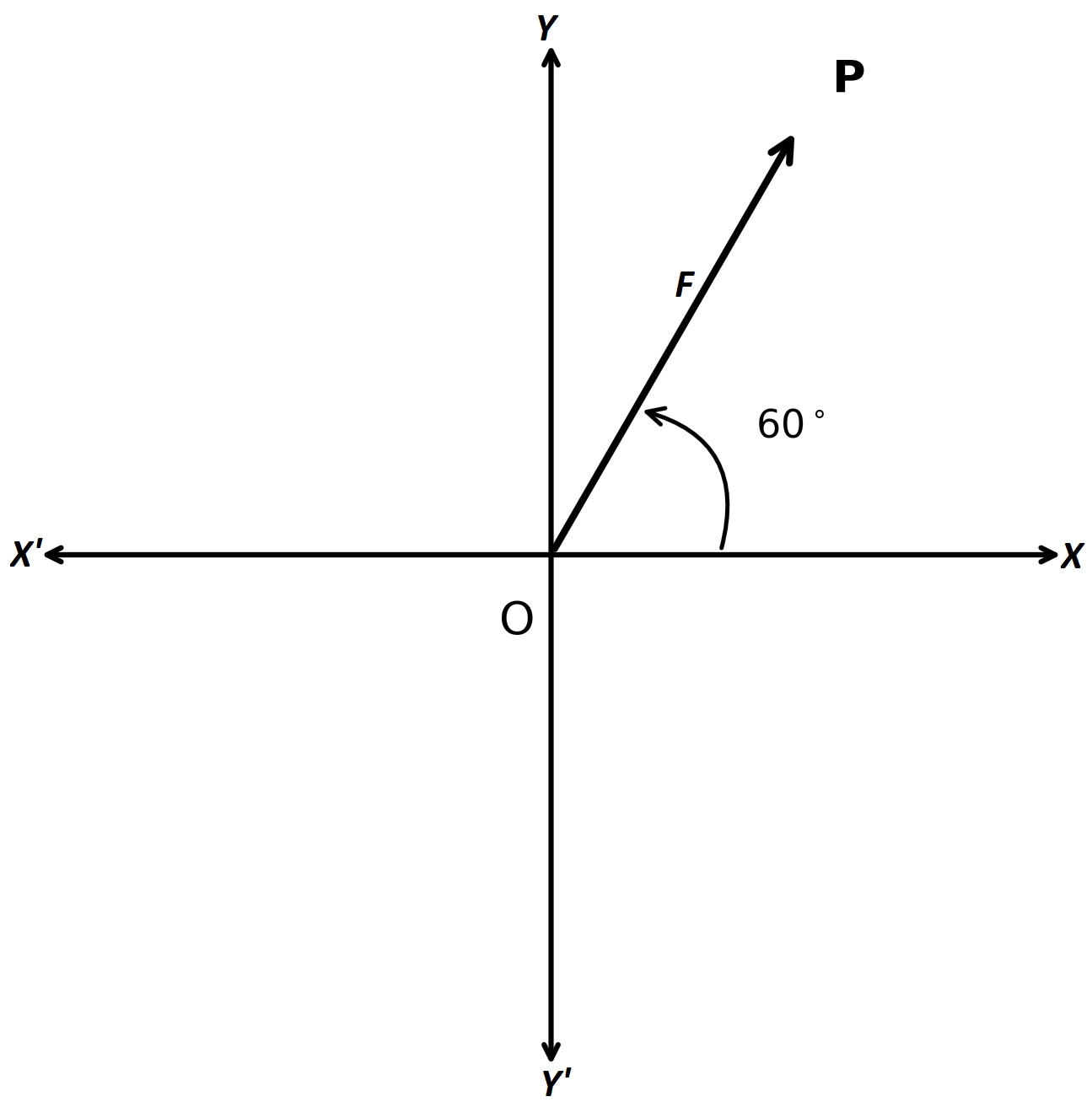
Figure: Graphical representation of vector \(F\) with magnitude 350N at 60°
✅ Vector represented by a line with arrowhead: length = magnitude, arrow = direction.
2.2 Differentiate between: (i) rest and motion (ii) speed and velocity
Answer:
(i) Rest and Motion:
| Rest | Motion |
|---|---|
| If a body does not change its position with respect to its surroundings, it is said to be at rest. | If a body continuously changes its position with respect to its surroundings, it is said to be in motion. |
| Example: A motorcyclist standing on the road is at rest. | Example: A moving motorcyclist is in motion. |
(ii) Speed and Velocity:
| Speed | Velocity |
|---|---|
| Speed is the distance covered in unit time. It tells us how fast a body is moving. | Velocity is the net displacement of a body in unit time. |
| Formula: \(v = \frac{S}{t}\) | Formula: \(v = \frac{d}{t}\) |
| Speed is a scalar quantity, and its SI unit is ms⁻¹ or kmh⁻¹. | Velocity is a vector quantity and its SI unit is ms⁻¹ or kmh⁻¹. |
✅ Rest: no position change. Motion: position change. Speed: scalar (distance/time). Velocity: vector (displacement/time).
2.3 Describe different types of motion. Also give examples.
Answer: Generally, there are three types of motion of bodies:
1. Translatory Motion: If the motion of a body is such that every particle of the body moves uniformly in the same direction, it is called translatory motion. Example: motion of a train or a car.
Translatory motion can be of three types:
a. Linear Motion: Body moves along a straight line. Example: a freely falling body.
b. Random Motion: Body moves along an irregular path. Example: motion of a bee.
c. Circular Motion: Body moves along a circle. Example: a Ferris wheel or a ball tied to a string and whirled in a circle.
2. Rotatory Motion: If each point of a body moves around a fixed point (axis), the motion is called rotatory motion. Example: motion of an electric fan or a spinning top.
3. Vibratory Motion: When a body repeats its to and fro motion about a fixed position, the motion is called vibratory motion. Example: a swing in a children's park.
✅ Types of motion: Translatory (linear, random, circular), Rotatory, Vibratory.
2.4 Explain the difference between distance and displacement.
Answer:
Distance: The distance is the length of the actual path of the motion.
Example: A person travelling from Lahore to Multan in a car travels a distance of \(320km\). This is the total distance travelled, not the shortest distance, as the car took many turns along the way.
Displacement: The displacement of an object is a vector quantity whose magnitude is the shortest distance between the initial and final positions of the motion. Its direction is from the initial position to the final position. We can also call this the change in position.
OR The shortest distance between the initial and final positions of a body is called its displacement.
Example: A car travels from position \(A\) to \(B\). The curved line is the actual path (distance). The displacement \((d)\) is the straight line from \(A\) to \(B\).
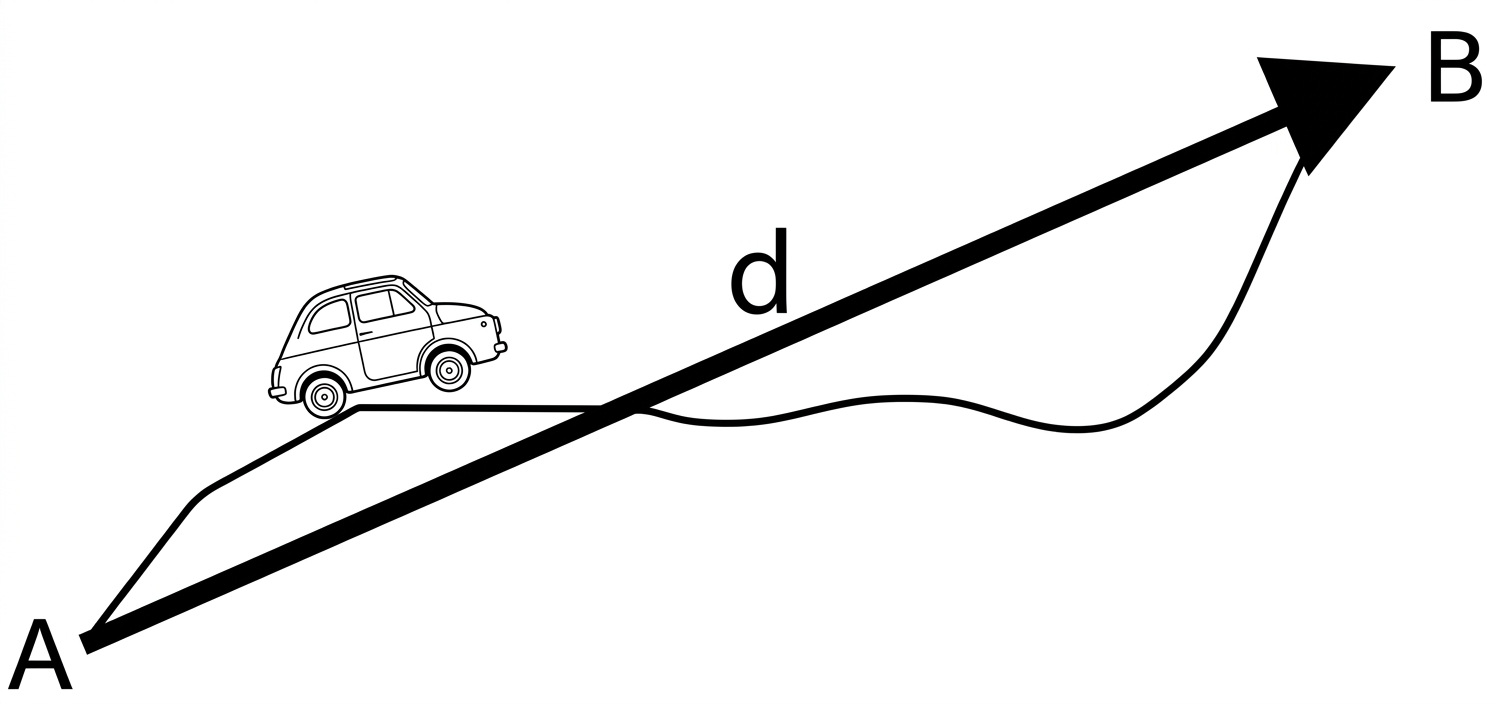
Figure: Distance (curved path) vs Displacement (straight line from A to B)
✅ Distance: actual path length (scalar). Displacement: shortest distance (vector).
2.5 What do gradients of distance-time graph and speed-time graph represent? Explain it by drawing diagrams.
Answer: The gradient is the measure of the slope of a line. In a distance-time graph, the gradient is equal to the average speed of the body.
To calculate the gradient:
(i) Select any two values of time \(t_1\) and \(t_2\).
(ii) Draw two vertical dotted lines at \(t_1\) and \(t_2\) on the x-axis.
(iii) These lines meet the graph at points \(P\) and \(Q\).
(iv) From points \(P\) and \(Q\), draw horizontal lines to meet the y-axis at \(S_1\) and \(S_2\), respectively.
The slope or gradient of the graph is the measure of tangent \(\theta\) of the triangle \(PQR\):
\(\text{Slope} = \frac{\text{y axis}}{\text{x axis}} = \frac{RQ}{PR} = \frac{S_2 - S_1}{t_2 - t_1} = \frac{S}{t}\)
From Equation \(v_{av} = \frac{S}{t}\), \(S = vt\) where \(v\) is the average speed:
\(\text{Slope} = \tan \theta = \frac{S}{t} = \text{Average speed}\)
Therefore, the gradient of the distance-time graph is equal to the average speed of the body.
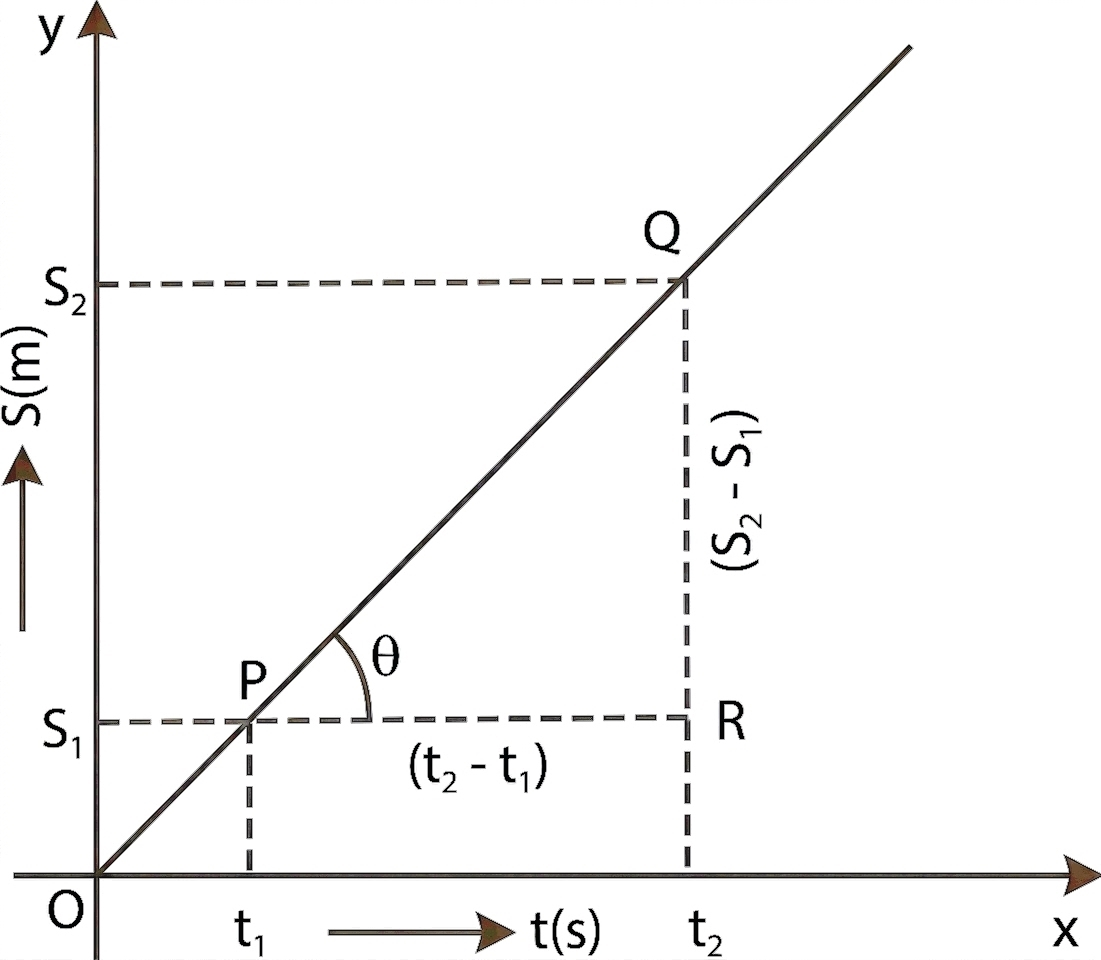
Figure: Distance-Time Graph – Gradient = Average Speed
✅ Gradient of distance-time graph = average speed. Gradient of speed-time graph = acceleration.
2.6 Prove that the area under speed-time graph is equal to the distance covered by an object.
Answer: The distance moved by an object can be found by calculating the area under the speed-time graph.
1. When the Object Moves with Constant Speed: The object moves with a constant speed \(v\). For a time interval \(t\), the distance covered is: \(\text{Distance} = v \times t\)
The area under the speed-time graph is a rectangle with sides \(v\) and \(t\): \(\text{Area of rectangle} = v \times t\)
Thus, the area under the speed-time graph up to the time axis is numerically equal to the distance covered.
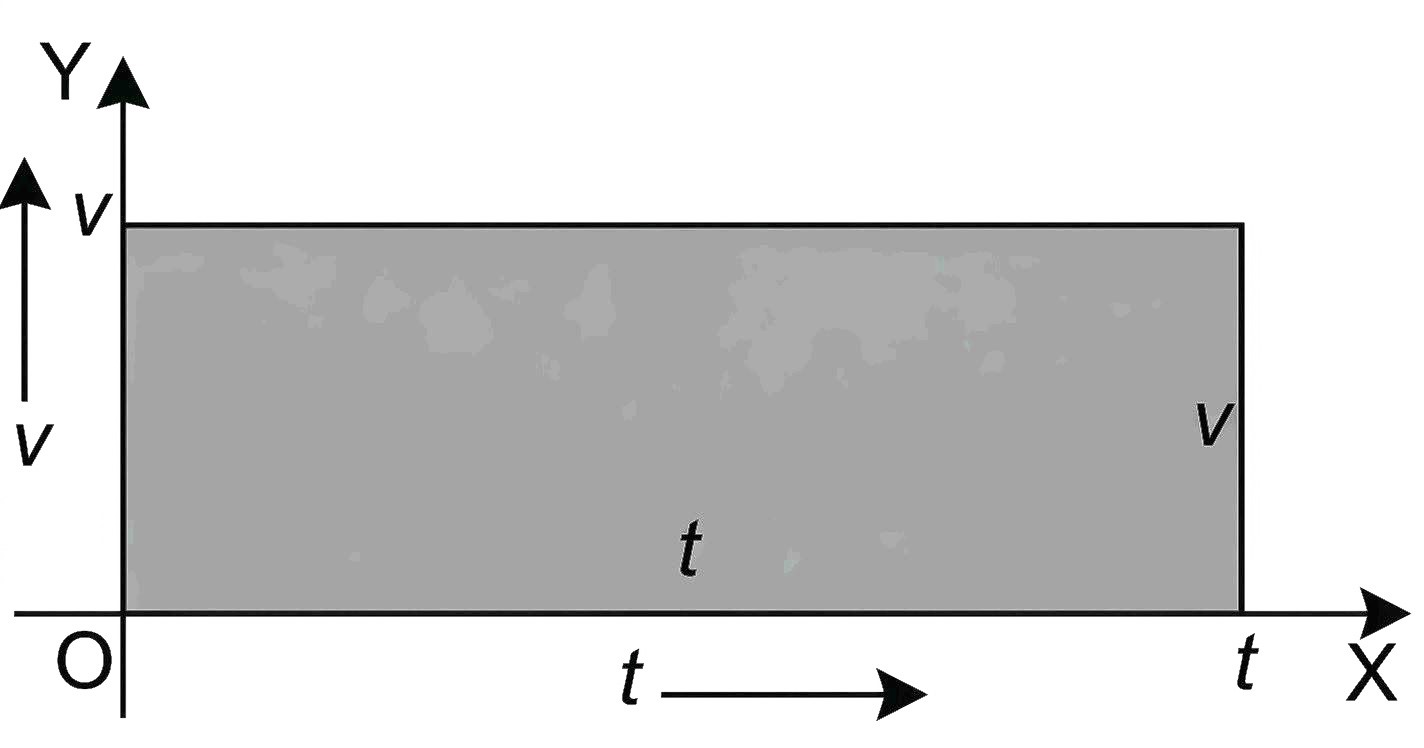
Figure: Speed-Time Graph – Constant Speed (Area = Distance)
2. When the Object Moves with Uniformly Increasing Speed (Acceleration): The object's speed increases uniformly from 0 to \(v\) in time \(t\).
The average speed is: \(v_{av} = \frac{0 + v}{2} = \frac{v}{2}\)
The distance covered is: \(\text{Distance} = v_{av} \times t = \frac{v}{2} \times t = \frac{1}{2} vt\)
The area under the speed-time graph is a right-angled triangle with base \(t\) and perpendicular \(v\): \(\text{Area of triangle} = \frac{1}{2} \times \text{base} \times \text{perpendicular} = \frac{1}{2} \times v \times t = \frac{1}{2} vt\)
Therefore, the area under the speed-time graph up to the time axis is numerically equal to the distance covered.
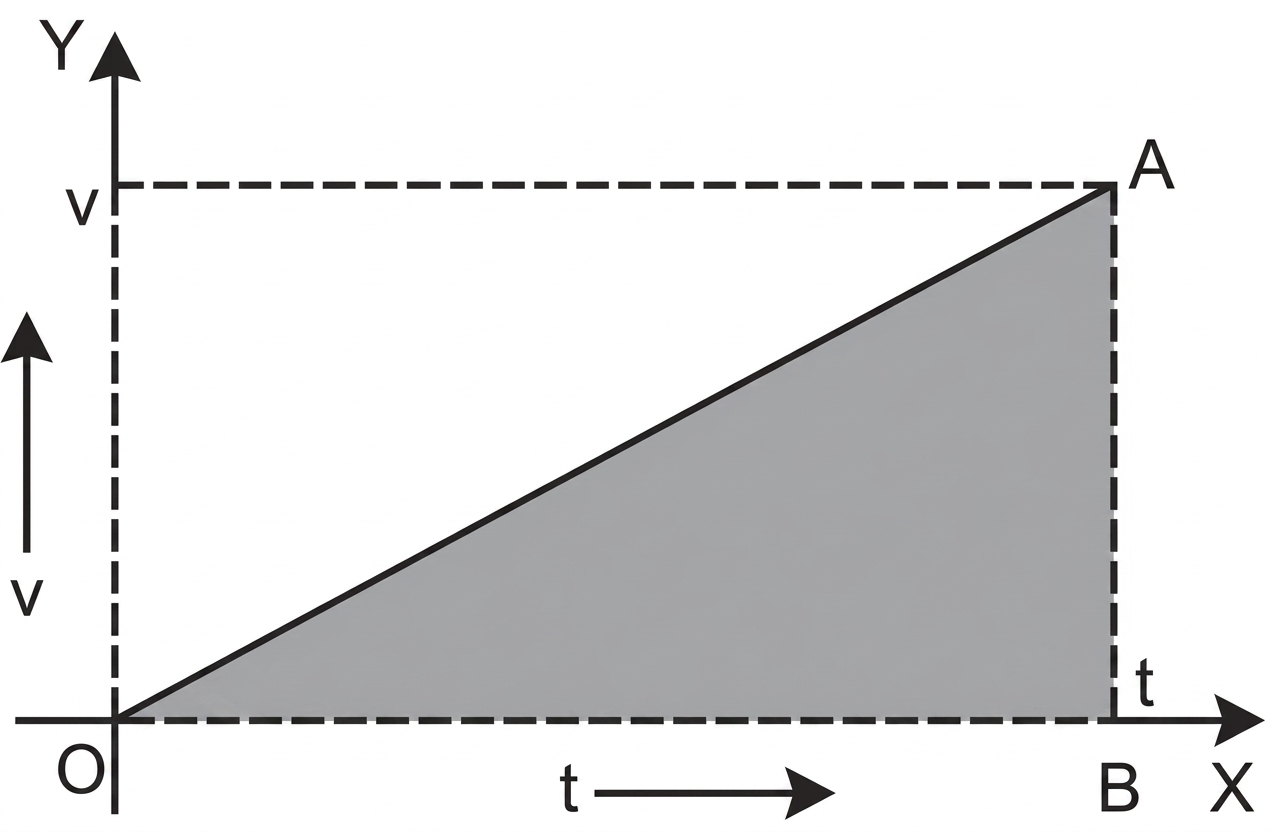
Figure: Speed-Time Graph – Uniform Acceleration (Area = Distance)
✅ Area under speed-time graph = distance covered (rectangle for constant speed, triangle for acceleration).
2.7 How equations of motion can be applied to the bodies moving under the action of gravity?
Answer: When a body falls freely under the action of Earth's gravity, the acceleration acting on it is called gravitational acceleration and is denoted by \(g\). The direction of gravitational acceleration is always downwards. Its value is \(9.8 \text{ms}^{-2}\), but for convenience, we use \(10 \text{ms}^{-2}\).
Since freely falling bodies move vertically downward in a straight line with uniform acceleration \(g\), the three equations of motion can be applied to their motion by replacing \(a\) with \(g\).
Thus, the equations of motion for freely falling bodies are:
\(v_f = v_i + gt\)
\(S = v_i t + \frac{1}{2} gt^2\)
\(2gS = v_f^2 - v_i^2\)
Points to Consider While Using These Equations:
(i) If a body is released from some height to fall freely, its initial velocity \(v_i\) is taken as zero.
(ii) The gravitational acceleration \(g\) is taken as positive in the downward direction. All other quantities in the downward direction are also taken as positive, while those in the opposite direction are taken as negative.
(iii) If a body is thrown vertically upward, the value of \(g\) is negative, and the final velocity is zero at the highest point.
✅ Equations of motion under gravity: replace \(a\) with \(g\). For free fall, \(v_i = 0\), \(g\) positive downward.
📐 Key Concepts – Kinematics
Vector Representation: Line with arrowhead – length = magnitude, arrow = direction.
Types of Motion: Translatory (linear, random, circular), Rotatory, Vibratory.
Distance vs Displacement: Distance = actual path length (scalar). Displacement = shortest distance (vector).
Gradient of Distance-Time Graph: = Average speed.
Area Under Speed-Time Graph: = Distance covered.
Equations of Motion Under Gravity: \(v_f = v_i + gt\), \(S = v_i t + \frac{1}{2} gt^2\), \(2gS = v_f^2 - v_i^2\).
💡 Exam Tip:
For comprehensive (long-answer) questions, write your answers in a structured format. Use headings, tables, and diagrams where appropriate. Include key terms like "vector representation", "translatory motion", "rotatory motion", "vibratory motion", "gradient", "area under graph", and "equations of motion under gravity". These questions follow the PECTAA 2026 pattern and are prepared by Subject Specialist Muhammad Tayyab.
Chapter 1Physical Quantities and Measurements
Chapter 2✨ Kinematics
Chapter 3Dynamics
Chapter 4Turning Effect of Forces
Chapter 5Work and Energy
Chapter 6Mechanical Properties of Matter
Chapter 7Thermal Properties of Matter
Chapter 8Magnetism
Chapter 9Nature of Science
📖 Complete syllabus coverage for Class 9 Physics (PECTAA 2026) – Chapters 1 to 9
Created by Hira Science Academy | Aligned with PECTAA 2026 Syllabus