📘 Chapter 2: Kinematics – Constructed Response Questions
Prepared by Muhammad Tayyab, Subject Specialist Physics, Govt Christian High School Daska. Based on PECTAA 2026 syllabus (National Curriculum 2023).
📖 What's Inside: This section covers constructed response questions from Chapter 2 Kinematics including distance vs displacement, muzzle velocity and acceleration, average vs instantaneous velocity, velocity-time graphs for vertical motion, distance-time graph analysis, and acceleration concepts. Each question is presented with a detailed answer as per the official PECTAA 2026 Physics curriculum. Perfect for Punjab Boards (Lahore, Gujranwala, Multan, etc.) and all BISE boards across Pakistan.
📚 Related Resources – Chapter 2: Kinematics
📋 Exercise Short Qs
📝 Short Qs
📖 Comprehensive Qs
🔢 Numerical Problems
✅ MCQs
✏️ Constructed Response
Kinematics covers motion, scalars, vectors, and graphical analysis of motion.
📝 Constructed Response Questions & Answers (PECTAA 2026)
2.1 Distance and displacement may or may not be equal in magnitude. Explain this statement.
Answer: Distance is the length of actual path, while displacement is the shortest distance between the initial and final positions. They are equal when the object moves in a straight line in one direction; otherwise, distance is greater than displacement.
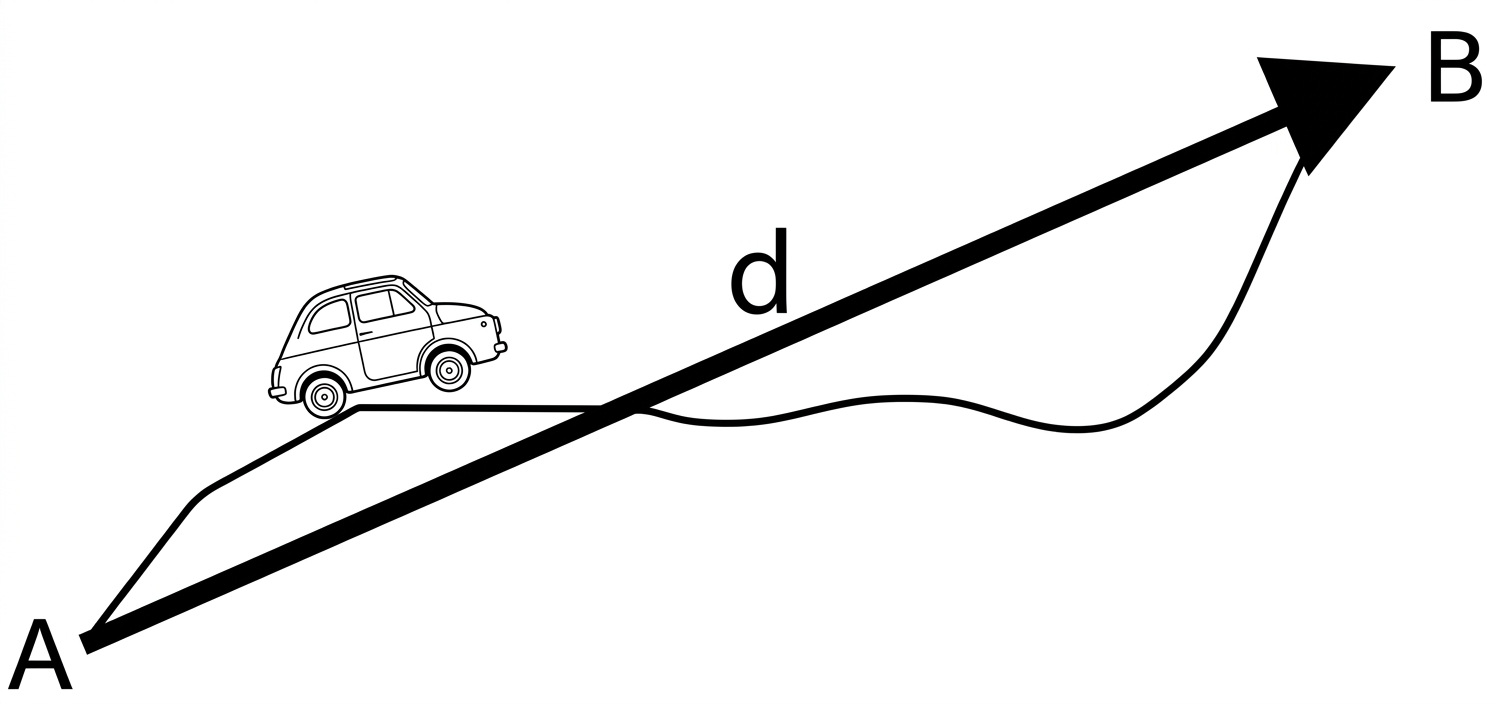
Figure: Distance (curved path) vs Displacement (straight line from A to B)
✅ Distance equals displacement only for straight-line motion in one direction. Otherwise, distance > displacement.
2.2 When a bullet is fired, its velocity with which it leaves the barrel is called the muzzle velocity of the gun. The muzzle velocity of one gun with a longer barrel is lesser than that of another gun with a shorter barrel. In which gun is the acceleration of the bullet larger? Explain your answer.
Answer: The acceleration is larger in the gun with the shorter barrel because the bullet attains its velocity in a shorter distance. Thus, its velocity changes more rapidly.

Figure: Acceleration is larger in the shorter barrel gun
✅ Shorter barrel → larger acceleration (velocity changes over shorter distance).
2.3 For a complete trip, average velocity was calculated. Its value came out to be positive. Is it possible that its instantaneous velocity at any time during the trip had the negative value? Give justification of your answer.
Answer: Yes. Average velocity depends on the net displacement, while instantaneous velocity may be negative during part of the trip if the object moves in the opposite direction.
✅ Yes. Instantaneous velocity can be negative even if average velocity is positive (depends on net displacement).
2.4 A ball is thrown vertically upward with velocity \(\nu\). It returns to the ground in time \(T\). Which of the following graphs correctly represents the motion? Explain your reasoning.
Answer: The ball experiences constant downward acceleration due to gravity \((g)\). As it moves upward, velocity decreases linearly from \(+v\) to 0 at time \(\frac{T}{2}\). As it falls back down, velocity becomes negative and increases in magnitude, reaching \(-v\) at time \(T\). Graph (c) correctly shows this continuous straight line with a constant negative slope.
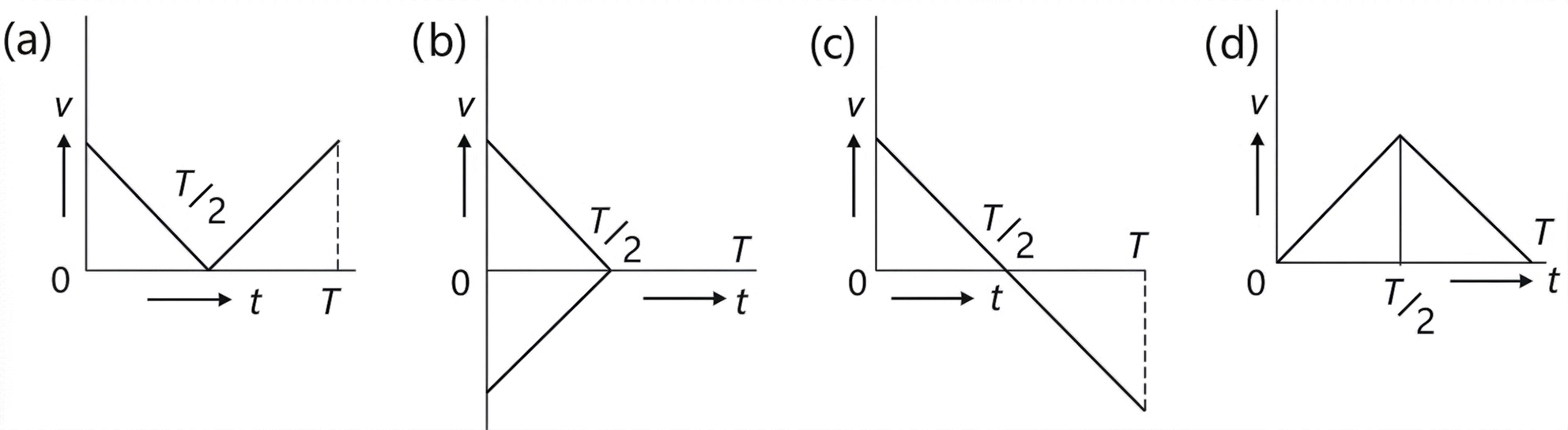
Figure: Velocity-Time Graph – Ball thrown upward (constant negative slope = g)
✅ Graph (c) correctly represents the motion: constant negative slope (acceleration due to gravity).
2.5 The figure given below shows the distance-time graph for the travel of a cyclist. Find the velocities for the segments a, b and c.
Answer: Velocity is given by the gradient of the distance-time graph: \(v = \frac{\Delta S}{\Delta t}\)
Segment a: \(\Delta S = 2 \text{ km}\), \(\Delta t = 6 \text{ min}\)
\(v_a = \frac{2 \text{ km}}{6 \text{ min}} = 0.333 \text{ km min}^{-1}\)
Segment b: Distance does not change with time. So \(\Delta S = 0\)
\(v_b = \frac{0}{\Delta t} = 0 \text{ km min}^{-1}\) (cyclist is at rest)
Segment c: Distance changes from \(2 \text{ km}\) to \(0 \text{ km}\) in \(10 \text{ min}\)
\(\Delta S = (0 - 2) \text{ km}\), \(\Delta t = (20 - 10) \text{ min}\)
\(v_c = \frac{(0 - 2) \text{ km}}{(20 - 10) \text{ min}} = -0.2 \text{ km min}^{-1}\)
The negative sign for segment c shows that the cyclist is moving in the opposite direction.
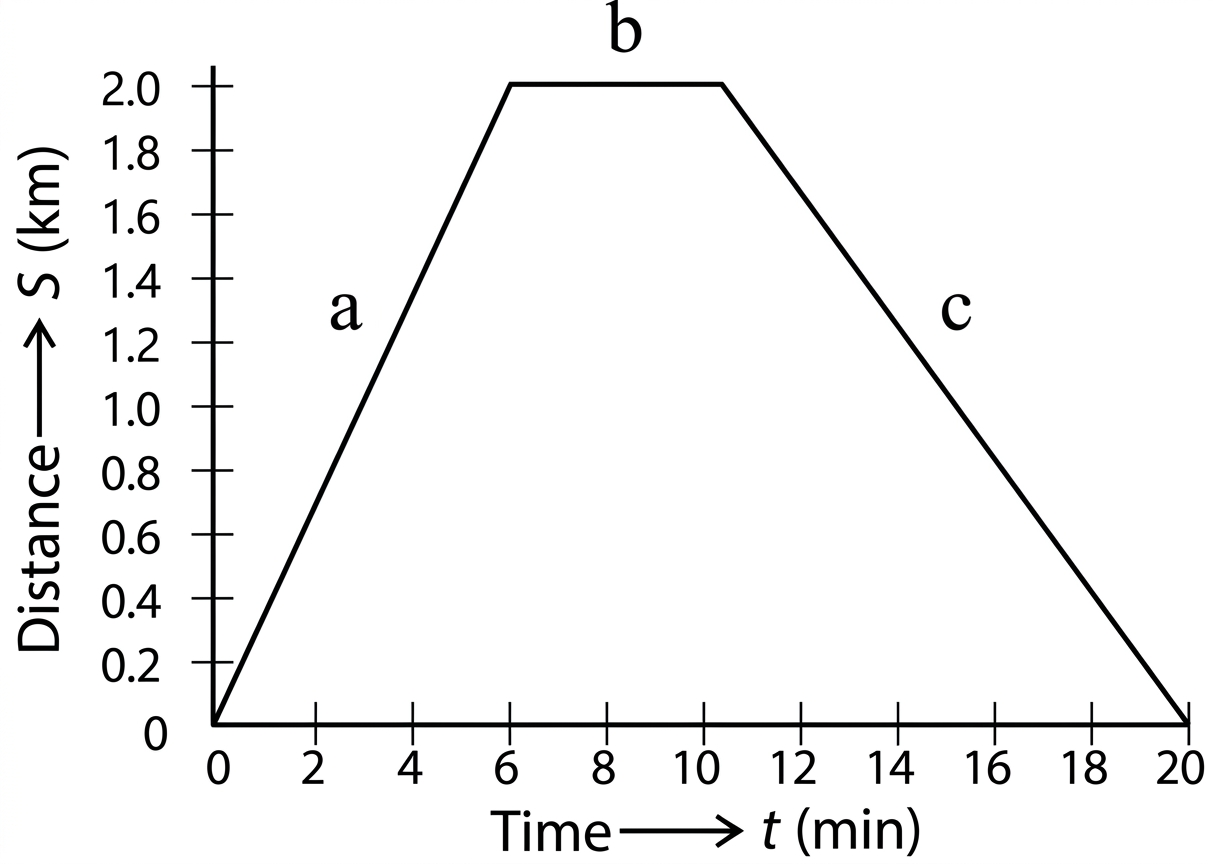
Figure: Distance-Time Graph for Cyclist – Segments a, b, and c
✅ \(v_a = 0.333 \text{ km min}^{-1}\), \(v_b = 0 \text{ km min}^{-1}\), \(v_c = -0.2 \text{ km min}^{-1}\) (opposite direction).
2.6 Is it possible that the velocity of an object is zero at an instant of time, but its acceleration is not zero? If yes, give an example of such a case.
Answer: Yes. For example, when a ball is thrown vertically upward, its velocity becomes zero at the highest point, but its acceleration due to gravity is still \(10 \text{ ms}^{-2}\) downward.
✅ Yes. Example: ball at the highest point in vertical motion (v = 0, a = g ≠ 0).
📐 Key Concepts – Kinematics
Distance vs Displacement: Distance = actual path length (scalar). Displacement = shortest distance (vector).
Muzzle Velocity: Shorter barrel → larger acceleration (velocity changes over shorter distance).
Average vs Instantaneous Velocity: Average depends on net displacement; instantaneous can be negative during part of the trip.
Velocity-Time Graph (Vertical Motion): Constant negative slope (g) for ball thrown upward.
Distance-Time Graph: Gradient = velocity. Flat segment = rest. Negative gradient = opposite direction.
Zero Velocity, Non-Zero Acceleration: Possible at highest point of vertical motion (v = 0, a = g).
💡 Exam Tip:
For constructed response questions, write your answers clearly and concisely. Use diagrams and graphs where appropriate to illustrate your points. Include key terms like "distance", "displacement", "muzzle velocity", "acceleration", "average velocity", "instantaneous velocity", "gradient", and "free fall acceleration". These questions follow the PECTAA 2026 pattern and are prepared by Subject Specialist Muhammad Tayyab.
Chapter 1Physical Quantities and Measurements
Chapter 2✨ Kinematics
Chapter 3Dynamics
Chapter 4Turning Effect of Forces
Chapter 5Work and Energy
Chapter 6Mechanical Properties of Matter
Chapter 7Thermal Properties of Matter
Chapter 8Magnetism
Chapter 9Nature of Science
📖 Complete syllabus coverage for Class 9 Physics (PECTAA 2026) – Chapters 1 to 9
Created by Hira Science Academy | Aligned with PECTAA 2026 Syllabus