📘 Chapter 2: Kinematics – Multiple Choice Questions
Prepared by Muhammad Tayyab, Subject Specialist Physics, Govt Christian High School Daska. Based on PECTAA 2026 syllabus (National Curriculum 2023).
📖 What's Inside: This section covers multiple choice questions from Chapter 2 Kinematics including displacement, rest, free fall, acceleration, gradient of graphs, area under graphs, and velocity concepts. Select an option and click "Check Answer" to see if you're correct!
📚 Related Resources – Chapter 2: Kinematics
📋 Exercise Short Qs
📝 Short Qs
📖 Comprehensive Qs
🔢 Numerical Problems
✅ MCQs
✏️ Constructed Response
Kinematics covers motion, scalars, vectors, and graphical analysis of motion.
📝 Multiple Choice Questions
2.1 The numerical ratio of displacement to distance is:
✅ Correct Answer: (D) equal to or less than one
Displacement is the shortest distance between initial and final positions, while distance is the actual path length. Displacement can be equal to distance (when moving in a straight line) or less than distance (when path is curved).
Displacement is the shortest distance between initial and final positions, while distance is the actual path length. Displacement can be equal to distance (when moving in a straight line) or less than distance (when path is curved).
2.2 If a body does not change its position with respect to some fixed point, then it will be in a state of:
✅ Correct Answer: (A) rest
If a body does not change its position with respect to its surroundings, it is said to be at rest.
If a body does not change its position with respect to its surroundings, it is said to be at rest.
2.3 A ball is dropped from the top of a tower, the distance covered by it in the first second is:
✅ Correct Answer: (A) 5 m
Using \(S = \frac{1}{2}gt^2 = \frac{1}{2} \times 10 \times (1)^2 = 5 \text{ m}\)
Using \(S = \frac{1}{2}gt^2 = \frac{1}{2} \times 10 \times (1)^2 = 5 \text{ m}\)
2.4 A body accelerates from rest to a velocity of \(144 \text{ kmh}^{-1}\) in 20 seconds. The distance covered by it is:
✅ Correct Answer: (B) 400 m
Using \(S = v_{av}t = \left(\frac{v_i + v_f}{2}\right)t = \left(\frac{0 + 40}{2}\right)(20) = 400 \text{ m}\)
Note: \(144 \text{ kmh}^{-1} = 144 \times \frac{10}{36} = 40 \text{ ms}^{-1}\)
Using \(S = v_{av}t = \left(\frac{v_i + v_f}{2}\right)t = \left(\frac{0 + 40}{2}\right)(20) = 400 \text{ m}\)
Note: \(144 \text{ kmh}^{-1} = 144 \times \frac{10}{36} = 40 \text{ ms}^{-1}\)
2.5 A body is moving with constant acceleration starting from rest. It covers a distance S in 4 seconds. How much time does it take to cover one-fourth of this distance?
✅ Correct Answer: (B) 2 s
\(S = \frac{1}{2}at^2\). If \(S\) becomes \(\frac{S}{4}\), then time becomes 2 seconds.
\(\frac{S}{4} = \frac{1}{2}a(t')^2 \Rightarrow \frac{t^2}{4} = (t')^2 \Rightarrow t' = 2 \text{ s}\)
\(S = \frac{1}{2}at^2\). If \(S\) becomes \(\frac{S}{4}\), then time becomes 2 seconds.
\(\frac{S}{4} = \frac{1}{2}a(t')^2 \Rightarrow \frac{t^2}{4} = (t')^2 \Rightarrow t' = 2 \text{ s}\)
2.6 The displacement time graphs of two objects A and B are shown in the figure. Point out the true statement from the following:
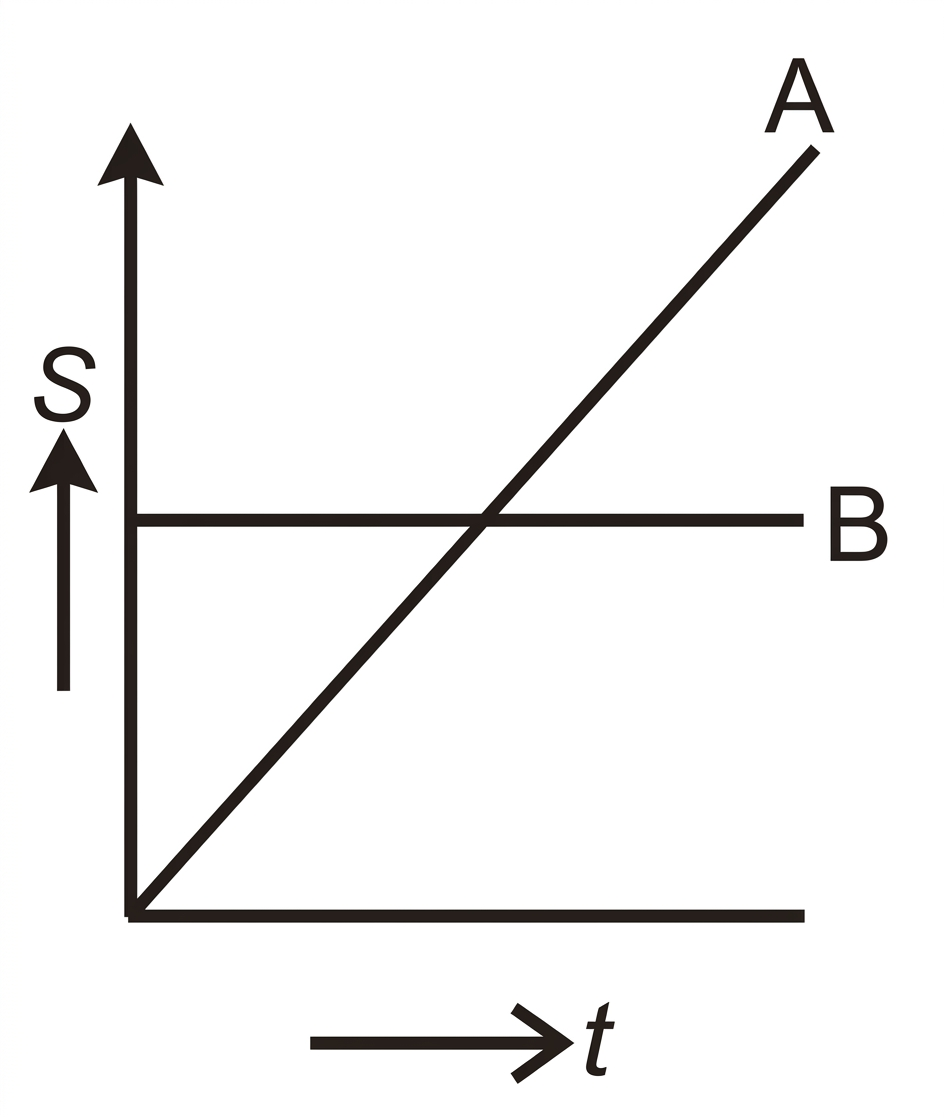
Figure: Displacement-Time Graph – Objects A and B
✅ Correct Answer: (A) The velocity of A is greater than B
Greater slope of distance-time graph means greater speed/velocity.
Greater slope of distance-time graph means greater speed/velocity.
2.7 The area under the speed–time graph is numerically equal to:
✅ Correct Answer: (D) distance covered
The area under the speed-time graph up to the time axis is numerically equal to the distance covered by the object.
The area under the speed-time graph up to the time axis is numerically equal to the distance covered by the object.
2.8 Gradient of the speed–time graph is equal to:
✅ Correct Answer: (C) acceleration
Gradient of the speed-time graph is equal to the average acceleration of the body.
Gradient of the speed-time graph is equal to the average acceleration of the body.
2.9 Gradient of the distance–time graph is equal to the:
✅ Correct Answer: (A) speed
Gradient of the distance-time graph is equal to the average speed of the body.
Gradient of the distance-time graph is equal to the average speed of the body.
2.10 A car accelerates uniformly from \(80.5 \text{ kmh}^{-1}\) at \(t = 0\) to \(113 \text{ kmh}^{-1}\) at \(t = 9 \text{ s}\). Which graph best describes the motion of the car?
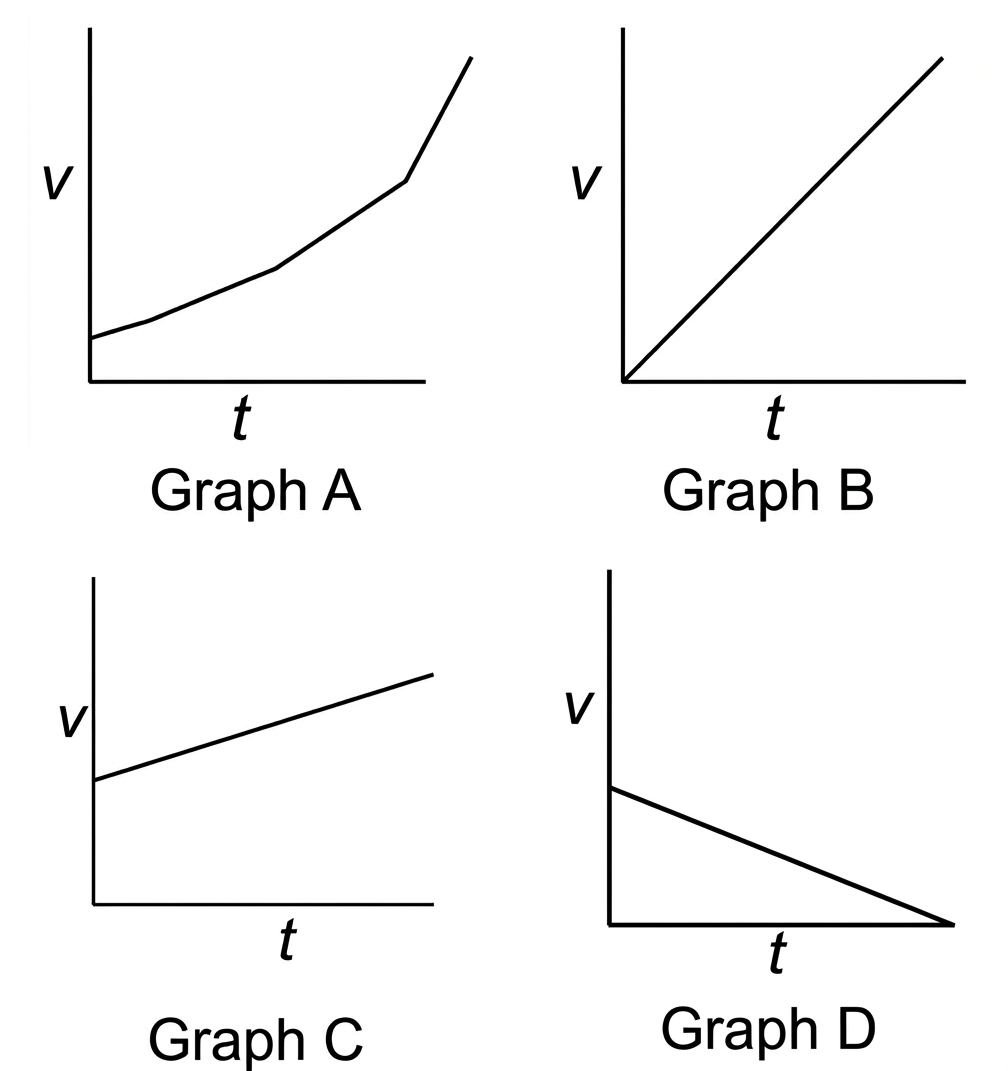
Figure: Velocity-Time Graphs for Uniform Acceleration
✅ Correct Answer: (C) Graph C
The third graph is correct because uniform acceleration means a straight line with a constant upward slope, starting above the origin due to the non-zero initial velocity is 80.5 kmh⁻¹.
The third graph is correct because uniform acceleration means a straight line with a constant upward slope, starting above the origin due to the non-zero initial velocity is 80.5 kmh⁻¹.
💡 Exam Tip:
For multiple choice questions, read all options carefully before selecting your answer. Pay attention to key terms like "displacement", "distance", "rest", "acceleration", "gradient", and "area under graph". Use the process of elimination when unsure. These questions follow the PECTAA 2026 pattern and are prepared by Subject Specialist Muhammad Tayyab.
Chapter 1Physical Quantities and Measurements
Chapter 2✨ Kinematics
Chapter 3Dynamics
Chapter 4Turning Effect of Forces
Chapter 5Work and Energy
Chapter 6Mechanical Properties of Matter
Chapter 7Thermal Properties of Matter
Chapter 8Magnetism
Chapter 9Nature of Science
📖 Complete syllabus coverage for Class 9 Physics (PECTAA 2026) – Chapters 1 to 9
Created by Hira Science Academy | Aligned with PECTAA 2026 Syllabus