📘 Chapter 5: Work and Energy – Numerical Problems
Prepared by Muhammad Tayyab, Subject Specialist Physics, Govt Christian High School Daska. Based on PECTAA 2026 syllabus (National Curriculum 2023).
📖 What's Inside: This section covers numerical problems from Chapter 5 Work and Energy including Work done at an angle, Kinetic Energy, Potential Energy, Power, Efficiency, and Force-Displacement graphs. Each problem is presented with Given Data, To Find, and step-by-step Solution as per the official PECTAA 2026 Physics curriculum. Perfect for Punjab Boards (Lahore, Gujranwala, Multan, etc.) and all BISE boards across Pakistan.
📚 Related Resources – Chapter 5: Work and Energy
📋 Exercise Short Qs
📝 Short Qs
📖 Comprehensive Qs
🔢 Numerical Problems
✅ MCQs
✏️ Constructed Response
Work and Energy covers work, kinetic energy, potential energy, power, and efficiency.
📐 Important Formulas – Work and Energy
Work Done: \(W = FS\) or \(W = FS\cos\theta\)
Kinetic Energy: \(E_k = \frac{1}{2} mv^2\)
Potential Energy: \(E_p = mgh\)
Mass Energy Equation: \(E = mc^2\)
Power: \(P = \frac{W}{t}\)
Efficiency: \(\eta = \frac{\text{Output}}{\text{Input}} \times 100\)
Weight: \(w = mg\)
📐 Numerical Problems & Solutions (PECTAA 2026)
5.1
A force of \(20\,\text{N}\) acting at an angle of \(60^\circ\) to the horizontal is used to pull a box through a distance of \(3\,\text{m}\) across a floor. How much work is done?
Given Data
Force\(F = 20\,\text{N}\)
Angle\(\theta = 60^\circ\)
Distance covered\(S = 3\,\text{m}\)
To Find
Work done \(W = ?\)
Solution
By using formula of work done:
\[\begin{aligned}
W &= FS\cos\theta \\
W &= (20)(3)\cos 60^\circ \\
W &= (20)(3)(0.5) \\
W &= 30\,\text{J}
\end{aligned}\]
✅ \(W = 30\,\text{J}\)
5.2
A body moves a distance of \(5\,\text{m}\) in a straight line under the action of a force of \(8\,\text{N}\). If the work done is \(20\,\text{J}\), find the angle which the force makes with the direction of motion of the body.
Given Data
Distance covered\(S = 5\,\text{m}\)
Force\(F = 8\,\text{N}\)
Work done\(W = 20\,\text{J}\)
To Find
Angle \(\theta = ?\)
Solution
By using formula of work done:
\[\begin{aligned}
W &= FS\cos\theta \\
\cos\theta &= \frac{W}{FS} \\
\cos\theta &= \frac{20}{(8)(5)} = \frac{20}{40} = 0.5 \\
\theta &= \cos^{-1}(0.5) \\
\theta &= 60^\circ
\end{aligned}\]
✅ \(\theta = 60^\circ\)
5.3
An engine raises \(100\,\text{kg}\) of water through a height of \(80\,\text{m}\) in \(25\,\text{s}\). What is the power of the engine?
Given Data
Mass of water\(m = 100\,\text{kg}\)
Height raised\(h = 80\,\text{m}\)
Time taken\(t = 25\,\text{s}\)
To Find
Power \(P = ?\)
Solution
By using formula of power:
\[\begin{aligned}
P &= \frac{W}{t} = \frac{FS}{t} = \frac{mgh}{t} \quad (\because F = w = mg,\ S = h) \\
P &= \frac{(100)(10)(80)}{25} \\
P &= 3200\,\text{W}
\end{aligned}\]
✅ \(P = 3200\,\text{W}\)
5.4
A body of mass \(20\,\text{kg}\) is at rest. A \(40\,\text{N}\) force acts on it for \(5\,\text{s}\). What is the kinetic energy of the body at the end of this time?
Given Data
Mass of body\(m = 20\,\text{kg}\)
Initial velocity\(v_i = 0\,\text{ms}^{-1}\)
Force\(F = 40\,\text{N}\)
Time\(t = 5\,\text{s}\)
To Find
Kinetic energy \(E_k = ?\)
Solution
By using Newton's second law of motion:
\[\begin{aligned}
F &= ma \\
40 &= (20)(a) \\
a &= 2\,\text{ms}^{-2}
\end{aligned}\]
For final velocity using first equation of motion:
\[\begin{aligned}
v_f &= v_i + at \\
v_f &= 0 + (2)(5) = 10\,\text{ms}^{-1}
\end{aligned}\]
Now, by using formula of kinetic energy:
\[\begin{aligned}
E_k &= \frac{1}{2} mv^2 \\
E_k &= \frac{1}{2}(20)(10)^2 = 1000\,\text{J}
\end{aligned}\]
✅ \(E_k = 1000\,\text{J}\)
5.5
A girl is swinging on a swing. At the lowest point of her swing, she is \(1.2\,\text{m}\) from the ground, and at the highest point she is \(2.0\,\text{m}\) from the ground. What is her maximum velocity and where?
Given Data
Height at lowest point\(h_1 = 1.2\,\text{m}\)
Height at highest point\(h_2 = 2.0\,\text{m}\)
Change in height\(h = h_2 - h_1 = 0.8\,\text{m}\)
Gravitational acceleration\(g = 10\,\text{ms}^{-2}\)
To Find
Maximum velocity \(v = ?\)
Location of maximum velocity \(= ?\)
Solution
At the lowest point, all the potential energy is converted into kinetic energy. So,
\[\begin{aligned}
E_p &= E_k \\
mgh &= \frac{1}{2} mv^2 \\
v^2 &= 2gh \\
v &= \sqrt{2gh} = \sqrt{(2)(10)(0.8)} = \sqrt{16} = 4\,\text{ms}^{-1}
\end{aligned}\]
The maximum velocity is \(4\,\text{ms}^{-1}\), and it occurs at the lowest point of the swing.
✅ \(v = 4\,\text{ms}^{-1}\) at the lowest point.
5.6
A person pushes a lawn mower with a force of \(50\,\text{N}\) making an angle of \(45^\circ\) with the horizontal. If the mower is moved through a distance of \(20\,\text{m}\), how much work is done?
Given Data
Force\(F = 50\,\text{N}\)
Angle\(\theta = 45^\circ\)
Distance\(S = 20\,\text{m}\)
To Find
Work done \(W = ?\)
Solution
By using formula of work done:
\[\begin{aligned}
W &= FS\cos\theta \\
W &= (50)(20)\cos 45^\circ \\
W &= (50)(20)(0.707) \\
W &= 707\,\text{J}
\end{aligned}\]
✅ \(W = 707\,\text{J}\)
5.7
Calculate the work done in (i) Pushing a \(5\,\text{kg}\) box up a frictionless inclined plane \(10\,\text{m}\) long that makes an angle of \(30^\circ\) with the horizontal. (ii) Lifting the box vertically up from the ground to the top of the inclined plane.
Given Data
Mass of box\(m = 5\,\text{kg}\)
Length of inclined plane\(S = 10\,\text{m}\)
Angle with horizontal\(\theta = 30^\circ\)
Gravitational acceleration\(g = 10\,\text{ms}^{-2}\)
To Find
Work done along the incline \(W = ?\)
Work done in lifting vertically \(W = ?\)
Solution
(i) The force needed to push the box up the slope is the component of weight along the incline: \(F = mg\sin\theta\)
Using the formula for work \(W = FS\):
\[\begin{aligned}
W &= (mg\sin\theta)(S) \\
W &= (5)(10)(\sin 30^\circ)(10) \\
W &= (5)(10)(0.5)(10) \\
W &= 250\,\text{J}
\end{aligned}\]
(ii) Given figure forms a right-angle triangle so for height use trigonometric ratio:
\[\begin{aligned}
\sin 30^\circ &= \frac{h}{10} \\
h &= (10)(0.5) = 5\,\text{m}
\end{aligned}\]
The work done against gravity is equal to the change in potential energy:
\[\begin{aligned}
W &= E_p = mgh \\
W &= (5)(10)(5) = 250\,\text{J}
\end{aligned}\]
✅ (i) \(W = 250\,\text{J}\), (ii) \(W = 250\,\text{J}\)
5.8
A box of mass \(10\,\text{kg}\) is pushed up along a ramp \(15\,\text{m}\) long with a force of \(80\,\text{N}\). If the box rises up a height of \(5\,\text{m}\), what is the efficiency of the system?
Given Data
Mass of box\(m = 10\,\text{kg}\)
Length of ramp\(S = 15\,\text{m}\)
Force applied\(F = 80\,\text{N}\)
Height raised\(h = 5\,\text{m}\)
Gravitational acceleration\(g = 10\,\text{ms}^{-2}\)
To Find
Efficiency of the system \(\eta = ?\)
Solution
Input energy (Work done on the box):
\[\begin{aligned}
E_{\text{input}} &= FS = (80)(15) = 1200\,\text{J}
\end{aligned}\]
Useful output energy (Gravitational potential energy gained):
\[\begin{aligned}
E_{\text{output}} &= mgh = (10)(10)(5) = 500\,\text{J}
\end{aligned}\]
By using formula of efficiency:
\[\begin{aligned}
\eta &= \frac{E_{\text{output}}}{E_{\text{input}}} \times 100 \\
\eta &= \frac{500}{1200} \times 100 = 41.7\%
\end{aligned}\]
✅ \(\eta = 41.7\%\)
5.9
A force of \(600\,\text{N}\) acts on a box to push it \(5\,\text{m}\) in \(15\,\text{s}\). Calculate the power.
Given Data
Force\(F = 600\,\text{N}\)
Distance\(S = 5\,\text{m}\)
Time\(t = 15\,\text{s}\)
To Find
Power \(P = ?\)
Solution
By using formula of power:
\[\begin{aligned}
P &= \frac{W}{t} = \frac{FS}{t} \\
P &= \frac{(600)(5)}{15} = 200\,\text{W}
\end{aligned}\]
✅ \(P = 200\,\text{W}\)
5.10
A \(40\,\text{kg}\) boy runs up stairs \(10\,\text{m}\) high in \(8\,\text{s}\). What power does he develop?
Given Data
Mass of boy\(m = 40\,\text{kg}\)
Height\(h = 10\,\text{m}\)
Time\(t = 8\,\text{s}\)
To Find
Power \(P = ?\)
Solution
By using formula of power:
\[\begin{aligned}
P &= \frac{W}{t} = \frac{mgh}{t} \\
P &= \frac{(40)(10)(10)}{8} = 500\,\text{W}
\end{aligned}\]
✅ \(P = 500\,\text{W}\)
5.11
A force \(F\) acts through a distance \(L\) on a body. The force is then increased to \(2F\) that further acts through \(2L\). Sketch a force-displacement graph and calculate the total work done.
Given Data
First force\(F\)
First distance\(L\)
Second force\(2F\)
Second distance\(2L\)
To Find
Total work done \(W = ?\)
Solution
As the area under a force-distance graph represents the work done by the force:
\[\begin{aligned}
\text{Work done} &= \text{Area under the graph} \\
&= (F \times L) + (2F \times 2L) \\
&= FL + 4FL = 5FL
\end{aligned}\]
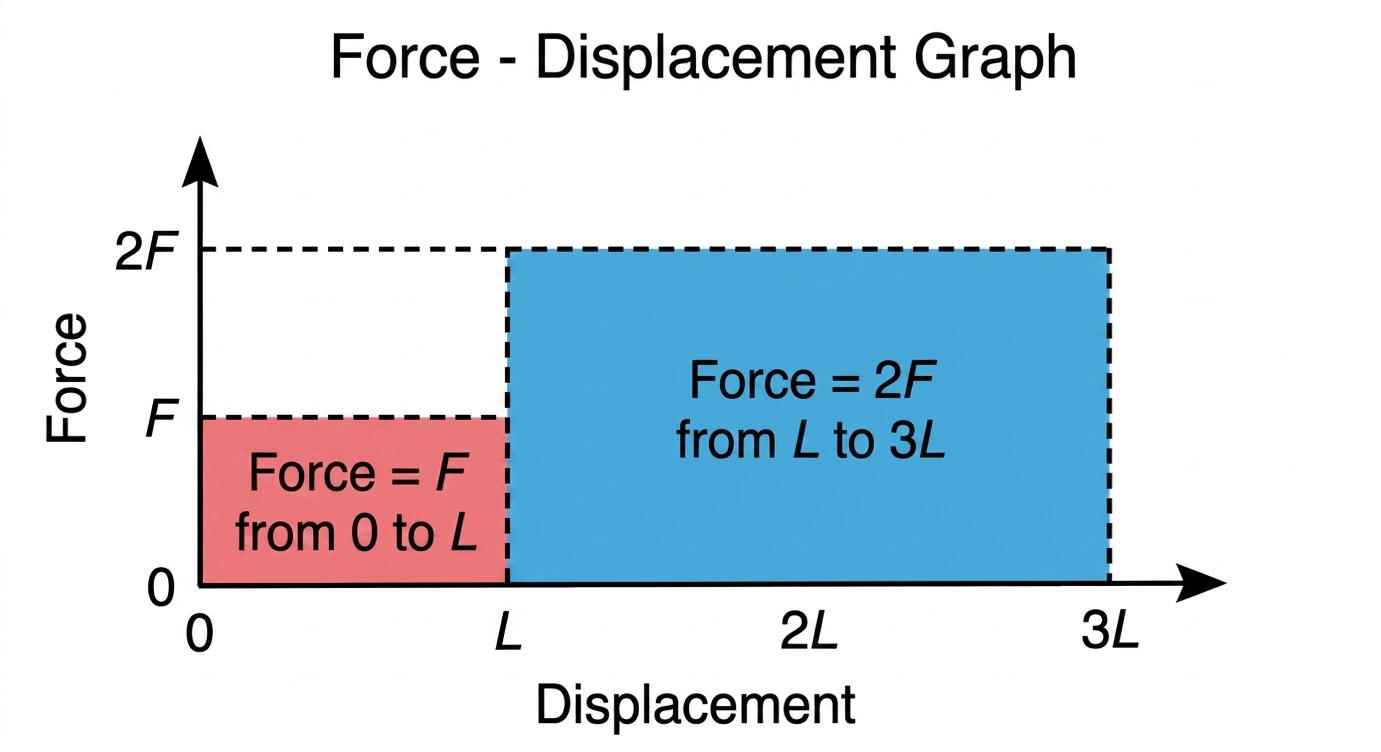
Figure: Force-Displacement Graph
✅ Total work done \(= 5FL\)
5.12
A body of mass \(20\,\text{kg}\) is at rest. A \(40\,\text{N}\) force acts on it for \(5\,\text{s}\). What is the kinetic energy of the body at the end of this time?
Given Data
Mass of body\(m = 20\,\text{kg}\)
Initial velocity\(v_i = 0\,\text{ms}^{-1}\)
Force\(F = 40\,\text{N}\)
Time\(t = 5\,\text{s}\)
To Find
Kinetic energy \(E_k = ?\)
Solution
By using Newton's second law of motion:
\[\begin{aligned}
F &= ma \\
40 &= (20)(a) \\
a &= 2\,\text{ms}^{-2}
\end{aligned}\]
For final velocity using first equation of motion:
\[\begin{aligned}
v_f &= v_i + at \\
v_f &= 0 + (2)(5) = 10\,\text{ms}^{-1}
\end{aligned}\]
Now, by using formula of kinetic energy:
\[\begin{aligned}
E_k &= \frac{1}{2} mv^2 \\
E_k &= \frac{1}{2}(20)(10)^2 = 1000\,\text{J}
\end{aligned}\]
✅ \(E_k = 1000\,\text{J}\)
5.13
A \(40\,\text{kg}\) boy runs up stairs \(10\,\text{m}\) high in \(8\,\text{s}\). What power does he develop?
Given Data
Mass of boy\(m = 40\,\text{kg}\)
Height\(h = 10\,\text{m}\)
Time\(t = 8\,\text{s}\)
To Find
Power \(P = ?\)
Solution
By using formula of power:
\[\begin{aligned}
P &= \frac{W}{t} = \frac{mgh}{t} \\
P &= \frac{(40)(10)(10)}{8} = 500\,\text{W}
\end{aligned}\]
✅ \(P = 500\,\text{W}\)
📘 Solved Examples (PECTAA 2026)
Example 5.1
A person does \(200\,\text{J}\) of work in pushing a carton through a distance of \(5\,\text{m}\). How much force is applied by him?
Given Data
Work done\(W = 200\,\text{J}\)
Distance\(S = 5\,\text{m}\)
To Find
Force \(F = ?\)
Solution
By using formula of work done:
\[\begin{aligned}
W &= FS \\
F &= \frac{W}{S} = \frac{200}{5} = 40\,\text{N}
\end{aligned}\]
✅ \(F = 40\,\text{N}\)
Example 5.2
Find the work done by a \(65\,\text{N}\) force in pulling the suitcase (figure) for a distance of \(20\,\text{m}\).
Given Data
Force\(F = 65\,\text{N}\)
Angle\(\theta = 30^\circ\)
Distance covered\(S = 20\,\text{m}\)
To Find
Work done \(W = ?\)
Solution
By using formula of work done:
\[\begin{aligned}
W &= FS\cos\theta \\
W &= (65)(20)\cos 30^\circ \\
W &= (65)(20)(0.866) \\
W &= 1125.8\,\text{J}
\end{aligned}\]
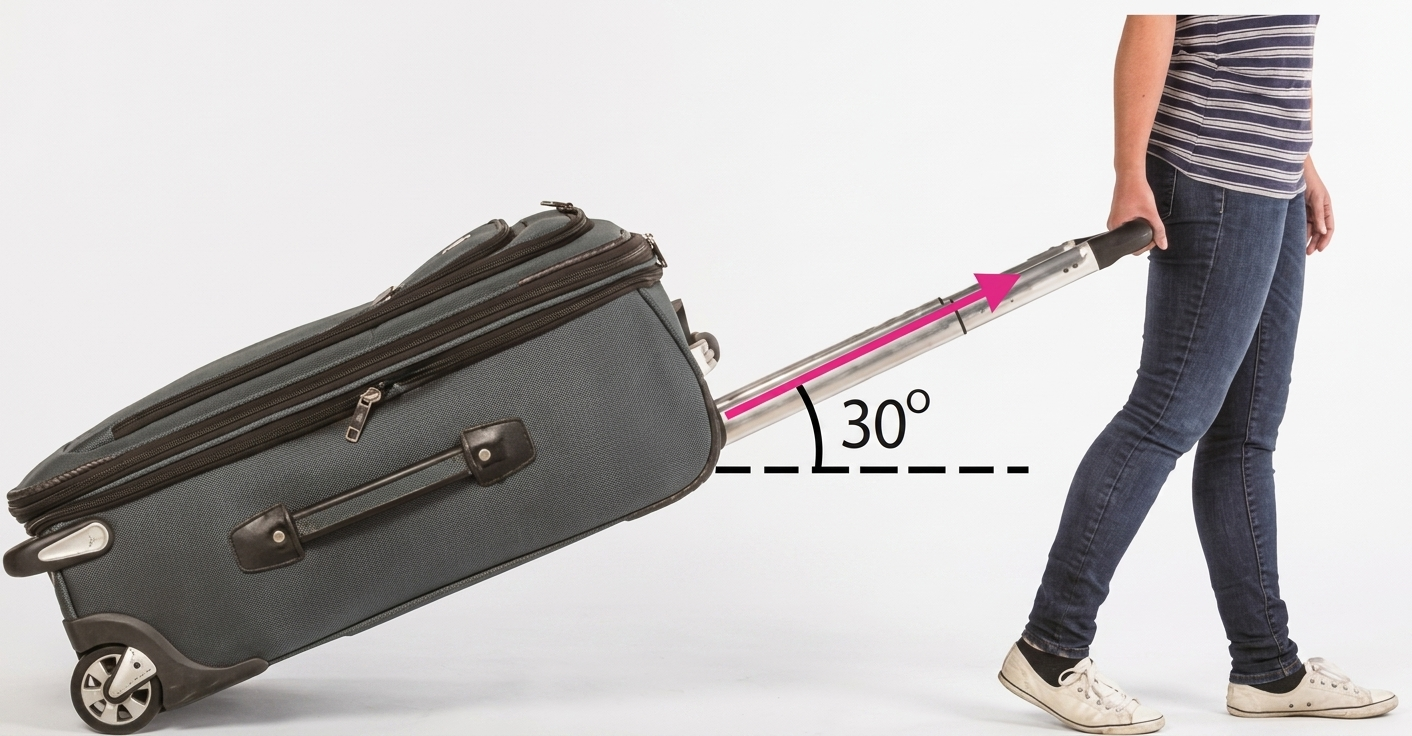
Figure: Pulling a suitcase at an angle
✅ \(W = 1125.8\,\text{J}\)
Example 5.3
A truck of mass \(3000\,\text{kg}\) is moving on a road with uniform velocity of \(54\,\text{kmh}^{-1}\). Determine its kinetic energy.
Given Data
Mass of truck\(m = 3000\,\text{kg}\)
Velocity\(v = 54\,\text{kmh}^{-1}\)
To Find
Kinetic energy \(E_k = ?\)
Solution
First convert velocity to \(\text{ms}^{-1}\):
\[\begin{aligned}
v &= 54 \times \frac{1000}{3600} = 15\,\text{ms}^{-1}
\end{aligned}\]
By using formula of kinetic energy:
\[\begin{aligned}
E_k &= \frac{1}{2} mv^2 \\
E_k &= \frac{1}{2}(3000)(15)^2 = 337500\,\text{J} = 337.5\,\text{kJ}
\end{aligned}\]
✅ \(E_k = 337.5\,\text{kJ}\)
Example 5.4
A ball of mass \(180\,\text{g}\) was thrown vertically upward to a height of \(12\,\text{m}\). Find the potential energy gained by the ball.
Given Data
Mass of ball\(m = 180\,\text{g} = 0.18\,\text{kg}\)
Height reached\(h = 12\,\text{m}\)
Gravitational acceleration\(g = 10\,\text{ms}^{-2}\)
To Find
Potential energy \(E_p = ?\)
Solution
By using formula of potential energy:
\[\begin{aligned}
E_p &= mgh = (0.18)(10)(12) = 21.6\,\text{J}
\end{aligned}\]
✅ \(E_p = 21.6\,\text{J}\)
Example 5.5
A \(1000\,\text{kg}\) car moving with an acceleration of \(4\,\text{ms}^{-2}\) covers a distance of \(50\,\text{m}\) in \(5\,\text{s}\). What is the power generated by its engine?
Given Data
Mass of car\(m = 1000\,\text{kg}\)
Acceleration\(a = 4\,\text{ms}^{-2}\)
Distance\(S = 50\,\text{m}\)
Time taken\(t = 5\,\text{s}\)
To Find
Power \(P = ?\)
Solution
By using formula of power:
\[\begin{aligned}
P &= \frac{W}{t} = \frac{FS}{t} = \frac{maS}{t} \quad (\because F = ma) \\
P &= \frac{(1000)(4)(50)}{5} = 40000\,\text{W} = 40\,\text{kW}
\end{aligned}\]
✅ \(P = 40\,\text{kW}\)
Example 5.6
A block weighing \(120\,\text{N}\) is dragged up a slope with a force of \(100\,\text{N}\) to lift it up a height of \(10\,\text{m}\). If the slope is \(20\,\text{m}\) long, calculate the efficiency of the system.
Given Data
Weight of block\(w = 120\,\text{N}\)
Force applied\(F = 100\,\text{N}\)
Length of slope\(S = 20\,\text{m}\)
Height raised\(h = 10\,\text{m}\)
To Find
Efficiency \(\eta = ?\)
Solution
Input energy (Work done on the block):
\[\begin{aligned}
E_{\text{input}} &= FS = (100)(20) = 2000\,\text{J}
\end{aligned}\]
Useful output energy (Gravitational potential energy gained):
\[\begin{aligned}
E_{\text{output}} &= wh = (120)(10) = 1200\,\text{J}
\end{aligned}\]
By using formula of efficiency:
\[\begin{aligned}
\eta &= \frac{E_{\text{output}}}{E_{\text{input}}} \times 100 \\
\eta &= \frac{1200}{2000} \times 100 = 60\%
\end{aligned}\]
✅ \(\eta = 60\%\)
📐 Key Concepts – Work and Energy (Numerical Problems)
Work: \(W = F \times S\)
Work (at angle): \(W = FS\cos\theta\)
Kinetic Energy: \(E_k = \frac{1}{2} mv^2\)
Potential Energy: \(E_p = mgh\)
Power: \(P = \frac{W}{t}\)
Efficiency: \(\eta = \frac{\text{Useful output}}{\text{Total input}} \times 100\)
Weight: \(w = mg\)
💡 Exam Tip:
For numerical problems, always write the given data, the formula being used, and show the steps of your solution clearly. Pay attention to unit conversions (e.g., grams to kilograms, km/h to m/s). Practice work, energy, power, and efficiency calculations thoroughly as they are the foundation for most numericals in this chapter. These problems follow the PECTAA 2026 pattern and are prepared by Subject Specialist Muhammad Tayyab.
Chapter 1Physical Quantities and Measurements
Chapter 2Kinematics
Chapter 3Dynamics
Chapter 4Turning Effect of Forces
Chapter 5✨ Work and Energy
Chapter 6Mechanical Properties of Matter
Chapter 7Thermal Properties of Matter
Chapter 8Magnetism
Chapter 9Nature of Science
📖 Complete syllabus coverage for Class 9 Physics (PECTAA 2026) – Chapters 1 to 9
Created by Hira Science Academy | Aligned with PECTAA 2026 Syllabus