📘 Chapter 5: Work and Energy – Comprehensive Questions
Prepared by Muhammad Tayyab, Subject Specialist Physics, Govt Christian High School Daska. Based on PECTAA 2026 syllabus (National Curriculum 2023).
📖 What's Inside: This section covers comprehensive questions from Chapter 5 Work and Energy including Kinetic Energy Determination, Law of Conservation of Energy, Renewable vs Non-renewable Energy, Efficiency of a Machine, and Electricity Generation. Each question is presented with a detailed answer as per the official PECTAA 2026 Physics curriculum. Perfect for Punjab Boards (Lahore, Gujranwala, Multan, etc.) and all BISE boards across Pakistan.
📚 Related Resources – Chapter 5: Work and Energy
📋 Exercise Short Qs
📝 Short Qs
📖 Comprehensive Qs
🔢 Numerical Problems
✅ MCQs
✏️ Constructed Response
Work and Energy covers kinetic energy, potential energy, conservation of energy, power, and efficiency.
📖 Comprehensive Questions & Answers (PECTAA 2026)
5.1 What is meant by kinetic energy? State its unit. Describe how it is determined.
Answer:
Kinetic Energy: Kinetic energy of a body is the energy that a body possesses by virtue of its motion.
Unit: Its SI unit is joule (J).
Determination: To find how much kinetic energy a moving body has, we apply a force in the opposite direction to bring it to rest. The work done by this force is equal to the kinetic energy of the body.
\[ \text{Kinetic energy} = E_k = \text{Work done} (W) \]
Suppose a body of mass \(m\) is moving with velocity \(v\). An opposing force \(F\) brings the body to rest over a distance \(S\). Then:
\[ E_k = F \times S \quad \cdots (i) \]
By Newton's second law, \(F = ma\), where \(a\) is the deceleration.
The distance \(S\) traveled under constant deceleration: \(S = v_{\text{av}} \times t = \frac{v}{2} \times t\)
Putting values in (i):
\[ E_k = ma \times \frac{v}{2} \times t \quad \cdots (ii) \]
Using velocity-time graph, \(a = \frac{v}{t}\). Substituting in (ii):
\[ E_k = m \times \frac{v}{t} \times \frac{v}{2} \times t = \frac{1}{2} mv^2 \]
✅ Kinetic Energy: \(E_k = \frac{1}{2} mv^2\)
5.2 State the law of conservation of energy. Explain it with the help of an example of a body falling from certain height in terms of its potential energy and kinetic energy.
Answer:
Law of Conservation of Energy: Energy cannot be created or destroyed. It may be transformed from one form to another, but the total amount of energy never changes.
During energy transfer, some energy is lost due to friction and appears as heat, dissipated in the environment. This is called waste energy.
Example: A body of mass \(m\) is at rest at point A at height \(h\) from the ground.
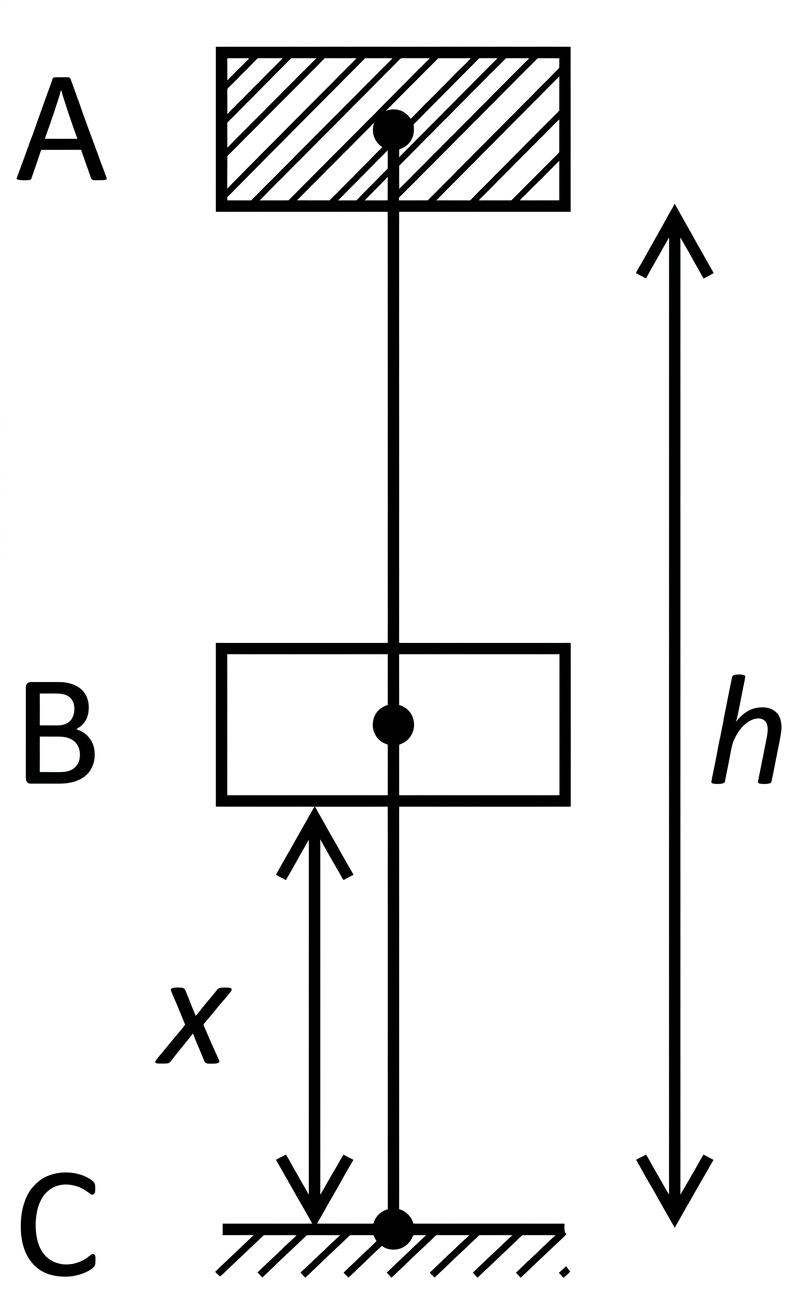
Figure: Body falling from height \(h\) – Conservation of Energy
At Point A (Top):
\[ E_p = mgh,\quad E_k = 0,\quad \text{Total Energy} = mgh \]
At Point B (Middle):
\[ E_p = mg(h-x),\quad E_k = mgx,\quad \text{Total Energy} = mgh \]
At Point C (Ground):
\[ E_p = 0,\quad E_k = mgh,\quad \text{Total Energy} = mgh \]
✅ Total energy remains constant (\(mgh\)) at all points.
5.3 Differentiate between renewable and non-renewable sources of energy. Give three examples for each.
Answer:
| Renewable Energy Sources | Non-Renewable Energy Sources |
|---|---|
| The resources of energy which are replaced by new ones after their use are called renewable energy sources. | Non-renewable sources are those, which are depleted with the continuous use. |
| Sources such as hydroelectricity, solar energy, wind energy, tidal energy, wave energy and geothermal energy are renewables. | Non-renewable sources include fossil fuels (coal, oil, natural gas) and nuclear energy. |
| For example, snowfall and rainfall are continuous processes. Therefore, water supply to the reservoirs of dams for generation of hydroelectric power will never end up. | The remnants of plants and animals buried under the Earth took millions of years to change into fossil fuels. |
| These are not going to run out in future. | These fuels are in limited quantity. Once they are used up, it will take further millions of years to form new ones. |
✅ Renewable Examples
- Solar Energy
- Wind Energy
- Hydroelectric Energy
❌ Non-Renewable Examples
- Coal
- Oil (Petroleum)
- Natural Gas
5.4 Explain what is meant by efficiency of a machine. How is it calculated? Why there is a limit for the efficiency of a machine?
Answer:
Efficiency: The ratio of useful output energy and the total input energy is called the efficiency of a working system.
Calculation:
\[ \text{Efficiency} = \frac{\text{Useful output energy}}{\text{Total input energy}} \]
Efficiency is often multiplied by 100 to give percentage efficiency:
\[ \text{Percentage Efficiency} = \frac{\text{Useful output energy}}{\text{Total input energy}} \times 100 \]
\[ \text{Percentage Efficiency} = \frac{\text{Useful power output}}{\text{Total power input}} \times 100 \]
Limit for Efficiency: It is found that the energy output is always less than the energy input. During any conversion of energy, some energy is wasted in the form of heat. No device has yet been invented that may convert all the input energy into required output. That is why a system cannot have an efficiency of 100%. As the energy losses are inevitable in the working of a machine, hence, an ideal or perpetual machine cannot be constructed.
✅ Efficiency < 100% due to energy losses (heat, friction, sound).
5.5 Describe the process of electricity generation by drawing a block diagram of the process in the following cases. (i) Hydroelectric power generations (ii) Fossil fuels
Answer:
(i) Hydroelectric Power Generation: Hydroelectric generation is the electricity generated by using the kinetic energy of the falling water.
Water stored in a high reservoir possesses gravitational potential energy. When it falls, the potential energy changes to kinetic energy which rotates a turbine. The turbine then runs an electric generator to produce electricity.
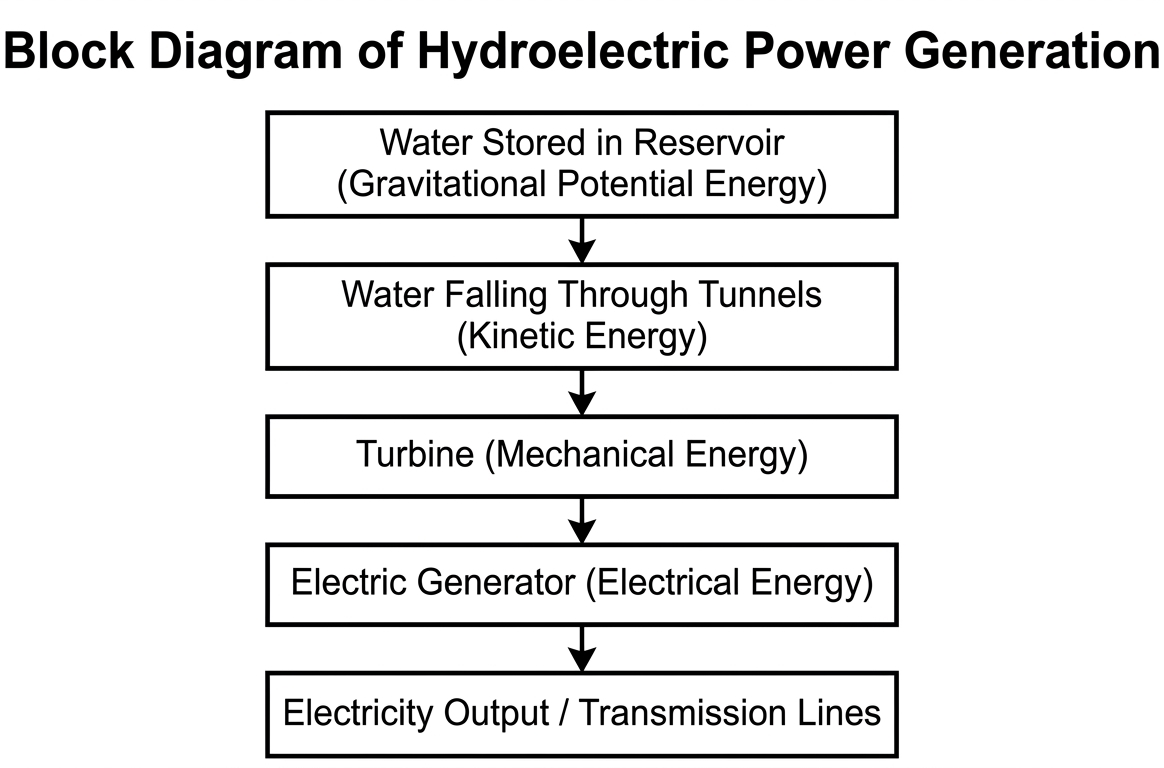
Figure: Block Diagram – Hydroelectric Power Generation
(ii) Fossil Fuels: Fossil fuel energy comes out from burning of oil, coal and natural gas. These materials are known as fossil fuels.
The burning of these fuels gives out heat which is used to generate steam that runs the turbines to produce electricity.
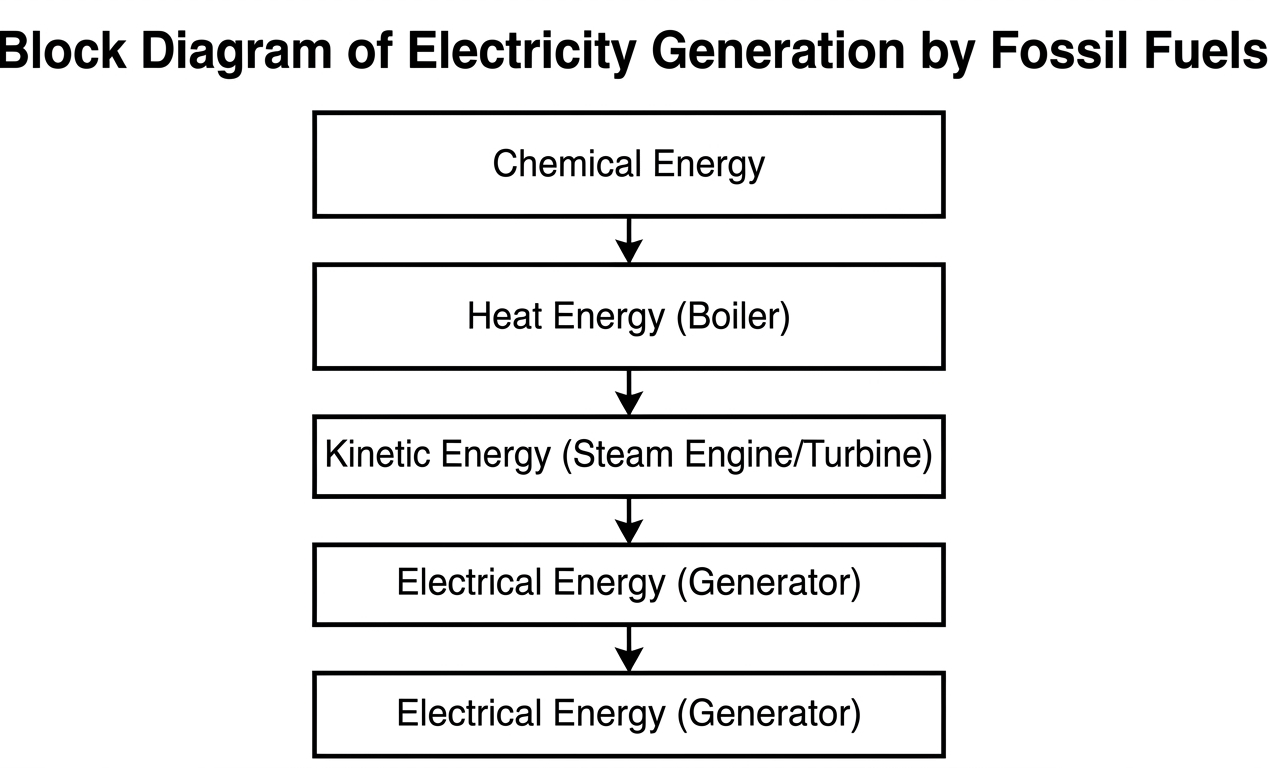
Figure: Block Diagram – Electricity Generation by Fossil Fuels
✅ Hydroelectric: P.E. → K.E. → Turbine → Generator → Electricity
✅ Fossil Fuels: Heat → Steam → Turbine → Generator → Electricity
📐 Key Concepts – Work and Energy (Comprehensive)
Kinetic Energy: Ek = ½ mv²
Potential Energy: Ep = mgh
Conservation of Energy: Total energy = constant
Efficiency: η = (Useful output / Total input) × 100
Power: P = W/t
💡 Exam Tip:
For comprehensive questions, write detailed answers with clear explanations, definitions, and mathematical derivations where required. Use diagrams to support your explanations (as shown in the figures). These questions test your in-depth understanding of concepts like kinetic energy, conservation of energy, efficiency, and electricity generation. These questions follow the PECTAA 2026 pattern and are prepared by Subject Specialist Muhammad Tayyab.
Chapter 1Physical Quantities and Measurements
Chapter 2Kinematics
Chapter 3Dynamics
Chapter 4Turning Effect of Forces
Chapter 5✨ Work and Energy
Chapter 6Mechanical Properties of Matter
Chapter 7Thermal Properties of Matter
Chapter 8Magnetism
Chapter 9Nature of Science
📖 Complete syllabus coverage for Class 9 Physics (PECTAA 2026) – Chapters 1 to 9
Created by Hira Science Academy | Aligned with PECTAA 2026 Syllabus