📘 Chapter 5: Work and Energy – Constructed Response Questions
Prepared by Muhammad Tayyab, Subject Specialist Physics, Govt Christian High School Daska. Based on PECTAA 2026 syllabus (National Curriculum 2023).
📖 What's Inside: This section covers constructed response questions from Chapter 5 Work and Energy including Kinetic Energy, Potential Energy, Conservation of Energy, Energy Conversions, and Renewable Energy Sources. Each question is presented with a detailed answer as per the official PECTAA 2026 Physics curriculum. Perfect for Punjab Boards (Lahore, Gujranwala, Multan, etc.) and all BISE boards across Pakistan.
📚 Related Resources – Chapter 5: Work and Energy
📋 Exercise Short Qs
📝 Short Qs
📖 Comprehensive Qs
🔢 Numerical Problems
✅ MCQs
✏️ Constructed Response
Work and Energy covers kinetic energy, potential energy, conservation of energy, power, and efficiency.
📖 Constructed Response Questions & Answers (PECTAA 2026)
5.1 Can the kinetic energy of a body ever be negative?
Answer:
No, the kinetic energy of a body can never be negative because:
\[ E_k = \frac{1}{2} mv^2 \]
Mass is always positive and the square of velocity is also positive. Therefore, kinetic energy is always positive or zero.
✅ Kinetic energy is always \(\ge 0\).
5.2 Which one has the greater kinetic energy; an object travelling with a velocity \(v\) or an object twice as heavy travelling with a velocity of \(\frac{1}{2} v\)?
Answer:
For the first object (mass \(m\), velocity \(v\)):
\[ E_{k1} = \frac{1}{2} mv^2 \]
For the second object (mass \(= 2m\), velocity \(= \frac{1}{2} v\)):
\[ E_{k2} = \frac{1}{2} (2m)\left(\frac{1}{2} v\right)^2 \]
\[ E_{k2} = (m)\left(\frac{1}{4} v^2\right) = \frac{1}{4} mv^2 \]
Therefore, the object travelling with velocity \(v\) has greater kinetic energy.
✅ Object with velocity \(v\) has greater \(E_k\).
5.3 A car is moving along a curved road at constant speed. Does its kinetic energy change?
Answer:
No. Kinetic energy depends only on speed. Since the speed is constant, its kinetic energy stays the same even though direction changes.
✅ Kinetic energy remains constant (speed is constant).
5.4 Comment on the statement: "An object has one joule of potential energy."
Answer:
The statement is incomplete because potential energy depends upon the position of an object with respect to a reference level. Thus, an object can have one joule of potential energy with respect to a particular reference level.
✅ Potential energy is always relative to a reference level.
5.5 While driving on a motorway, tyre of a vehicle sometimes bursts. What may be its cause?
Answer:
When a vehicle moves at high speed, friction between the tyres and the road produces heat. The temperature of the tyres rises due to friction, which may cause the tyre to become too hot and burst.
✅ Excessive heat from friction causes tyre burst.
5.6 While playing cricket on a street, the ball smashes a window pane. Describe the energy changes in this event.
Answer:
The ball's kinetic energy transfers to the glass. It does work to break the glass, and some energy becomes sound and a little heat.
✅ Kinetic energy → work (breaking glass) + sound + heat.
5.7 A man rowing boat upstream is at rest with respect to the shore. Is he doing work?
Answer:
Yes, the man is doing work.
Although the boat is at rest with respect to the shore, the man applies force on the water and moves the oars through a distance. Therefore, work is being done.
✅ Yes, work is done (force applied, oars move).
5.8 A cyclist goes downhill from the top of a steep hill without pedalling and takes it to the top of the next hill. (i) Draw a diagram of what happened. (ii) Analyse this event in terms of potential and kinetic energy.
Answer:
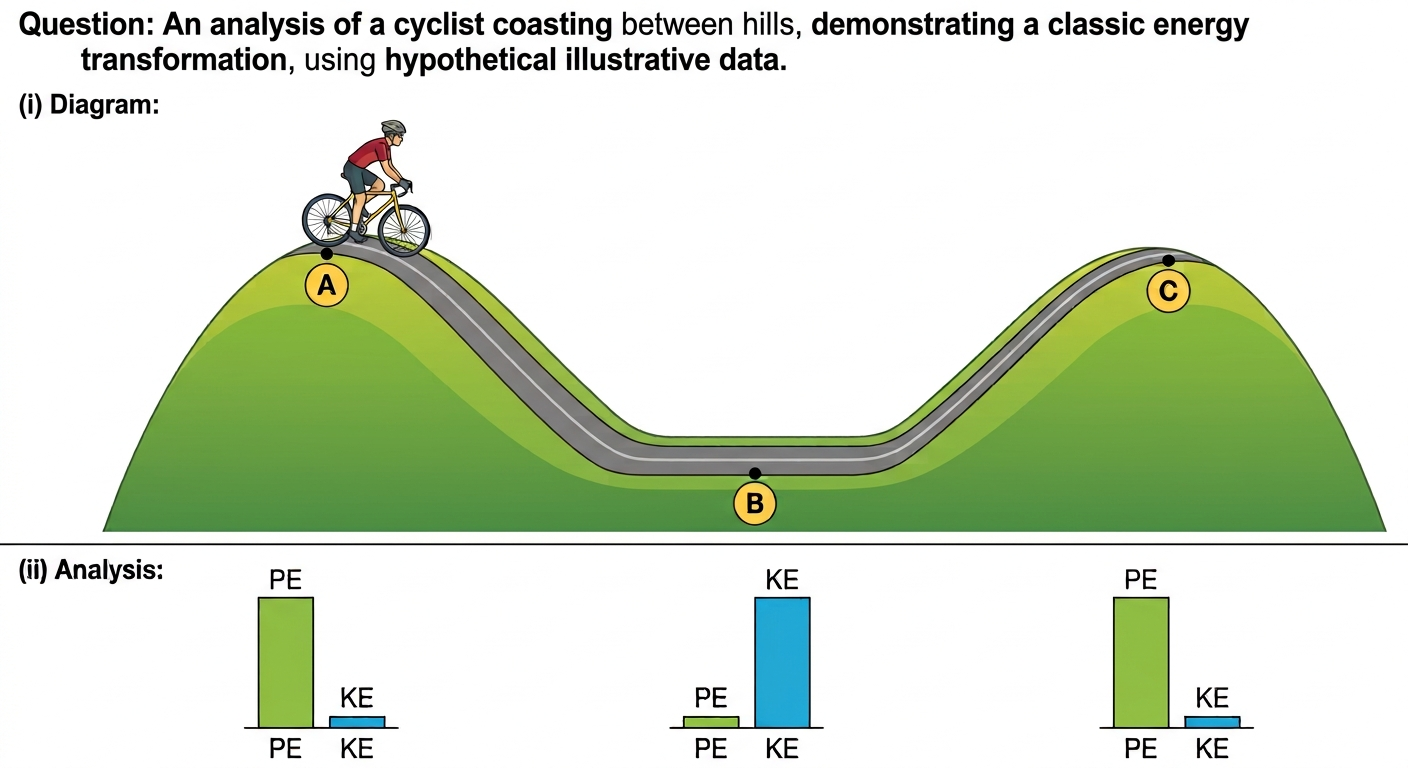
Figure: Cyclist going downhill and uphill – Energy Conversion
Analysis:
At point A, the cyclist has maximum gravitational potential energy and minimum kinetic energy.
As the cyclist moves downhill towards B, gravitational potential energy is converted into kinetic energy. At B, kinetic energy is maximum and potential energy is minimum.
As the cyclist moves uphill towards C, kinetic energy is converted back into gravitational potential energy. Thus, the cyclist reaches the top of the next hill without pedalling.
✅ P.E. → K.E. (downhill), K.E. → P.E. (uphill).
5.9 Is timber or wood renewable source of heat energy? Comment.
Answer:
Yes, timber or wood is a renewable source of heat energy because trees can be replanted and grown again. However, it takes many years for trees to mature, so it must be used sustainably.
✅ Yes, renewable but must be used sustainably.
📐 Key Concepts – Work and Energy (Constructed Response Questions)
Work: \(W = F \times S\)
Kinetic Energy: \(E_k = \frac{1}{2} mv^2\)
Potential Energy: \(E_p = mgh\)
Power: \(P = \frac{W}{t}\)
Efficiency: \(\eta = \frac{\text{Useful output}}{\text{Total input}} \times 100\)
💡 Exam Tip:
For constructed response questions, write clear, concise, and complete answers. Use definitions, formulas, and examples where required. These questions test your understanding of fundamental concepts like kinetic energy, potential energy, conservation of energy, and energy conversions. These questions follow the PECTAA 2026 pattern and are prepared by Subject Specialist Muhammad Tayyab.
Chapter 1Physical Quantities and Measurements
Chapter 2Kinematics
Chapter 3Dynamics
Chapter 4Turning Effect of Forces
Chapter 5✨ Work and Energy
Chapter 6Mechanical Properties of Matter
Chapter 7Thermal Properties of Matter
Chapter 8Magnetism
Chapter 9Nature of Science
📖 Complete syllabus coverage for Class 9 Physics (PECTAA 2026) – Chapters 1 to 9
Created by Hira Science Academy | Aligned with PECTAA 2026 Syllabus