📘 Chapter 1: Physical Quantities and Measurements – Exercise Short Questions
Prepared by Muhammad Tayyab, Subject Specialist Physics, Govt Christian High School Daska. Based on PECTAA 2026 syllabus (National Curriculum 2023).
📖 What's Inside: This section covers exercise short questions from Chapter 1 Physical Quantities and Measurements including measurement, standard units, base and derived quantities, SI units, prefixes, Vernier Callipers, least count, zero error, and parallax error. Each question is presented with a precise answer as per the official PECTAA 2026 Physics curriculum. Perfect for Punjab Boards (Lahore, Gujranwala, Multan, etc.) and all BISE boards across Pakistan.
📚 Related Resources – Chapter 1: Physical Quantities and Measurements
📋 Exercise Short Qs
📝 Short Qs
📖 Comprehensive Qs
🔢 Numerical Problems
✅ MCQs
✏️ Constructed Response
Physical Quantities and Measurements covers fundamental concepts of measurement, SI units, and measuring instruments.
📝 Exercise Short Questions & Answers (PECTAA 2026)
1.1 Can a non-physical quantity be measured? If yes, then how?
Answer: No, non-physical quantities (e.g., love, fear) cannot be measured using tools or instruments. They are subjective and lack numerical value or units.
✅ Non-physical quantities cannot be measured.
1.2 What is measurement? Name its two parts.
Answer: Measurement is a process of comparison of an unknown quantity with a widely accepted standard quantity. Its two parts are: (i) A number (magnitude) (ii) A unit (standard of measurement)
✅ Measurement: Comparison with a standard. Two parts: Number and Unit.
1.3 Why do we need a standard unit for measurements?
Answer: To avoid confusion, there is a need of a standard so that measurement by any person may result the same. This standard of measurement is known as a unit. Standard unit does not vary from person to person and is understood by all the scientists.
✅ Standard unit avoids confusion and ensures consistency.
1.4 Write the name of 3 base quantities and 3 derived quantities.
Answer: Base quantities: Length, mass, time. Derived quantities: Speed, area, volume.
✅ Base: Length, Mass, Time. Derived: Speed, Area, Volume.
1.5 Which SI unit will you use to express the height of your desk?
Answer: Metre \((m)\) or its sub-multiples e.g., centimetres, cm use to express the height of desk.
✅ Metre (m) or centimetre (cm).
1.6 Write the name and symbols of all SI base units.
Answer: The seven SI base units are:
| No. | Physical quantity | Unit | Symbol |
|---|---|---|---|
| 1. | Length | metre | m |
| 2. | Mass | kilogram | kg |
| 3. | Time | second | s |
| 4. | Temperature | kelvin | K |
| 5. | Electric current | ampere | A |
| 6. | Intensity of light | candela | cd |
| 7. | Amount of substance | mole | mol |
✅ Seven SI base units: m, kg, s, K, A, cd, mol.
1.7 Why prefix is used? Name three sub-multiple and three multiple prefixes with their symbols.
Answer: Prefixes are the words or symbols added before SI unit such as milli, centi, kilo, mega, giga etc.
| Type | Prefix | Symbol | Powers of Ten |
|---|---|---|---|
| Sub-multiples | milli | m | 10-3 |
| micro | μ | 10-6 | |
| nano | n | 10-9 | |
| Multiples | kilo | k | 103 |
| mega | M | 106 | |
| giga | G | 109 |
✅ Prefixes simplify large or small quantities.
1.8 What is meant by: (a) \(5pm\) (b) \(15ns\) (c) \(6\mu m\) (d) \(5fs\)
Answer:
(a) 5 picometres = \(5 \times 10^{-12} m\)
(b) 15 nanoseconds = \(15 \times 10^{-9} s\)
(c) 6 micrometres = \(6 \times 10^{-6} m\)
(d) 5 femtoseconds = \(5 \times 10^{-15} s\)
✅ (a) \(5 \times 10^{-12} m\) (b) \(15 \times 10^{-9} s\) (c) \(6 \times 10^{-6} m\) (d) \(5 \times 10^{-15} s\)
1.9 (a) For what purpose, a Vernier Callipers is used? (b) Name its two main parts. (c) How is least count found? (d) What is meant by zero error?
Answer:
(a) The Vernier Calliper is an instrument used to measure small lengths with high precision, down to \(\frac{1}{10}\) th of a millimetre. It can measure the thickness, diameter, width, or depth of an object.
(b) Two main parts of Vernier Calliper are main scale and Vernier scale.
(c) The least count of a Vernier Calliper is the difference between one main scale division (1 mm) and one Vernier scale division (0.9 mm). Hence, least count = 1 M.S div – 1 V.S div = 1 mm – 0.9 mm = 0.1 mm. OR L.C = Smallest reading on main scale / Total no. of divisions on vernier scale = 1 mm / 10 = 0.1 mm = 0.01 cm.
(d) Zero error occurs if, on joining the jaws of Vernier Callipers, the zeros of the main scale and Vernier scale do not exactly coincide with each other. This error in the instrument is called zero error.
✅ Vernier Callipers: measure small lengths precisely. Main scale and Vernier scale. Least count = 0.1 mm. Zero error: non-coinciding zeros.
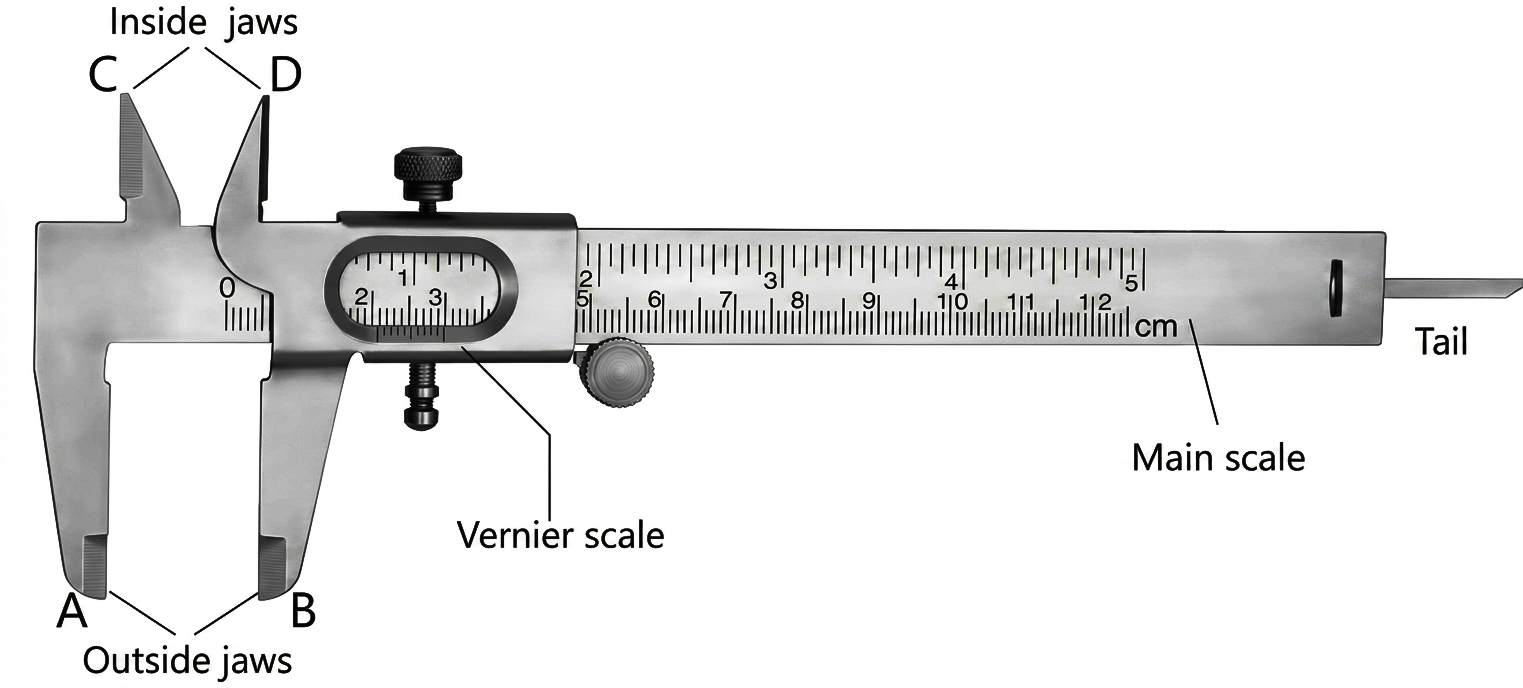
Figure: Vernier Callipers – Main Scale and Vernier Scale
1.10 State least count and Vernier scale reading as shown in the figure and hence, find the length.
Answer: The least count of Vernier Callipers is 0.01 cm. The main scale reading before the zero of the Vernier scale is 2.6 cm and the Vernier scale reading is 4 as shown in figure, then length of the object is:
Length = M.S reading + (L.C × V.S reading) = 2.6 + (0.01 × 4) = 2.64 cm
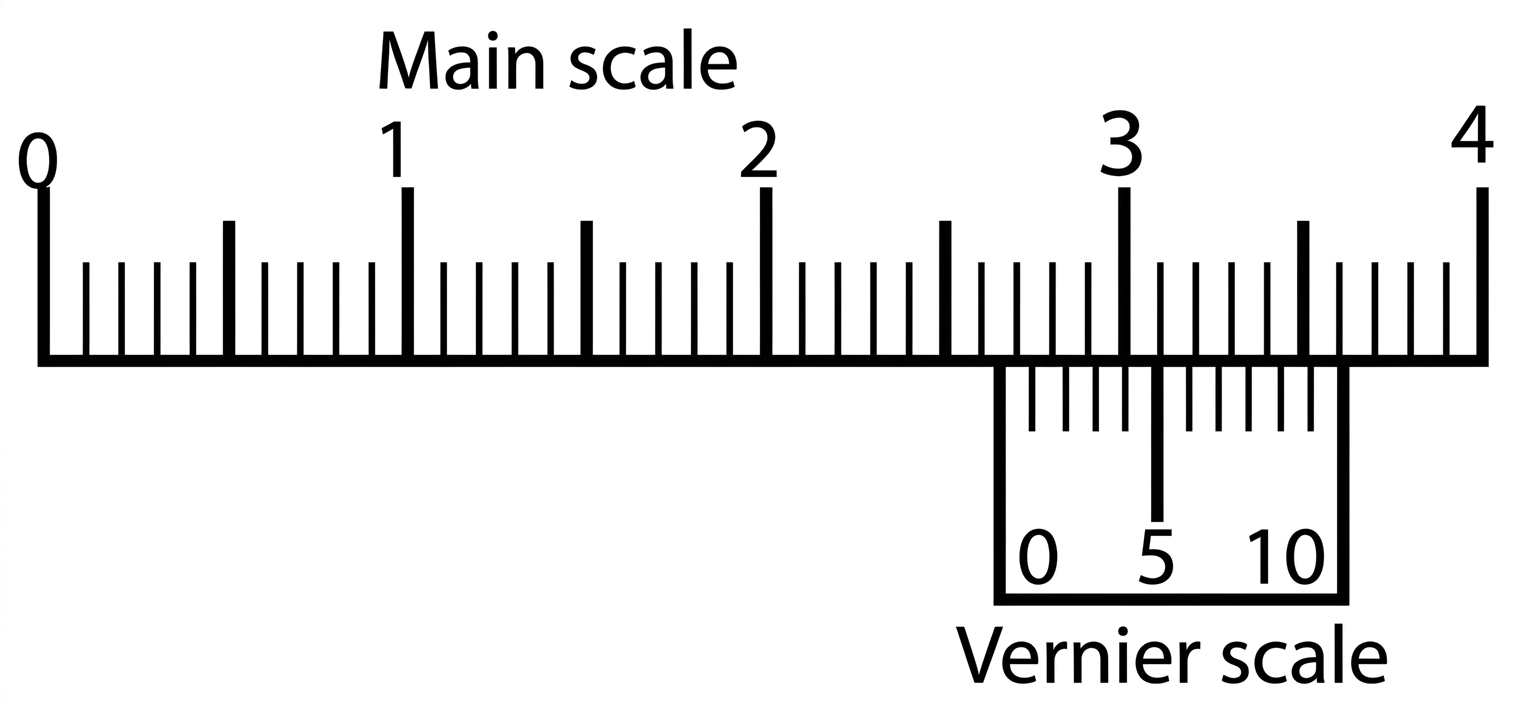
Figure: Vernier Callipers Reading – Main Scale = 2.6 cm, Vernier Scale = 4
✅ Length = 2.64 cm
1.11 Which reading out of A, B and C shows the correct length and why?
Answer: The correct reading should be the one where the ruler aligns properly with the object's length.
Looking at the image, B (6.0 cm) appears to be the correct reading because it aligns well with the edge of the object. Thus, B is the correct reading because it minimizes parallax error and aligns accurately with the scale.
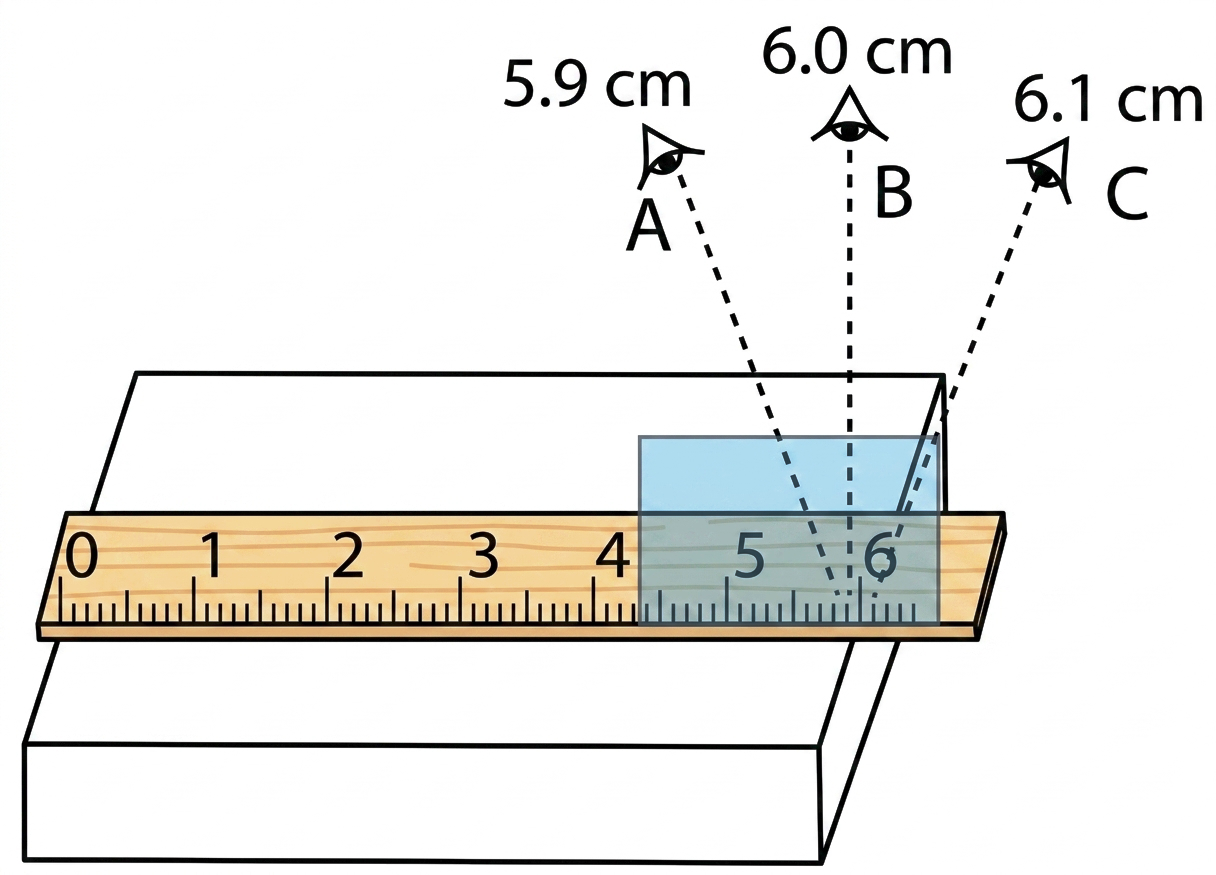
Figure: Correct Reading (B) minimizes parallax error
✅ Reading B is correct as it minimizes parallax error.
📐 Key Formulas – Physical Quantities and Measurements
Least Count of Vernier Callipers: \( L.C = \frac{\text{Smallest reading on main scale}}{\text{Total no. of divisions on vernier scale}} \)
Length Measurement: \( \text{Length} = M.S\ reading + (L.C \times V.S\ reading) \)
💡 Exam Tip:
For short questions, always write precise and to-the-point answers. Use key terms like "measurement", "standard unit", "base quantities", "derived quantities", "SI units", "Vernier Callipers", "least count", and "zero error" as they are commonly tested in exams. These questions follow the PECTAA 2026 pattern and are prepared by Subject Specialist Muhammad Tayyab.
Chapter 1✨ Physical Quantities and Measurements
Chapter 2Kinematics
Chapter 3Dynamics
Chapter 4Turning Effect of Forces
Chapter 5Work and Energy
Chapter 6Mechanical Properties of Matter
Chapter 7Thermal Properties of Matter
Chapter 8Magnetism
Chapter 9Nature of Science
📖 Complete syllabus coverage for Class 9 Physics (PECTAA 2026) – Chapters 1 to 9
Created by Hira Science Academy | Aligned with PECTAA 2026 Syllabus