📘 Chapter 1: Physical Quantities and Measurements – Constructed Response Questions
Prepared by Muhammad Tayyab, Subject Specialist Physics, Govt Christian High School Daska. Based on PECTAA 2026 syllabus (National Curriculum 2023).
📖 What's Inside: This section covers constructed response questions from Chapter 1 Physical Quantities and Measurements including units for various quantities, importance of standard system, micrometer screw gauge least count calculation, measuring pencil diameter using metre scale, parallax error, meniscus in wider vessels, and measuring instruments for internal diameter and depth. Each question is presented with a detailed answer as per the official PECTAA 2026 Physics curriculum. Perfect for Punjab Boards (Lahore, Gujranwala, Multan, etc.) and all BISE boards across Pakistan.
📚 Related Resources – Chapter 1: Physical Quantities and Measurements
📋 Exercise Short Qs
📝 Short Qs
📖 Comprehensive Qs
🔢 Numerical Problems
✅ MCQs
✏️ Constructed Response
Physical Quantities and Measurements covers fundamental concepts of measurement, SI units, and measuring instruments.
📝 Constructed Response Questions & Answers (PECTAA 2026)
1.1 In what unit will you express each of the following?
Answer:
(a) Thickness of a five-rupee coin: millimetre (mm) or micrometre (μm)
(b) Length of a book: centimetre (cm)
(c) Length of football field: metre (m)
(d) The distance between two cities: kilometre (km)
(e) Mass of five-rupee coin: gram (g)
(f) Mass of your school bag: kilogram (kg)
(g) Duration of your class period: minute (min) or second (s)
(h) Volume of petrol filled in the tank of a car: litre (L)
(i) Time to boil one litre milk: minute (min) or second (s)
✅ Appropriate units for various quantities.
1.2 Why might a standard system of measurement be helpful to a tailor?
Answer: A standard unit does not vary from person to person and is understood by all the scientists. Therefore, it helps a tailor to measure cloth correctly and consistently.
✅ Standard units ensure consistency and accuracy in measurements.
1.3 The minimum main scale reading of a micrometer screw gauge is 1 mm and there are 100 divisions on the circular scale. When thimble is rotated once, 1 mm is its measurement on the main scale. What is the least count of the instrument? The reading for thickness of a steel rod as shown in the figure. What is the thickness of the rod?
Answer:
The least count of a screw gauge is calculated using the formula:
\[ \text{Least Count} = \frac{\text{Pitch of the Screw Gauge}}{\text{Number of Divisions on the Circular Scale}} \]
\[ \text{Least Count} = \frac{1 \text{ mm}}{100} = 0.01 \text{ mm} \]
From figure:
Thickness = M.S.R + (C.S.R × Least Count)
= 5.5 mm + (70 × 0.01 mm)
= 5.5 mm + 0.70 mm
= 6.20 mm
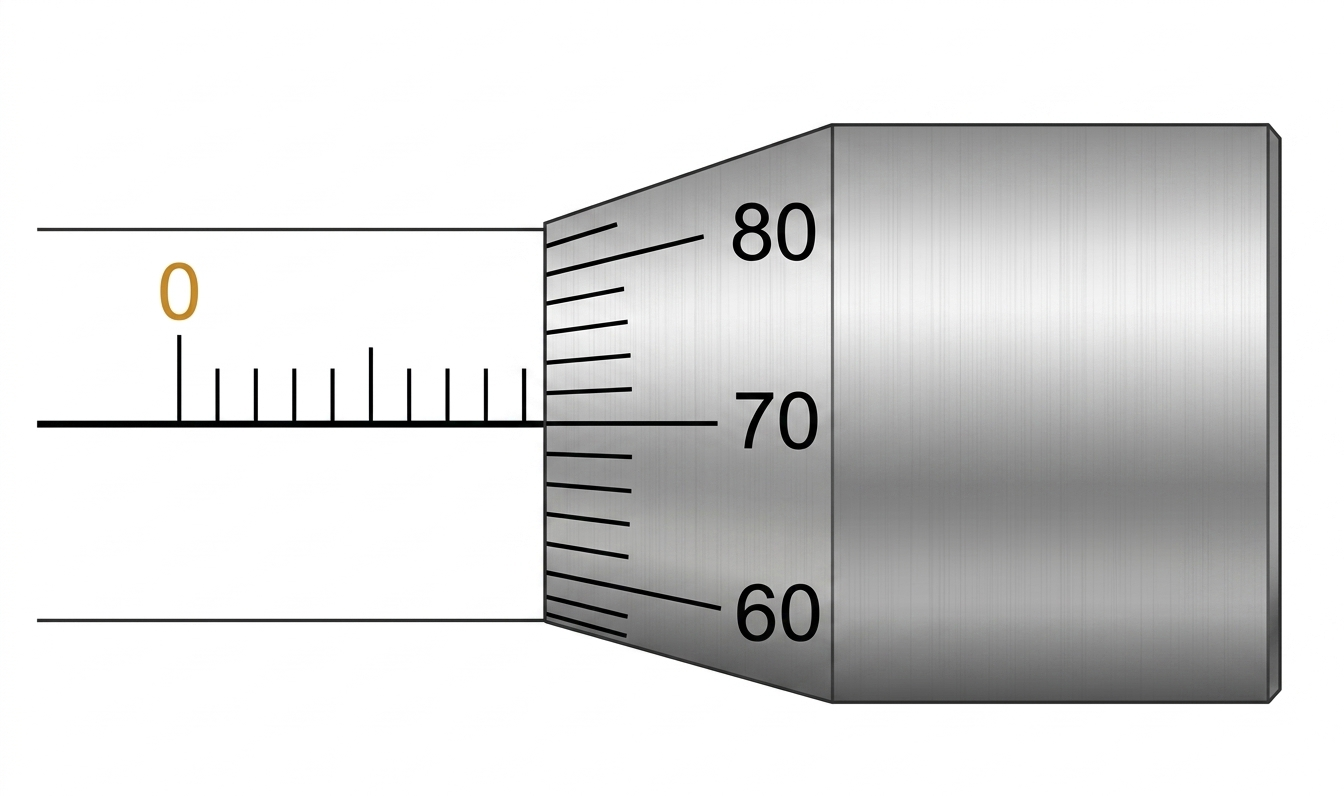
Figure: Micrometer Screw Gauge Reading – Main Scale = 5.5 mm, Circular Scale = 70
✅ Least count = 0.01 mm. Thickness = 6.20 mm.
1.4 You are provided a metre scale and a bundle of pencils; how can the diameter of a pencil be measured using the metre scale with the same precision as that of Vernier Callipers? Describe briefly.
Answer: Place a number of pencils closely together in a bundle and measure the total diameter of the bundle with the metre scale. Divide the total diameter by the number of pencils to find the diameter of one pencil. Taking multiple readings and finding their average reduces the uncertainty in the measurement.
✅ Bundle method: Measure total diameter, divide by number of pencils.
1.5 The end of a metre scale is worn out. Where will you place a pencil to find the length?
Answer: Place the pencil at a non-zero mark (like 1 cm). Find the length by subtracting this initial reading from the final reading.
✅ Use a non-zero mark and subtract initial from final reading.
1.6 Why is it better to place the object close to the metre scale?
Answer: To avoid parallax error. This error happens when the eye position is wrong, leading to inaccurate readings.
✅ Placing object close to the scale avoids parallax error.
1.7 Why a standard unit is needed to measure a quantity correctly?
Answer: To prevent confusion, allow efficient trade, and share scientific information globally. Different old units created problems in trade and science.
✅ Standard units prevent confusion and enable global communication.
1.8 Suggest some natural phenomena that could serve as a reasonably accurate time standard.
Answer: Some repetitive processes occurring in nature, such as the rotation of the Earth, revolution of the Earth and oscillation of a pendulum, could serve as reasonably accurate time standards.
✅ Natural time standards: Earth's rotation, Earth's revolution, pendulum oscillation.
1.9 It is difficult to locate the meniscus in a wider vessel. Why?
Answer: Because the curve of the liquid surface (meniscus) is less pronounced in a wider vessel.
✅ Meniscus is less pronounced in wider vessels.
1.10 Which instrument can be used to measure: (i) internal diameter of a test tube (ii) depth of a beaker?
Answer:
(i) Internal diameter of a test tube: Vernier Callipers
(ii) Depth of a beaker: Vernier Callipers (using tail or depth gauge that projects from behind the main scale)
✅ Vernier Callipers can measure both internal diameter and depth.
📐 Key Formulas – Physical Quantities and Measurements
Least Count of Screw Gauge: \( L.C = \frac{\text{Pitch}}{\text{Number of divisions on circular scale}} \)
Thickness (Screw Gauge): \( \text{Thickness} = M.S.R + (C.S.R \times L.C) \)
💡 Exam Tip:
For constructed response questions, always write detailed answers with clear explanations and examples. Use key terms like "standard units", "parallax error", "meniscus", "least count", "Vernier Callipers", and "micrometer screw gauge" as they are commonly tested in exams. These questions follow the PECTAA 2026 pattern and are prepared by Subject Specialist Muhammad Tayyab.
Chapter 1✨ Physical Quantities and Measurements
Chapter 2Kinematics
Chapter 3Dynamics
Chapter 4Turning Effect of Forces
Chapter 5Work and Energy
Chapter 6Mechanical Properties of Matter
Chapter 7Thermal Properties of Matter
Chapter 8Magnetism
Chapter 9Nature of Science
📖 Complete syllabus coverage for Class 9 Physics (PECTAA 2026) – Chapters 1 to 9
Created by Hira Science Academy | Aligned with PECTAA 2026 Syllabus