📘 Chapter 1: Physical Quantities and Measurements – Comprehensive Questions
Prepared by Muhammad Tayyab, Subject Specialist Physics, Govt Christian High School Daska. Based on PECTAA 2026 syllabus (National Curriculum 2023).
📖 What's Inside: This section covers comprehensive (long) questions from Chapter 1 Physical Quantities and Measurements including base and derived quantities, SI units, derived units with examples, similarities and differences between Vernier Callipers and micrometer screw gauge, human errors, systematic errors, random errors, precision and accuracy. Each question is presented with a detailed answer as per the official PECTAA 2026 Physics curriculum. Perfect for Punjab Boards (Lahore, Gujranwala, Multan, etc.) and all BISE boards across Pakistan.
📚 Related Resources – Chapter 1: Physical Quantities and Measurements
📋 Exercise Short Qs
📝 Short Qs
📖 Comprehensive Qs
🔢 Numerical Problems
✅ MCQs
✏️ Constructed Response
Physical Quantities and Measurements covers fundamental concepts of measurement, SI units, and measuring instruments.
📝 Comprehensive Questions & Answers (PECTAA 2026)
1.1 What is meant by base and derived quantities? Give the names and symbols of SI base units.
Answer:
Base Quantities: Quantities selected arbitrarily by scientists to play a key role in describing physical phenomena. Base quantities are length, mass, time, temperature, electric current, etc.
Derived Physical Quantities: Quantities that can be described in terms of one or more base quantities. For example, speed is a derived quantity depending on distance and time.
SI Base Units:
| No. | Physical quantity | Unit | Symbol |
|---|---|---|---|
| 1 | Length | metre | m |
| 2 | Mass | kilogram | kg |
| 3 | Time | second | s |
| 4 | Temperature | kelvin | K |
| 5 | Electric current | ampere | A |
| 6 | Intensity of light | candela | cd |
| 7 | Amount of substance | mole | mol |
✅ Base quantities: Length, mass, time, etc. Derived quantities: From base quantities (e.g., speed). Seven SI base units: m, kg, s, K, A, cd, mol.
1.2 Give three examples of derived unit in SI. How are they derived from base units? Describe briefly.
Answer:
Derived Units: Derived units are the units of quantities that can be expressed in terms of base units.
Example 1: Area
\[ \begin{aligned} \text{Area} & = \text{length} \times \text{breadth} \\ \text{Area} & = \text{metre} \times \text{metre} \\ \text{Area} & = \text{metre}^2 \\ \text{Area} & = m^2 \end{aligned} \]
Example 2: Speed
\[ \begin{aligned} \text{Speed} & = \frac{\text{distance}}{\text{time}} \\ \text{Speed} & = \frac{\text{metre}}{\text{second}} \\ \text{Speed} & = \frac{\text{m}}{\text{s}} \\ \text{Speed} & = \text{ms}^{-1} \end{aligned} \]
Example 3: Volume
\[ \begin{aligned} \text{Volume} & = \text{length} \times \text{breadth} \times \text{height} \\ \text{Volume} & = m \times m \times m \\ \text{Volume} & = m^3 \end{aligned} \]
✅ Derived units: Area (m²), Speed (ms⁻¹), Volume (m³).
1.3 State the similarities and differences between Vernier Callipers and micrometer screw gauge.
Answer:
Similarities:
(i) Both are measuring instruments used to measure small lengths.
(ii) Both have a least count and provide more precise measurements than a metre rule.
(iii) Measurements using both instruments are subject to errors.
Differences:
| Vernier Callipers | Micrometer Screw Gauge |
|---|---|
| It can measure length correct up to 0.1 mm. | It can measure length correct up to 0.01 mm. |
| Its least count is 0.1 mm. | Its least count is 0.01 mm. |
| It is used to measure small lengths such as diameter and depth. | It is used to measure very small lengths such as diameter of a wire or thickness of a metal sheet. |
✅ Both measure small lengths. Vernier: 0.1 mm least count. Micrometer: 0.01 mm least count.
1.4 Identify and explain the reasons for human errors, random errors and systematic errors in experiments.
Answer: Measurements using tools and instruments are never perfect. They inherit some errors and differ from their true values. There are three types of experimental errors:
(i) Human Errors:
• These occur due to personal performance.
• Caused by limitation of human perception, such as the inability to perfectly estimate the position of the pointer on a scale.
• Can also arise due to faulty procedure to read the scale.
• Correct measurement needs to line up the eye right in front of the level.
• In timing experiments, the reaction time to start or stop the clock also affects the measured value.
Can be reduced by:
(i) Proper training, techniques and procedures
(ii) Avoiding distractions
(iii) Using automated or digital instruments
(ii) Systematic Errors:
• Refer to effects that influence all measurements equally, causing a consistent difference in readings.
• Occur due to a definite rule, such as:
(i) Zero error of instrument
(ii) Incorrect marking
Can be reduced by:
(i) Comparing with a more accurate instrument
(ii) Applying a correction factor
(iii) Random Errors:
• Occur when repeated measurements give different values under the same conditions.
• Caused by unknown or unpredictable factors such as sudden fluctuation in:
(i) Temperature (ii) Pressure (iii) Humidity (iv) Voltage, etc.
• The experimenter has little or no control over it.
Can be reduced by:
(i) Taking several readings and finding the average (mean) value
(ii) For example, in pendulum experiments, the time for 30 oscillations is measured, then the average time of one oscillation is calculated.
✅ Human errors: Personal performance. Systematic: Consistent errors (zero error). Random: Unpredictable fluctuations (temperature, pressure).
1.5 Differentiate between precision and accuracy of a measurement with examples.
Answer:
Precision: Precision refers to how close together a group of measurements are.
Accuracy: Accuracy refers to how close the measured value is to the true value.
To explain this with a target example:
(i) Precise but not accurate: The arrows hit near each other but not near the bullseye. (Fig. a)
(ii) Accurate but not precise: The arrows hit near the bullseye but are spread out. (Fig. b)
(iii) Accurate and precise: The arrows hit near the center of the bullseye, indicating both precision and accuracy. (Fig. c)
This illustrates how precision and accuracy are related and can be visualized through the behavior of arrows on a target.
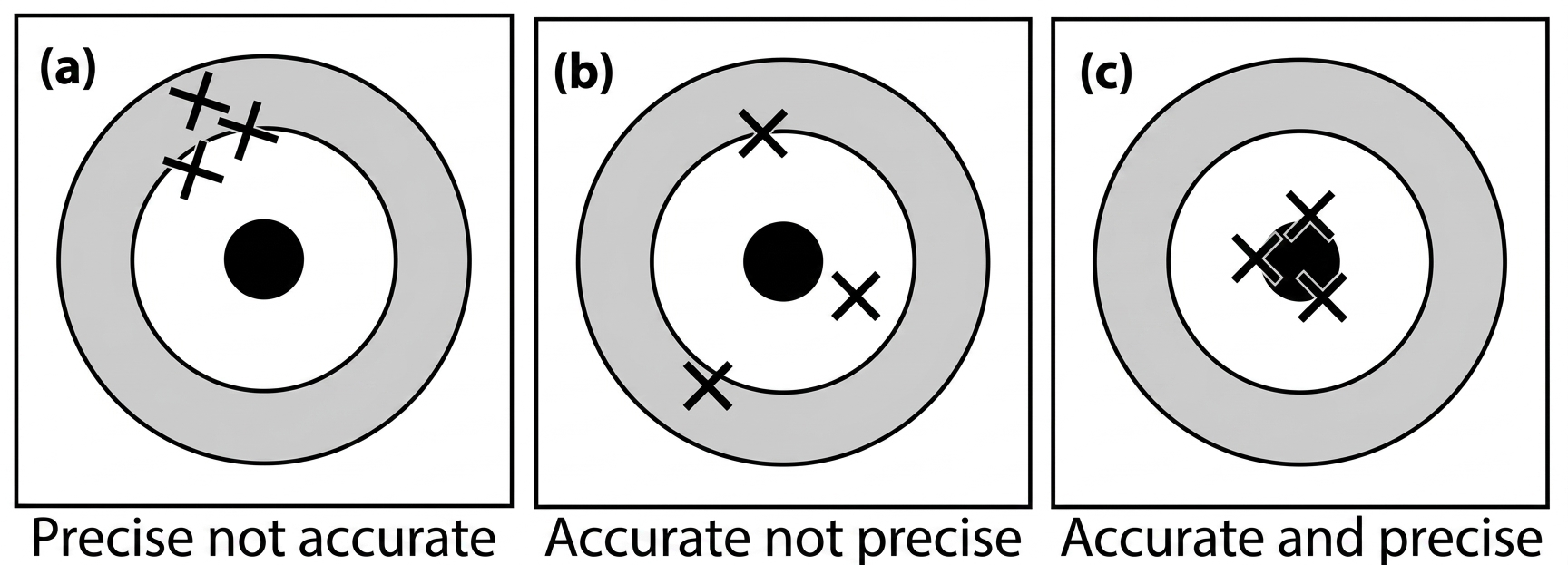
Figure: (a) Precise not accurate (b) Accurate not precise (c) Accurate and precise
✅ Precision: Consistency of measurements. Accuracy: Closeness to true value.
📐 Key Concepts – Physical Quantities and Measurements
Area: \( \text{Area} = \text{length} \times \text{breadth} = m^2 \)
Speed: \( \text{Speed} = \frac{\text{distance}}{\text{time}} = \text{ms}^{-1} \)
Volume: \( \text{Volume} = \text{length} \times \text{breadth} \times \text{height} = m^3 \)
💡 Exam Tip:
For comprehensive (long) questions, always write detailed answers with clear headings and examples. Use key terms like "base quantities", "derived quantities", "SI units", "Vernier Callipers", "micrometer screw gauge", "human errors", "systematic errors", "random errors", "precision", and "accuracy" as they are commonly tested in exams. These questions follow the PECTAA 2026 pattern and are prepared by Subject Specialist Muhammad Tayyab.
Chapter 1✨ Physical Quantities and Measurements
Chapter 2Kinematics
Chapter 3Dynamics
Chapter 4Turning Effect of Forces
Chapter 5Work and Energy
Chapter 6Mechanical Properties of Matter
Chapter 7Thermal Properties of Matter
Chapter 8Magnetism
Chapter 9Nature of Science
📖 Complete syllabus coverage for Class 9 Physics (PECTAA 2026) – Chapters 1 to 9
Created by Hira Science Academy | Aligned with PECTAA 2026 Syllabus