📘 Chapter 6: Mechanical Properties of Matter – Numerical Problems
Prepared by Muhammad Tayyab, Subject Specialist Physics, Govt Christian High School Daska. Based on PECTAA 2026 syllabus (National Curriculum 2023).
📖 What's Inside: This section covers numerical problems from Chapter 6 Mechanical Properties of Matter including Spring Constant, Density, Pressure, Hydraulic Press, Barometer, and Hot Air Balloon data analysis. Each problem is presented with Given Data, To Find, and step-by-step Solution as per the official PECTAA 2026 Physics curriculum. Perfect for Punjab Boards (Lahore, Gujranwala, Multan, etc.) and all BISE boards across Pakistan.
📚 Related Resources – Chapter 6: Mechanical Properties of Matter
📋 Exercise Short Qs
📝 Short Qs
📖 Comprehensive Qs
🔢 Numerical Problems
✅ MCQs
✏️ Constructed Response
Mechanical Properties of Matter covers elasticity, pressure, Hooke's law, Pascal's law, and atmospheric pressure.
📐 Important Formulas – Mechanical Properties of Matter
Density: \(\rho = \frac{m}{V}\)
Pressure: \(P = \frac{F}{A}\)
Spring Constant: \(k = \frac{F}{x}\)
Hydraulic Press: \(\frac{F_1}{A_1} = \frac{F_2}{A_2}\)
Volume: \(V = L \times B \times H\)
Pressure at Depth: \(P = \rho gh\)
📐 Numerical Problems & Solutions (PECTAA 2026)
6.1
A spring is stretched \(20\,\text{mm}\) by a load of \(40\,\text{N}\). Calculate the value of spring constant. If an object cause an extension of \(16\,\text{mm}\), what will be its weight?
Given Data
Extension in spring\(x_1 = 20\,\text{mm} = 20 \times 10^{-3}\,\text{m} = 0.02\,\text{m}\)
Force applied\(F_1 = 40\,\text{N}\)
New extension\(x_2 = 16\,\text{mm} = 16 \times 10^{-3}\,\text{m} = 0.016\,\text{m}\)
To Find
Spring constant \(k = ?\)
Weight for extension of \(16\,\text{mm} = F_2 = ?\)
Solution
By using formula of spring constant \(k = \frac{F}{x}\):
\[\begin{aligned}
k &= \frac{F_1}{x_1} \\
k &= \frac{40}{0.02} \\
k &= 2000\,\text{Nm}^{-1}
\end{aligned}\]
As \(k = \frac{F}{x} \Rightarrow F = kx\), so
\[\begin{aligned}
F_2 &= kx_2 \\
F_2 &= (2000)(0.016) \\
F_2 &= 32\,\text{N}
\end{aligned}\]
✅ \(k = 2000\,\text{Nm}^{-1}\), \(F_2 = 32\,\text{N}\)
6.2
The mass of 5 litres of milk is \(4.5\,\text{kg}\). Find its density in SI units.
Given Data
Mass of milk\(m = 4.5\,\text{kg}\)
Volume of milk\(V = 5\,\text{litres} = 5 \times 10^{-3}\,\text{m}^3\)
To Find
Density \(\rho = ?\)
Solution
By using formula of density:
\[\begin{aligned}
\rho &= \frac{m}{V} \\
\rho &= \frac{4.5}{5 \times 10^{-3}} \\
\rho &= 900\,\text{kgm}^{-3}
\end{aligned}\]
Note: A volume of 1000 litres is the same as 1 cubic meter of space.
✅ \(\rho = 900\,\text{kgm}^{-3}\)
6.3
When a solid of mass \(60\,\text{g}\) is lowered into a measuring cylinder, the level of water rises from \(40\,\text{cm}^3\) to \(44\,\text{cm}^3\). Calculate the density of the solid.
Given Data
Mass of solid\(m = 60\,\text{g} = 0.06\,\text{kg}\)
Initial volume\(V_1 = 40\,\text{cm}^3\)
Final volume\(V_2 = 44\,\text{cm}^3\)
To Find
Density \(\rho = ?\)
Solution
Volume of solid:
\[\begin{aligned}
V &= V_2 - V_1 = 44 - 40 = 4\,\text{cm}^3 \\
V &= 4 \times (10^{-2})^3\,\text{m}^3 = 4 \times 10^{-6}\,\text{m}^3
\end{aligned}\]
By using formula of density:
\[\begin{aligned}
\rho &= \frac{m}{V} \\
\rho &= \frac{0.06}{4 \times 10^{-6}} \\
\rho &= 15000\,\text{kgm}^{-3} = 15 \times 10^{3}\,\text{kgm}^{-3}
\end{aligned}\]
✅ \(\rho = 15 \times 10^{3}\,\text{kgm}^{-3}\)
6.4
A block of density \(8 \times 10^3\,\text{kgm}^{-3}\) has a volume \(60\,\text{cm}^3\). Find its mass.
Given Data
Density\(\rho = 8 \times 10^3\,\text{kgm}^{-3}\)
Volume\(V = 60\,\text{cm}^3 = 60 \times 10^{-6}\,\text{m}^3\)
To Find
Mass \(m = ?\)
Solution
By using formula of density:
\[\begin{aligned}
\rho &= \frac{m}{V} \\
m &= \rho V \\
m &= (8 \times 10^3)(60 \times 10^{-6}) \\
m &= 0.48\,\text{kg}
\end{aligned}\]
✅ \(m = 0.48\,\text{kg}\)
6.5
A brick measures \(5\,\text{cm} \times 10\,\text{cm} \times 20\,\text{cm}\). If its mass is \(5\,\text{kg}\), calculate the maximum and minimum pressure which the brick can exert on a horizontal surface.
Given Data
Dimensions\(5\,\text{cm} \times 10\,\text{cm} \times 20\,\text{cm}\)
Mass of brick\(m = 5\,\text{kg}\)
Minimum area\(A_{\text{min}} = 5 \times 10 = 50\,\text{cm}^2 = 50 \times 10^{-4}\,\text{m}^2\)
Maximum area\(A_{\text{max}} = 10 \times 20 = 200\,\text{cm}^2 = 200 \times 10^{-4}\,\text{m}^2\)
To Find
Minimum pressure \(P_{\text{min}} = ?\)
Maximum pressure \(P_{\text{max}} = ?\)
Solution
As we know that force is equal to weight of brick, so
\[\begin{aligned}
F &= w = mg = (5)(10) = 50\,\text{N}
\end{aligned}\]
For minimum pressure, by using formula of pressure \(P = \frac{F}{A}\):
\[\begin{aligned}
P_{\text{min}} &= \frac{F}{A_{\text{max}}} \\
P_{\text{min}} &= \frac{50}{200 \times 10^{-4}} \\
P_{\text{min}} &= 2500\,\text{Nm}^{-2} = 2.5 \times 10^3\,\text{Nm}^{-2}
\end{aligned}\]
For maximum pressure:
\[\begin{aligned}
P_{\text{max}} &= \frac{F}{A_{\text{min}}} \\
P_{\text{max}} &= \frac{50}{50 \times 10^{-4}} \\
P_{\text{max}} &= 10000\,\text{Nm}^{-2} = 1.0 \times 10^4\,\text{Nm}^{-2}
\end{aligned}\]
Note: Pressure is minimum when the area is maximum, and pressure is maximum when the area is minimum.
✅ \(P_{\text{min}} = 2.5 \times 10^3\,\text{Pa}\), \(P_{\text{max}} = 1.0 \times 10^4\,\text{Pa}\)
6.6
What will be the height of the column in barometer at sea level if mercury is replaced by water of density \(1000\,\text{kgm}^{-3}\), where density of mercury is \(13.6 \times 10^3\,\text{kgm}^{-3}\).
Given Data
Density of water\(\rho_1 = 1000\,\text{kgm}^{-3}\)
Density of mercury\(\rho_2 = 13.6 \times 10^3\,\text{kgm}^{-3}\)
Height of mercury column\(h_2 = 0.76\,\text{m}\)
To Find
Height of water column \(h_1 = ?\)
Solution
Since the pressure at sea level remains the same, we equate the pressures for mercury and water columns. So
\[\begin{aligned}
P_{\text{water}} &= P_{\text{mercury}} \\
\rho_1 g h_1 &= \rho_2 g h_2 \\
h_1 &= \frac{\rho_2 h_2}{\rho_1} \\
h_1 &= \frac{(13.6 \times 10^3)(0.76)}{1000} \\
h_1 &= 10.34\,\text{m}
\end{aligned}\]
✅ \(h_1 = 10.34\,\text{m}\)
6.7
Suppose in the hydraulic brake system of a car, the force exerted normally on its piston of cross-sectional area of \(5\,\text{cm}^2\) is \(500\,\text{N}\). What will be the pressure transferred to the brake oil? What will be the force on the second piston of area of cross-section \(20\,\text{cm}^2\)?
Given Data
Area of first piston\(A_1 = 5\,\text{cm}^2 = 5 \times 10^{-4}\,\text{m}^2\)
Force on first piston\(F_1 = 500\,\text{N}\)
Area of second piston\(A_2 = 20\,\text{cm}^2 = 20 \times 10^{-4}\,\text{m}^2\)
To Find
Pressure transferred to brake oil \(P_1 = ?\)
Force on second piston \(F_2 = ?\)
Solution
By using formula of pressure \(P = \frac{F}{A}\):
\[\begin{aligned}
P_1 &= \frac{F_1}{A_1} \\
P_1 &= \frac{500}{5 \times 10^{-4}} \\
P_1 &= 1.0 \times 10^6\,\text{Nm}^{-2}
\end{aligned}\]
By using equation of hydraulic press:
\[\begin{aligned}
\frac{F_1}{A_1} &= \frac{F_2}{A_2} \\
F_2 &= \frac{F_1 A_2}{A_1} \\
F_2 &= \frac{(500)(20 \times 10^{-4})}{5 \times 10^{-4}} \\
F_2 &= 2000\,\text{N}
\end{aligned}\]
✅ \(P_1 = 1.0 \times 10^6\,\text{Pa}\), \(F_2 = 2000\,\text{N}\)
6.8
Find the water pressure on a deep-sea diver at a depth of \(10\,\text{m}\), where the density of sea water is \(1030\,\text{kgm}^{-3}\).
Given Data
Depth of water\(h = 10\,\text{m}\)
Density of sea water\(\rho = 1030\,\text{kgm}^{-3}\)
Gravitational acceleration\(g = 10\,\text{ms}^{-2}\)
To Find
Pressure at depth \(h = P = ?\)
Solution
Using the formula for pressure in a liquid:
\[\begin{aligned}
P &= \rho gh \\
P &= (1030)(10)(10) \\
P &= 103000\,\text{Nm}^{-2} \\
P &= 1.03 \times 10^5\,\text{Nm}^{-2}
\end{aligned}\]
✅ \(P = 1.03 \times 10^5\,\text{Pa}\)
6.9
The area of cross-section of the small and large pistons of a hydraulic press is respectively \(10\,\text{cm}^2\) and \(100\,\text{cm}^2\). What force should be exerted on the small piston in order to lift a car of weight \(4000\,\text{N}\)?
Given Data
Area of small piston\(A_1 = 10\,\text{cm}^2 = 10 \times 10^{-4}\,\text{m}^2\)
Area of large piston\(A_2 = 100\,\text{cm}^2 = 100 \times 10^{-4}\,\text{m}^2\)
Weight to be lifted\(F_2 = 4000\,\text{N}\)
To Find
Force on small piston \(F_1 = ?\)
Solution
By Pascal's law:
\[\begin{aligned}
\frac{F_1}{A_1} &= \frac{F_2}{A_2} \\
F_1 &= \frac{F_2 A_1}{A_2} \\
F_1 &= \frac{(4000)(10 \times 10^{-4})}{100 \times 10^{-4}} \\
F_1 &= 400\,\text{N}
\end{aligned}\]
✅ \(F_1 = 400\,\text{N}\)
6.10
In a hot air balloon, the following data was recorded. Draw a graph between the altitude and pressure and find out: (a) What would the air pressure have been at sea level? (b) At what height the air pressure would have been \(90\,\text{kPa}\)?
Given Data
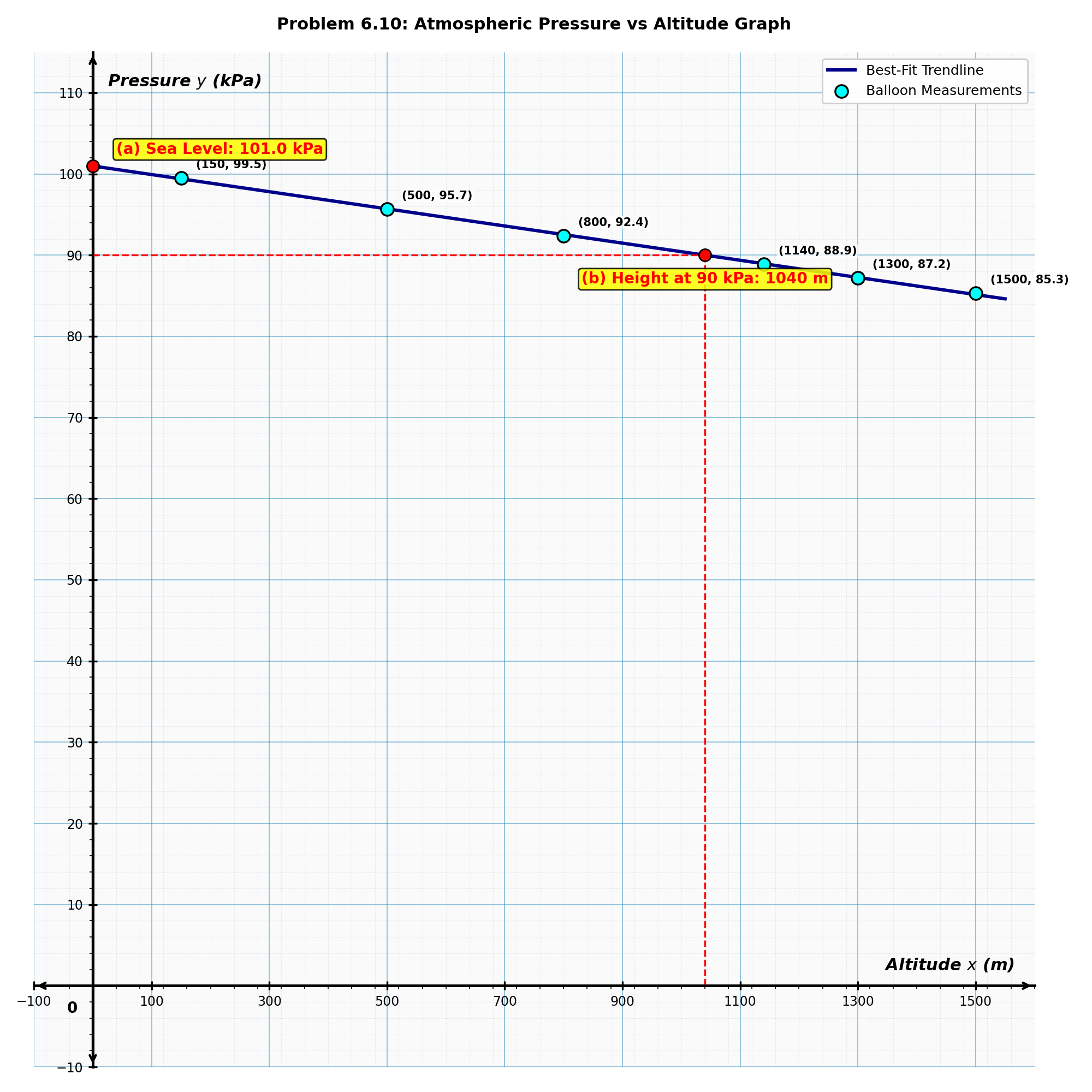
Figure: Altitude vs Pressure Graph
Results
From the graph:
(a) At sea level (\(0\,\text{m}\)), the extrapolated air pressure is approximately \(101.1\,\text{kPa}\).
(b) When the air pressure is \(88.9\,\text{kPa}\), the interpolated altitude is approximately \(1140\,\text{m}\).
✅ (a) \(101.1\,\text{kPa}\) at sea level, (b) \(1140\,\text{m}\) at \(88.9\,\text{kPa}\)
6.11
If the pressure in a hydraulic press is increased by an additional \(10\,\text{Ncm}^{-2}\), how much extra load will the output platform support if its cross-sectional area is \(50\,\text{cm}^2\)?
Given Data
Pressure increase\(P = 10\,\text{Ncm}^{-2}\)
Cross-sectional area\(A = 50\,\text{cm}^2\)
To Find
Extra load (Force) supported \(F = ?\)
Solution
By using formula of pressure \(P = \frac{F}{A}\):
\[\begin{aligned}
F &= PA \\
F &= (10)(50) \\
F &= 500\,\text{N}
\end{aligned}\]
✅ Extra load supported \(= 500\,\text{N}\)
📘 Solved Examples (PECTAA 2026)
Example 6.1
The length, breadth and thickness of an iron block are \(3\,\text{cm}\), \(2\,\text{cm}\), \(2\,\text{cm}\) respectively. Calculate the density of iron if the mass of block is \(94\,\text{g}\).
Given Data
Volume of block\(V = 3\,\text{cm} \times 2\,\text{cm} \times 2\,\text{cm} = 12\,\text{cm}^3 = 12 \times 10^{-6}\,\text{m}^3\)
Mass of block\(m = 94\,\text{g} = 0.094\,\text{kg}\)
To Find
Density \(\rho = ?\)
Solution
By using formula of density:
\[\begin{aligned}
\rho &= \frac{m}{V} \\
\rho &= \frac{0.094}{12 \times 10^{-6}} \\
\rho &= 7833.33\,\text{kgm}^{-3}
\end{aligned}\]
✅ \(\rho = 7833.33\,\text{kgm}^{-3}\)
Example 6.2
Calculate the pressure of column of mercury \(76\,\text{cm}\) high. Density of mercury is \(13.6 \times 10^3\,\text{kgm}^{-3}\).
Given Data
Height of mercury column\(h = 76\,\text{cm} = 0.76\,\text{m}\)
Density of mercury\(\rho = 13.6 \times 10^3\,\text{kgm}^{-3}\)
Gravitational acceleration\(g = 10\,\text{ms}^{-2}\)
To Find
Pressure \(P = ?\)
Solution
Using the formula for pressure in a liquid:
\[\begin{aligned}
P &= \rho gh \\
P &= (13.6 \times 10^3)(10)(0.76) \\
P &= 103360\,\text{Nm}^{-2} \\
P &= 1.0336 \times 10^5\,\text{Nm}^{-2}
\end{aligned}\]
✅ \(P = 1.0336 \times 10^5\,\text{Pa}\)
Example 6.3
A cylindrical water tank \(2\,\text{m}\) deep has been built on the top of a building \(20\,\text{m}\) high. What will be the pressure of water at the ground floor when the tank is full? Density of water is \(1000\,\text{kgm}^{-3}\). Take \(g = 10\,\text{ms}^{-2}\).
Given Data
Depth of tank\(h_1 = 2\,\text{m}\)
Height of building\(h_2 = 20\,\text{m}\)
Total height\(h = h_1 + h_2 = 2 + 20 = 22\,\text{m}\)
Density of water\(\rho = 1000\,\text{kgm}^{-3}\)
Gravitational acceleration\(g = 10\,\text{ms}^{-2}\)
To Find
Pressure at ground floor \(P = ?\)
Solution
Using the formula for pressure in a liquid:
\[\begin{aligned}
P &= \rho gh \\
P &= (1000)(10)(22) \\
P &= 220000\,\text{Nm}^{-2} \\
P &= 2.2 \times 10^5\,\text{Nm}^{-2}
\end{aligned}\]
✅ \(P = 2.2 \times 10^5\,\text{Pa}\)
Example 6.4
The diameters of the pistons of a hydraulic press are \(5\,\text{cm}\) and \(25\,\text{cm}\) respectively. A normal force of \(160\,\text{N}\) is applied on the smaller piston, what will be the pressure exerted by this force on the bigger piston? How much weight can be lifted by the other piston?
Given Data
Diameter of smaller piston\(d_1 = 5\,\text{cm} = 0.05\,\text{m}\)
Radius of smaller piston\(r_1 = \frac{d_1}{2} = 2.5\,\text{cm} = 0.025\,\text{m}\)
Diameter of larger piston\(d_2 = 25\,\text{cm} = 0.25\,\text{m}\)
Radius of larger piston\(r_2 = \frac{d_2}{2} = 12.5\,\text{cm} = 0.125\,\text{m}\)
Force on smaller piston\(F_1 = 160\,\text{N}\)
To Find
Pressure \(P = ?\)
Weight lifted \(F_2 = ?\)
Solution
Area of smaller piston:
\[\begin{aligned}
A_1 &= \pi r_1^2 = \pi (0.025)^2
\end{aligned}\]
By using formula of pressure \(P = \frac{F}{A}\):
\[\begin{aligned}
P_1 &= \frac{F_1}{A_1} \\
P_1 &= \frac{160}{\pi(0.025)^2} \\
P_1 &= \frac{160}{(3.14)(0.025)^2} \\
P_1 &= \frac{160}{1.9625 \times 10^{-3}} \\
P_1 &= 81528.66 \approx 8.15 \times 10^4\,\text{Nm}^{-2}
\end{aligned}\]
By Pascal's law:
\[\begin{aligned}
\frac{F_1}{A_1} &= \frac{F_2}{A_2} \\
F_2 &= \frac{F_1 A_2}{A_1}
\end{aligned}\]
Area of larger piston:
\[\begin{aligned}
A_2 &= \pi r_2^2 = \pi (0.125)^2
\end{aligned}\]
\[\begin{aligned}
F_2 &= \frac{160 \times \pi(0.125)^2}{\pi(0.025)^2} \\
F_2 &= 160 \times \left(\frac{0.125}{0.025}\right)^2 \\
F_2 &= 160 \times (5)^2 \\
F_2 &= 160 \times 25 = 4000\,\text{N}
\end{aligned}\]
✅ \(P = 8.15 \times 10^4\,\text{Pa}\), \(F_2 = 4000\,\text{N}\)
📐 Key Concepts – Mechanical Properties of Matter (Numerical Problems)
Density: \(\rho = \frac{m}{V}\)
Pressure: \(P = \frac{F}{A}\)
Spring Constant: \(k = \frac{F}{x}\)
Hydraulic Press: \(\frac{F_1}{A_1} = \frac{F_2}{A_2}\)
Volume: \(V = L \times B \times H\)
Pressure at Depth: \(P = \rho gh\)
💡 Exam Tip:
For numerical problems, always write the given data, the formula being used, and show the steps of your solution clearly. Pay attention to unit conversions (e.g., mm to m, cm² to m²). Practice spring constant, pressure, density, and hydraulic press calculations thoroughly as they are the foundation for most numericals in this chapter. These problems follow the PECTAA 2026 pattern and are prepared by Subject Specialist Muhammad Tayyab.
Chapter 1Physical Quantities and Measurements
Chapter 2Kinematics
Chapter 3Dynamics
Chapter 4Turning Effect of Forces
Chapter 5Work and Energy
Chapter 6✨ Mechanical Properties of Matter
Chapter 7Thermal Properties of Matter
Chapter 8Magnetism
Chapter 9Nature of Science
📖 Complete syllabus coverage for Class 9 Physics (PECTAA 2026) – Chapters 1 to 9
Created by Hira Science Academy | Aligned with PECTAA 2026 Syllabus