📘 Chapter 6: Mechanical Properties of Matter – Comprehensive Questions
Prepared by Muhammad Tayyab, Subject Specialist Physics, Govt Christian High School Daska. Based on PECTAA 2026 syllabus (National Curriculum 2023).
📖 What's Inside: This section covers comprehensive questions from Chapter 6 Mechanical Properties of Matter including Hooke's Law, Barometer, Manometer, Pascal's Law, Liquid Pressure, and Atmospheric Pressure. Each question is presented with a detailed answer as per the official PECTAA 2026 Physics curriculum. Perfect for Punjab Boards (Lahore, Gujranwala, Multan, etc.) and all BISE boards across Pakistan.
📚 Related Resources – Chapter 6: Mechanical Properties of Matter
📋 Exercise Short Qs
📝 Short Qs
📖 Comprehensive Qs
🔢 Numerical Problems
✅ MCQs
✏️ Constructed Response
Mechanical Properties of Matter covers elasticity, pressure, Hooke's law, Pascal's law, and atmospheric pressure.
📖 Comprehensive Questions & Answers (PECTAA 2026)
6.1 What is Hooke's law? Give three applications of this law.
Answer:
Hooke's Law: If force \(F\) is applied on a spring to stretch or compress it, the extension or compression \(x\) has been found directly proportional to the applied force within the elastic limit. Thus,
\[ F \propto x \]
\[ F = kx \]
\[ k = \frac{F}{x} \]
Here, \(k\) is the constant of proportionality and is known as the spring constant. Its unit is Nm⁻¹.
Spring Constant: Spring constant is defined as the ratio of applied force to the change in length of spring.
\[ k = \frac{F}{x} \]
Applications of Hooke's Law:
(i) Spring Scales: Spring scales use the extension or compression of a spring to determine the weight of objects. In a common spring balance the extension or elongation produced is a measure of the weight. In compression balance, the spring is compressed by the load (force) and the compression produced is measured by means of a pointer moving over a scale.
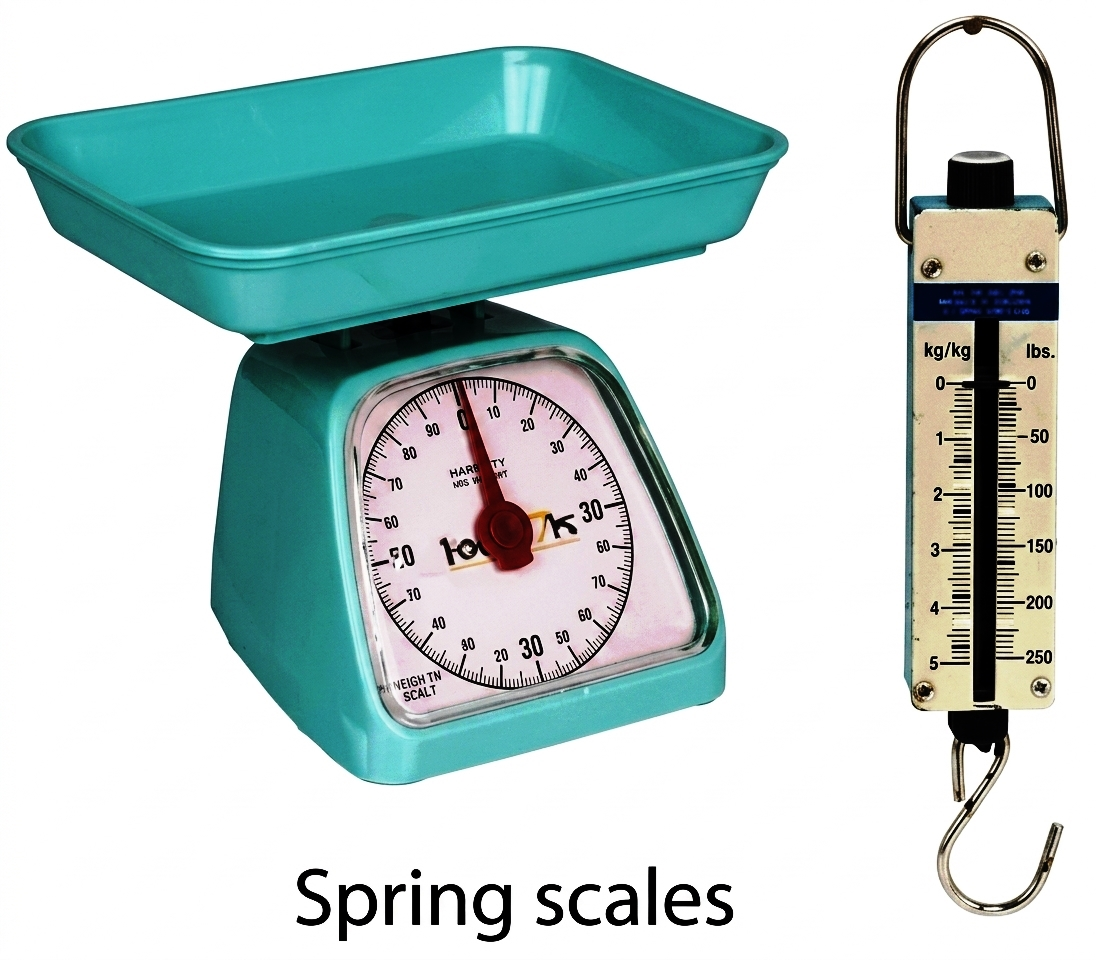
Figure: Spring balance – extension is a measure of weight
(ii) Balance wheel of mechanical clocks: The balance wheel in mechanical clocks use spring to control the back and forth motion that regulates the speed of the hands of a clock.
(iii) Galvanometer: Galvanometer is a current detecting device. It makes use of a tiny spring called hair spring which provides electrical connections to the galvanometer coil and also restores the pointer back to zero position. The deflection of the pointer is proportional to the current flowing through it within the range.
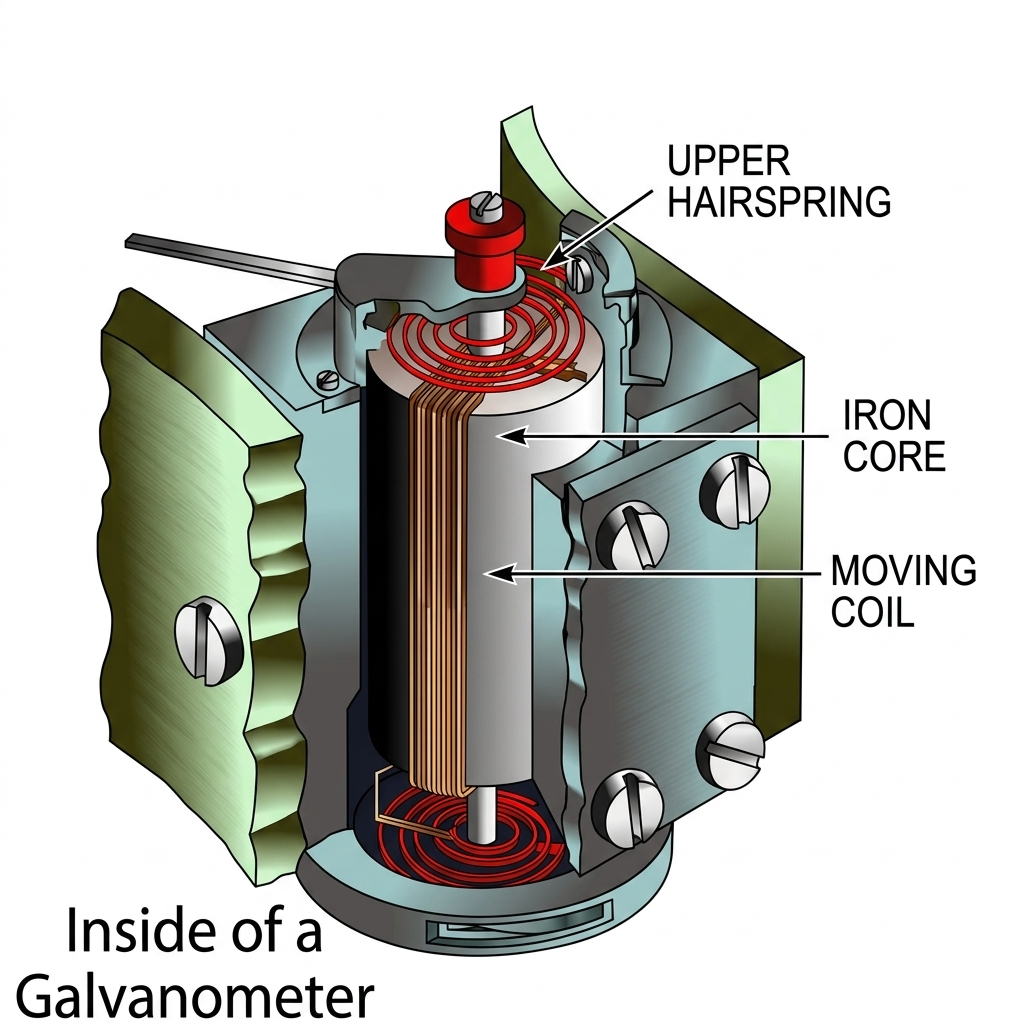
Figure: Galvanometer – hair spring restores pointer to zero
✅ Hooke's Law: \(F = kx\) | Applications: Spring Scales, Clocks, Galvanometer
6.2 Describe the working and applications of a simple mercury barometer and a manometer.
Answer:
Simple Mercury Barometer: Atmospheric pressure is usually measured by the height of mercury column which it can support. Instruments which measure the atmospheric pressure are called barometers.
A simple mercury barometer consists of a glass tube about one metre long that is closed at one end. It is filled with mercury and inverted vertically in a dish of mercury. A metre scale is placed by the side of the tube to measure the height of mercury column. The space in the glass tube over the top of the mercury is completely empty. The pressure is almost zero.
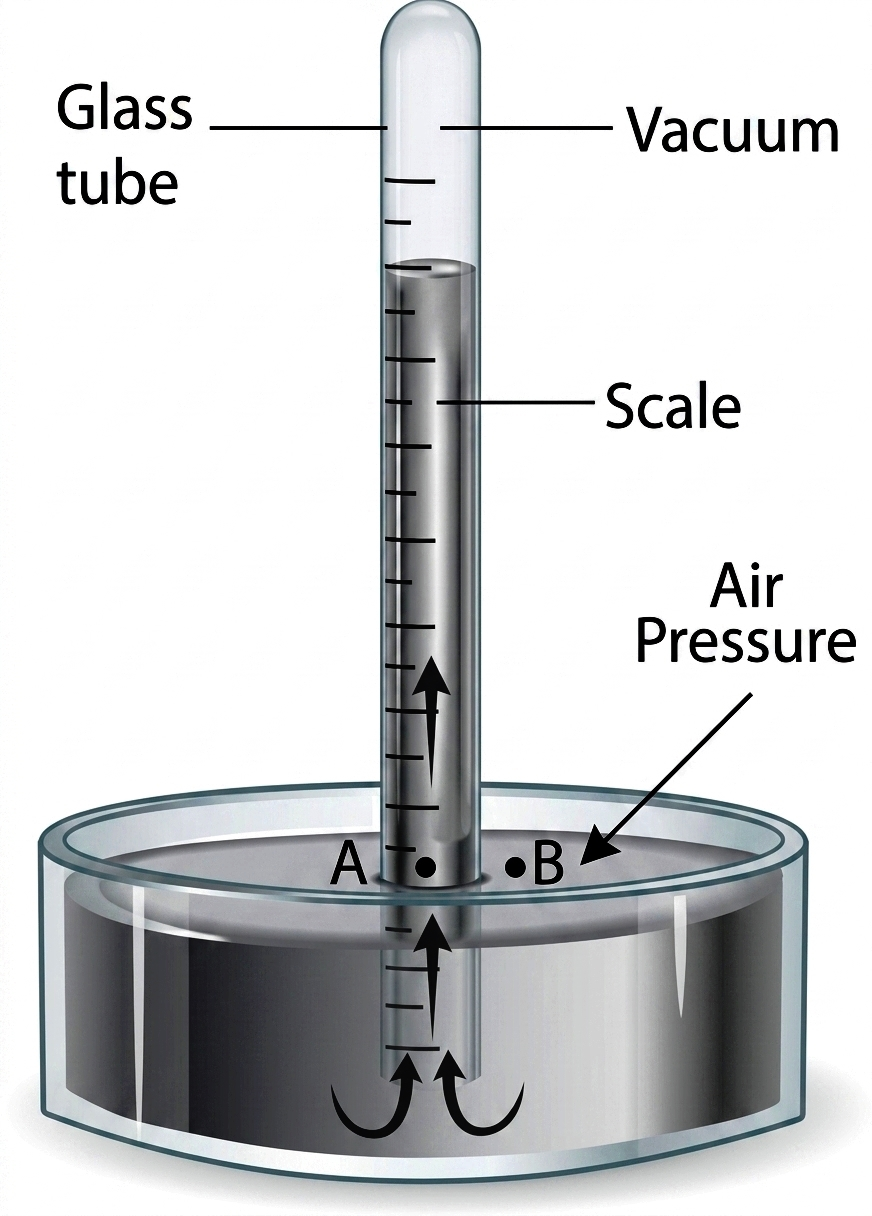
Figure: Simple mercury barometer
The pressure \(P\), at point A in the mercury column is the same as at point B at the surface of mercury in the dish because both points are at the same level. This is equal to the atmospheric pressure \(P = \rho gh\) acting at the surface of mercury.
If \(P = 1.013 \times 10^5\) Pa at sea level and \(\rho = 13.6 \times 10^3\) kgm⁻³ for mercury, the height of mercury column is 760 mm.
Using this instrument, atmospheric pressure at any altitude can be measured in terms of height of mercury column.
Manometer: A simple manometer consists of a U-shaped glass tube containing mercury. Initially, the atmospheric pressure at both open ends is the same, so the mercury level in both arms remains equal.
If a gas cylinder is connected to the short arm while keeping the long arm open:
- (i) If the mercury level in the short arm is lower than in the long arm (Fig. a), the unknown pressure is more than atmospheric pressure.
- (ii) If the mercury level in the short arm is higher than in the long arm (Fig. b), the unknown pressure is less than atmospheric pressure.
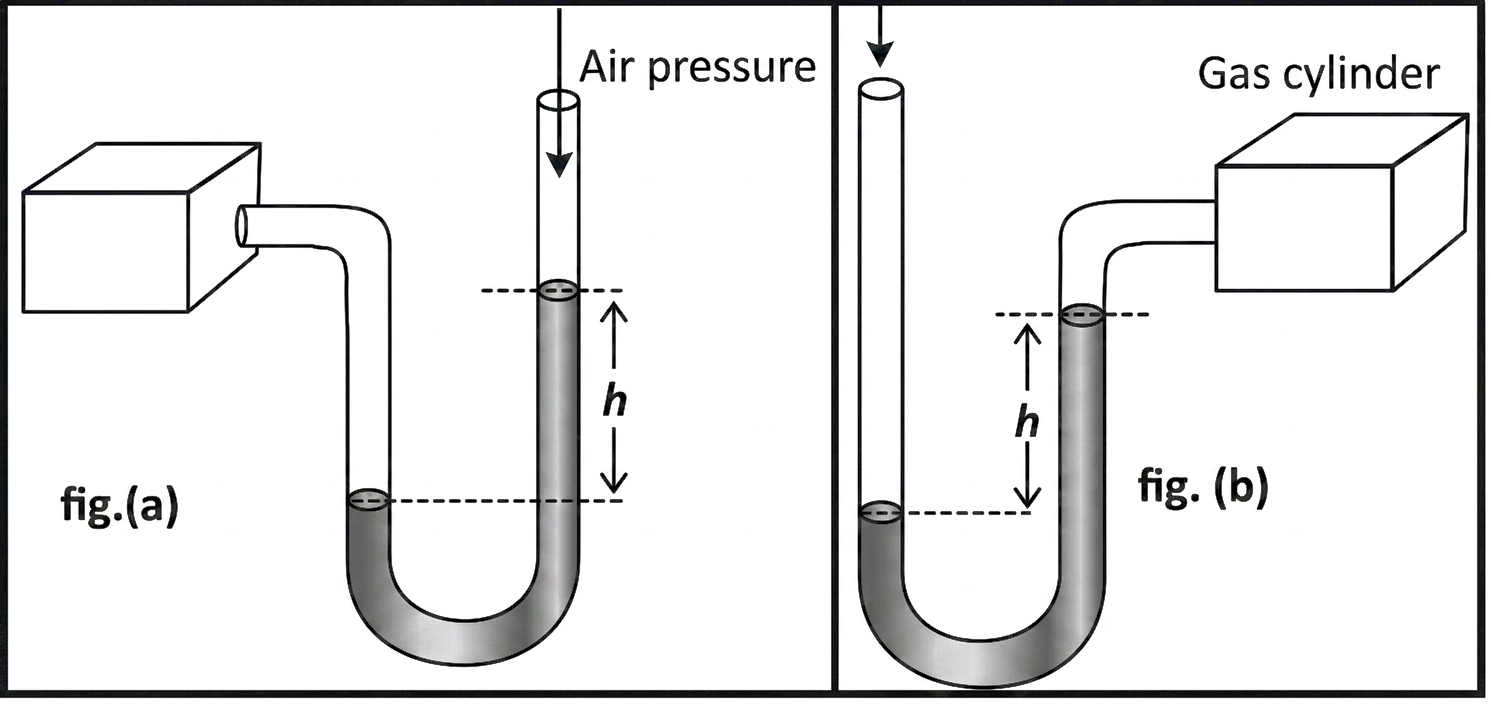
Figure: U-tube manometer – measuring gas pressure
Thus, a manometer is used for the measurement of pressure, particularly the unknown pressure of a gas relative to atmospheric pressure.
✅ Barometer: Measures atmospheric pressure | Manometer: Measures gas pressure relative to atmosphere
6.3 Describe Pascal's Law. State its applications with examples.
Answer:
Pascal's Law: When pressure is applied at one point in an enclosed fluid, it is transmitted equally to all parts of fluid without loss.
Application: The technology of hydraulic systems is based on Pascal's law. Some useful hydraulic systems are:
- (i) Hydraulic press
- (ii) Car lift at service stations
- (iii) Hydraulic brakes of vehicles
Hydraulic Press: Consider a specially designed container with two cylinders connected by a pipe as shown in figure. The smaller cylinder has a cross-sectional area \(A_1\) and the larger cylinder has area \(A_2\). Both are filled with an incompressible liquid.
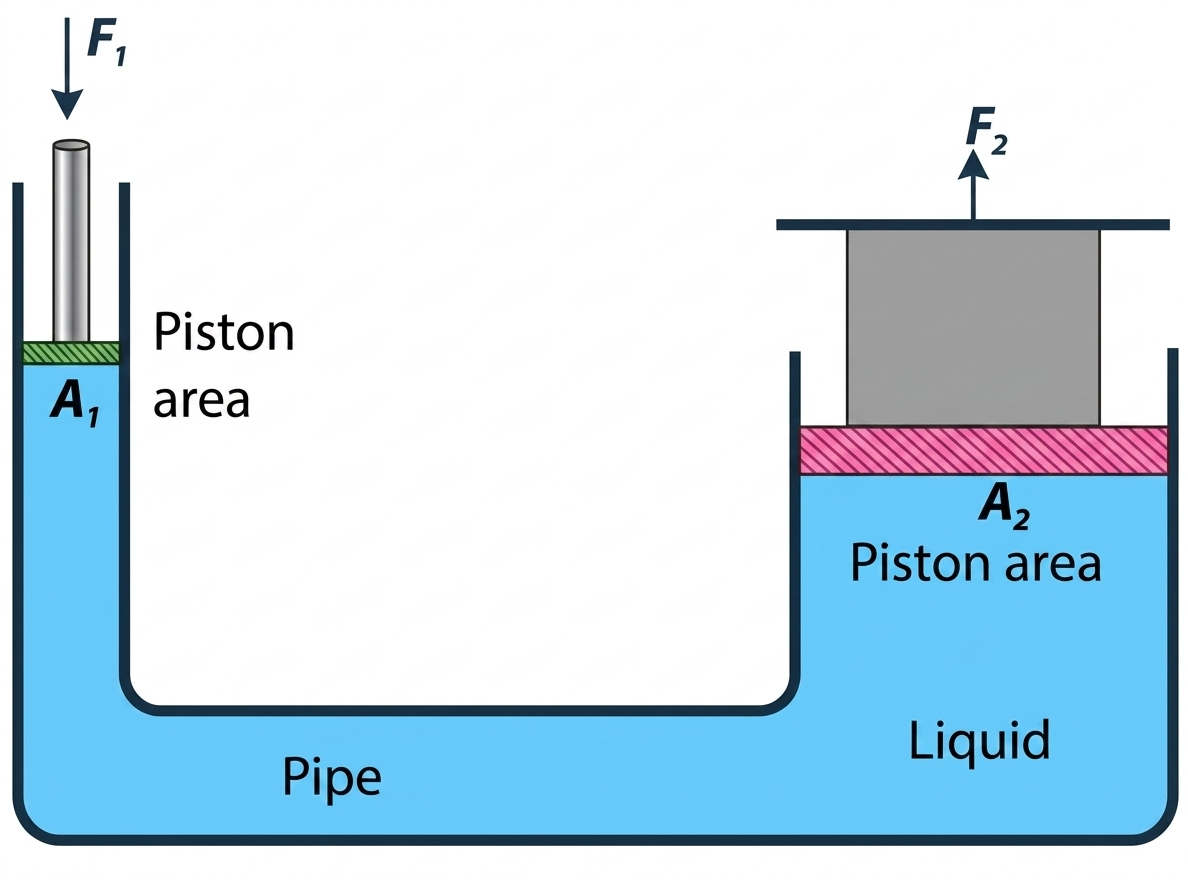
Figure: Hydraulic press – force multiplication
When a force \(F_1\) is applied on the small piston, it creates pressure
\[ P = \frac{F_1}{A_1} \]
This pressure is transmitted equally to the larger piston due to Pascal's Law. Hence, a force \(F_2\) acts on the larger piston and is given by:
\[ F_2 = P \times A_2 \]
\[ F_2 = \left(\frac{F_1}{A_1}\right) \times A_2 \]
\[ F_2 = F_1 \times \left(\frac{A_2}{A_1}\right) \]
Since \(A_2 > A_1\), therefore \(F_2 > F_1\). This means a small force applied on the small piston results in a large force on the larger piston. Such a system is called a force multiplier.
A hydraulic press works on this principle. The object to be compressed (like a cotton bale) is placed on the larger piston. A force \(F_1\) is applied on the smaller piston. The pressure generated lifts the larger piston and compresses the object.
This principle is also used at service stations to lift cars for washing.
Hydraulic Brakes: Hydraulic brakes of some vehicles work on Pascal's law. In this system:
- A master cylinder with a small cross-sectional area is connected to a brake pedal.
- It is joined through pipes to larger cylinders with pistons attached to the wheels.
- The system is filled with oil.
When the brake pedal is pressed, the piston in the master cylinder applies pressure to the liquid. According to Pascal's law, this pressure is transmitted equally to all the larger pistons in the wheel cylinders.
This causes the larger pistons to move outward, pressing the brake pads against brake discs or drums. The resulting friction slows down the vehicle.
When the pedal is released, springs pull back the brake pads and the wheels move freely again.
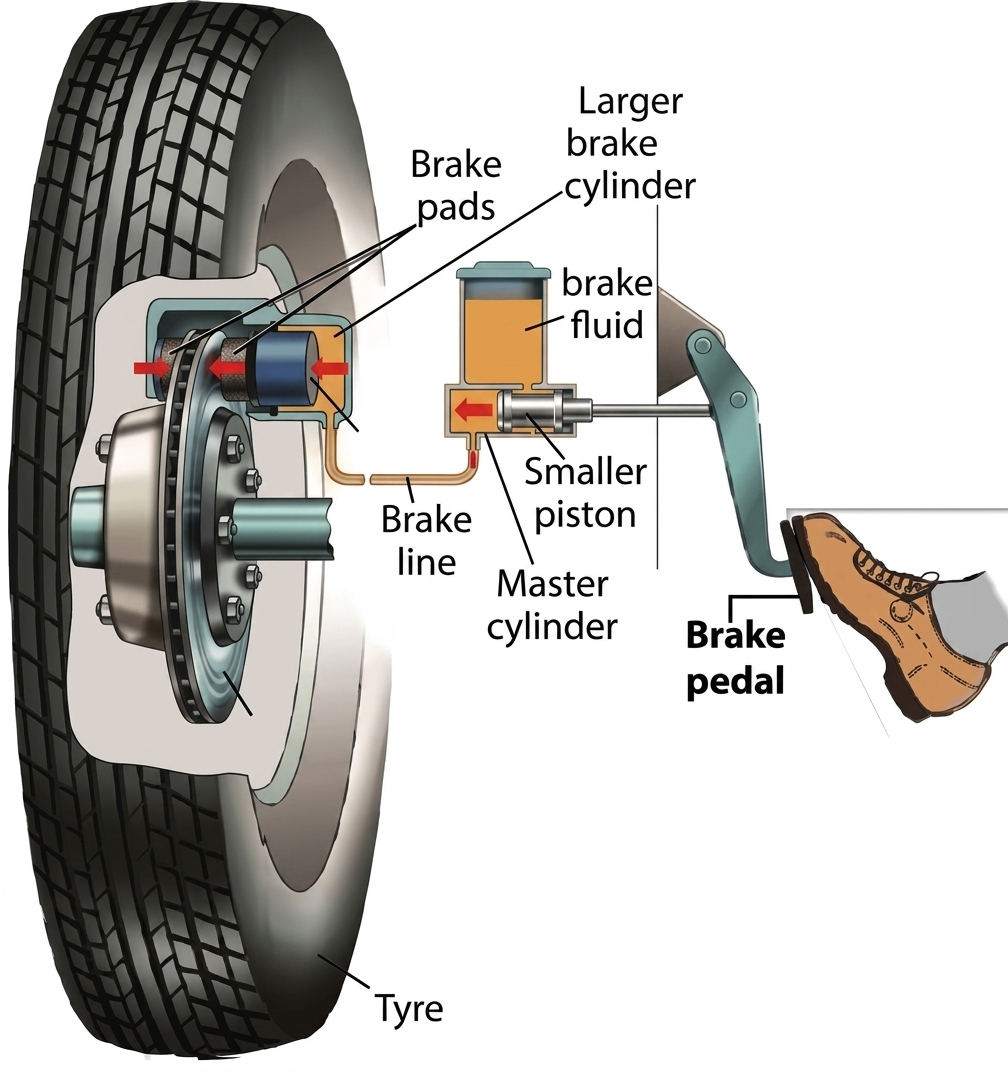
Figure: Hydraulic brake system – based on Pascal's law
✅ Pascal's Law: Pressure transmitted equally | Applications: Hydraulic Press, Car Lift, Brakes
6.4 On what factors the pressure of a liquid in a container depend? How is it determined?
Answer:
Liquids exert pressure in all directions, and this pressure increases with depth.
Consider a container filled with liquid as shown in figure. Take an area \(A\) located at a depth \(h\) in the liquid. The force acting on this area is due to the weight of the liquid column above it.
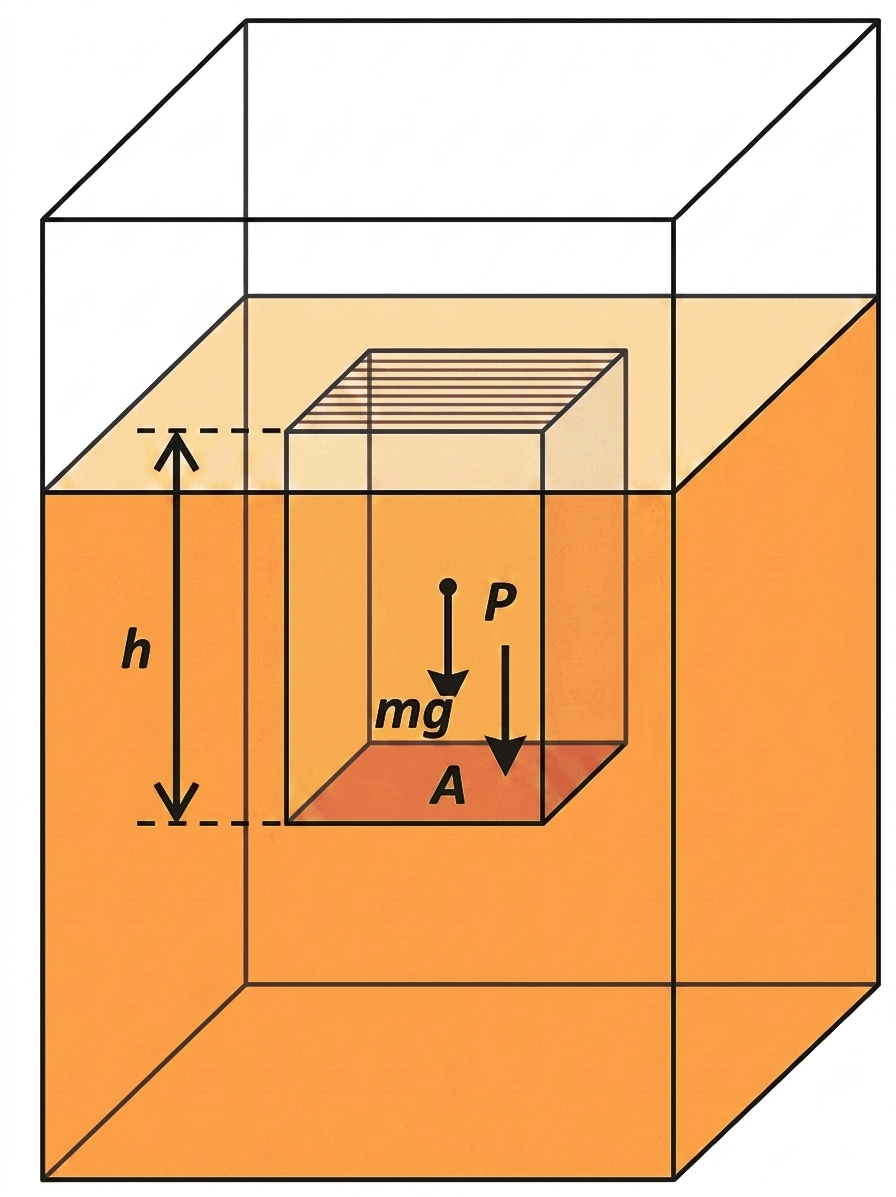
Figure: Pressure at depth \(h\) in a liquid
The volume of the liquid column is:
\[ V = Ah \]
Let \(\rho\) be the density of the liquid. Then the mass of the liquid column is:
\[ m = \rho V \]
\[ m = \rho Ah \]
The force on area \(A\) is:
\[ F = \text{weight} \]
\[ F = mg \]
\[ F = \rho Ahg \]
So, the pressure at depth \(h\) is:
\[ P = \frac{F}{A} \]
\[ P = \frac{\rho Ahg}{A} \]
\[ P = \rho gh \]
Factors: Equation shows that pressure depends on the depth and the density of the liquid, and increases with depth.
✅ \(P = \rho gh\) | Depends on: depth (\(h\)), density (\(\rho\)), and \(g\)
6.5 Explain that atmosphere exerts pressure. What are its applications? Give at least three examples.
Answer:
The Earth is surrounded by a layer of air which we call atmosphere.
We know that air is a mixture of gases. Their molecules are always in motion. They collide with one another and with all other objects coming in their way. Thus, they exert force on the objects. This force per unit area is the atmospheric pressure.
Since the molecules of air have random motion, therefore, atmospheric pressure acts equally in all directions.
The atmosphere exerts pressure on the surface of the Earth and on everything on the Earth. This pressure is called atmospheric pressure.
Experimental Verification: Boil some water in a tin can. When it is full of steam, remove it from the burner and close its mouth by an air-tight cork. Then pour cold water over it. The can crumples.
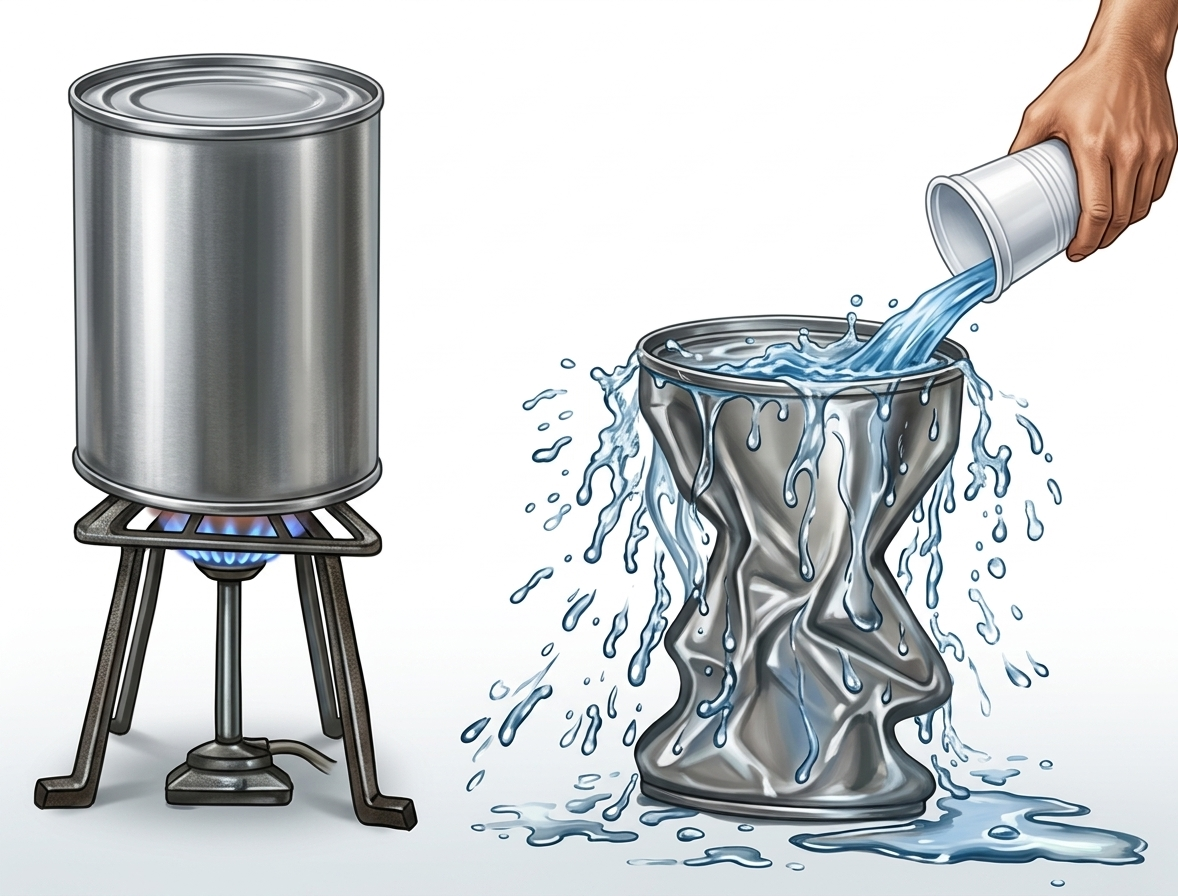
Figure: Tin can crumples due to atmospheric pressure
Why does the tin crumple? The tin crumples because the steam inside cools down and condenses, creating low pressure. The higher atmospheric pressure outside pushes on the can and crushes it.
Applications/Examples:
(i) Barometer: Atmospheric pressure is usually measured by the height of mercury column which it can support. Instruments which measure the atmospheric pressure are called barometers.
(ii) Weather forecasting: The atmospheric pressure does not always remain uniform but fluctuates. By observing the variation, the meteorologists can forecast the weather conditions.
(iii) Determining altitude: By measuring the atmospheric pressure at a point in air, altitude of that point can be determined. The lower the atmospheric pressure, the greater is the altitude.
(iv) Air pressure gauge: Air pressure gauge is used to measure the pressure in motor car tyres.
✅ Atmosphere exerts pressure | Applications: Barometer, Weather Forecasting, Altitude Determination, Tyre Pressure Gauge
📐 Key Concepts – Mechanical Properties of Matter (Comprehensive Questions)
Hooke's Law: \(F = kx\)
Pressure: \(P = \frac{F}{A}\)
Liquid Pressure: \(P = \rho gh\)
Pascal's Law: \(P = \frac{F_1}{A_1} = \frac{F_2}{A_2}\)
Atmospheric Pressure: \(P = \rho gh\) (mercury column)
💡 Exam Tip:
For comprehensive questions, write detailed answers with definitions, derivations, formulas, and applications. Use diagrams where applicable. These questions test your in-depth understanding of concepts like Hooke's law, pressure measurement, Pascal's law, liquid pressure, and atmospheric pressure. These questions follow the PECTAA 2026 pattern and are prepared by Subject Specialist Muhammad Tayyab.
Chapter 1Physical Quantities and Measurements
Chapter 2Kinematics
Chapter 3Dynamics
Chapter 4Turning Effect of Forces
Chapter 5Work and Energy
Chapter 6✨ Mechanical Properties of Matter
Chapter 7Thermal Properties of Matter
Chapter 8Magnetism
Chapter 9Nature of Science
📖 Complete syllabus coverage for Class 9 Physics (PECTAA 2026) – Chapters 1 to 9
Created by Hira Science Academy | Aligned with PECTAA 2026 Syllabus