📘 Chapter 8: Magnetism – Comprehensive Questions
Prepared by Muhammad Tayyab, Subject Specialist Physics, Govt Christian High School Daska. Based on PECTAA 2026 syllabus (National Curriculum 2023).
📖 What's Inside: This section covers comprehensive questions from Chapter 8 Magnetism including Identification of Magnets, Strength of Magnetic Field, Field Patterns, Circuit Breaker, Attraction of Magnetic Materials, and Domain Theory (Paramagnetic, Diamagnetic, Ferromagnetic Materials). Each question is presented with a detailed answer as per the official PECTAA 2026 Physics curriculum. Perfect for Punjab Boards (Lahore, Gujranwala, Multan, etc.) and all BISE boards across Pakistan.
📚 Related Resources – Chapter 8: Magnetism
Magnetism covers magnetic materials, magnetic fields, electromagnets, electromagnetic induction, and applications.
📖 Comprehensive Questions & Answers (PECTAA 2026)
8.1 How can you identify whether an object is a magnet or a magnetic material?
Answer:
Identification of a Magnet: To identify whether an object is a magnet or simply a magnetic material, we can bring its one end close to any pole of a suspended bar magnet. If it is attracted, then we can conclude that the end of the object is either of opposite pole to that of the suspended magnet or it is simply a magnetic material.
Then we should bring the same end of the object close to the other end of the suspended magnet. If the object is again attracted, it is not a magnet but it is a magnetic material. If it is repelled by the other end of the suspended magnet, then the object is a magnet.
Real Test: The repulsion between the like poles is a real test to identify a magnet.
✅ Repulsion between like poles is the real test to identify a magnet.
8.2 Describe the strength of a magnetic field in terms of magnetic lines of force. Explain it by drawing a few diagrams for the fields as examples.
Answer:
Strength of the Magnetic Field: The strength of the magnetic field is proportional to the number of magnetic lines of force passing through unit area placed perpendicular to the lines.
Thus, the magnetic field is stronger in regions where the field lines are relatively close together and weaker where these are far apart.
For example, the lines are closest together near north and south poles indicating that the strength of the magnetic field is stronger in these regions. Away from the poles, the magnetic field becomes weaker.
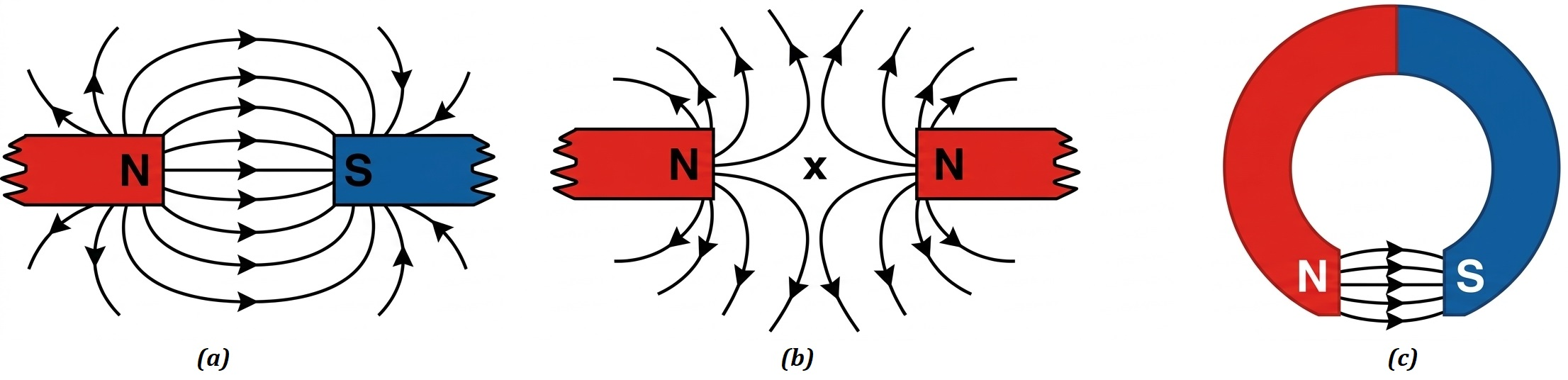
Figure: Magnetic field patterns – (a) two magnets, (b) neutral point, (c) horse-shoe magnet
Examples of Field Patterns:
(a) Combined Magnetic Field of Two Magnets: When two magnets are placed close to each other, their combined magnetic field can be drawn by using a compass needle. Figure (a) shows the pattern of the combined magnetic field for one orientation of two magnets.
(b) Neutral Point: Figure (b) shows another orientation of two magnets. Point X is called a neutral point because the field due to one magnet cancels out that due to the other magnet.
(c) Field Pattern Of A Horse-Shoe Magnet: Figure (c) represents the field pattern of a horse-shoe magnet. The field is almost uniform between the poles except near the edges.
✅ Field strength ∝ number of field lines per unit area | Stronger near poles, weaker away
8.3 What is a circuit breaker? Describe its working with the help of a diagram.
Answer:
Circuit Breaker: A circuit breaker is designed to pass a certain maximum current through it safely. If the current becomes excessive, it switches OFF the circuit. Thus, electric appliances are protected from burning.
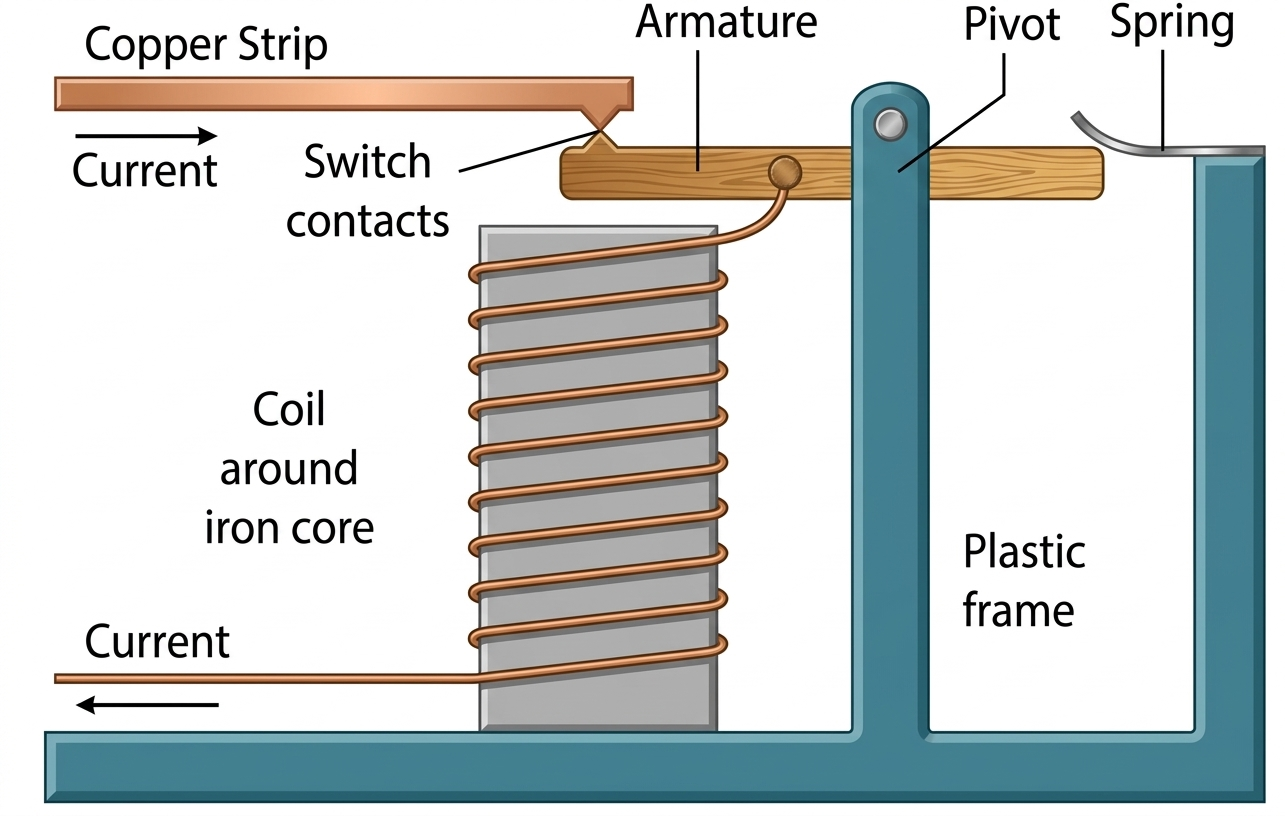
Figure: Circuit breaker – copper strip, armature, electromagnet, pivot, and spring
Working: Inside a circuit breaker, the current flows along a copper strip, through the iron armature and coil of the electromagnet.
The electromagnet attracts the armature. If the current is large enough, the armature is detached from the copper strip and the circuit breaks.
✅ Excessive current → electromagnet pulls armature → circuit breaks → appliances protected
8.4 A magnet attracts only a magnet. Explain the statement.
Answer:
The given statement is not correct. A magnet attracts both other magnets and magnetic materials (such as iron, nickel, cobalt).
Reason: When a magnet is brought near a magnetic material such as iron, the external magnetic field penetrates the unmagnetized iron and induces magnetism in it. The near end of the iron becomes an opposite pole to the pole of the magnet, while the far end becomes the same pole.
For example, the S-pole of a true magnet induces N-pole in the near end of the iron piece, while the far end becomes S-pole. Thus, the opposite poles attract each other and the magnet attracts the iron piece. The induced magnetism vanishes when the true magnet is removed.
Conclusion: Since a magnet can attract unmagnetized magnetic materials by inducing magnetism in them, the correct statement is: "A magnet attracts magnetic materials and other magnets."
✅ A magnet attracts both magnets and magnetic materials (through induced magnetism)
8.5 Differentiate between paramagnetic, diamagnetic and ferromagnetic materials with reference to the domain theory.
Answer:
Paramagnetic Materials: If the orbital and spin axes of the electrons in an atom are so oriented that their fields support one another and the atom behaves like a tiny magnet, the materials with such atoms are called paramagnetic materials, such as aluminium and lithium.
Diamagnetic Materials: Magnetic fields produced by both orbital and spin motions of the electrons in an atom may add up to zero. In this case, the atom has no resultant field. The materials with such atoms are called diamagnetic materials. Some of their examples are copper, bismuth, water, etc.
Ferromagnetic Materials: There are some solid substances such as iron, steel, nickel, cobalt, etc. In which cancellation of any type does not occur for large groups of neighbouring atoms because they have electron spins that are naturally aligned parallel to each other. These are known as ferromagnetic materials.
The group of atoms in this type of material form a region of about \(0.1\,\text{mm}\) size that is highly magnetized. This region is called a magnetic domain. Each domain behaves as a small magnet with its own north and south poles.
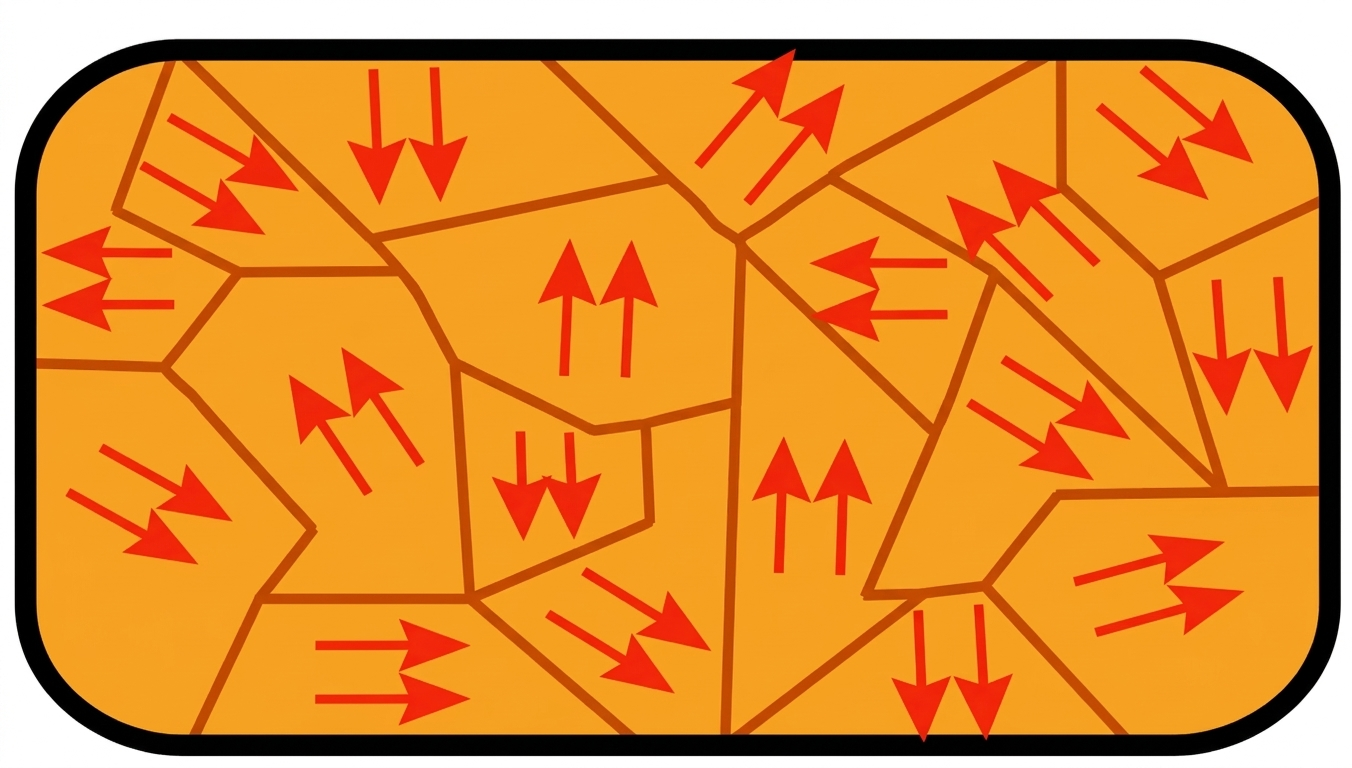
Figure: Random orientation of domains in an unmagnetized ferromagnetic material
1. Random Orientation of Domains: The domains in a ferromagnetic material are randomly oriented as shown in figure. The magnetic fields of the domains cancel each other, so the material does not display any magnetism.
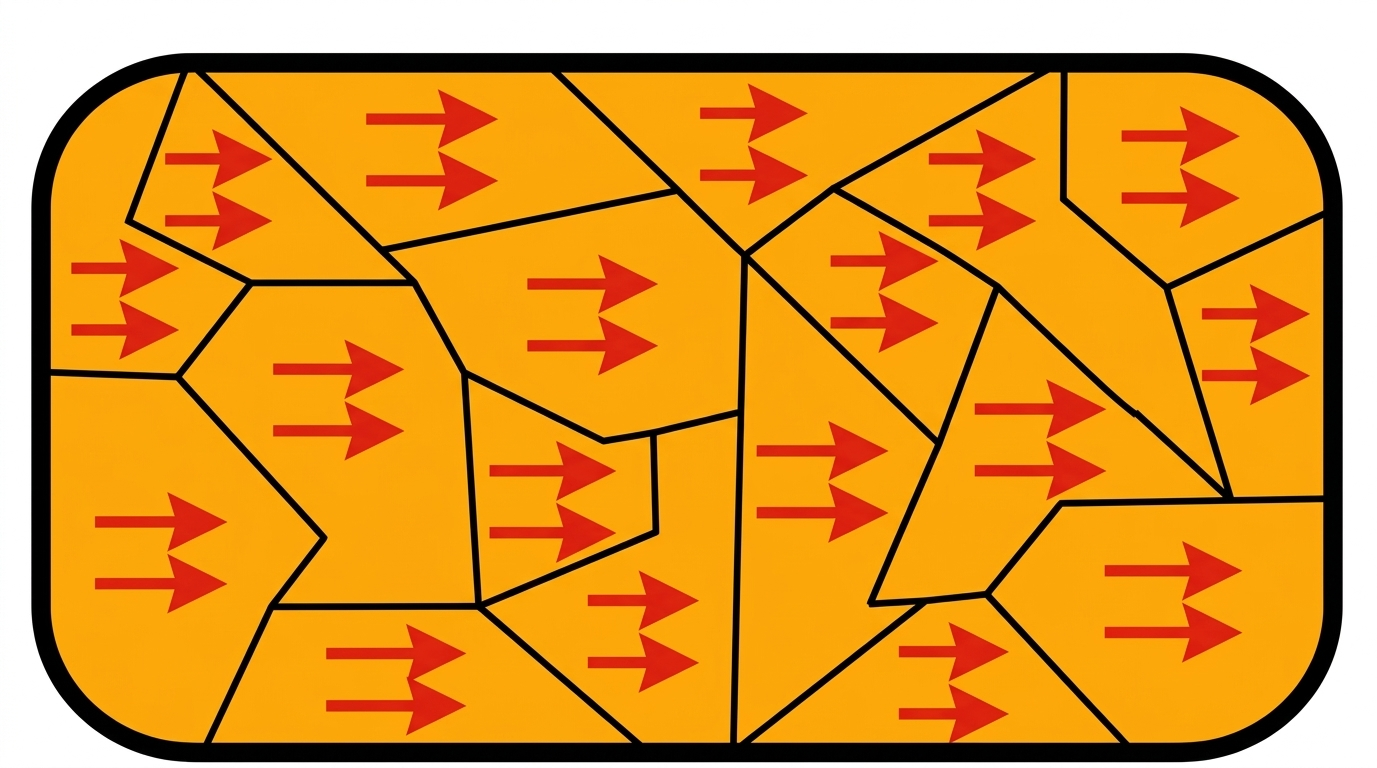
Figure: Domains aligned in the direction of an external magnetic field
2. Effect of External Magnetic Field: An unmagnetized piece of iron can be magnetized by placing it in an external magnetic field provided by a permanent magnet or an electromagnet. The external magnetic field penetrates the unmagnetized iron and induces magnetism in it by causing two effects on the domains. Those domains whose magnetism is parallel or nearly parallel to the external magnetic field grow in size at the expense of other domains that are not oriented. In addition, the magnetic alignment of the other domains rotates and becomes oriented in the direction of the external field.
3. Resulting Magnetization: As a result, the iron is magnetized and behaves like a magnet having its own north and south poles.
4. Permanent and Temporary Magnetism: In soft iron, the domains are easily oriented on applying an external field and return to random position when the field is removed. On the other hand, steel is not so easily oriented to change order. It requires a very strong external field, but once oriented, it retains the alignment. That is why, steel is used to make permanent magnets.
✅ Paramagnetic: fields support each other | Diamagnetic: fields cancel out | Ferromagnetic: domains naturally aligned parallel
8.6 Why ferromagnetic materials are suitable for making magnets?
Answer:
Ferromagnetic materials (such as iron, steel, nickel, cobalt) are suitable for making magnets because in these materials, large groups of neighbouring atoms have electron spins that are naturally aligned parallel to each other. These groups form regions called magnetic domains, each behaving as a small magnet with its own north and south poles.
When an external magnetic field is applied, the domains align in the direction of the field, causing the material to become strongly magnetized. This ability to form and align domains makes ferromagnetic materials ideal for making both temporary magnets (soft iron) and permanent magnets (steel).
✅ Ferromagnetic materials have naturally aligned domains → strong magnetization possible
📐 Key Concepts – Magnetism (Comprehensive Questions)
Magnetic Field Strength: ∝ number of field lines per unit area
Real Test of Magnet: Repulsion between like poles
Circuit Breaker: Electromagnet trips armature when current is excessive
Paramagnetic: Aluminium, Lithium (fields support each other)
Diamagnetic: Copper, Bismuth, Water (fields cancel out)
Ferromagnetic: Iron, Steel, Nickel, Cobalt (domains naturally aligned)
💡 Exam Tip:
For comprehensive questions, write detailed answers with definitions, explanations, and examples where applicable. Use diagrams where required. These questions test your in-depth understanding of concepts like magnetic field strength, field patterns, circuit breakers, magnetic materials, and domain theory. These questions follow the PECTAA 2026 pattern and are prepared by Subject Specialist Muhammad Tayyab.
Chapter 1Physical Quantities and Measurements
Chapter 2Kinematics
Chapter 3Dynamics
Chapter 4Turning Effect of Forces
Chapter 5Work and Energy
Chapter 6Mechanical Properties of Matter
Chapter 7Thermal Properties of Matter
Chapter 8✨ Magnetism
Chapter 9Nature of Science
📖 Complete syllabus coverage for Class 9 Physics (PECTAA 2026) – Chapters 1 to 9
Created by Hira Science Academy | Aligned with PECTAA 2026 Syllabus