📘 Chapter 7: Thermal Properties of Matter – Comprehensive Questions
Prepared by Muhammad Tayyab, Subject Specialist Physics, Govt Christian High School Daska. Based on PECTAA 2026 syllabus (National Curriculum 2023).
📖 What's Inside: This section covers comprehensive questions from Chapter 7 Thermal Properties of Matter including Kinetic Molecular Theory, Temperature and Thermometers, Mercury-in-Glass Thermometer Construction, Temperature Scales, and Thermometer Parameters (Sensitivity, Range, Linearity). Each question is presented with a detailed answer as per the official PECTAA 2026 Physics curriculum. Perfect for Punjab Boards (Lahore, Gujranwala, Multan, etc.) and all BISE boards across Pakistan.
📚 Related Resources – Chapter 7: Thermal Properties of Matter
📋 Exercise Short Qs
📝 Short Qs
📖 Comprehensive Qs
🔢 Numerical Problems
✅ MCQs
✏️ Constructed Response
Thermal Properties of Matter covers temperature, heat, thermometers, temperature scales, and kinetic molecular theory.
📖 Comprehensive Questions & Answers (PECTAA 2026)
7.1 Describe the main points of particle theory of matter which differentiate solids, liquids and gases.
Answer:
Kinetic Molecular Theory of Matter: According to the kinetic molecular theory, matter is composed of very small particles called molecules, which are always in motion. Their motion may be vibrational, rotational or linear.
There exists a mutual force of attraction between the molecules known as intermolecular force. This force depends upon the distance between the molecules. It decreases with increasing distance between them.
Properties of Kinetic Molecular Theory: In general, matter exists in three states: solids, liquids, and gases.
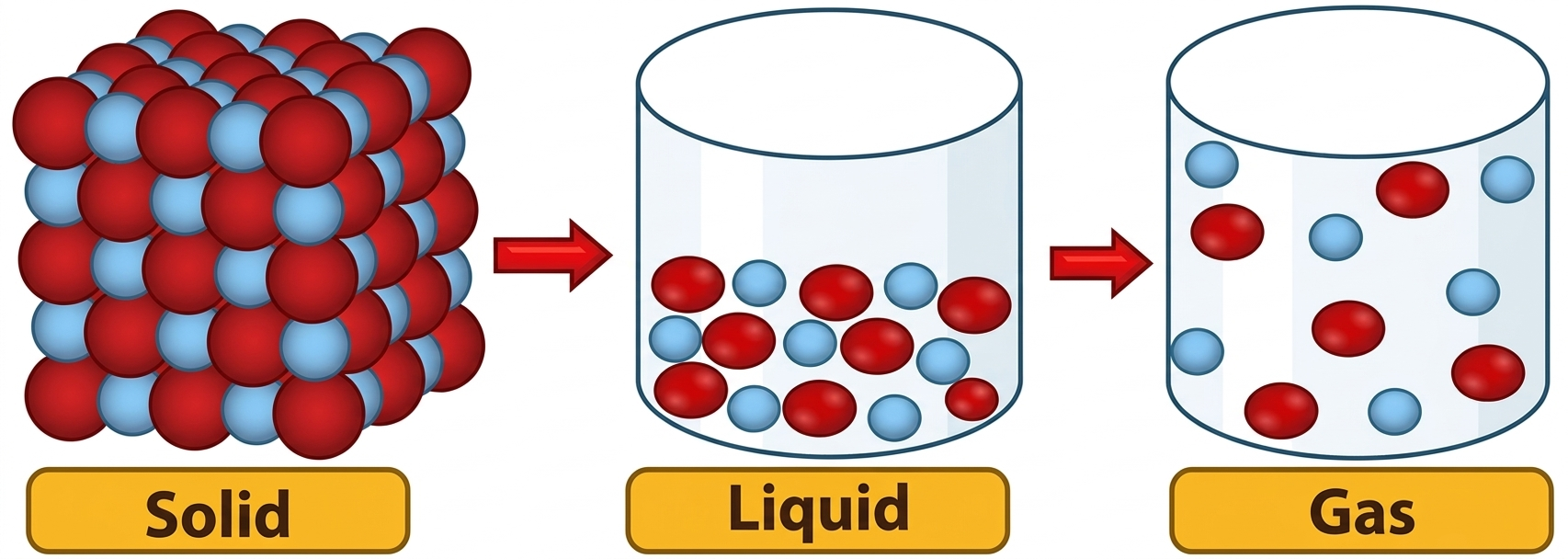
Figure: Molecular arrangement in solids, liquids, and gases
Solids: In case of solids, the intermolecular forces are so strong that they keep the molecules bound. So, the molecules are held at fixed positions but still they show vibrational motion about their fixed points. This is why, the solids have a definite shape and a definite volume.
Liquids: In case of liquids, intermolecular force is so weak that it cannot hold the molecules at fixed positions and the molecules can slide over each other in random directions. A liquid, therefore, possesses a definite volume but has no definite shape. Due to flow of the molecules, it acquires the shape of the containing vessel.
Gases: In gases, the molecules are relatively far apart and the intermolecular forces are very weak. Therefore, gases have neither a definite shape nor a definite volume.
✅ Kinetic Molecular Theory: Molecules in constant motion | Intermolecular forces vary with distance | Solids: fixed shape and volume | Liquids: definite volume, no shape | Gases: no fixed shape or volume
7.2 What is temperature? How is it measured? Describe briefly the construction of a mercury-in-glass thermometer.
Answer:
Temperature: Temperature of a body is defined as degree of its hotness or coldness. Temperature can also be defined as a physical quantity which determines the direction of flow of thermal energy.
According to molecular theory of matter, temperature is a measure of the average kinetic energy of the molecules of an object.
Measurement of Temperature: For the exact measurement of the hotness of a substance, we require an instrument called a thermometer.
Thermometers use some property of a substance, which changes appreciably with the change of temperature.
Construction of a Mercury-in-Glass Thermometer: Liquids expand on heating. So, expansion in the volume of a liquid can be used for the measurement of temperature. This is known as a liquid-in-glass thermometer.

Figure: Mercury-in-glass thermometer
A liquid-in-glass thermometer is made of glass. It has a bulb at one end filled with mercury. When the temperature rises, the mercury expands and moves up through the narrow capillary tube in the form of a mercury thread. The position of the end of the thread reads the temperature. Mercury is opaque and can be easily seen due to its silvery colour.
✅ Temperature = degree of hotness/coldness | Mercury thermometer uses expansion of mercury | Bulb → capillary tube → scale reading
7.3 Compare the three scales used for measuring temperature.
Answer:
The three types of temperature scales are:
- (i) Celsius or centigrade scale
- (ii) Fahrenheit scale
- (iii) Kelvin scale
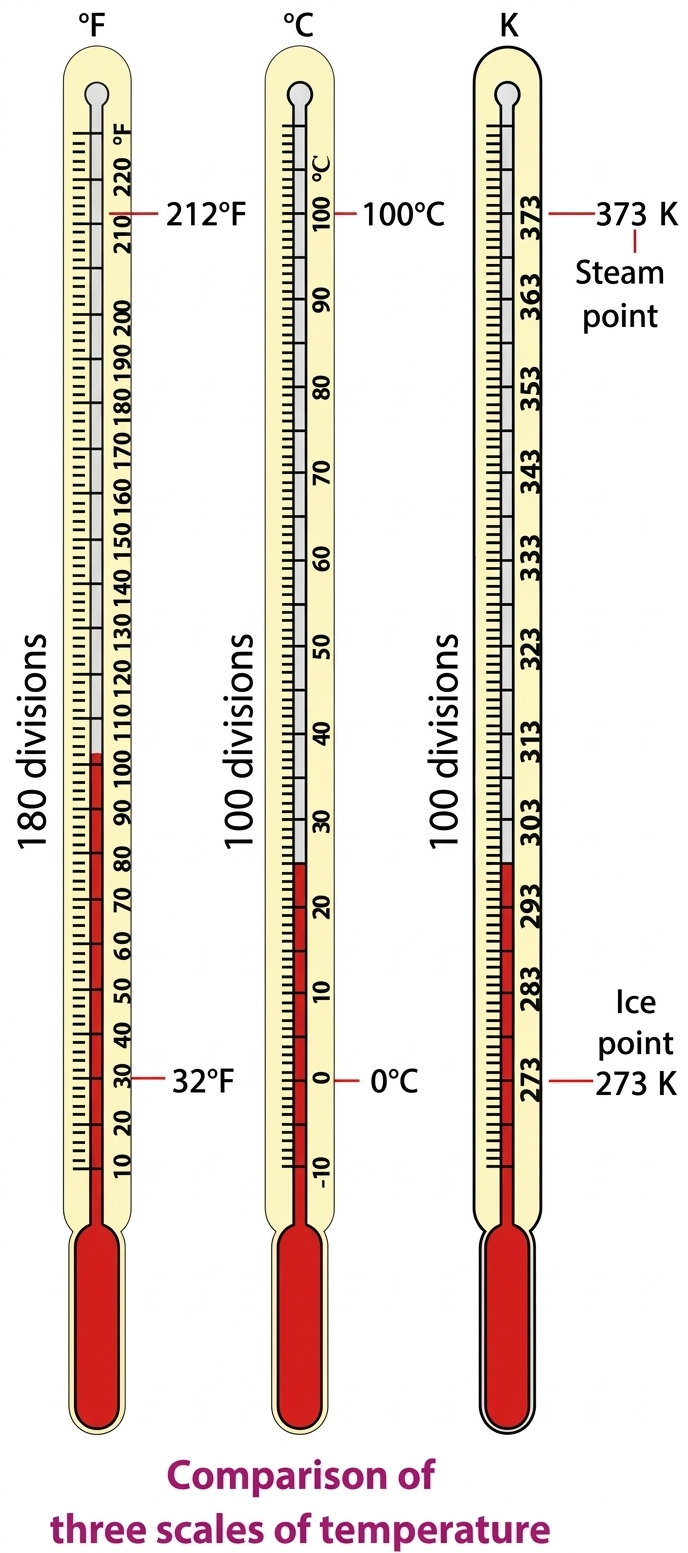
Figure: Comparison of the three temperature scales
(i) Celsius Scale: In Celsius or centigrade scale, the numerical values assigned to lower and upper fixed points are 0 and 100. The space between these points is divided into 100 equal parts. Each part is known as \(1^\circ C\).
(ii) Fahrenheit Scale: In Fahrenheit scale, the lower fixed point is labelled as 32 and upper as 212. The space between these points is divided into 180 equal parts. Each part is known as \(1^\circ F\). Celsius and Fahrenheit scales are generally used in ordinary life.
(iii) Kelvin Scale: There is a third scale of temperature known as Kelvin scale or Absolute temperature scale. It is used in scientific measurements. In Kelvin scale, the lower and upper fixed points are labelled as 273 and 373. The width of 1 K is the same as that of \(1^\circ C\).
The zero point of Kelvin scale is known as absolute zero. Its value is \(-273.15^\circ C\) and for calculations it is simply taken as \(-273^\circ C\).
✅ Celsius: 0°C to 100°C (100 divisions) | Fahrenheit: 32°F to 212°F (180 divisions) | Kelvin: 273 K to 373 K (100 divisions) | Absolute zero = -273.15°C
7.4 What is meant by sensitivity, range and linearity of thermometers? Explain with examples.
Answer:
1. Sensitivity: Sensitivity of a thermometer refers to its ability to detect small changes in the temperature of an object.
For example, if the minimum division on the scale of a thermometer is \(1^\circ C\), its accuracy will be \(1^\circ C\). If another thermometer has marks \(0.1^\circ C\) apart, it is more sensitive and its measurement will be more precise.
2. Range: Range refers to the span of temperature, from low to high, over which the thermometer can measure accurately.
For example, a clinical thermometer has a narrow range, say from \(35^\circ C\) to \(45^\circ C\), whereas a long-range laboratory thermometer may have markings from \(-10^\circ C\) to \(110^\circ C\).
The choice of liquid puts a lower and upper limit for the range. Mercury freezes at \(-39^\circ C\) and boils at \(357^\circ C\).
3. Linearity: Linearity refers to a direct proportional relationship between the temperature and scale reading across entire range of measurement.
A good linear thermometer should measure equal increments on the scale corresponding to equal change in the temperature. Therefore, markings on the scale should be evenly spaced over the whole range.
✅ Sensitivity: detects small changes | Range: span of temperature measurement | Linearity: proportional relationship between temperature and scale reading
7.5 Explain how the parameters mentioned in question 7.4 are improved in the structure of liquid-in-glass thermometer.
Answer:
1. Improving Sensitivity: The thin wall of the glass bulb allows quick conduction through glass to the liquid from a hot object whose temperature is to be measured.
Mercury being metal is a good conductor and hence responds quickly to the change in temperature.
The small amount of liquid also responds more quickly to a change in temperature. The quick response makes the device sensitive.
For greater accuracy, alcohol can be used as its expansivity is six times more than mercury.
2. Improving Linearity: The uniformity of the narrow tube or bore ensures even expansion of the liquid required to make the linear measuring scale.
3. Improving Range: The choice of mercury allows to use it over a long-range temperature due to its low freezing point (\(-39^\circ C\)) and high boiling point (\(357^\circ C\)). It provides a fairly long range of measurement of temperature.
For extremely low temperatures, alcohol is used due to its much lower freezing point (about \(-112^\circ C\)).
✅ Sensitivity: thin bulb, mercury conductor, small liquid amount | Linearity: uniform bore | Range: mercury (-39°C to 357°C), alcohol for low temperatures
📐 Key Concepts – Thermal Properties of Matter (Comprehensive Questions)
Kinetic Molecular Theory: Molecules in constant motion (vibrational, rotational, linear)
Intermolecular Force: Force of attraction between molecules; decreases with distance
Temperature: Degree of hotness/coldness; average kinetic energy of molecules
Temperature Scales: Celsius (°C), Fahrenheit (°F), Kelvin (K)
Absolute Zero: -273.15°C = 0 K
Thermometer Parameters: Sensitivity, Range, Linearity
💡 Exam Tip:
For comprehensive questions, write detailed answers with definitions, explanations, and examples where applicable. Use diagrams where required. These questions test your in-depth understanding of concepts like Kinetic Molecular Theory, temperature measurement, thermometer construction, temperature scales, and thermometer parameters. These questions follow the PECTAA 2026 pattern and are prepared by Subject Specialist Muhammad Tayyab.
Chapter 1Physical Quantities and Measurements
Chapter 2Kinematics
Chapter 3Dynamics
Chapter 4Turning Effect of Forces
Chapter 5Work and Energy
Chapter 6Mechanical Properties of Matter
Chapter 7✨ Thermal Properties of Matter
Chapter 8Magnetism
Chapter 9Nature of Science
📖 Complete syllabus coverage for Class 9 Physics (PECTAA 2026) – Chapters 1 to 9
Created by Hira Science Academy | Aligned with PECTAA 2026 Syllabus