📘 Chapter 3: Dynamics – Comprehensive Questions
Prepared by Muhammad Tayyab, Subject Specialist Physics, Govt Christian High School Daska. Based on PECTAA 2026 syllabus (National Curriculum 2023).
📖 What's Inside: This section covers comprehensive questions from Chapter 3 Dynamics including concept of force with practical examples, Newton's laws of motion (detailed), momentum and Newton's second law in terms of momentum, principle of conservation of momentum, motion of a block on a table with friction (static and kinetic), and effect of friction on vehicles (tyre surface and braking force). Each question is presented with a detailed answer as per the official PECTAA 2026 Physics curriculum. Perfect for Punjab Boards (Lahore, Gujranwala, Multan, etc.) and all BISE boards across Pakistan.
📚 Related Resources – Chapter 3: Dynamics
📋 Exercise Short Qs
📝 Short Qs
📖 Comprehensive Qs
🔢 Numerical Problems
✅ MCQs
✏️ Constructed Response
Dynamics covers force, Newton's laws, momentum, friction, and circular motion.
📖 Comprehensive Questions & Answers (PECTAA 2026)
3.1 Explain the concept of force by practical examples.
Answer:
Concept of Force: A common concept of a force is a push or a pull that starts, stops or changes the magnitude and direction of velocity of a body.
Practical Examples: When we open a door, we push or pull it by applying force. When we are sitting in a car, we push against the seat as the car turns round a corner.
Force Transfers Energy: Force transfers energy to an object. For example, a man who moves a wheelbarrow with its load first applies force to lift it and then applies force to push it. He applies a different amount of force on each handle when turning the wheelbarrow around the corner in order to keep it from tipping over.
✅ Force: push/pull that changes velocity. Examples: opening a door, sitting in a turning car.
3.2 Describe Newton's laws of motion.
Answer:
Newton's First Law of Motion: A body continues its state of rest or of uniform motion in a straight line unless acted upon by some external force.
Explanation with Examples: A book placed on a table remains there unless a force is applied to move it. A ball rolling on the floor should continue to move with the same velocity in the absence of an applied force. However, in reality, the ball stops after covering some distance due to an opposing force (friction). When a fast-moving bus stops suddenly, passengers bend forward because they tend to continue their motion. Conversely, when the bus starts moving quickly from rest, passengers are pushed back against the seat because they tend to retain their state of rest. The first law also provides another definition of force: Force is an agency which changes or tends to change the state of rest or of uniform motion of a body. In simple terms, force causes acceleration.
Newton's Second Law of Motion: If a net external force acts upon a body, it accelerates the body in the direction of force. The magnitude of acceleration is directly proportional to the magnitude of force and is inversely proportional to the mass of the body. \(F = ma\).
Mathematical Form: If a net force of magnitude \(F\) acts on a body of mass \(m\) and produces an acceleration of magnitude \(a\), then \(a \propto F\) and \(a \propto \frac{1}{m}\). Therefore, \(a = (constant) \frac{F}{m}\). According to SI units, if \(m = 1kg\), \(a = 1ms^{-2}\), \(F = 1N\), then the value of the constant is 1. Hence, \(a = \frac{F}{m}\) or \(F = ma\).
SI Unit of Force: The SI unit of force is newton \((N)\). One newton is the force which produces an acceleration of \(1ms^{-2}\) in a body of mass \(1kg\). \(1N = 1kg \times 1ms^{-2}\).
Newton's Third Law of Motion: For every action, there is always an equal and opposite reaction. Since action and reaction do not act on the same body but they act on two different bodies, so they can never balance each other. If one body exerts a force on a second body, the second body also exerts an equal and opposite force on the first body.
Examples:
(i) Block on a table: A block lying on a table experiences a downward force due to its weight \((w)\). The block exerts this force on the table. In response, the table applies an equal and opposite normal reaction force \((F_n)\) upward on the block. These two forces balance each other, keeping the block at rest.
(ii) Bullet fired from a gun: When a bullet is fired, the force of action \((F)\) propels the bullet forward. Simultaneously, the gun experiences a reaction force \((R)\) in the opposite direction, causing it to recoil.
✅ Newton's First Law (Inertia), Second Law (\(F=ma\)), Third Law (Action-Reaction).
3.3 Define momentum and express Newton's 2nd law of motion in terms of change in momentum.
Answer:
Momentum: The momentum of a moving body is the product of its mass and velocity. Mathematically, \(p = m \times v\). Momentum is a vector quantity, and its SI unit is \(kgms^{-1}\) or Ns.
Newton's Second Law in Terms of Momentum: According to Newton's second law of motion, the rate of change of momentum of a body is equal to the force acting on it.
When a ball is hit by a bat, a force \(F\) is exerted on the ball for a short interval of time \(\Delta t\). In such cases, it is difficult to calculate the exact magnitude of the force, but the initial velocity \(v_i\) and final velocity \(v_f\) after collision can be determined. The acceleration \(a\) is given by \(a = \frac{\Delta v}{\Delta t} = \frac{v_f - v_i}{\Delta t}\).
From Newton's second law:
\(F = ma\)
\(F = m\left(\frac{v_f - v_i}{\Delta t}\right)\)
\(F \times \Delta t = m(v_f - v_i)\)
\(F \times \Delta t = mv_f - mv_i\)
\(F \times \Delta t = p_f - p_i\)
\(F \times \Delta t = \Delta p\)
\(F = \frac{\Delta p}{\Delta t}\)
This equation expresses Newton's second law in terms of momentum, stating that: The rate of change of momentum of a body is equal to the force acting on it, and the direction of change in momentum is the same as the direction of the applied force.
✅ Momentum: \(p = mv\). Newton's Second Law: \(F = \frac{\Delta p}{\Delta t}\).
3.4 State and explain the principle of conservation of momentum.
Answer:
Principle of Conservation of Momentum: If no external force acts on an isolated system, the final total momentum of the system is equal to the initial total momentum of the system.
System: The collection of objects is known as a system.
Isolated System: If no external force acts on any object of the system, it is known as an isolated system.
Explanation: Consider a system of two balls of masses \(m_1\) and \(m_2\). Suppose that the balls are moving with velocities \(v_1\) and \(v_2\) along a straight line in the same direction. If \(v_1 > v_2\), the balls will collide as shown in figure. If their velocities become \(v_1'\) and \(v_2'\) respectively after collision, then:
Total momentum of the system before collision \(= m_1v_1 + m_2v_2\)
Total momentum of the system after collision \(= m_1v_1' + m_2v_2'\)
Thus, according to the principle of conservation of momentum:
\(m_1v_1 + m_2v_2 = m_1v_1' + m_2v_2'\)
Special Case: Consider the collision of two identical balls, in which the second ball is at rest. When there is a collision, there is a transfer of momentum from one ball to another. The ball at rest gains momentum and starts moving, whereas the striking ball slows down. If the balls are identical, there is a total transfer of momentum. The striking ball comes to rest and the other ball starts moving with the same speed. This means that the second ball gains momentum equal to that lost by the first one. Therefore, the total momentum of the two balls after collision remains the same as total momentum before collision.
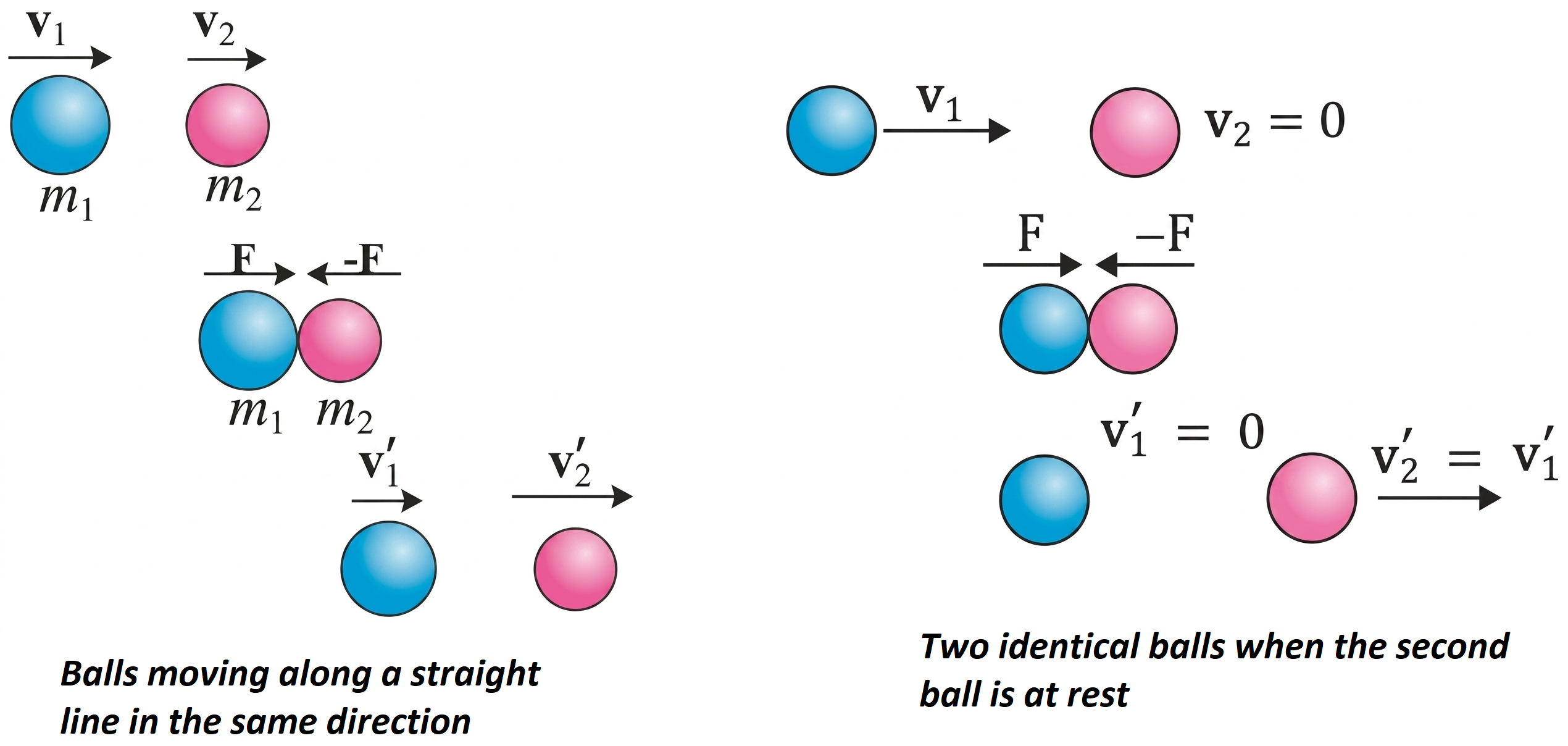
Figure: Collision of two balls – Conservation of Momentum
✅ Total momentum before collision = Total momentum after collision (if no external force).
3.5 Describe the motion of a block on a table taking into account the friction between the two surfaces. What is the static friction and kinetic friction?
Answer:
Motion of a Block on a Table: Let us consider the motion of a block on a horizontal surface. When a weight is put in the pan, a force \(F = T\), equal to the sum of this weight and weight of the pan, acts on the block. This force tends to pull the block. At the same time, an opposing force appears that does not let the block move. This opposing force is the static friction \(F_s\).
Static and Limiting Friction: Friction is the force that tends to prevent the bodies from sliding over each other. The resisting force between the two surfaces before the motion starts is called the static friction. The maximum value of the static friction is called limiting friction.
If we go on adding more weights in the pan one by one in small steps, a stage will come when the block starts sliding on the horizontal surface. This is the limit of static friction that is equal to the total weights including pan.
Kinetic Friction: The friction during motion is called kinetic friction. When the block is sliding, friction still exists. It is known as kinetic friction.
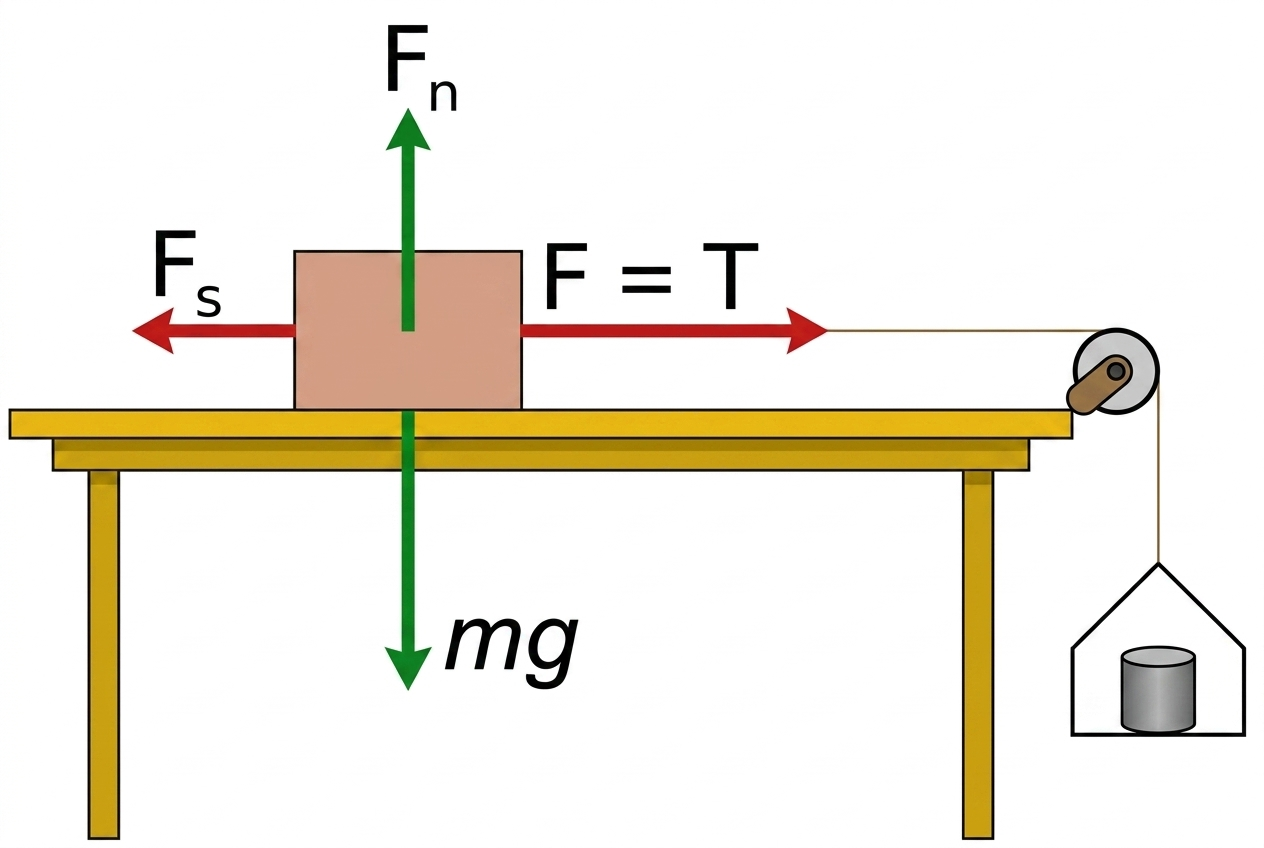
Figure: Block on a table with friction (Static and Kinetic)
✅ Static friction: resists motion before it starts. Kinetic friction: opposes motion during sliding.
3.6 Explain the effect of friction on the motion of vehicles in context of tyre surface and braking force.
Answer:
Effect of Friction on Vehicles: Friction is the force that tends to prevent the bodies from sliding over each other.
Friction between the tyres and road prevents the tyres from sliding over the road. It provides the force needed for a vehicle to move and stop. During braking, friction between the tyres and road opposes the motion of the vehicle and helps to stop it. The tyres of vehicles also wear out after becoming too hot due to friction between tyres and road.
✅ Friction between tyres and road provides grip for motion and braking force.
📐 Key Concepts – Dynamics (Comprehensive)
Force: Push or pull that changes velocity.
Newton's Laws: 1st (Inertia), 2nd (\(F = ma\)), 3rd (Action-Reaction).
Momentum: \(p = mv\).
Impulse-Momentum: \(F \Delta t = \Delta p\).
Conservation of Momentum: Total momentum remains constant if no external force.
Friction: Static (before motion) and Kinetic (during motion).
💡 Exam Tip:
For comprehensive questions, write detailed answers with clear explanations, definitions, and mathematical derivations where required. Use diagrams to support your explanations (as shown in the figures). These questions test your in-depth understanding of concepts like force, Newton's laws, momentum, friction, and their applications. These questions follow the PECTAA 2026 pattern and are prepared by Subject Specialist Muhammad Tayyab.
Chapter 1Physical Quantities and Measurements
Chapter 2Kinematics
Chapter 3✨ Dynamics
Chapter 4Turning Effect of Forces
Chapter 5Work and Energy
Chapter 6Mechanical Properties of Matter
Chapter 7Thermal Properties of Matter
Chapter 8Magnetism
Chapter 9Nature of Science
📖 Complete syllabus coverage for Class 9 Physics (PECTAA 2026) – Chapters 1 to 9
Created by Hira Science Academy | Aligned with PECTAA 2026 Syllabus