Prepared by Muhammad Tayyab, Subject Specialist Mathematics, Govt Christian High School Daska
📌 Based on National Curriculum 2023 / PECTAA Syllabus
📖 What's Inside: This review exercise covers MCQs, magnitude of vectors, unit vector, vector operations, translations, parallelogram verification, isosceles triangle using vector magnitude, projectile motion, resultant velocity, and conceptual questions. Perfect for Punjab Boards exam preparation.
📚 Related Resources – Chapter 6: Vectors in Plane
Mastering Vectors: Class 10 Math Chapter 6 Review Exercise
The Review Exercise of Chapter 6 is your ultimate revision tool for Vectors in Plane, covering all the key concepts from Exercises 6.1 through 6.3. This comprehensive review is designed to solidify your understanding of vector operations, translations, and geometric applications, ensuring you are fully prepared for the Punjab Board exams.
What You Will Learn in This Review
This review exercise is structured to test and reinforce your knowledge across the entire chapter. You will revisit the fundamental concept of a vector, learn to represent them in component form, practice finding magnitudes and unit vectors, and perform addition, subtraction, and scalar multiplication. The exercise also covers important geometric applications and physics problems.
Topics Covered in This Review
- MCQs – Testing fundamental concepts of vectors and their properties.
- Magnitude of Vectors – Calculating the length of a vector using the distance formula.
- Unit Vectors – Finding a vector of magnitude 1 in the same direction as a given vector.
- Vector Operations – Addition, subtraction, and scalar multiplication of vectors.
- Translations – Using vectors to translate points and figures in the plane.
- Parallelogram Verification – Proving a quadrilateral is a parallelogram using vector equality.
- Isosceles Triangle – Using vector magnitudes to prove a triangle is isosceles.
- Resultant Velocity – Finding the resultant vector of two velocities and its magnitude.
- Conceptual Questions – Deepening understanding of equality and opposites of vectors.
Why This Review Exercise is Crucial for Board Exams
The Review Exercise is not just another set of problems; it is a carefully curated collection that mirrors the style and difficulty of questions that appear in board exams. By mastering this review, you'll gain the confidence to tackle any vector-related question, from straightforward calculations to complex geometric and application-based problems.
📖 Multiple Choice Questions (Chapter 6 Review)
1. x-axis and y-axis divide a coordinate plane into ___ parts.
x-axis and y-axis divide the coordinate plane into four quadrants.
2. P(4, -4) lies in ___ quadrant.
P(4, -4) has x > 0 and y < 0, so it lies in the fourth quadrant.
3. A vector having magnitude 1 is called:
A vector with magnitude 1 is called a unit vector.
4. What is the value of \(|3i + 4j|\)?
\(|3i + 4j| = \sqrt{3^2 + 4^2} = \sqrt{25} = 5\)
5. If \(a = \lambda b\), then \(a\) and \(b\) are:
If \(a = \lambda b\), then \(a\) and \(b\) are parallel vectors.
6. If \(\overline{OA} = a\), \(\overline{OB} = b\), then \(\overline{AB}\) is:
\(\overline{AB} = \overline{OB} - \overline{OA} = b - a\)
7. Translation vector shows:
Translation vector shows movement (displacement).
8. Sum of two vectors is:
Sum of two vectors is always a vector.
9. The position vector of point P(3, -2) with respect to O is:
Position vector of P(3, -2) is \(3i - 2j\) (from origin to point).
10. Vector from point P(3,4) to origin is:
Vector from P(3,4) to origin = O − P = \((0i+0j) − (3i+4j) = -3i − 4j\)
(i) A(7,7), B(-12,0)
Vector AB:
Magnitude:
(ii) A(9,3), B(2,11)
Hence, \( |\overline{AB}| = \sqrt{410} \) and \( \sqrt{113} \) respectively.
Unit vector:
Hence, \( \hat{a} = \frac{5}{\sqrt{26}}i + \frac{1}{\sqrt{26}}j \).
If \(\overline{a} = 2i - j\), \(\overline{b} = 3i + j\) and \(\overline{c} = 4i + j\), then find:
(i) \(5\overline{b} - \overline{a} + \overline{c}\)
(ii) \(8\overline{a} + \overline{b} + 5\overline{c}\)
(iii) \(\overline{c} + \overline{b} - 4\overline{a}\)
Hence, \(17i+7j\), \(39i-2j\), and \(-i+6j\) respectively.
\[(2x i + y j) + (-i + 5j) = \frac{1}{4} i - 8j\]
Equating components:
Hence, \(x = \frac{5}{8}\) and \(y = -13\).
Plot \(A(-5,3)\), \(B(-2,3)\) and \(C(-4,5)\) to form triangle ABC. Translate by vector \(5i - 2j\).
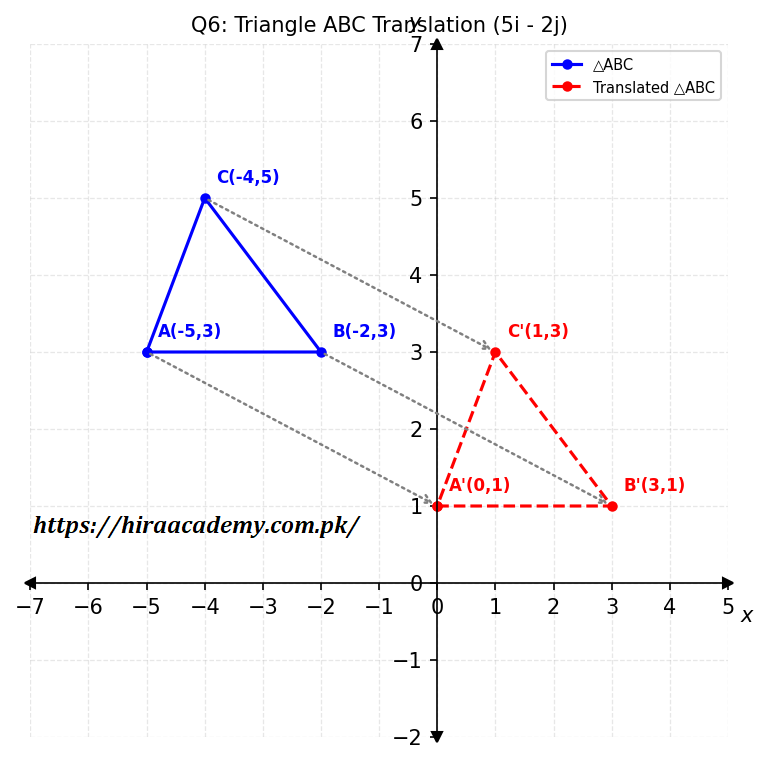
Hence, translated triangle vertices are \(A'(0,1)\), \(B'(3,1)\), and \(C'(1,3)\).
Use vectors to show that ABCD is a parallelogram, where \(A(2,3)\), \(B(6,3)\), \(C(7,6)\), \(D(3,6)\).
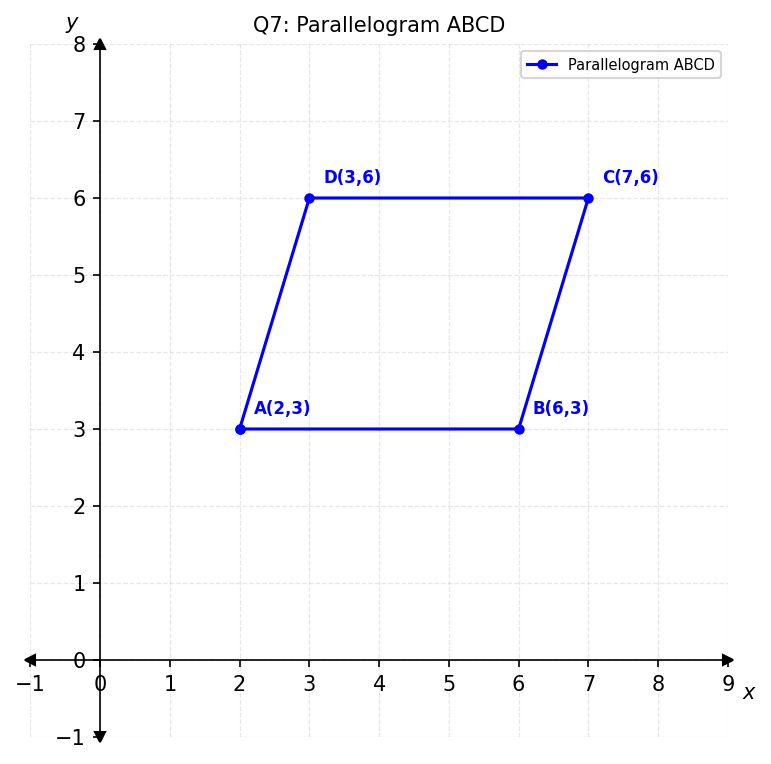
Since \(\overline{AB} = \overline{DC}\) and \(\overline{AD} = \overline{BC}\), ABCD is a parallelogram.
Use vectors to show that triangle ABC is isosceles, where \(A(1,2)\), \(B(4,6)\), \(C(7,2)\).
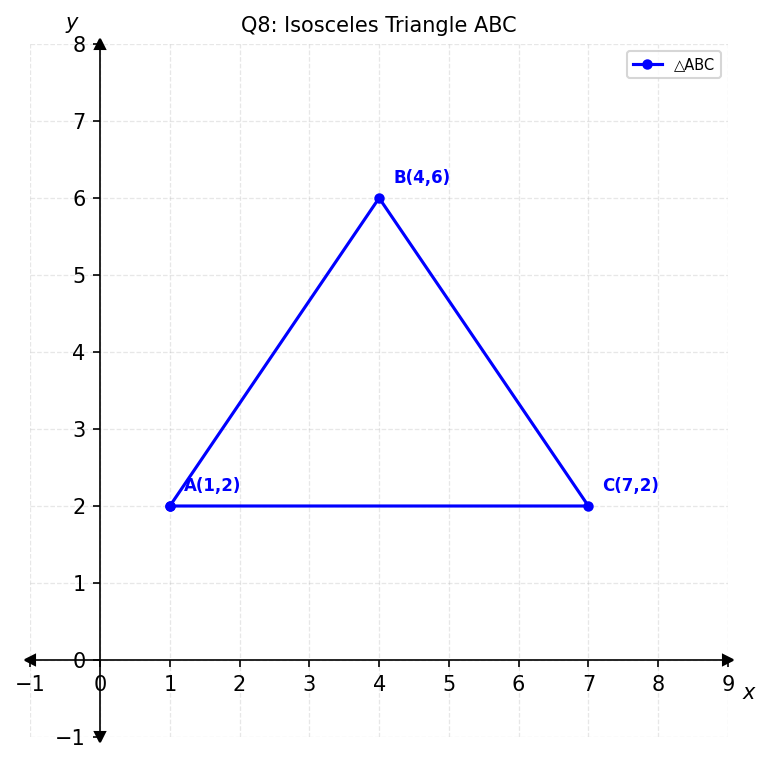
Since \(|\overline{AB}| = |\overline{BC}| = 5\), triangle ABC is isosceles.
A ball is projected with velocity vector \(\overline{v} = 6i + 8j\). What is the magnitude of velocity?
Hence, magnitude of velocity = 10 units.
An aircraft is flying due east with airspeed \(200km/h\). There is a wind blowing due north at \(60km/h\). Find the resultant velocity and its magnitude.
Resultant velocity = \(200i + 60j\), Magnitude ≈ 208.81 km/h.
(i) Suppose vectors \(\overline{a}\) and \(\overline{b}\) are equal. Can we say they originate from the same point? Why or why not?
No. Equal vectors may have different initial points, provided they have the same magnitude and direction.
(ii) Do they have equal magnitudes? Explain.
Yes. Equal vectors always have equal magnitudes.
(iii) Do they have same direction? Why?
Yes. Equal vectors have the same direction as well as the same magnitude.
(i) Suppose vectors \(\overline{a}\) and \(\overline{b}\) are opposite. Can we assume they begin at the same point? Give a reason.
No. Opposite vectors may have different initial points.
(ii) Do they have same magnitude? Why?
Yes. Opposite vectors have equal magnitudes.
(iii) Do they have the same direction? Explain why or why not.
No. Opposite vectors have opposite directions.
📈 Key Concepts & Quick Revision
- Vector Translation: Add translation vector to position vector of each vertex.
- Parallelogram Property: Opposite sides are equal and parallel: \(\overline{AB} = \overline{DC}\).
- Isosceles Triangle: At least two side vectors have equal magnitude.
- Unit Vector: \(\hat{a} = \frac{\overline{a}}{|\overline{a}|}\).
- Resultant Velocity: Add vectors component-wise.
- Equal Vectors: Same magnitude and direction; may have different initial points.
- Opposite Vectors: Same magnitude, opposite direction.
❓ Frequently Asked Questions
What is covered in Chapter 6 Review Exercise?
The review exercise covers MCQs, magnitude of vectors, unit vector, vector operations, translations, parallelogram verification, isosceles triangle using vector magnitude, projectile motion, resultant velocity, and conceptual questions.
How many MCQs are in Chapter 6 Review Exercise?
There are 10 multiple choice questions covering key concepts from Chapter 6.
Is this solution according to the PECTAA syllabus?
Yes, these solutions are prepared according to the PECTAA / National Curriculum 2023 syllabus.
Are solved PDF notes available for Review Exercise 6?
Yes, a complete solved PDF is embedded on this page and available for free download.
Who prepared these Class 10 Math Chapter 6 notes?
These notes were prepared by Muhammad Tayyab, Subject Specialist Mathematics at Govt Christian High School Daska.