Prepared by Muhammad Tayyab, Subject Specialist Mathematics, Govt Christian High School Daska
📌 Based on National Curriculum 2023 / PECTAA Syllabus
📖 What's Inside: This exercise covers quadrants, plotting points, vector notation, magnitude, unit vectors, and parallel vectors. Perfect for Punjab Boards exam preparation.
📚 Related Resources – Chapter 6: Vectors in Plane
Class 10 Math Chapter 6 Exercise 6.1 – Vectors in Plane: Complete Guide
Chapter 6 of Class 10 Mathematics introduces students to vectors in the plane, one of the most visual and application-rich topics in the PECTAA syllabus. Exercise 6.1 is the entry point into this chapter, and it lays the groundwork that every later exercise in Chapter 6 — including Exercise 6.2, Exercise 6.3, and the Review Exercise — builds on. This page walks through every question of Exercise 6.1 step by step, prepared according to the unified Punjab textbook used across all 10 BISE Punjab boards.
What You Will Learn
By working through Exercise 6.1, students learn how to identify the four quadrants of the Cartesian plane, plot points and vectors accurately, write a vector in the standard form \(x\hat{i} + y\hat{j}\), calculate the magnitude of a vector using the distance-style formula, convert any vector into a unit vector, and test two vectors for parallelism using the scalar multiple condition.
Topics Covered in This Exercise
- Quadrants and coordinate points – naming the quadrant in which a given point lies
- Plotting points and vectors – representing coordinates visually on the Cartesian plane
- Tail and tip of a vector – identifying the starting and ending points of a vector
- Vector notation – writing \(\overrightarrow{AB}\) as \(\overrightarrow{OB} - \overrightarrow{OA}\)
- Magnitude of a vector – using \(|\bar{a}| = \sqrt{x^2 + y^2}\)
- Unit vectors – finding \(\hat{a} = \bar{a} / |\bar{a}|\)
- Parallel vectors – checking whether \(\bar{b} = \lambda \bar{a}\) for some scalar \(\lambda\)
Why Exercise 6.1 Is Important
Exercise 6.1 is the foundation exercise of Chapter 6. Punjab Board exam papers frequently draw at least one short question directly from this exercise, particularly on magnitude, unit vectors, and parallel vectors. Students who skip Exercise 6.1 and jump straight into Exercise 6.2 or Exercise 6.3 often struggle, because those exercises assume fluency with the notation and formulas introduced here.
Punjab Board Preparation
For students preparing for board exams under any of the 10 BISE Punjab boards, this exercise should be treated as compulsory practice rather than optional revision. The magnitude formula, the unit vector formula, and the parallel vector condition \((\bar{b} = \lambda \bar{a})\) are the three most commonly repeated question types from Chapter 6 in past board papers.
Exam Tips for Vectors in Plane
- Always simplify the magnitude under the square root fully before writing the final answer.
- When writing a unit vector, keep the denominator as the exact magnitude — do not round it to a decimal.
- For parallel vector questions, always state the value of the scalar \(\lambda\) explicitly.
- Double-check the direction of subtraction in \(\overrightarrow{AB} = \overrightarrow{OB} - \overrightarrow{OA}\).
Common Mistakes Students Make
- Confusing \(\overrightarrow{AB}\) with \(\overrightarrow{BA}\) and getting the sign reversed.
- Forgetting to square negative components correctly when computing magnitude.
- Leaving the unit vector un-simplified, or forgetting to rationalise a denominator.
- Assuming two vectors are parallel just because their magnitudes look similar.
(i) (4, 3)
The point (4, 3) lies in Quadrant I.
(ii) (5, −4)
The point (5, −4) lies in Quadrant IV.
(iii) (−6, 2)
The point (−6, 2) lies in Quadrant II.
(iv) (−4, −4)
The point (−4, −4) lies in Quadrant III.
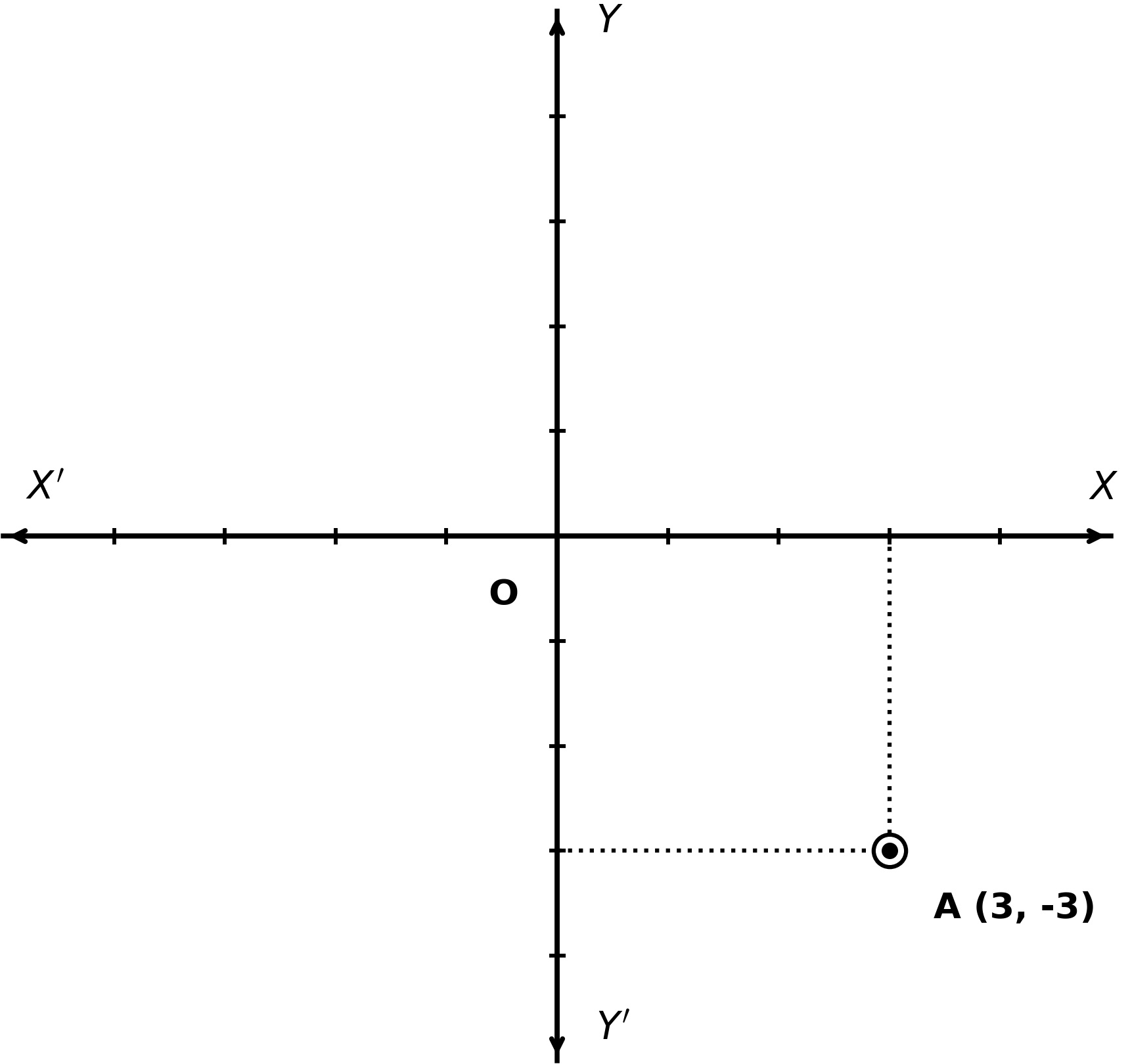
(i) (3, −3)
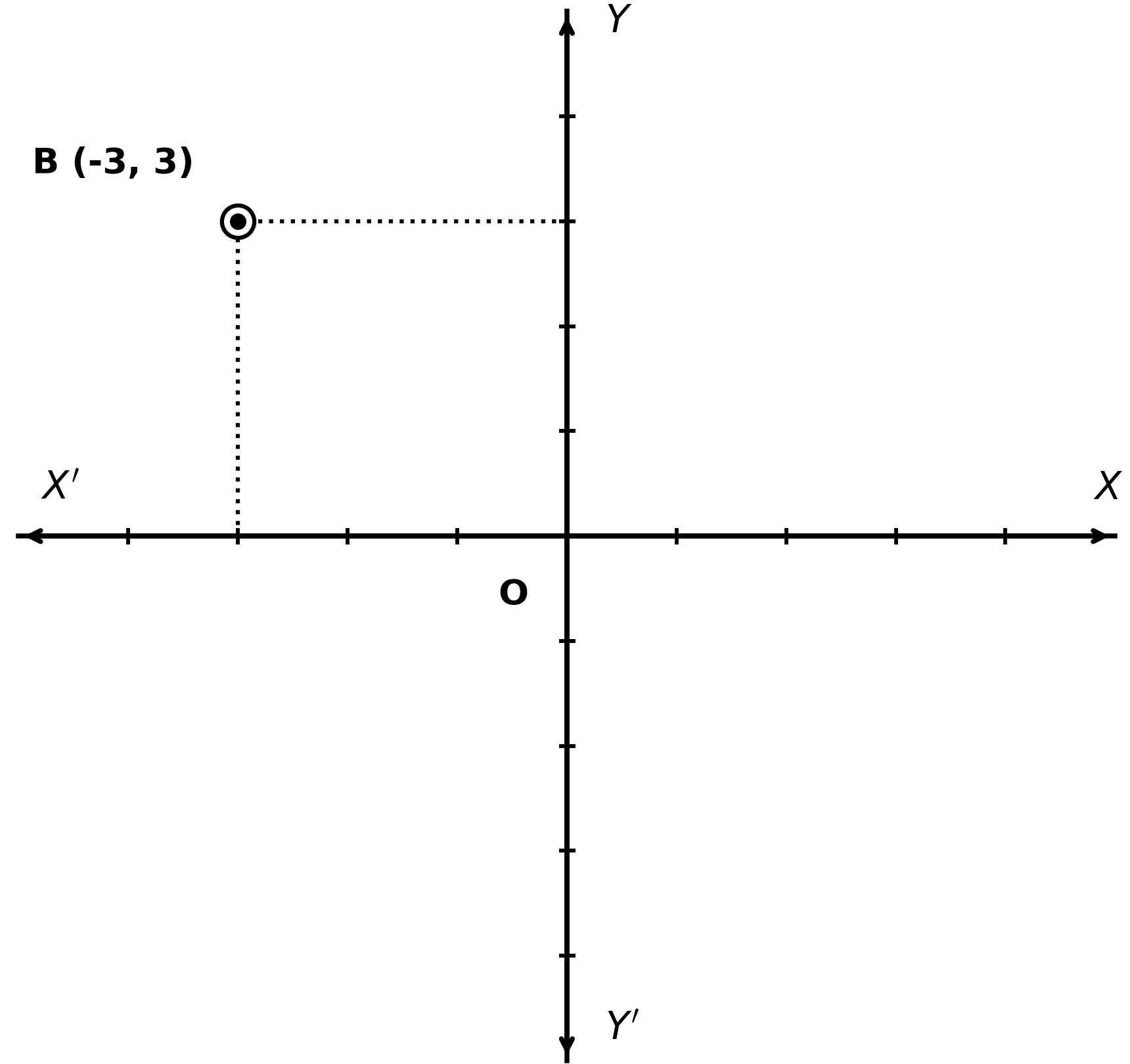
(ii) (−3, 3)
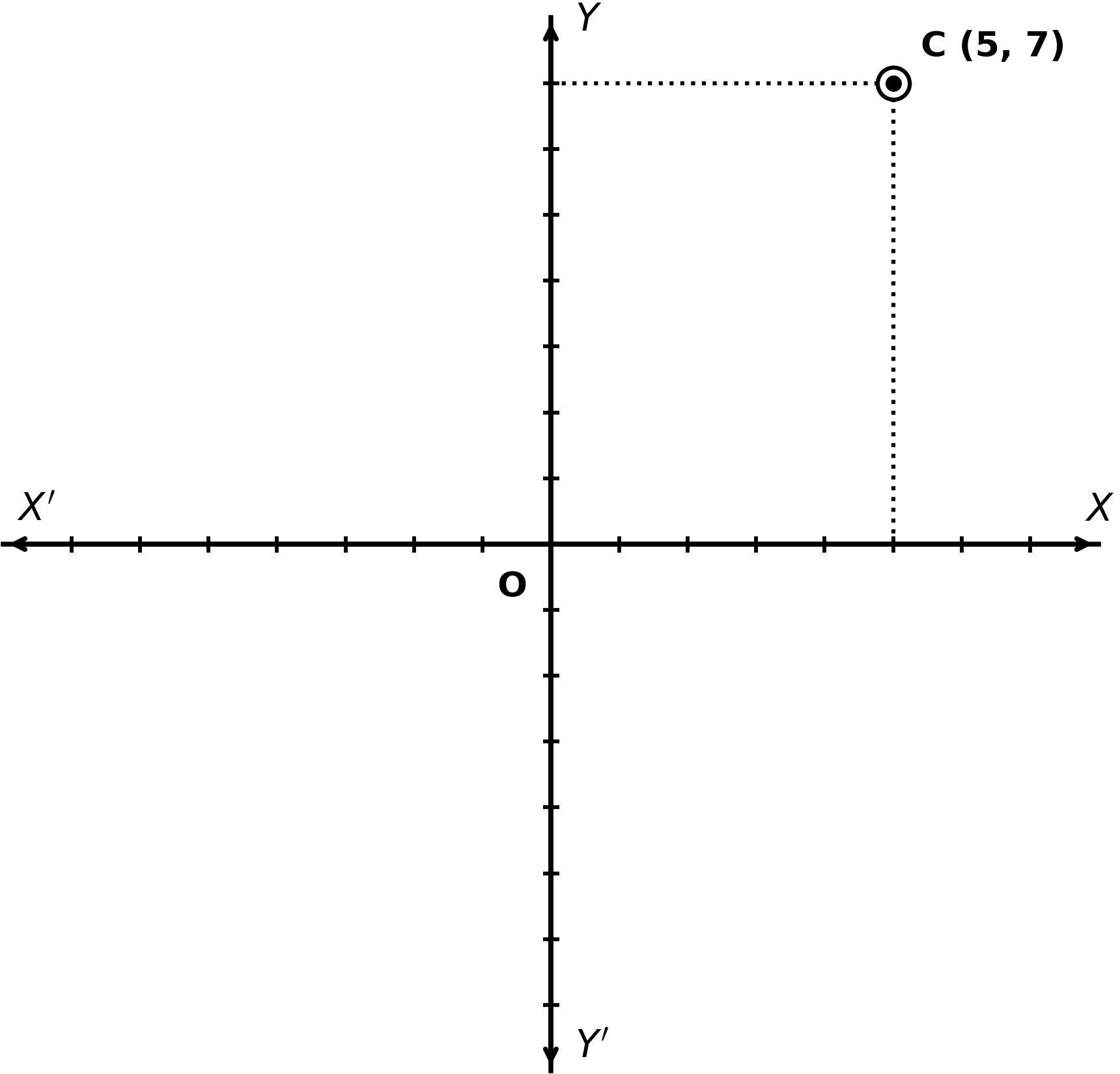
(iii) (5, 7)
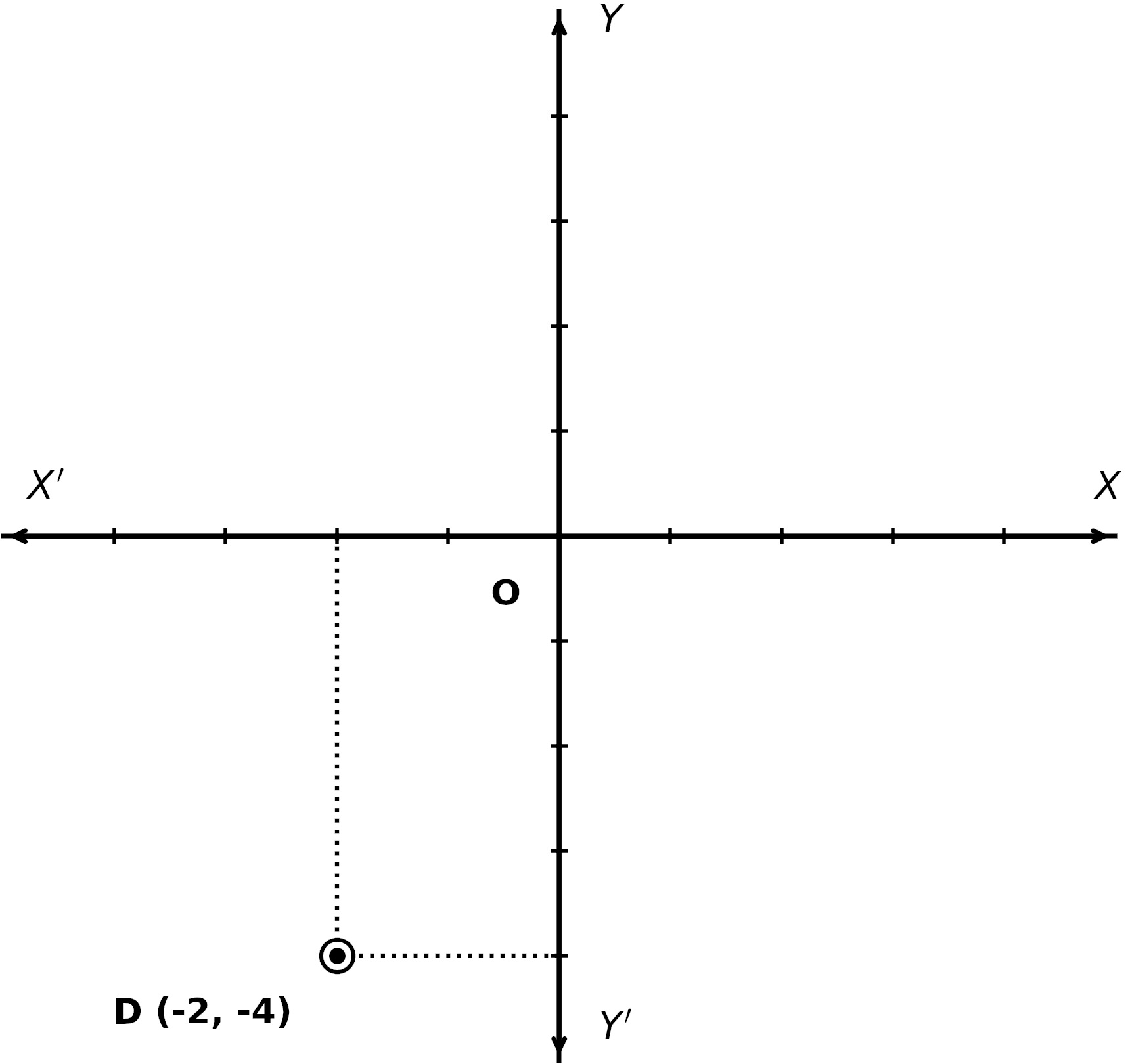
(iv) (−2, −4)
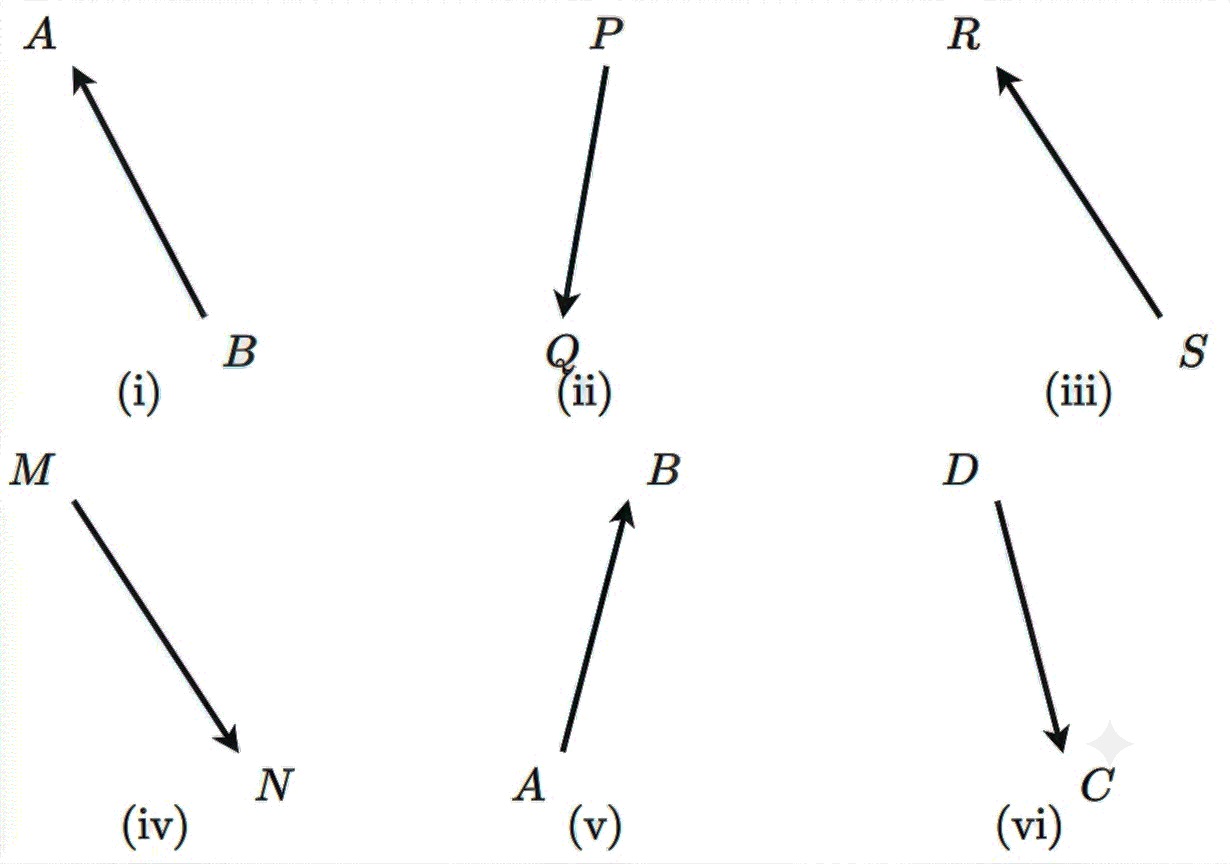
(i) \(A(1, -7), B(-2, 4)\)
(ii) \(A(8, 9), B(12, 3)\)
(i) \(\bar{a} = -3\hat{i} + 2\hat{j}\)
(ii) \(\bar{a} = 4\hat{i} - 3\hat{j}\)
(iii) \(\bar{a} = \frac{1}{2}\hat{i} + \frac{3}{2}\hat{j}\)
(i) \(\bar{a} = -4\hat{i} + 5\hat{j}\)
(ii) \(\bar{a} = 6\hat{i} + 8\hat{j}\)
(iii) \(\bar{a} = \frac{1}{\sqrt{6}}\hat{i} + \frac{1}{\sqrt{6}}\hat{j}\)
(iv) \(\bar{a} = \frac{1}{2}\hat{i} + \frac{3}{4}\hat{j}\)
Given: \(\bar{a} = 5\hat{i} - 7\hat{j}, \bar{b} = -\hat{i} - \hat{j}, \bar{c} = 2\hat{i} + 3\hat{j}\)
Let \(\bar{v} = \bar{a} + \bar{b} - 3\bar{c}\)
Given: \(\bar{a} = 3\hat{i} - \hat{j}, \bar{b} = -2\hat{i} + 4\hat{j}, \bar{c} = \hat{i} + 2\hat{j}\)
Let \(\bar{v} = 3\bar{a} - 2\bar{c} + 4\bar{b}\)
(i) \(\bar{a} = 6\hat{i} + \hat{j}, \bar{b} = 12\hat{i} + 2\hat{j}\)
Hence, \(\bar{a}\) and \(\bar{b}\) are parallel with \(\lambda = 2\).
(ii) \(\bar{a} = -2\hat{i} + 3\hat{j}, \bar{b} = 6\hat{i} - 9\hat{j}\)
Hence, \(\bar{a}\) and \(\bar{b}\) are parallel with \(\lambda = -3\).
(iii) \(\bar{a} = 5\hat{i} - 4\hat{j}, \bar{b} = 6\hat{i} - 3\hat{j}\)
\(\bar{a} \neq \lambda \bar{b}\) and \(\bar{b} \neq \lambda \bar{a}\).
Hence, \(\bar{a}\) and \(\bar{b}\) are not parallel.
(iv) \(\bar{a} = 3\hat{i} - 7\hat{j}, \bar{b} = 6\hat{i} - 14\hat{j}\)
Hence, \(\bar{a}\) and \(\bar{b}\) are parallel with \(\lambda = 2\).
Given vector: \(\bar{v} = 3\hat{i} - 2\hat{j}\)
Three times in length: \(3\bar{v} = 9\hat{i} - 6\hat{j}\)
Opposite in direction: \(-3\bar{v} = -9\hat{i} + 6\hat{j}\)
Given vector: \(\bar{v} = 3\hat{i} - 5\hat{j}\)
Double in magnitude in same direction:
Double in magnitude in opposite direction:
📈 Key Formulas & Quick Revision
- Quadrants: I (+,+), II (−,+), III (−,−), IV (+,−).
- Vector Notation: \(\overrightarrow{AB} = \overrightarrow{OB} - \overrightarrow{OA}\).
- Magnitude: \(|\bar{a}| = \sqrt{x^2 + y^2}\).
- Unit Vector: \(\hat{a} = \frac{\bar{a}}{|\bar{a}|}\).
- Parallel Vectors: \(\bar{b} = \lambda \bar{a}\) for some scalar \(\lambda\).
🎯 Important Definitions
- Vector: a quantity with both magnitude and direction.
- Tail and Tip: the starting point and ending point of a vector arrow.
- Unit Vector: a vector whose magnitude equals 1.
- Parallel Vectors: two vectors that are scalar multiples of one another.
📝 Important MCQs for Practice
1. The point (−5, 6) lies in which quadrant?
2. If \(\bar{a} = 3\hat{i} + 4\hat{j}\), then \(|\bar{a}|\) equals:
3. A unit vector always has magnitude equal to:
4. Two vectors \(\bar{a}\) and \(\bar{b}\) are parallel if:
5. \(\overrightarrow{AB}\) is calculated as:
🏆 Board Exam Tips & Strategy
- Attempt magnitude and unit vector questions first — they are formula-based and quick to score.
- Show the intermediate step \(\bar{b} = \lambda \bar{a}\) explicitly when proving vectors parallel.
- Leave answers in exact surd form unless the question asks for a decimal approximation.
- Revise Exercise 6.1 before starting Exercise 6.2, since later questions assume these formulas are already memorised.
❓ Frequently Asked Questions
What is taught in Exercise 6.1 of Class 10 Math Chapter 6?
Exercise 6.1 introduces vectors in the plane. It covers identifying quadrants, plotting points, writing vectors in the form \(x\hat{i} + y\hat{j}\), finding the magnitude of a vector, finding a unit vector, and checking whether two vectors are parallel.
How many questions are there in Chapter 6 Exercise 6.1?
Exercise 6.1 has 11 questions, ranging from naming quadrants and plotting points to finding magnitudes, unit vectors, and identifying parallel vectors.
Is this solution according to the PECTAA syllabus?
Yes, these solutions are prepared according to the PECTAA / National Curriculum 2023 syllabus for Class 10 Mathematics.
Is this Exercise 6.1 solution valid for all Punjab Boards?
Yes, the content follows the unified Punjab textbook and is applicable to students of all 10 BISE Punjab boards.
What is a vector in mathematics?
A vector is a quantity that has both magnitude and direction, usually represented as an arrow from a tail point to a tip point, or in component form as \(x\hat{i} + y\hat{j}\).
How do you find the magnitude of a vector?
The magnitude of a vector \(\bar{a} = x\hat{i} + y\hat{j}\) is found using the formula \(|\bar{a}| = \sqrt{x^2 + y^2}\).
What is a unit vector?
A unit vector is a vector with magnitude equal to 1. It is found by dividing a vector by its own magnitude: \(\hat{a} = \bar{a} / |\bar{a}|\).
Are solved PDF notes available for Exercise 6.1?
Yes, a complete solved PDF for Exercise 6.1 is embedded on this page and available to download for free.
Can I download the Chapter 6 Exercise 6.1 solution as a PDF?
Yes, use the Download PDF button on this page to save the complete solved Exercise 6.1 notes to your device.
Is Exercise 6.1 important for Class 10 board exams?
Yes, vectors are a regularly tested topic in Punjab Board papers, and Exercise 6.1 builds the foundational skills of magnitude, unit vectors, and parallel vectors needed for later exercises in Chapter 6.
How should students prepare for the Vectors chapter?
Students should practise plotting points and vectors by hand, memorise the magnitude and unit vector formulas, solve each exercise question without looking at the solution first, and then check their working against these solved notes.
Who prepared these Class 10 Math Chapter 6 notes?
These notes were prepared by Muhammad Tayyab, Subject Specialist Mathematics at Govt Christian High School Daska, for Hira Science Academy.