📘 Chapter 9: Nature of Science – Comprehensive Questions
Prepared by Muhammad Tayyab, Subject Specialist Physics, Govt Christian High School Daska. Based on PECTAA 2026 syllabus (National Curriculum 2023).
📖 What's Inside: This section covers comprehensive questions from Chapter 9 Nature of Science including Branches of Physics, Interdisciplinary Fields, Scientific Method, Science vs Technology vs Engineering, and Scope of Physics in Everyday Life. Each question is presented with a detailed answer as per the official PECTAA 2026 Physics curriculum.
📚 Related Resources – Chapter 9: Nature of Science
📖 Comprehensive Questions & Answers (PECTAA 2026)
9.1 What are the main branches of Physics? State briefly.
Answer:
1. Mechanics: It is a study of motion and the physical effects which influence motion. It is based on Newton's laws of motion and gravitation and is often called classical mechanics.
2. Heat and Thermodynamics: It deal with the thermal energy possessed by the materials and it is used when it flows from one body to another.
3. Acoustics: It deals with the nature and physical aspects of audible sound energy.
4. Optics: It deal with the physical aspects of visible light.
5. Electromagnetism: It is the study of electromagnetic phenomenon and mutual relationship between electric current and magnetic field.
6. Quantum Mechanics: It explains the behavior of particles at the atomic and subatomic level.
7. Relativistic Mechanics: It explains how space and time are not absolute quantities but related to observer. It describes the relationship between them and how they are influenced by gravity and speed.
8. Nuclear Physics: It is the study of the properties of nuclei of the atoms.
9. Particle Physics: It is the study of subatomic particles and elementary particles which are basic building blocks of matter.
10. Astronomy: It is study of distribution of celestial bodies like planets, stars and galaxies.
11. Cosmology: It explores the large structure and evolution of the universe.
12. Solid State Physics: It is the study of some specific properties of matter in solid form.
✅ 12 branches: Mechanics, Heat & Thermodynamics, Acoustics, Optics, Electromagnetism, Quantum, Relativistic, Nuclear, Particle, Astronomy, Cosmology, Solid State
9.2 What is meant by interdisciplinary fields of Physics? Give three examples.
Answer:
Interdisciplinary nature of Physics refers to integration and interaction of Physics with various other fields of study. Physics provides essential principles, techniques and methods that are applicable across a wide range of disciplines. Three examples are:
1. Biophysics: Some biological systems and processes are described using the principles and technique of physics under this field of Study. For example, the mechanics of biological structures, physical properties of cells, tissues and organs.
2. Medical Physics: It applies physical principles to develop techniques and technologies for health diagnosis and treatment. For example, imaging techniques such as X-rays, ultrasound, MRI and CT scan, and radiation therapy for cancer treatment.
3. Astrophysics: It deals with the physical properties and processes of celestial bodies and phenomena. For example, the interaction between matter and energy in space to understand the universe as a whole.
4. Geophysics: It applies physical principle to the study of internal structure of the Earth, its magnetic and gravitational fields, seismic activity (earthquake), volcanoes, etc.
5. Climate Physics: It includes the study of physical processes in the environment, including atmospheric dynamics, climate change and weather conditions.
6. Computational Physics: It is about the use of computational techniques and methods to solve complex physical problems.
✅ Interdisciplinary = Physics + other fields | Examples: Biophysics, Medical Physics, Astrophysics, Geophysics, Climate Physics, Computational Physics
9.3 What is scientific method? Describe its main steps with examples.
Answer:
Scientific Method: Scientific method is a systematic approach used to search for the truth of an issue and to solve problems related to the natural and physical world. It is based on the following steps:
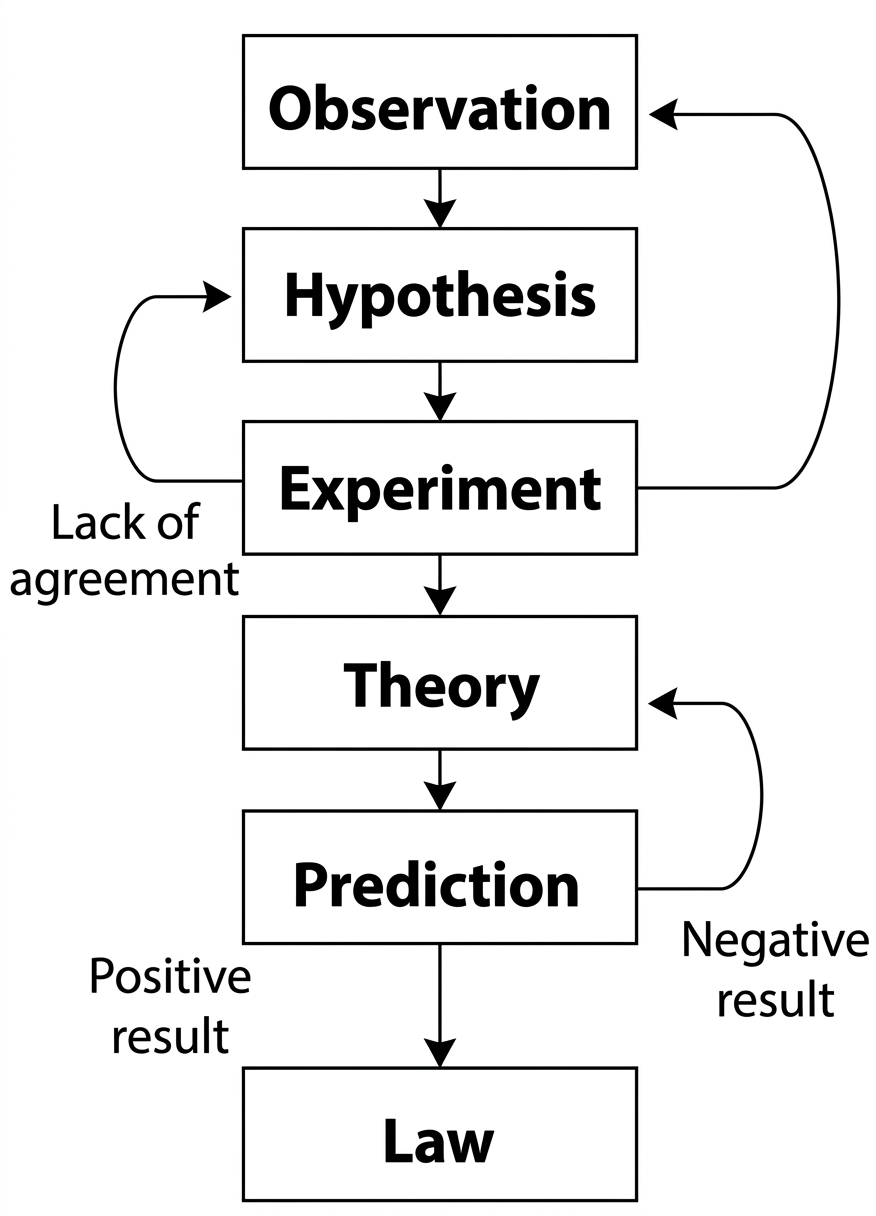
Figure: Steps of the Scientific Method
1. Observation: The first step is to observe natural processes and collect data. This can be done by simple observation or through experiments. Example: We commonly observe that a shadow is formed when an opaque object is placed in the path of light from the Sun or a lamp.
2. Hypothesis: A hypothesis is a possible explanation or guess based on observations. It is made to test logical results. Example: From the above observation, we guess that light travels in a straight line, so when an opaque object blocks it, a shadow forms.
3. Experiment: An experiment is a repeatable process used to test the truth of a hypothesis. Example: Take four cardboards with holes and arrange them in a straight line in front of a torch. Light passes through all holes when aligned. If one cardboard is moved, the light is blocked. This proves that light travels in a straight line.
4. Theory: After successful experiments, the hypothesis becomes a theory. A theory explains the causes and effects of a natural event. Example: The above experiment proves that light travels in a straight line, so this assumption becomes a theory.
5. Prediction: Based on the theory, we can make predictions about other natural events. Example: We can predict that a ball will make a round shadow and a block will make a rectangular shadow when placed in light.
6. Falsifiability: A theory must make predictions that can be tested and possibly proven wrong. This helps to check if the theory is truly scientific and not based on vague ideas.
7. Law: After many successful tests and wide acceptance, a theory becomes a law. Example: The theory that light travels in a straight line becomes the law of rectilinear propagation of light.
✅ Steps: Observation → Hypothesis → Experiment → Theory → Prediction → Falsifiability → Law
9.4 Differentiate the terms, science, technology and engineering with examples.
Answer:
| Term | Description | Example |
|---|---|---|
| Science | Science is a collective knowledge about the natural phenomena, processes and events occurring around us. | Study of natural phenomena |
| Technology | Technology refers to the methods and techniques developed by using scientific knowledge. | Automobile technology, radar technology and laser technology |
| Engineering | Engineering is the process of applying various technologies and scientific principles to design instruments, tools and build things that help to meet specific needs. | A civil engineer designs a bridge; a software engineer designs a smartphone application. |
✅ Science = knowledge | Technology = methods/techniques | Engineering = application to design & build
9.5 What is the scope of Physics in everyday life? Give some examples.
Answer:
Physics is the fundamental science that deals with the constituents of the universe, that is, matter, energy, space, time and their mutual relationships and interactions.
It strives to understand how the universe works, from the smallest subatomic particles to the largest stars and galaxies.
Physics is applied to a wide variety of phenomena, from everyday occurrences such as motion and heat to extreme conditions found in the universe.
Its applications include:
- Automobile technology, based on principles of thermodynamics.
- Radar technology, based on detection and reflection principles of electromagnetic waves.
- Laser technology, based on principles of atomic physics.
- Applications in medical diagnosis and treatment, metallurgy, industry, telecommunication and space exploration.
✅ Scope: Automobile, Radar, Laser, Medical diagnosis, Metallurgy, Industry, Telecommunication, Space exploration
📐 Key Concepts – Nature of Science (Comprehensive Questions)
Branches of Physics: Mechanics, Thermodynamics, Optics, Electromagnetism, Quantum, Nuclear, etc.
Interdisciplinary: Biophysics, Medical Physics, Astrophysics, Geophysics
Scientific Method: Observation → Hypothesis → Experiment → Theory → Law
Science: Knowledge of natural phenomena
Technology: Methods/techniques using scientific knowledge
Engineering: Application of technology & science to design & build
💡 Exam Tip:
For comprehensive questions, write detailed answers with definitions, explanations, and examples where applicable. Use diagrams where required (e.g., scientific method flowchart). These questions test your in-depth understanding of concepts like branches of physics, interdisciplinary fields, scientific method, science vs technology vs engineering, and scope of physics. These questions follow the PECTAA 2026 pattern and are prepared by Subject Specialist Muhammad Tayyab.
Chapter 1Physical Quantities and Measurements
Chapter 2Kinematics
Chapter 3Dynamics
Chapter 4Turning Effect of Forces
Chapter 5Work and Energy
Chapter 6Mechanical Properties of Matter
Chapter 7Thermal Properties of Matter
Chapter 8Magnetism
Chapter 9✨ Nature of Science
📖 Complete syllabus coverage for Class 9 Physics (PECTAA 2026) – Chapters 1 to 9
Created by Hira Science Academy | Aligned with PECTAA 2026 Syllabus