Prepared by Muhammad Tayyab, Subject Specialist Mathematics, Govt Christian High School Daska
📌 Based on National Curriculum 2023 / PECTAA Syllabus
📖 What's Inside: This review exercise covers MCQs and short-answer questions from the entire Chapter 8. Perfect for final revision and exam preparation.
If the PDF does not load, click here to view it directly on Google Drive .
📚 Related Resources – Chapter 8: Chords and Arcs
Advertisement
Class 10 Math Chapter 8 Review Exercise 8 – Complete Revision Guide
The Review Exercise 8 is the culmination of Chapter 8: Chords and Arcs of a Circle. It tests your understanding of all the theorems and properties covered in Exercises 8.1 and 8.2, including chord properties, perpendicular bisectors, equidistant chords, arcs, central angles, and the uniqueness of a circle through three non-collinear points. This exercise is an essential checkpoint before your board exams.
What You Will Learn
By working through Review Exercise 8, students reinforce their ability to solve a mix of multiple-choice questions (MCQs) and short-answer problems. You will apply the Pythagorean theorem to calculate chord lengths and distances, use the properties of equal chords and arcs to find unknown angles and lengths, and verify whether points are collinear to determine the possibility of drawing a unique circle.
Topics Covered in This Review Exercise
- Basic Definitions: Radius, circumference, chord, diameter, arc, and secant.
- Chord Properties: Perpendicular from the centre bisects a chord; equal chords are equidistant from the centre.
- Arc and Angle Properties: Equal chords subtend equal central angles; congruent arcs have equal chords.
- Pythagorean Applications: Calculating the distance of a chord from the centre, or the radius of the circle.
- Coordinate Geometry: Using slopes to check if three points are non-collinear and therefore lie on a unique circle.
Why This Review Exercise Is Important
Board exam papers frequently draw direct questions from the Review Exercise. The mix of MCQs and short questions mirrors the pattern of the actual board exams, making this an excellent resource for self-assessment. The MCQs test conceptual clarity, while the short questions test your ability to apply formulas and theorems in multi-step problems.
Punjab Board Preparation
For students preparing for the 10th class board exams under any of the 10 BISE Punjab boards, the Review Exercise is a must-solve. Most of the questions are directly from past papers or are variations of them, so mastering this exercise gives you a strong advantage.
PECTAA Syllabus Alignment
These solved notes are aligned with the Punjab Education & Curriculum Textbook Authority (PECTAA) syllabus, following the National Curriculum 2023 framework for Class 10 Mathematics. The question numbering, formulas, and terminology match the current Punjab textbook exactly.
Exam Tips for Review Exercise 8
- Always read the question carefully to identify whether it is asking for an angle, a length, or a logical conclusion (e.g., collinearity).
- For numerical problems, draw a diagram and label the known values, the unknown, and the right-angled triangle if applicable.
- Remember the key theorems: perpendicular from the centre bisects the chord; equal chords are equidistant; equal chords subtend equal angles.
- For MCQs, use elimination and refer to the definitions. For example, the longest chord of a circle is the diameter.
- Double-check your calculations, especially when dealing with square roots (e.g., \( \sqrt{11} \)).
Common Mistakes Students Make
- Forgetting to halve the chord length before using the Pythagorean theorem.
- Confusing the radius with the diameter.
- Not recognizing when a chord passes through the centre (making it a diameter).
- Making arithmetic errors when calculating slopes for collinearity.
- Assuming the measure of an arc is the same as its length.
Use the table of contents below to jump directly to any question, or scroll through the full solved exercise in order.
📝 Multiple Choice Questions (Review Exercise 8)
Select the correct option for each question. Click Check Answer to see if you're correct and read the explanation. Your score updates automatically.
Your Score
0 / 10
Attempted: 0
1. Distance of a point on the circumference to the centre of the circle is called:
By definition, the line segment from the centre to any point on the circle is the radius.
2. Radii of same circles are:
All radii of the same circle (or congruent circles) are equal in length.
3. The boundary of the circle is called:
The length of the boundary of a circle is called its circumference.
4. Any part of a circumference is called:
Any part of the circumference of a circle is called an arc.
5. A chord passing through the centre of the circle is called:
A chord that passes through the centre of the circle is called a diameter.
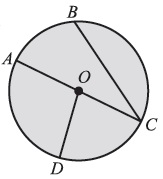
Line segment AB connects two points on the circle but does not pass through the centre O, so it is a chord.
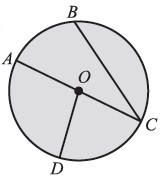
A major arc is greater than a semicircle. Arc BDC spans more than half the circle.
8. _______ circle(s) can pass through the three non-collinear points.
Theorem states: "One and only one circle can pass through any three non-collinear points."
9. Perpendicular bisector of a chord always passes through the _______ of circle.
By theorem, the perpendicular bisector of a chord always passes through the centre of the circle.
10. The sum of the measures of central angles of a circle is:
The sum of the measures of the central angles of a circle with no interior points in common is \(360^{\circ}\).
🎉 Quiz Complete!
Your final score: 0 / 10
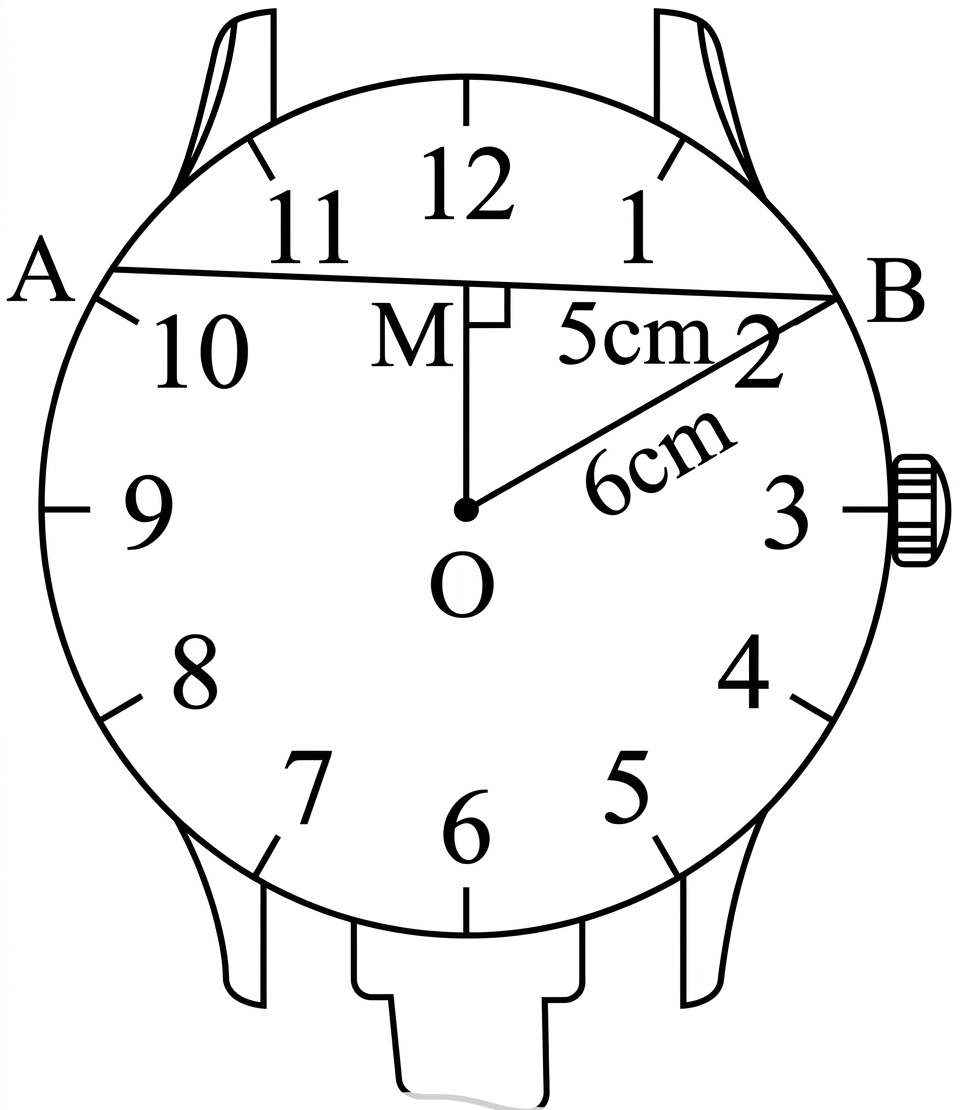
Given: Radius of the circle \(r = 6\text{ cm}\), length of the chord \(= 10\text{ cm}\).
To find: Perpendicular distance from the centre to the chord \(OM\).
Calculation: Let the perpendicular from the centre bisect the chord.
Using the Pythagoras theorem in the right-angled \(\triangle OMB\):
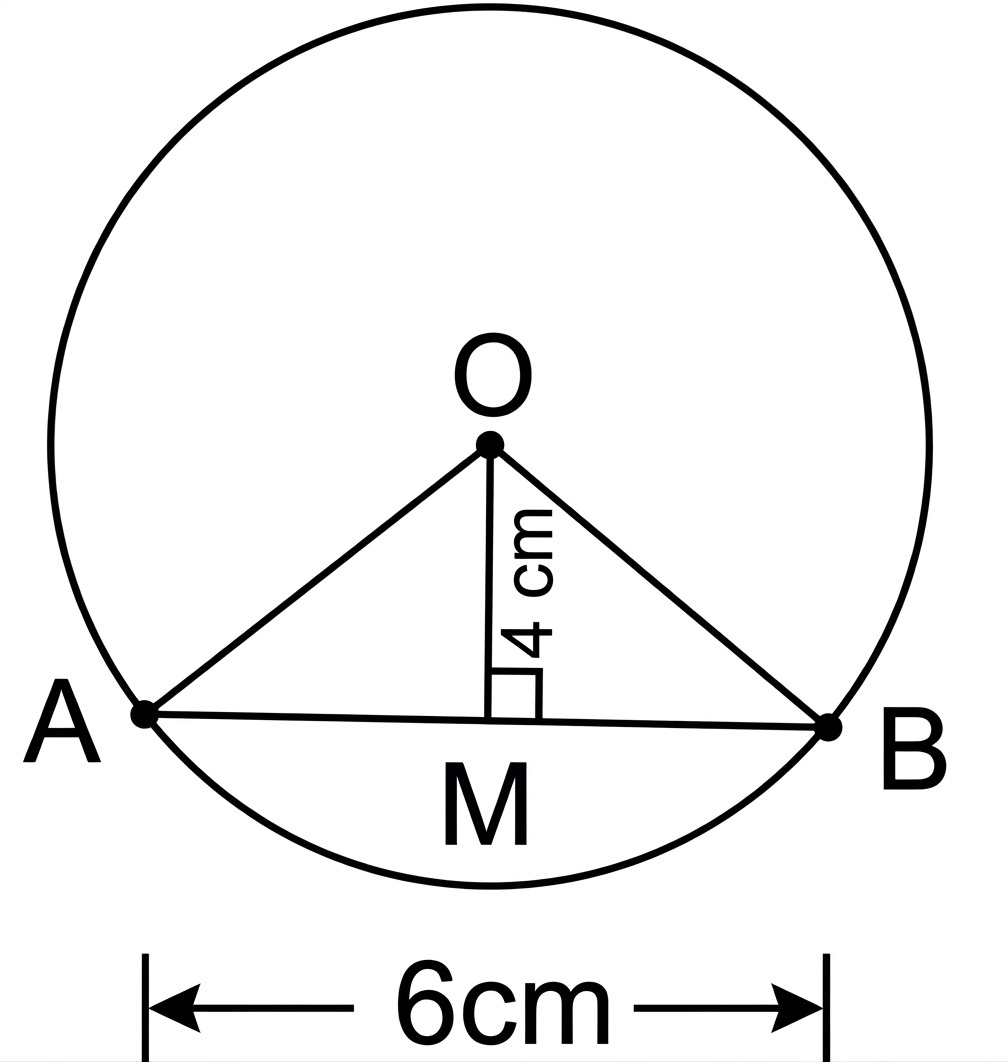
Given: Chord length \(= 6\text{ cm}\), distance from centre \(= 4\text{ cm}\).
To find: Radius \(\overline{OA} = r\).
Calculation: The perpendicular from the centre bisects the chord. So,
Using the Pythagoras theorem in the right-angled \(\triangle OAM\):
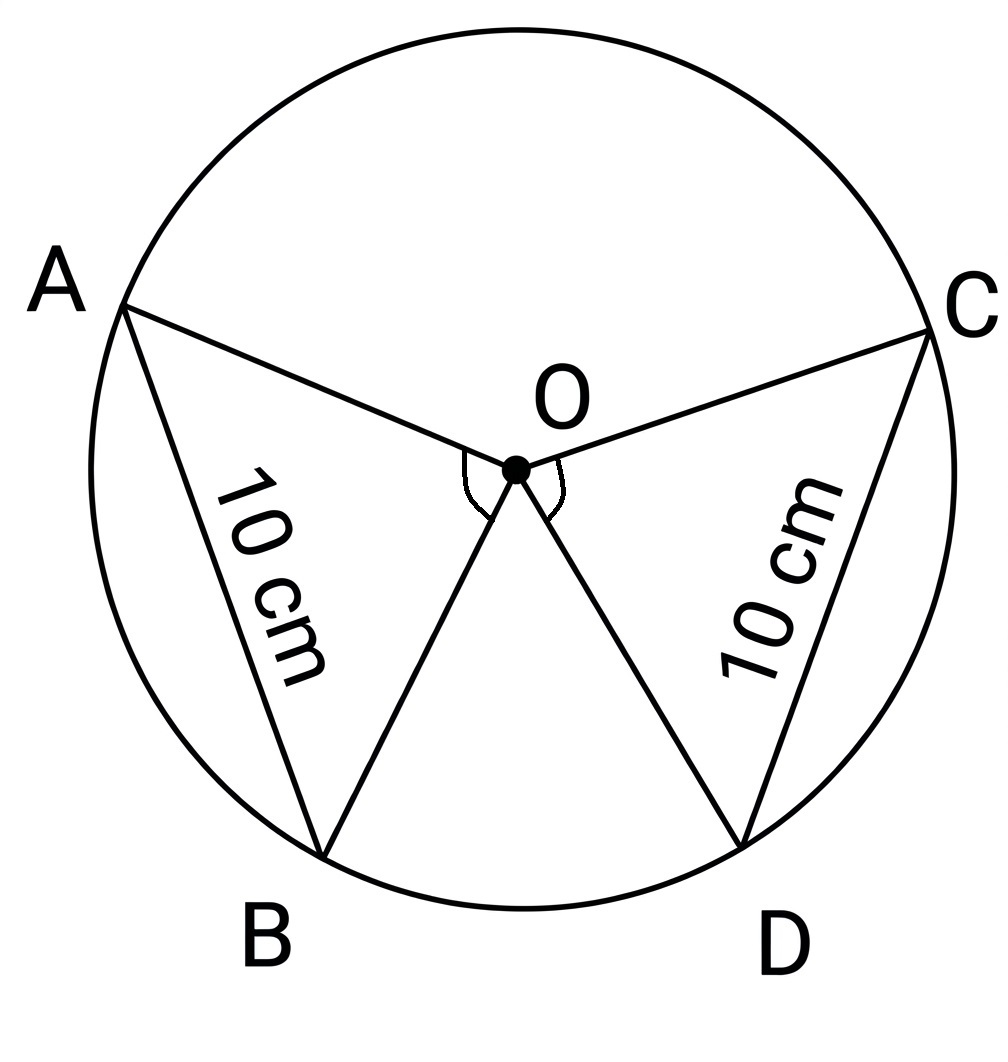
Given: Two chords of equal length (\(10\text{ m}\)).
Reasoning: According to the theorem, equal chords of a circle subtend equal angles at the centre.
Hence, both benches subtend equal angles at the centre of the circle. i.e. \(m\angle AOB = m\angle COD\).
Given: Points \(A(2,1)\), \(B(4,4)\), and \(C(1,5)\).
Reasoning: We must check if the three points are non-collinear (not in a straight line). If they are non-collinear, the theorem states that one and only one circle can pass through them.
Calculation: We check the slopes.
Since \(m_1 \neq m_2\), the points \(A, B\), and \(C\) are non-collinear.
Hence, she can install a circular fountain because the three corners are non-collinear, allowing a unique circle to pass through them.
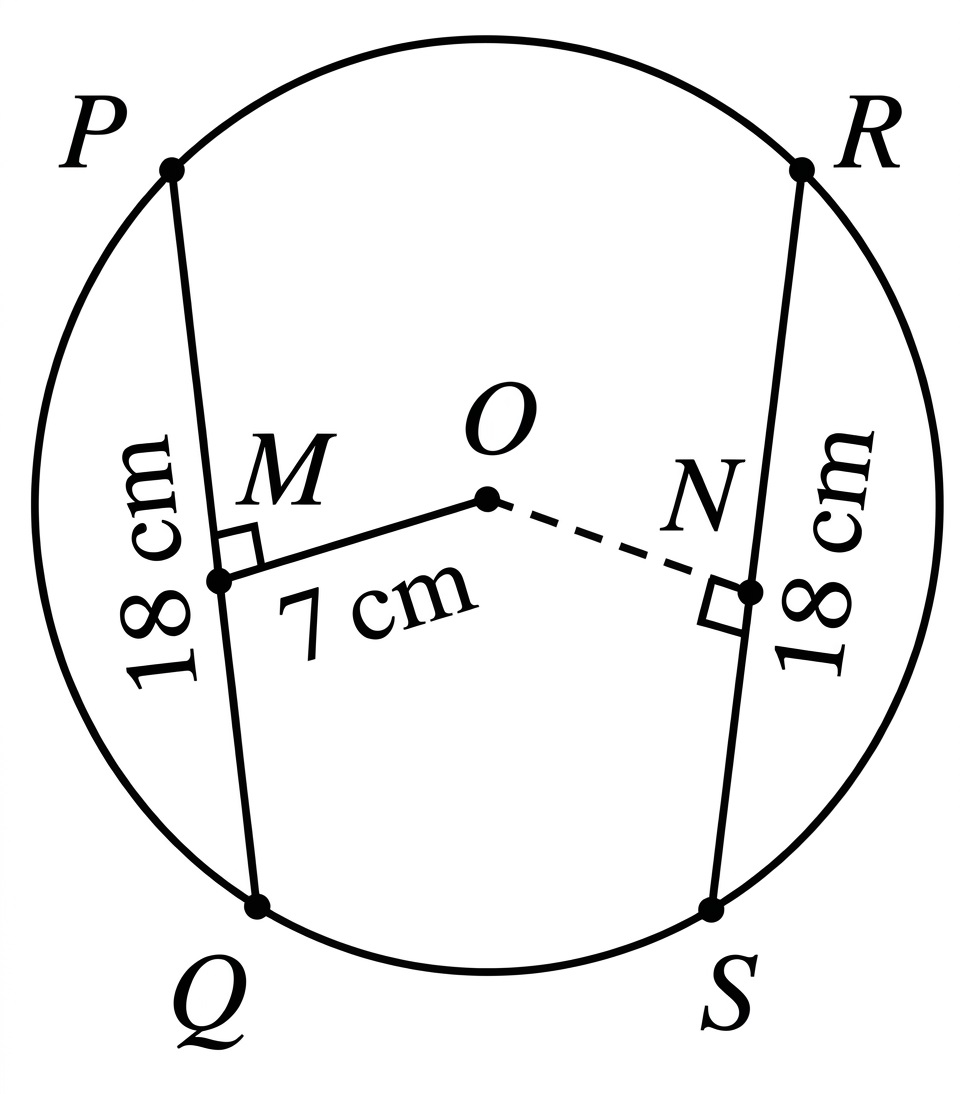
Given: Chord \(PQ = 18\text{ cm}\), chord \(RS = 18\text{ cm}\), distance of \(PQ\) from centre \(= 7\text{ cm}\).
To find: Distance of \(RS\) from centre \(= ON\).
Reasoning: By the theorem, "If two chords of a circle are congruent, then they will be equidistant from the centre."
Since \(PQ\) and \(RS\) are equal in length, they must be at the same distance from the centre.
Hence, the distance of \(RS\) from the centre is \(7\text{ cm}\).
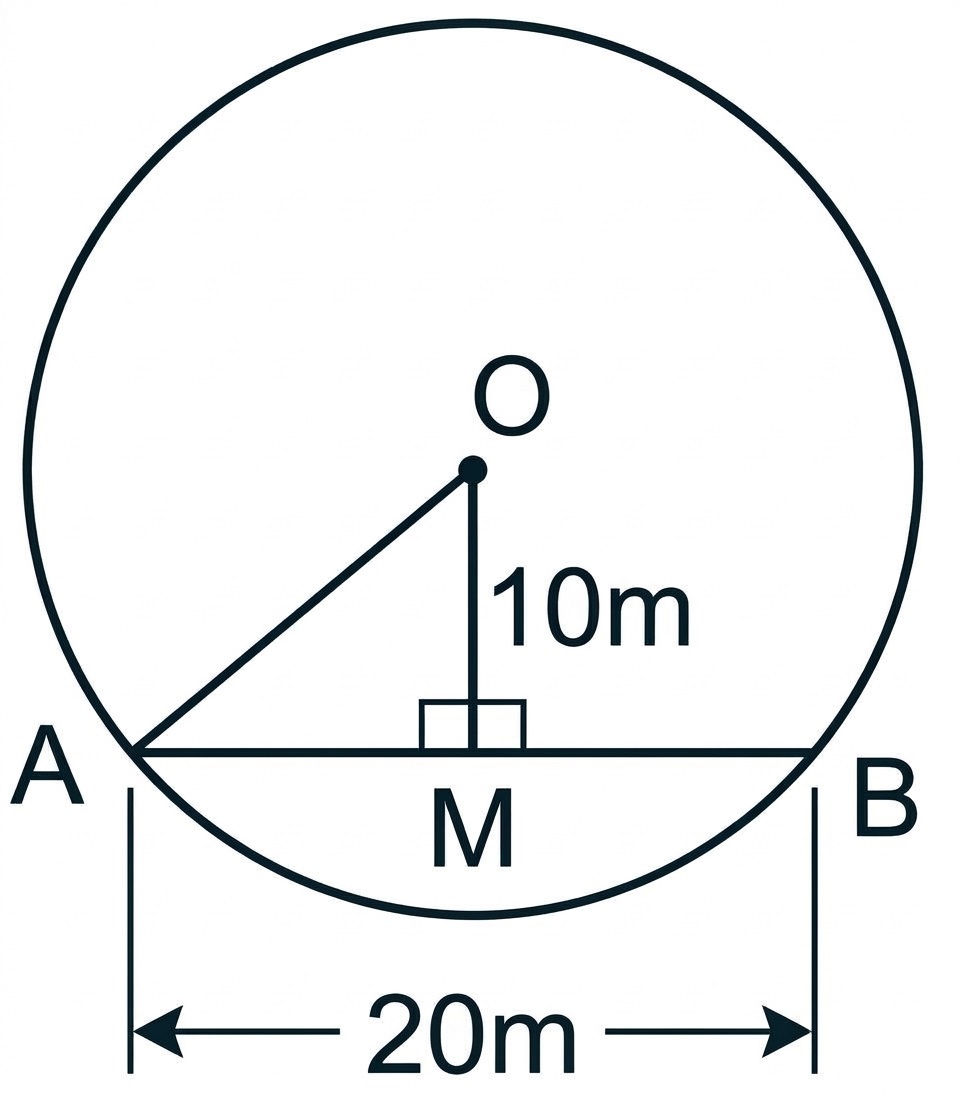
Given: Chord length \(= 20\text{ m}\), distance from centre \(= 10\text{ m}\).
To find: Radius \(\overline{OA} = r\).
Calculation: The perpendicular from the centre bisects the chord. So,
Using the Pythagoras theorem in the right-angled \(\triangle OAM\):
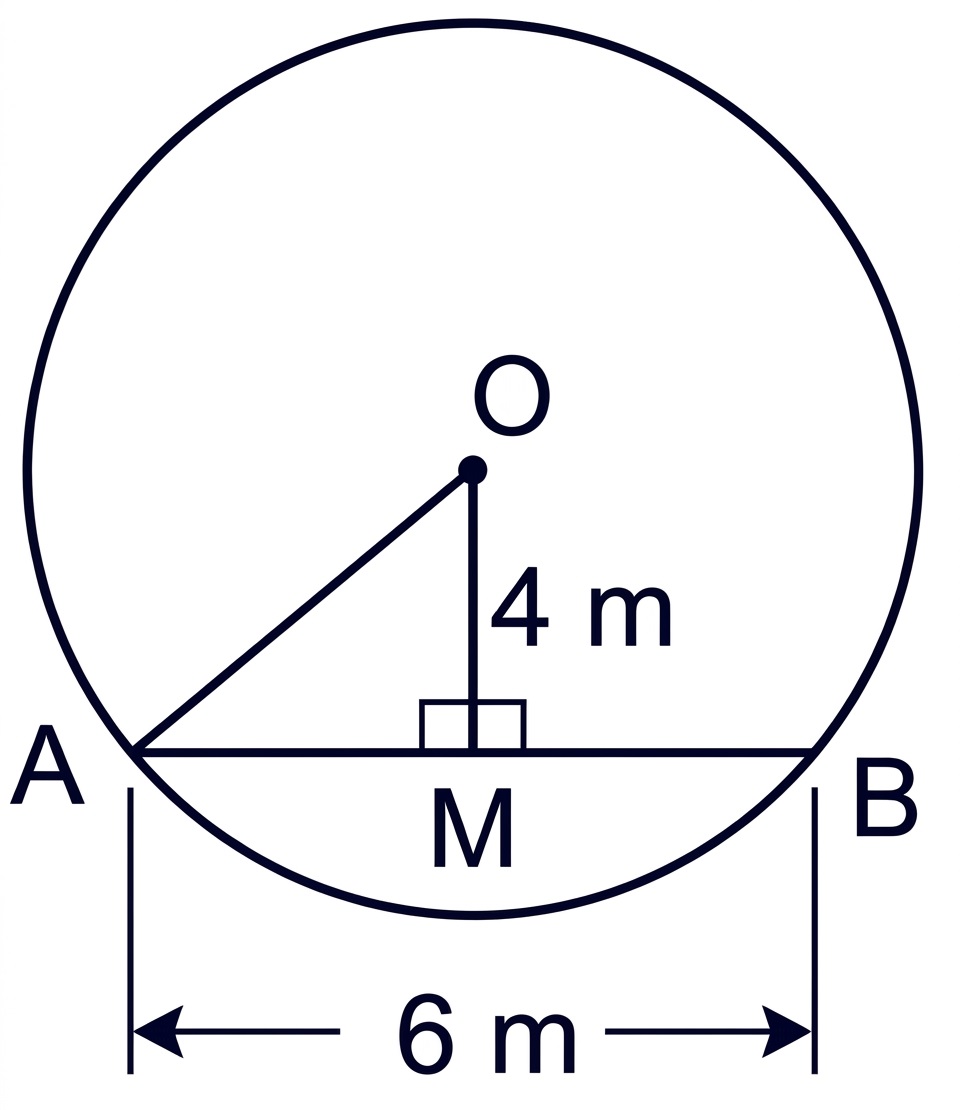
Given: Chord length \(= 6\text{ m}\), distance from centre \(= 4\text{ m}\).
To find: Radius \(\overline{OA} = r\).
Calculation: The perpendicular from the centre bisects the chord. So,
Using the Pythagoras theorem in the right-angled \(\triangle OAM\):
📈 Key Concepts & Quick Revision
📐 Circle Geometry Theorems
- Perpendicular from Centre: The perpendicular from the centre of a circle to a chord bisects the chord.
- Equidistant Chords: Two chords of a circle are congruent if and only if they are equidistant from the centre.
- Equal Chords and Angles: Equal chords of a circle subtend equal angles at the centre.
- Congruent Arcs: Congruent arcs of a circle have equal corresponding chords.
- Unique Circle: One and only one circle can pass through three non-collinear points.
- Sum of Central Angles: The sum of the measures of central angles of a circle with no interior points in common is \(360^{\circ}\).
- Pythagorean Relationship: \( r^2 = d^2 + (\text{half-chord})^2 \) for a chord at distance \(d\) from the centre.
📝 Quick Practice Questions
1. A chord of length \(16\text{ cm}\) is at a distance of \(6\text{ cm}\) from the centre. What is the radius?
2. If a chord is \(12\text{ cm}\) long and the radius is \(10\text{ cm}\), the distance from the centre is:
3. Two chords of a circle are equidistant from the centre. If one chord is \(14\text{ cm}\), the other chord is:
🏆 Board Exam Tips & Strategy
- Always draw a labeled diagram for numerical problems — this helps you identify the right-angled triangle.
- For MCQs, eliminate options that contradict definitions (e.g., a diameter is a chord, but not all chords are diameters).
- Double-check your calculations when working with square roots.
- For coordinate geometry problems, remember that non-collinear points have different slopes between them.
- Use the theorem that equal chords subtend equal angles to save time on angle calculations.
❓ Frequently Asked Questions
What is included in the Review Exercise 8 of Class 10 Math?
The Review Exercise 8 includes 10 multiple-choice questions (MCQs) and 7 short-answer questions covering all major concepts from Chapter 8, including chord properties, central angles, equidistant chords, and circle geometry theorems.
Is this solution according to the PECTAA syllabus?
Yes, these solutions strictly follow the PECTAA / National Curriculum 2023 syllabus for Class 10 Mathematics.
Are solved PDF notes available for Review Exercise 8?
Yes, a complete solved PDF for Review Exercise 8 is embedded at the top of this page and is available to download for free.
How do I solve the collinearity question (Q5)?
To check if three points \(A\), \(B\), and \(C\) are non-collinear, calculate the slopes of \(AB\) and \(BC\). If the slopes are different, the points are non-collinear, meaning a unique circle can pass through them. In Q5, the slopes are \(\frac{3}{2}\) and \(-\frac{1}{3}\), which are different, so a unique circle exists.
What is the most common mistake in numerical problems from this chapter?
The most common mistake is forgetting to halve the chord length before applying the Pythagorean theorem. The perpendicular from the centre bisects the chord, so you must use half the chord length in the right-angled triangle.
Who prepared these Class 10 Math Chapter 8 notes?
These notes were prepared by Muhammad Tayyab, Subject Specialist Mathematics at Govt Christian High School Daska, for Hira Science Academy.