Prepared by Muhammad Tayyab, Subject Specialist Mathematics, Govt Christian High School Daska
📌 Based on National Curriculum 2023 / PECTAA Syllabus
📖 What's Inside: This page provides the solved Exercise 2.2 Class 10 Maths new book solutions, covering finding intercepts of linear equations graphically, solving systems of linear equations by graphical method, and solving linear-quadratic systems graphically. Perfect for Punjab Boards (BISE) exam preparation.
If the PDF does not load, click here to view it directly on Google Drive .
📚 Related Resources – Chapter 2: Quadratic Equations
Class 10 Math Chapter 2 Exercise 2.2 – Graphical Solutions: Complete Guide
Exercise 2.2 of Chapter 2 introduces students to graphical solutions of equations. Students learn to find intercepts of linear equations, solve systems of linear equations graphically, and solve linear-quadratic systems. These visual methods help students understand the geometric meaning of equations and their solutions. The full solved Exercise 2.2 Class 10 Maths new book solutions are provided below in step-by-step form, and a free Exercise 2.2 Class 10 Math PDF download is available at the top of this page.
What You Will Learn
By working through Exercise 2.2, students master: finding \( x \)-intercepts (put \( y=0 \)) and \( y \)-intercepts (put \( x=0 \)) of linear equations, solving systems of linear equations by plotting both lines and finding their intersection, and solving linear-quadratic systems by finding intersection points of a line and a parabola.
Topics Covered in This Exercise
- Intercepts of Linear Equations – finding \( x \) and \( y \) intercepts graphically
- Linear Systems Graphically – solving \( 2 \times 2 \) systems by graphing
- Linear-Quadratic Systems – finding intersection points of a line and a parabola
- Algebraic Verification – confirming graphical solutions algebraically
Why Exercise 2.2 Is Important
Exercise 2.2 builds essential graphing skills. Board exam papers frequently feature questions on graphical solutions, especially intercepts and systems. This exercise helps students visualize the relationship between algebraic equations and their geometric representations.
Punjab Board Preparation
Students preparing for board exams under any of the 9 BISE Punjab boards should prioritise this exercise. Graphical methods are frequently tested, and intercept questions appear regularly. Practising every part of Q1, Q2, and Q3 by hand is highly recommended.
Exam Tips for Graphical Solutions
- For \( x \)-intercept: set \( y = 0 \) and solve for \( x \).
- For \( y \)-intercept: set \( x = 0 \) and solve for \( y \).
- When graphing, use at least two points for each line.
- For linear-quadratic systems, the intersection points are the solutions.
Common Mistakes Students Make
- Swapping \( x \) and \( y \) intercept values.
- Not plotting enough points for accurate graphs.
- Forgetting to verify solutions algebraically.
- Misinterpreting intersection points on the graph.
📖 Exercise 2.2 – Solved Problems
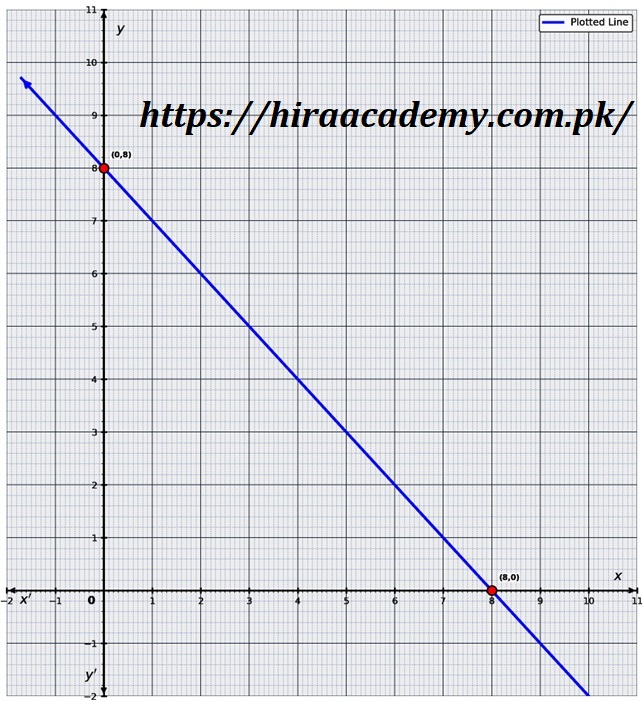
For \(x\)-intercept: Put \(y = 0\)
\[ x + 0 = 8 \quad\Rightarrow\quad x = 8 \]Point: \((8,0)\)
For \(y\)-intercept: Put \(x = 0\)
\[ 0 + y = 8 \quad\Rightarrow\quad y = 8 \]Point: \((0,8)\)
For \(x\)-intercept: Put \(y = 0\)
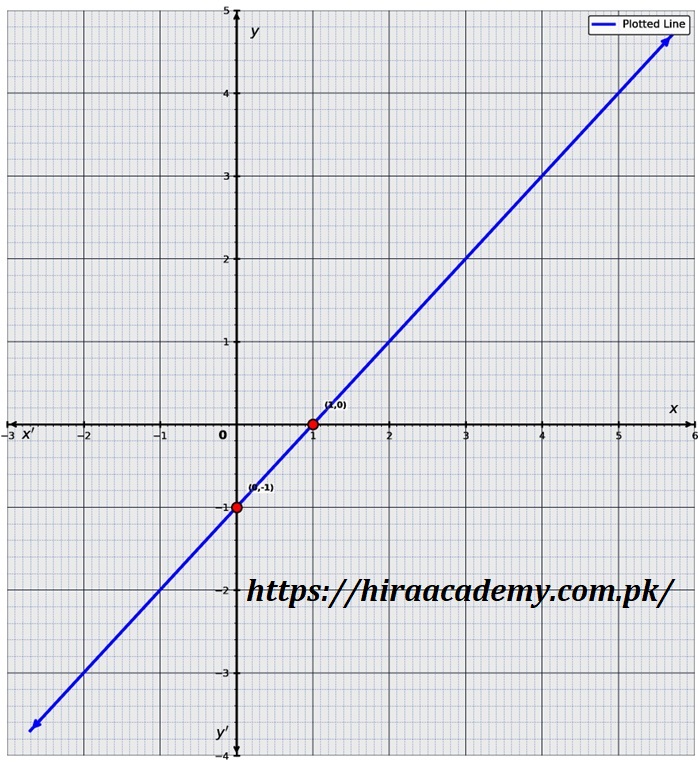
\[ x - 0 = 1 \quad\Rightarrow\quad x = 1 \]Point: \((1,0)\)
For \(y\)-intercept: Put \(x = 0\)
\[ 0 - y = 1 \quad\Rightarrow\quad -y = 1 \quad\Rightarrow\quad y = -1 \]Point: \((0,-1)\)
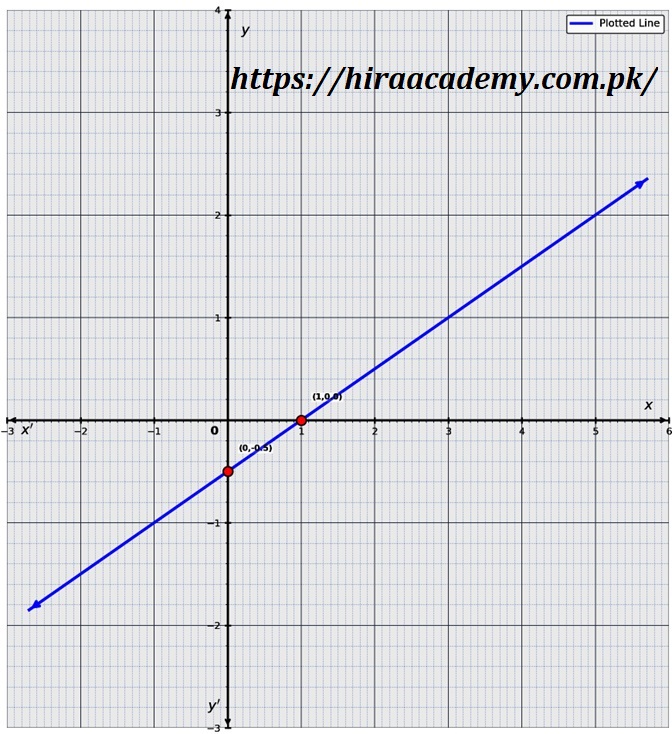
For \(x\)-intercept: \(y = 0\)
\[ x - 2(0) = 1 \quad\Rightarrow\quad x = 1 \]Point: \((1,0)\)
For \(y\)-intercept: \(x = 0\)
\[ 0 - 2y = 1 \quad\Rightarrow\quad -2y = 1 \quad\Rightarrow\quad y = -\frac{1}{2} = -0.5 \]Point: \((0, -0.5)\)
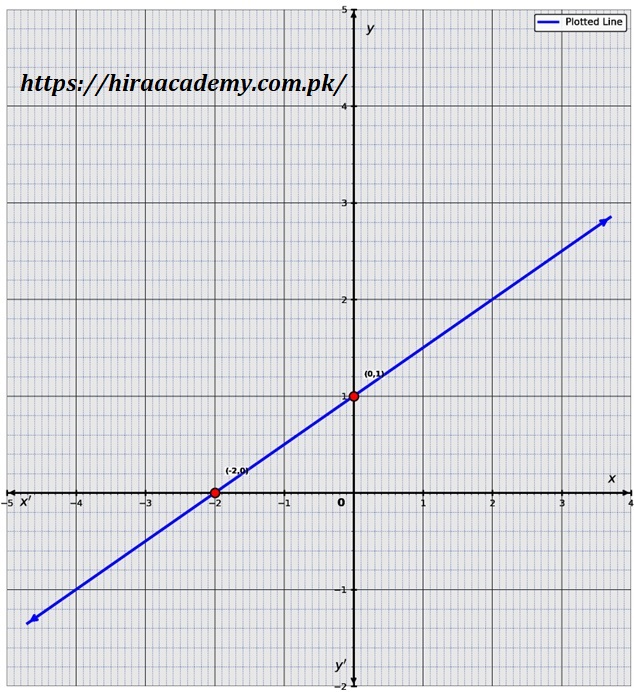
For \(x\)-intercept: \(y = 0\)
\[ x - 2(0) + 2 = 0 \quad\Rightarrow\quad x + 2 = 0 \quad\Rightarrow\quad x = -2 \]Point: \((-2,0)\)
For \(y\)-intercept: \(x = 0\)
\[ 0 - 2y + 2 = 0 \quad\Rightarrow\quad -2y = -2 \quad\Rightarrow\quad y = 1 \]Point: \((0,1)\)
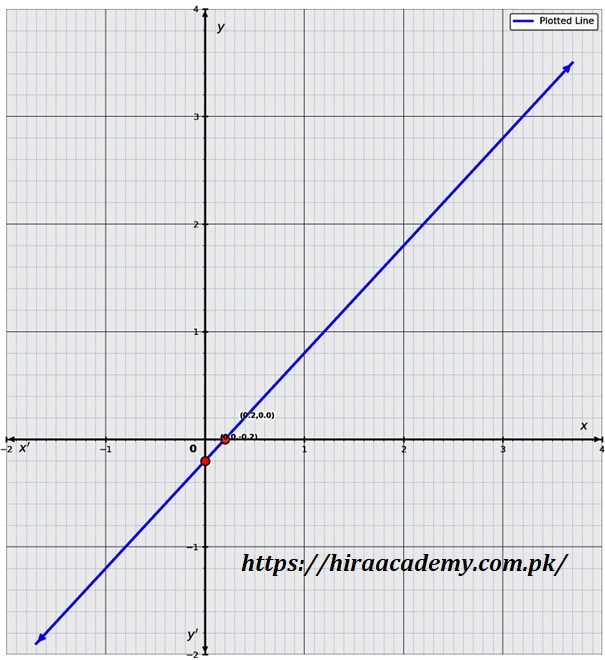
For \(x\)-intercept: \(y = 0\)
\[ 5x - 5(0) = 1 \quad\Rightarrow\quad 5x = 1 \quad\Rightarrow\quad x = \frac{1}{5} = 0.2 \]Point: \((0.2, 0)\)
For \(y\)-intercept: \(x = 0\)
\[ 5(0) - 5y = 1 \quad\Rightarrow\quad -5y = 1 \quad\Rightarrow\quad y = -\frac{1}{5} = -0.2 \]Point: \((0, -0.2)\)
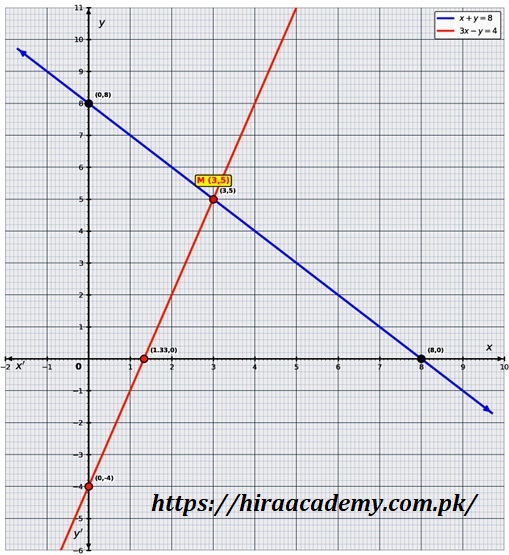
For \(x + y = 8\): \(x\)-intercept: \((8,0)\), \(y\)-intercept: \((0,8)\)
For \(3x - y = 4\): \(x\)-intercept: \(\left(\frac{4}{3},0\right)\), \(y\)-intercept: \((0,-4)\)
Point of intersection (Algebraic verification):
\[ \begin{aligned} x + y &= 8 \quad \text{(i)}\\ 3x - y &= 4 \quad \text{(ii)}\\ \text{From (i): } x &= 8 - y \\ \text{Substitute into (ii): } 3(8-y) - y &= 4 \\ 24 - 3y - y &= 4 \\ 24 - 4y &= 4 \\ 20 &= 4y \\ y &= 5 \\ x &= 8 - 5 = 3 \end{aligned} \]Hence intersection point \(M(3,5)\).
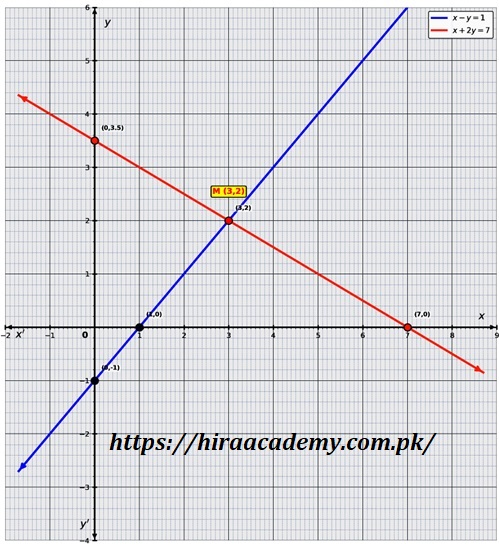
Line 1: \(x - y = 1\): intercepts \((1,0)\) and \((0,-1)\).
Line 2: \(x + 2y = 7\): intercepts \((7,0)\) and \((0,3.5)\).
\[ \begin{aligned} x - y &= 1 \quad \text{(i)}\\ x + 2y &= 7 \quad \text{(ii)}\\ \text{From (i): } x &= 1 + y \\ 1 + y + 2y &= 7 \\ 1 + 3y &= 7 \\ 3y &= 6 \quad\Rightarrow\quad y = 2 \\ x &= 1 + 2 = 3 \end{aligned} \]Intersection: \(M(3,2)\).
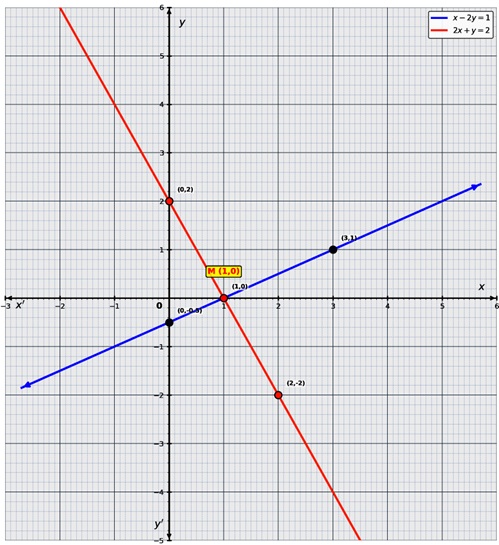
\(x-2y=1\): intercepts \((1,0)\), \((0,-0.5)\). \(2x+y=2\): \((1,0)\), \((0,2)\).
\[ \begin{aligned} x - 2y &= 1 \quad\Rightarrow\quad x = 1+2y \\ 2(1+2y) + y &= 2 \\ 2 + 4y + y &= 2 \\ 5y &= 0 \quad\Rightarrow\quad y = 0 \\ x &= 1 + 0 = 1 \end{aligned} \]Intersection: \(M(1,0)\).
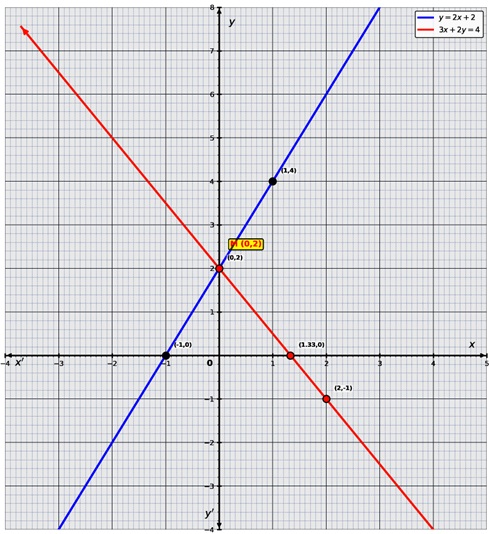
Line \(y=2x+2\): intercepts: \((-1,0)\) and \((0,2)\).
\(3x+2y=4\): intercepts: \((\frac{4}{3},0)\) and \((0,2)\).
\[ \begin{aligned} y &= 2x+2 \\ 3x + 2(2x+2) &= 4 \\ 3x + 4x + 4 &= 4 \\ 7x &= 0 \quad\Rightarrow\quad x = 0 \\ y &= 2(0)+2 = 2 \end{aligned} \]Intersection: \(M(0,2)\).
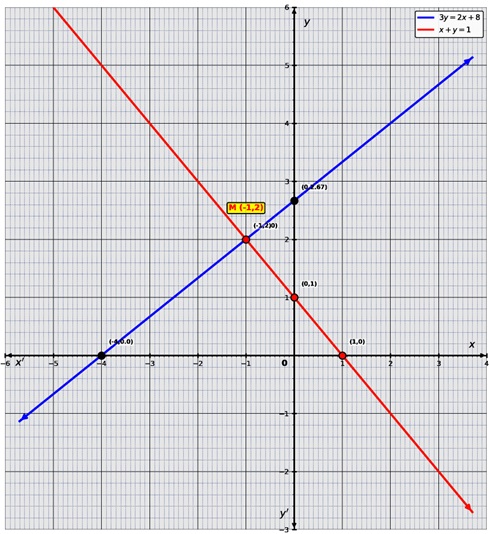
\(3y=2x+8\): intercepts \((-4,0)\), \((0,\frac{8}{3})\).
\(x+y=1\): intercepts \((1,0)\), \((0,1)\).
\[ \begin{aligned} 3y &= 2x+8 \quad\Rightarrow\quad y = \frac{2x+8}{3} \\ x + \frac{2x+8}{3} &= 1 \\ \frac{3x + 2x+8}{3} &= 1 \\ 5x + 8 &= 3 \\ 5x &= -5 \quad\Rightarrow\quad x = -1 \\ y = \frac{2(-1)+8}{3} = \frac{-2+8}{3} = 2 \end{aligned} \]Intersection: \(M(-1,2)\).
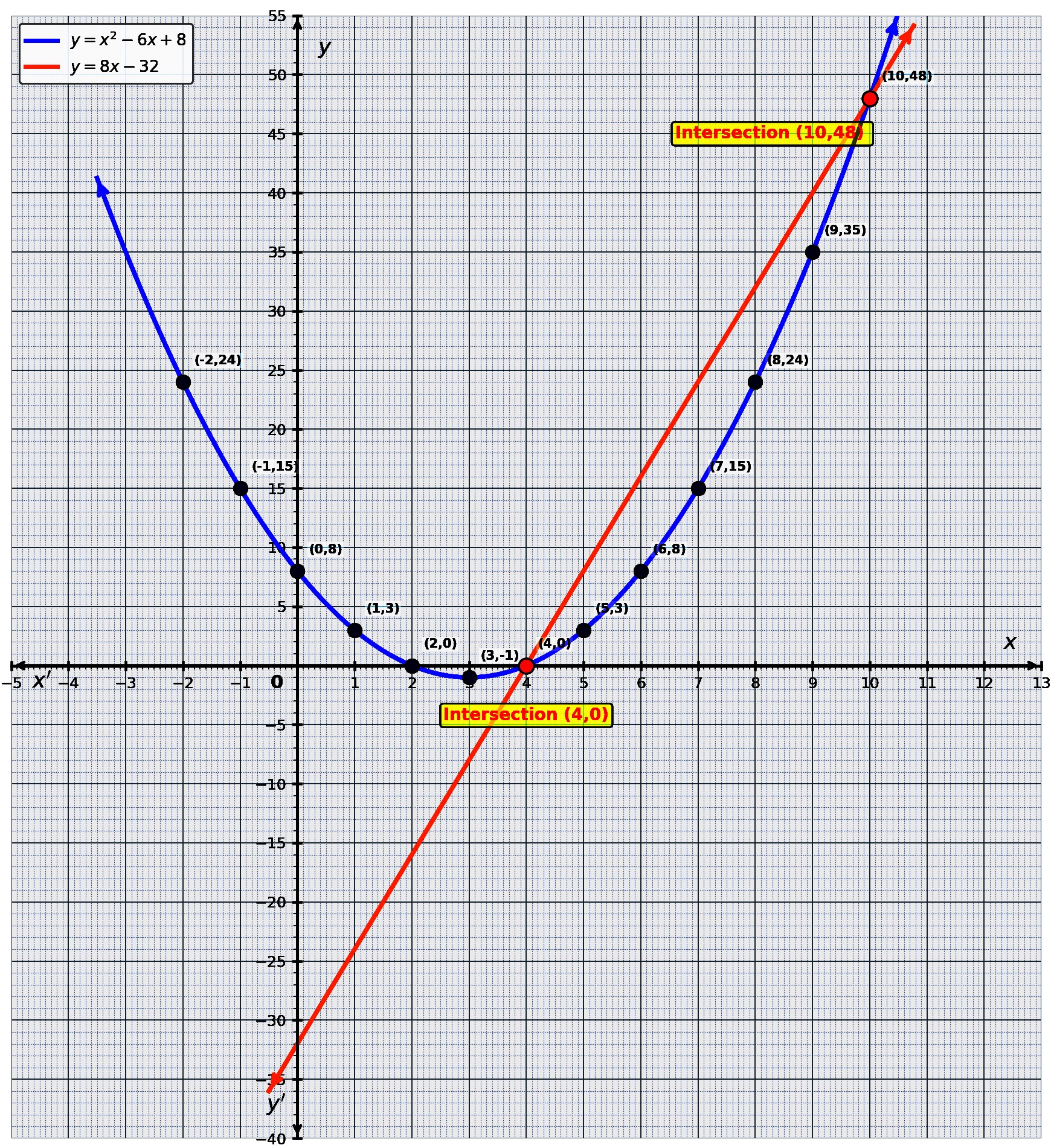
Linear: \(y = 8x - 32\): \(x\)-intercept: \((4,0)\); \(y\)-intercept: \((0,-32)\).
Quadratic: \(y = x^2 - 6x + 8\). Vertex: \(x = 3\).
| \(x\) | -3 | -2 | -1 | 0 | 1 | 2 | 3 | 4 | 5 | 6 | 7 |
|---|---|---|---|---|---|---|---|---|---|---|---|
| \(y = x^2-6x+8\) | 35 | 24 | 15 | 8 | 3 | 0 | -1 | 0 | 3 | 8 | 15 |
Algebraic intersection:
\[ \begin{aligned} x^2 - 6x + 8 &= 8x - 32 \\ x^2 -14x + 40 &= 0 \\ (x-10)(x-4) &= 0 \\ \Rightarrow x = 10 \quad\text{or}\quad x = 4 \end{aligned} \]For \(x=4\): \(y=8(4)-32=0\) → \((4,0)\)
For \(x=10\): \(y=8(10)-32=48\) → \((10,48)\).
Intersection points: \(M_1(4,0)\) and \(M_2(10,48)\).
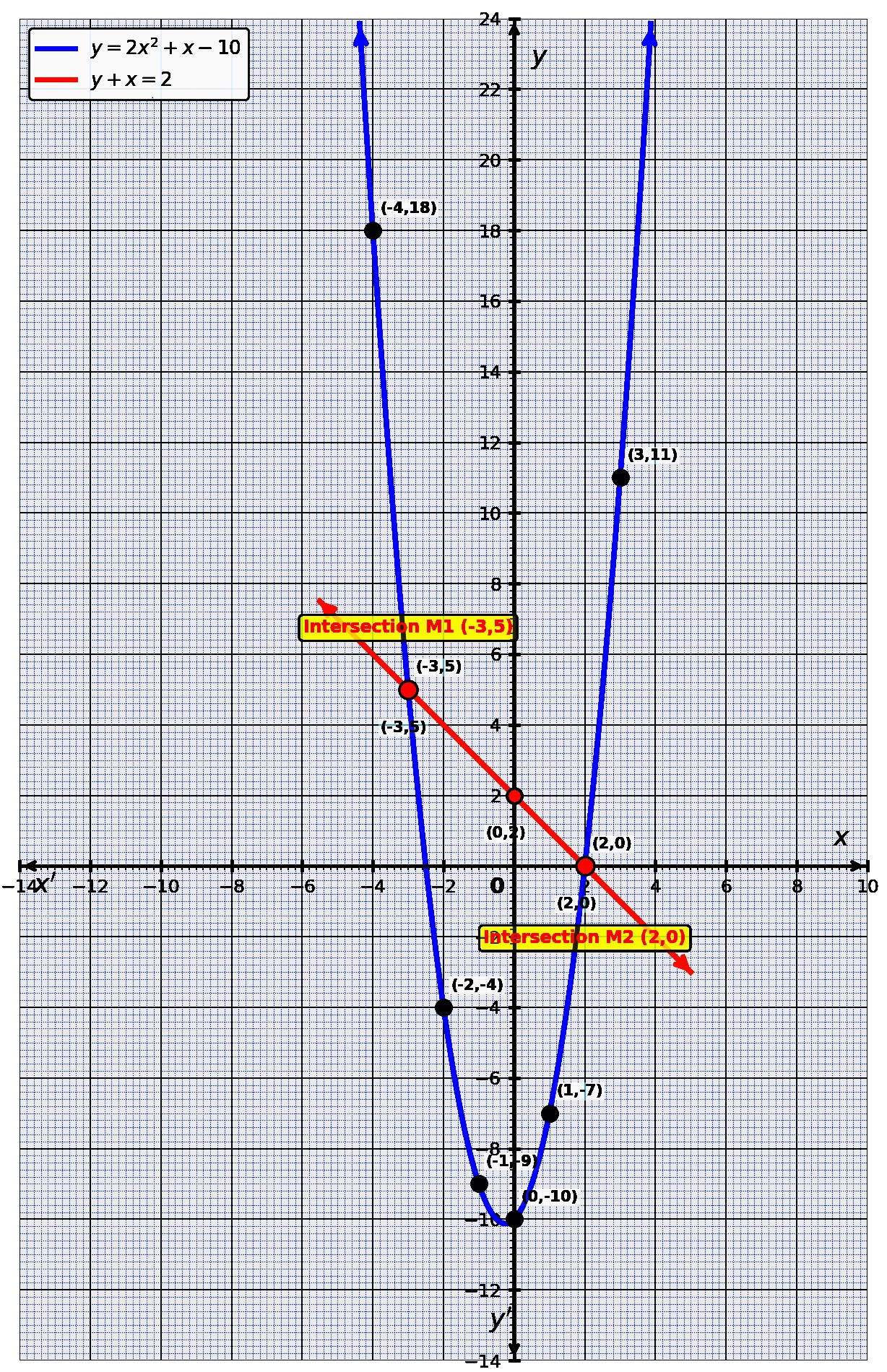
Rewrite linear: \(y = -x + 2\). Intercepts: \((2,0)\) and \((0,2)\).
Quadratic: \(y = 2x^2 + x - 10\). Vertex: \(x = -0.25\).
| \(x\) | -4 | -3 | -2 | -1 | 0 | 1 | 2 | 3 |
|---|---|---|---|---|---|---|---|---|
| \(y=2x^2+x-10\) | 18 | 5 | -4 | -9 | -10 | -7 | 0 | 11 |
Algebraic solution:
\[ \begin{aligned} 2x^2 + x - 10 &= -x + 2 \\ 2x^2 + 2x - 12 &= 0 \\ 2(x^2 + x - 6) &= 0 \\ x^2 + x - 6 &= 0 \\ x^2 + 3x - 2x - 6 &= 0 \\ x(x+3) - 2(x+3) &= 0 \\ (x-2)(x+3) &= 0 \\ \Rightarrow x = 2 \quad\text{or}\quad x = -3 \end{aligned} \]When \(x=2\): \(y = -2 + 2 = 0\) → \((2,0)\)
When \(x=-3\): \(y = -(-3) + 2 = 5\) → \((-3,5)\).
Intersection points: \(M_1(-3,5)\) and \(M_2(2,0)\).
📝 Multiple Choice Questions (Chapter 2 Practice)
1. The \(x\)-intercept of \(x + y = 8\) is:
For \(x\)-intercept, put \(y=0\): \(x+0=8 \Rightarrow x=8\).
2. The \(y\)-intercept of \(x - 2y = 1\) is:
For \(y\)-intercept, put \(x=0\): \(-2y=1 \Rightarrow y=-0.5\).
3. The intersection point of \(x+y=8\) and \(3x-y=4\) is:
Solving \(x+y=8\) and \(3x-y=4\) gives \(x=3, y=5\).
4. A linear-quadratic system can have at most:
A line and a parabola can intersect at a maximum of 2 points.
5. The graph of \(y = 2x^2 + x - 10\) is a:
Since \(a=2>0\), the parabola opens upward.
📈 Key Graphical Concepts
- x-intercept: Put \(y=0\) → point where graph meets x-axis.
- y-intercept: Put \(x=0\) → point where graph meets y-axis.
- Solving linear systems graphically: Intersection of two lines gives the solution.
- Linear-Quadratic system: Intersection points satisfy both equations; may have 0, 1, or 2 solutions.
- Vertex of Parabola: \(x_v = -\frac{b}{2a}\) for \(y=ax^2+bx+c\)
🔍 People Also Ask
Which is the hardest exercise in maths class 10?
For most students, the most challenging exercises in the new PECTAA textbook are Exercise 1.4 (complex simultaneous equations from Chapter 1) and Exercise 3.6 (Cramer's rule and matrix inversion from Chapter 3). Exercise 2.2 (graphical solutions) is comparatively straightforward because the graphical method is intuitive once you understand intercepts and intersections.
What is the solution to Exercise 2.3 in Class 10 maths?
Exercise 2.3 covers roots and coefficients of quadratic equations — forming equations from given roots, finding equations with transformed roots, and conditions on roots. The full solved Exercise 2.3 Class 10 Math is available on Hira Science Academy.
Can you provide the exercise 2.2 in Class 9 maths?
Class 9 Exercise 2.2 (Real and Complex Numbers) is a different topic from Class 10 Exercise 2.2 (Graphical Solutions). For Class 9, check the Class 9 Math notes section; for Class 10, the solved solutions are on this page.
How many exercises are in class 10 maths chapter 2?
Chapter 2 (Quadratic Equations and Inequalities) in the new PECTAA textbook has 7 exercises (2.1 to 2.7) plus a Review Exercise 2.
❓ Frequently Asked Questions
What is taught in Exercise 2.2 of Class 10 Math Chapter 2?
Exercise 2.2 covers graphical solutions: finding intercepts of linear equations, solving systems of linear equations graphically, and solving linear-quadratic systems graphically.
How many questions are there in Chapter 2 Exercise 2.2?
Exercise 2.2 has 3 main questions: Question 1 (5 parts) covers finding intercepts graphically, Question 2 (5 parts) covers solving linear systems graphically, and Question 3 (2 parts) covers solving linear-quadratic systems graphically.
What is an x-intercept in graphical solutions?
The \( x \)-intercept is the point where the graph crosses the \( x \)-axis. To find it, set \( y = 0 \) and solve for \( x \).
What is a y-intercept in graphical solutions?
The \( y \)-intercept is the point where the graph crosses the \( y \)-axis. To find it, set \( x = 0 \) and solve for \( y \).
How do you solve systems of equations graphically?
To solve systems graphically, plot both equations on the same coordinate plane. The point(s) where the graphs intersect represent the solution(s) to the system.
Is this solution according to the PECTAA syllabus?
Yes, these solutions are prepared according to the PECTAA / National Curriculum 2023 syllabus for Class 10 Mathematics.
Is this Exercise 2.2 solution valid for all Punjab Boards?
Yes, the content follows the unified Punjab textbook and is applicable to students of all 9 BISE Punjab boards.
Are solved PDF notes available for Exercise 2.2?
Yes, a complete solved PDF for Exercise 2.2 is embedded on this page and available to download for free.
Can I download the Chapter 2 Exercise 2.2 solution as a PDF?
Yes, use the Download PDF button on this page to save the complete solved Exercise 2.2 notes to your device.
Is Exercise 2.2 important for Class 10 board exams?
Yes, graphical solutions are frequently tested in board exams. Exercise 2.2 builds essential skills in visualizing equations and finding solutions graphically.
Who prepared these Class 10 Math Chapter 2 notes?
These notes were prepared by Muhammad Tayyab, Subject Specialist Mathematics at Govt Christian High School Daska, for Hira Science Academy.